By Catie George, Manager, Communications and Storytelling

2023 was a big year for the Dallas Regional Chamber’s efforts to champion economic development in Southern Dallas County (SDC), a historically under-championed area of the region.

The year saw DRC member companies drive more than $2 million in direct economic impact and investments to SDC businesses and nonprofits, a ripple effect of investments in the DRC’s Tomorrow Fund.

A significant portion of this funding was compelled by the DRC’s Vision Tours, which takes leaders from a member company on a tour showcasing the qualities that make the area one of the great economic growth opportunities for the Dallas Region. The tours also showcase the companies, entrepreneurs, organizations, and individuals doing great work in SDC.

None of these tours would be possible without the shuttle services of Southern Dallas Link, which benefitted from the year of significant investments in SDC.

Mobilizing the vision for inclusive development

Curtis Corbins founded Southern Dallas Link in 2015 to help SDC residents access reliable transportation to work. Now, Southern Dallas Link also provides transportation for seniors and students.

“The need [for transportation] is out there,” Corbins told the Dallas Morning News. “It’s just a matter of having a reliable company that can come in there and provide the services. That’s what we plan to do, is to come in here and fill those pockets and get the people in the southern sector the mobility that they need.”

In August, Corbins secured a contract with DRC member Dallas Area Rapid Transit (DART) to add 30 buses to his fleet. A planned delay in funding meant Corbins could not immediately expand his fleet—until another DRC member stepped in to help.

American National Bank of Texas Emerging Markets President Marcelo Mills heard about Corbins’ situation during a DRC Vision Tour and connected with Corbins to explore financial options that could help. Ultimately, Mills helped Corbins get a $500,000 revolving line of credit to support his growth until the DART contract began paying.

“That allows us to pay our staff, our drivers, take care of fuel costs, whatever costs we incur until we start getting our monthly deposits from DART…the timing was just perfect,” Corbins said to the Dallas Morning News.

Catalyzing opportunities

In addition to its support of Corbins’ Southern Dallas Link, American National Bank also invested in several community development corporations (CDC): Builders of Hope, South Dallas Fair Park Innercity CDC, Harmony CDC, and SouthFair CDC.

Target, another DRC member company, invested significantly in Forest Forward, Fair Park First, The DEC Network, and Bonton Farms.

A welcomed surprise

While on an SDC Vision Tour, Wells Fargo surprised Builders of Hope, Paul Quinn College, and The DEC Network with major grants. Watch how it unfolded.

“The grants that we’re providing helps fuel the work that these organizations do,” said Vice President of Philanthropy and Community Impact at the Wells Fargo Foundation Alexis Snow to NBC. “Whether it be to provide small business housing, small business workshops here at the Dallas Entrepreneurship Center or to look at Paul Quinn College where they’re providing students with the opportunity to go to college almost debt-free.”

A very good year for SDC

All told, these investments represent a combined more than $2 million, which does not even reflect the other economic activity the DRC helped generate in SDC in 2023.

The DRC helped drive the placement of a Tom Thumb grocery store in SDC at The Shops at RedBird, a move that promises to increase access to high-quality groceries for families in an area chronically affected by food deserts with a total of $22.8 million invested.

Southern Dallas County also had two major manufacturing wins, with last summer’s announcements of Canadian Solar and Trina Solar’s plans to open new plants in SDC. Combined, they will create 3,000 well-paying jobs and generate $450 million of capital investment.

The DRC’s work in SDC is powered by investments in the Tomorrow Fund. Tomorrow Fund investors go above and beyond membership to be a valued partner in the DRC’s long-term mission while enhancing their company’s ability to do good for our region and all the people who live, work, and do business here.

Become a Tomorrow Fund investor.

Visit the Southern Dallas County Economic Development Guide to see the latest news and opportunities in SDC.

The DRC conducts Vision Tours to tell the story and spread the message of Southern Dallas County. To get involved, email dei@dallaschamber.org.
By Catie George, Manager, Communications and Storytelling

When the staff of the Advanced Research Projects Agency for Health (ARPA-H) convened in Dallas-Fort Worth for a quarterly meeting in January, the Dallas Regional Chamber joined them for listening sessions and facilitated connections to deepen the agency’s impact in the region.

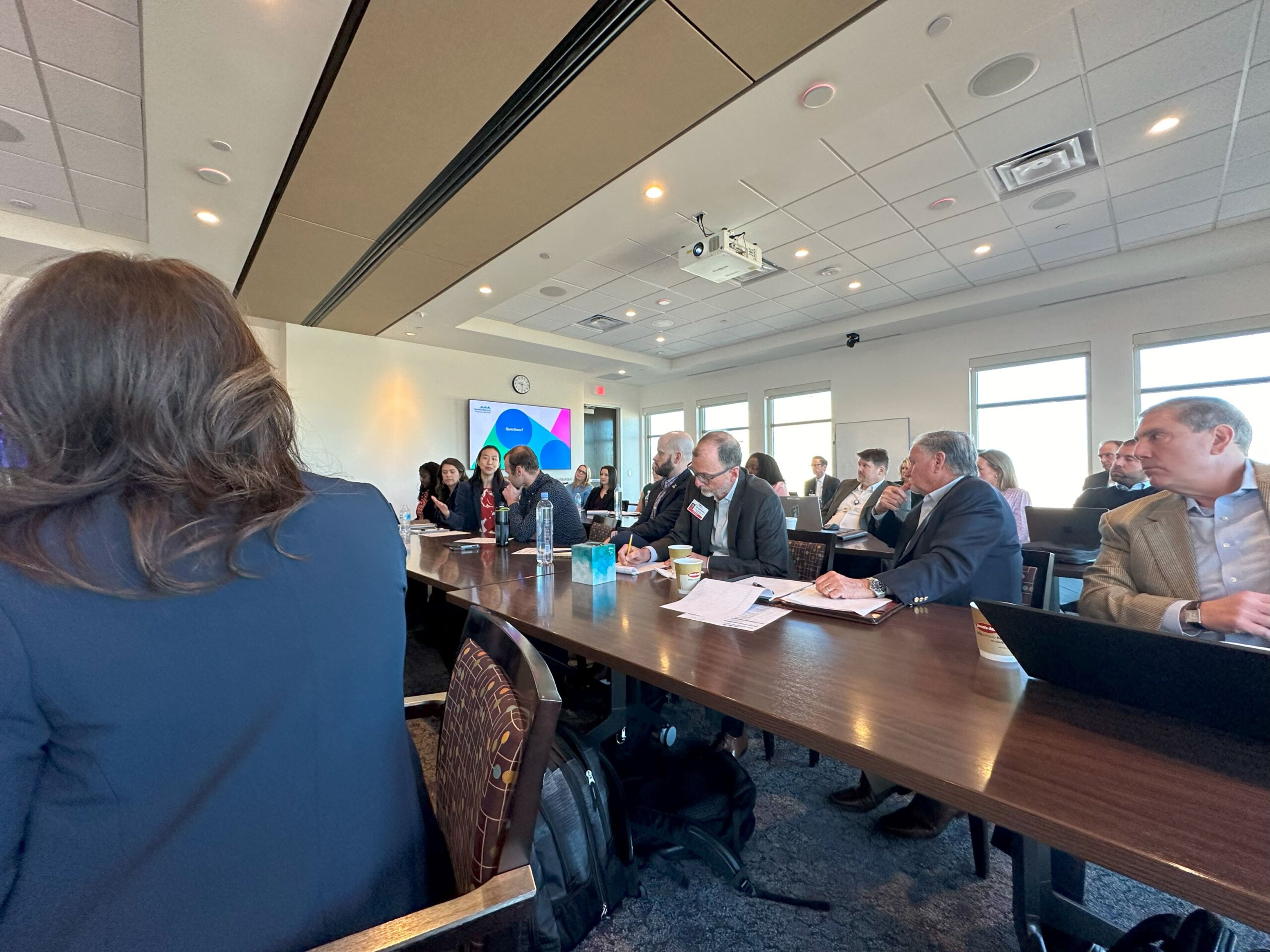
DFW ARPA-H Customer Experience Hub “spoke” members convene for a listening session.

ARPA-H supports high-impact research by funding transformative biomedical and health breakthroughs. The agency selected Texas as the home of one of three national hubs in October following a competitive bid process, announcing the Customer Experience Hub’s physical site to be located in Dallas’ Pegasus Park. The DRC provided key support for the state’s collaborative bid effort.

“We are the heart of a national effort,” said Kelly Cloud, Vice President of Economic Development-Life Sciences for the DRC. “This process is about tapping into a network of networks to find out what the true problems are and to create solutions.”

As the ARPA-H Customer Experience Hub is focused on developing better health outcomes for all people, the DRC sought to show the ARPA-H team the existing diversity of Dallas-Fort Worth and the community’s work to create a more equitable health care system for the region.

ARPA-H hubs are supported by a consortium with a nationwide network of “spokes,” or partners, with varying expertise, community voices, and geographic spread to support the agency’s success. Part of the DRC’s engagement with ARPA-H’s visit was to convene potential spoke members to participate in a listening session.

The DRC supported a visit by the ARPA-H team to For Oak Cliff, a local nonprofit focusing on empowering and supporting residents, where DRC staff detailed the chamber’s work in public policy, economic development and life sciences, and community engagement.

Latosha Herron Bruff, Senior Vice President of Diversity, Inclusion & Community Engagement, remarked on the similarities between ARPA-H’s mission and that of the DRC.

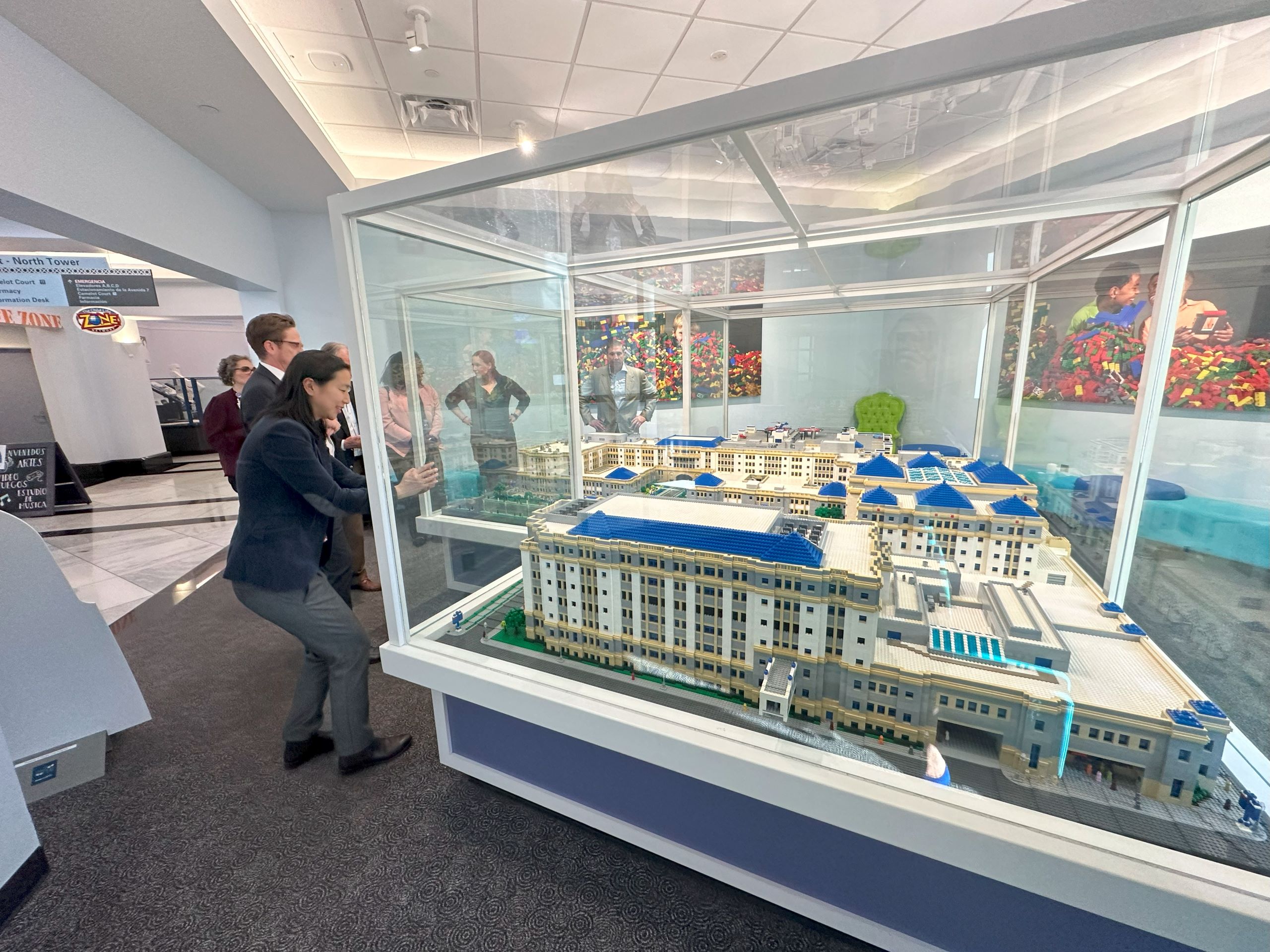
The ARPA-H team on a Cook Children’s tour, admiring the Lego model of the campus, following listening sessions with “spoke” members.

“We always talk about building tomorrow together at the DRC. We think about tomorrow’s problems today. This is closely related to how ARPA-H thinks of health care,” Herron Bruff said. “The link between the DRC and ARPA-H is how we think about the future now. To me, this work with ARPA-H shows how we are caring for all people today, for tomorrow.”

The visit also included a trip to Fort Worth to visit established spoke Cook Children’s Health Care System, a top-ranked network for children’s health, with other spoke members of equal reach to share and learn.

Several of the DRC’s community partners were present throughout the engagement.

“The DRC builds inclusive projects by prioritizing the voice of our communities,” said Cloud. “Hearing from the experts who are involved in their relevant communities and know what is needed is invaluable.”

ARPA-H also shared a bit about their work in assisting the next generation of health care breakthroughs.

“Kudos to ARPA-H for understanding how important it is to get it right the first time and to prioritize the voices of the community. And this is not something we’re doing in isolation; this is something we’re not doing for the community, but it is something we are doing with the community,” said Herron Bruff. “They didn’t have to guess what the community was experiencing or the hurdles or the challenges, because they had people sitting around the table telling them and explaining that to them.”

To learn more about the ARPA-H Customer Experience Hub located in Dallas at Pegasus Park and the DRC, read our coverage of ARPA-H.

By Catie George, Manager, Communications & Storytelling

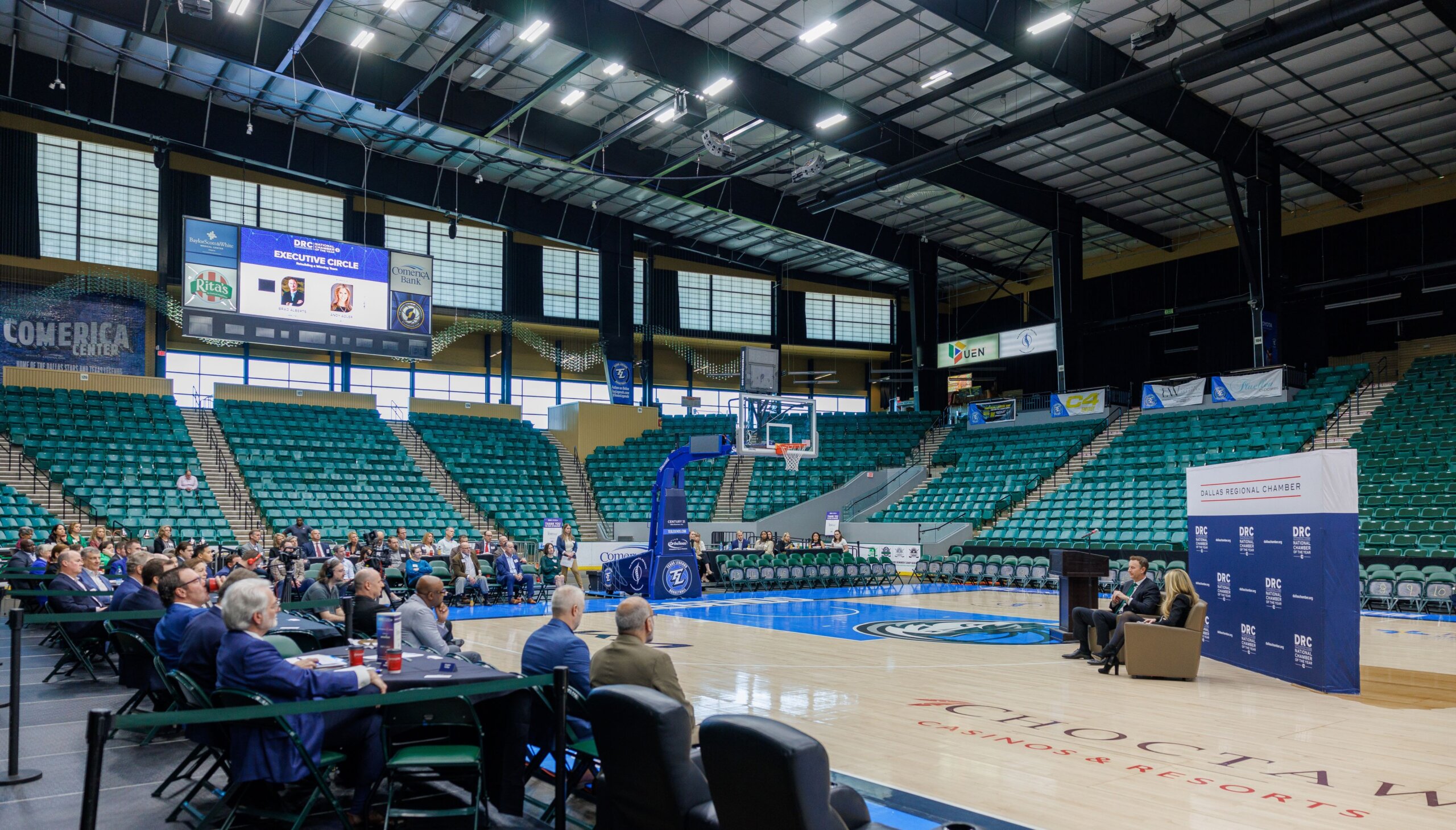
President and CEO of the Dallas Stars Brad Alberts spoke to a collection of Dallas-Fort Worth professionals at the Dallas Regional Chamber’s (DRC) Executive Circle event on Thursday, Feb. 22, at the Dallas Stars practice facility at Comerica Center in Frisco.

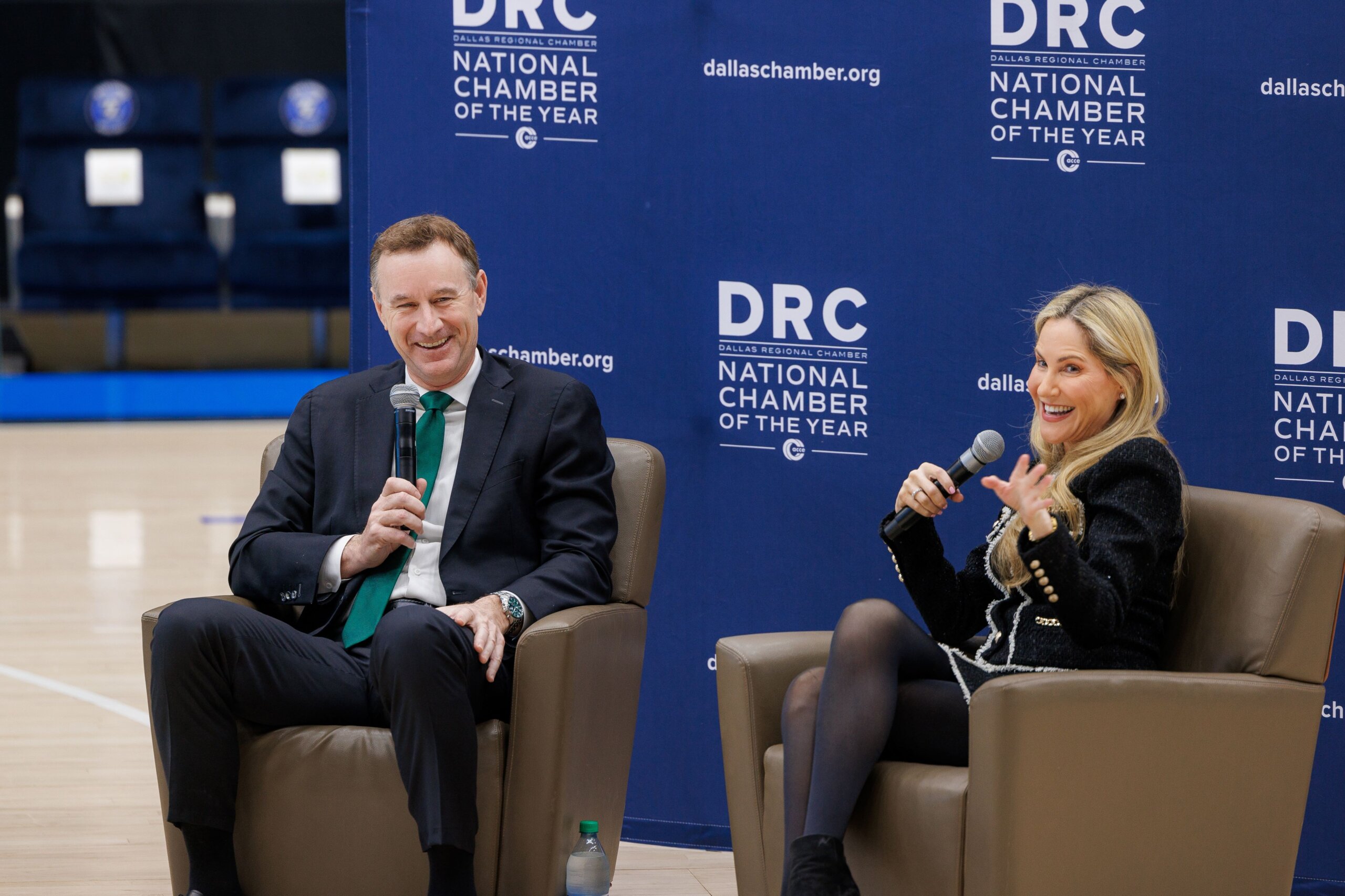
Dallas Stars President and CEO Brad Alberts in conversation with Sports Anchor for CBS News Texas Andy Adler.

In a conversation with Andy Adler, Sports Anchor for CBS News Texas, Alberts detailed his career journey with the Stars, beginning in the ticketing office during the team’s glory days in the late 1990s and 2000 to being presented the opportunity to return to the franchise at its lowest point in 2011, fresh on the heels of bankruptcy.

“I knew we needed to reestablish this franchise. I love this city; I love this market. And I knew the Stars needed to be run right,” said Alberts. “When this opportunity then presented itself, I knew it was going to be difficult, and it has been. It’s been the hardest professional challenge I’ve ever had… looking back, I’m incredibly proud of what this entire organization has been able to do in getting this franchise reestablished to where it should be, which is one of the elite NHL franchises in the country.”

While Alberts was excited to jump back into the team he loved despite all its challenges, he knew rebuilding the team to playoff prominence would not happen all at once.

“You can’t take on too much. I went and started my to-do list and just started to check off boxes, and I knew that I couldn’t jump 30 boxes down without checking the first box. And I think not getting overwhelmed by the challenge is really, really important,” said Alberts. “Not letting the enormity of the challenge overwhelm you is also something important to think about as you’ve got to rebuild the business.”

An essential part of rebuilding for Alberts was establishing a teamwork-oriented, respectful, and challenging culture.

Attendees listen to the fireside chat at the Dallas Stars practice facility at Comerica Center in Frisco.

“My executive team knows I challenge them. They challenge their [vice presidents] because it’s an execution business. It’s a closer business. We’ve got to have results,” he said. “It can’t just be rhetoric; it can’t just be talk. We have to generate revenue. We need everyone to buy tickets, watch us, watch our games, buy merchandise, and that kind of thing to have our business flourish.”

Another key to the Stars’ comeback was building a sales team made up of dedicated believers.

“You’ve got to have an incredible sales culture, and we do that. All our leadership and all our employees really embrace selling, customer service, and the experience of the fans, not only at our rinks but also at the American Airlines Center,” said Alberts. “I love our group. We’ve got a lot of great people who love our hockey team, who love our business, and who have dedicated their lives to this job. And I appreciate that every day.”

Alberts was ultimately named President in 2018, then added the CEO title in 2020. Under his leadership and direction, the organization hosted the 2020 Winter Classic at the Cotton Bowl Stadium. The event sold out within hours of tickets going on sale and was hailed as one of the most successful NHL events of all time, becoming the second-highest-attended game in league history.

Alberts knew the team was “back.”

“The Winter Classic was one of those mic-drop moments for us as a franchise… That was really the day that I thought we were back,” said Alberts. “It was incredible, and it became one of our greatest days.”

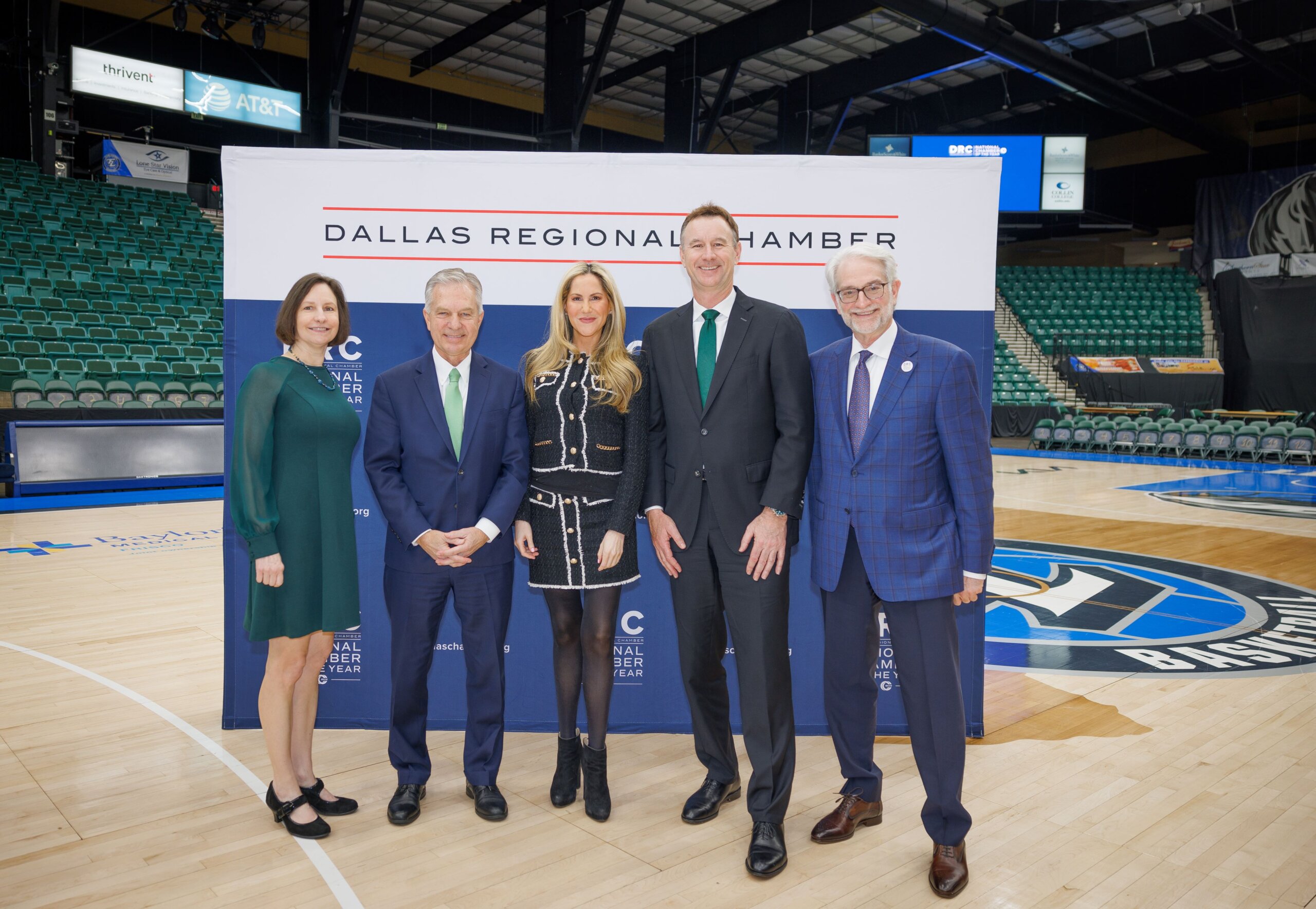
DRC COO & CFO Angela Farley, DRC President & CEO Dale Petroskey, Sports Anchor for CBS News Texas Andy Adler, Dallas Stars President & CEO Brad Alberts, and Texas Mutual Insurance Company Vice President of Dallas Regional Operations Bill Jackson.

The team reached new heights under Alberts in the 2022-2023 season and run to the Western Conference Finals, which helped the organization sell out all season tickets in the lower bowl and platinum level for the 2023-2024 season for the first time since 2002-2003.

Today, the Stars are firmly seated at the top of the NHL standings.

“This franchise is back, with one exception: We need to win a championship again,” Alberts said. “We know we’re in a window where we can win a championship. We’re committed to that, and we’re going to give it everything we’ve got. I can guarantee it.”

Alberts is confident that this is the year the Stars become a championship team.

“This team has an x-factor to it, similar to the Texas Rangers. There’s humility, but that’s also matched with talent and drive,” he said. “I think our mic drop moment is about to happen, and it’s when we win the Stanley Cup.”

Texas Mutual Insurance Company was the event sponsor for the first Executive Circle event of the year, joined by NewsRadio 1080 KRLD as the official media partner.

The DRC’s Executive Circle event series brings key decision-makers together with interesting subject-matter experts like Brad Alberts once a quarter. To attend a future Executive Circle event, connect with our membership team.

Portrait of Monica Christopher, the inaugural Texas Woman’s University Dallas Campus President (Leo Gonzalez / TWU Photo)

By Catie George, Manager, Communications & Storytelling

Monica Christopher, former Chair of the Dallas Regional Chamber’s (DRC) Leadership Dallas Alumni, took office as the inaugural President of Texas Woman’s University (TWU) Dallas Thursday, Feb. 1.

TWU is Texas’ first and only higher education system with a women-focused mission—which Christopher proudly bears.

“At TWU, our enrollment is 90% women, and we believe that when you educate a woman, you empower the world. When students complete a degree program, their life trajectory changes, not just financially,” said Christopher. “Having a college education and viable career options also changes the prospects for that person’s children and grandchildren. This is particularly true for students of color, and we are very proud that the demographics of our students on all TWU campuses mirror those of the communities we serve.”

Christopher, a longtime nonprofit executive and community relations veteran, brings deep-seated Dallas roots to her role in growing the TWU Dallas campus. In addition to her relationship-building track record in Dallas, Christopher benefits from her time in the DRC’s Leadership Dallas program.

“Leadership Dallas opened my eyes to so many things about Dallas that I might have never known. The program also gave me an opportunity to forge relationships with smart, talented people across our region who I might otherwise have never known,” Christopher said. “I still call on many of my classmates for advice and counsel and will continue to do so in my new role at TWU. It’s true that through Leadership Dallas, you build lifelong friendships.”

Christopher is excited to lead TWU Dallas and help the university become more involved with the Dallas business community.

Christopher on the TWU Dallas campus (Leo Gonzalez / TWU Photo)

“Partnering with the business community in new and expanded ways will be critical to our success. Given the degree programs offered at the Dallas campus, we have long relationships with some of the largest health care organizations–both nonprofit and for-profit–in Dallas,” Christopher said. “As we look to grow or expand programs, we will need to work closely with business leaders to help us better understand workforce gaps and opportunities for TWU to help fill those needs. To launch new programs in Dallas, we’ll need the business community to support us as thought partners and allies of our mission and, of course, to hire TWU graduates.”

In addition to working alongside the business community, TWU Dallas will continue to partner with other higher education institutions throughout the region.

“We are active partners in collaborative efforts like the Dallas County Promise and the Commit Partnership, which are working collectively to meet workforce needs by increasing the number of college-educated adults in the Dallas region,” Christopher said. “As we grow enrollment at TWU Dallas, we will be looking for gaps in educational opportunities and workforce needs not being served by other institutions in the region. There is untapped potential in certain sectors that TWU is well-positioned to take advantage of, particularly those that need more women.”

Christopher hopes that TWU Dallas’ new role in the region will attract more students and change more lives.

“Everyone can help us spread the word about the exciting things happening at TWU. With more community champions, we can have an even greater impact,” said Christopher. “TWU has an incredible story to tell, and I look forward to serving as our chief brand ambassador in Dallas.”

To get involved or learn more about TWU Dallas, visit their website. To learn more about Leadership Dallas through the Dallas Regional Chamber, visit our website.

By Dana Jennings, Senior Vice President, Communications, Marketing & Events

The National Association of Workforce Boards (NAWB) has awarded Workforce Solutions Greater Dallas (WFSDallas) the prestigious Excellence in Chamber of Commerce Partnership Award for its partnership and collaboration with the Dallas Regional Chamber (DRC).

Former Workforce Solutions Greater Dallas President & CEO Laurie B. Larrea speaking at the DRC’s 2022 State of the Workforce.

Awards from NAWB honor remarkable contributions to workforce development across the country. In selecting the DRC and WFSDallas partnership, the awarding committee lauded the “true collaborative effort and long-term commitments” demonstrated by both organizations, deeming the partnership an “exemplary” model.

“Workforce readiness and inclusive opportunities for workforce participation are essential to achieving the Dallas Regional Chamber’s mission of making our region the best place in America to live, work, and do business,” said Angela Farley, DRC COO and CFO. “For more than 30 years, Workforce Solutions Greater Dallas has been an indelible partner as we’ve connected the needs of the business community with the development of our region’s workers and future workers to support the prosperity of our companies and communities while ensuring all people can lead a fulfilling life and career.”

Through various workforce development initiatives, WFSDallas helps connect employers with quality people and people with quality jobs. For the decades-long partnership, the DRC has represented the voice of its member companies and the business community in decisions about WFSDallas’ investments in workforce development to help ensure the Dallas Region’s talent pool is trained and equipped to fill jobs that regional companies need.

“This award underscores the pivotal role of collaboration in effecting meaningful change within our community,” said Carter Holston, Chair of the Board for Workforce Solutions Greater Dallas. “We take immense pride in our partnership with the Dallas Regional Chamber, working together to advance workforce development initiatives and bolster economic prosperity in the Greater Dallas area.”

The DRC and WFSDallas partnership presents a particular advantage to the Dallas Region because it allows organizations driving workforce development and the business community to align on the data that drives decision-making, which makes it easier to identify and address shared challenges and maximizes the number of open jobs matched with qualified people.

DRC President & CEO Dale Petroskey engages panelists prior to the program at the 2023 State of the Workforce event.

To provide additional value to stakeholders of both organizations, WFSDallas has payrolled positions that co-locate at the DRC, meaning a WFSDallas employee is working day-to-day with DRC teams. At present, the DRC has a WFSDallas data developer in-house. In the past, this strategy has responded to the business community’s needs, at times featuring employees focused on health care and child care, among others.

“Workforce boards and partners nationwide work together to catalyze economic vitality; these award recipients are inspiring proof points, demonstrating just how much good the workforce system can achieve,” said Brad Turner-Little, NAWB President and CEO. “We at NAWB are inspired by their work and are so excited to honor their commitment. These recipients are serving their communities in both innovative and impactful ways—providing a model for our workforce system. NAWB is privileged to elevate their work.”

The DRC and WFSDallas will officially be presented with the NAWB’s Excellence in Chamber of Commerce Partnership Award at NAWB’s national conference in Washington, D.C., in late March, tailored for leaders in workforce development, business, and education.

To learn more about how the DRC drives workforce development for the good of the region and its people, explore our Education, Talent & Workforce strategic priority.

By Dana Jennings, Senior Vice President, Communications, Marketing & Events

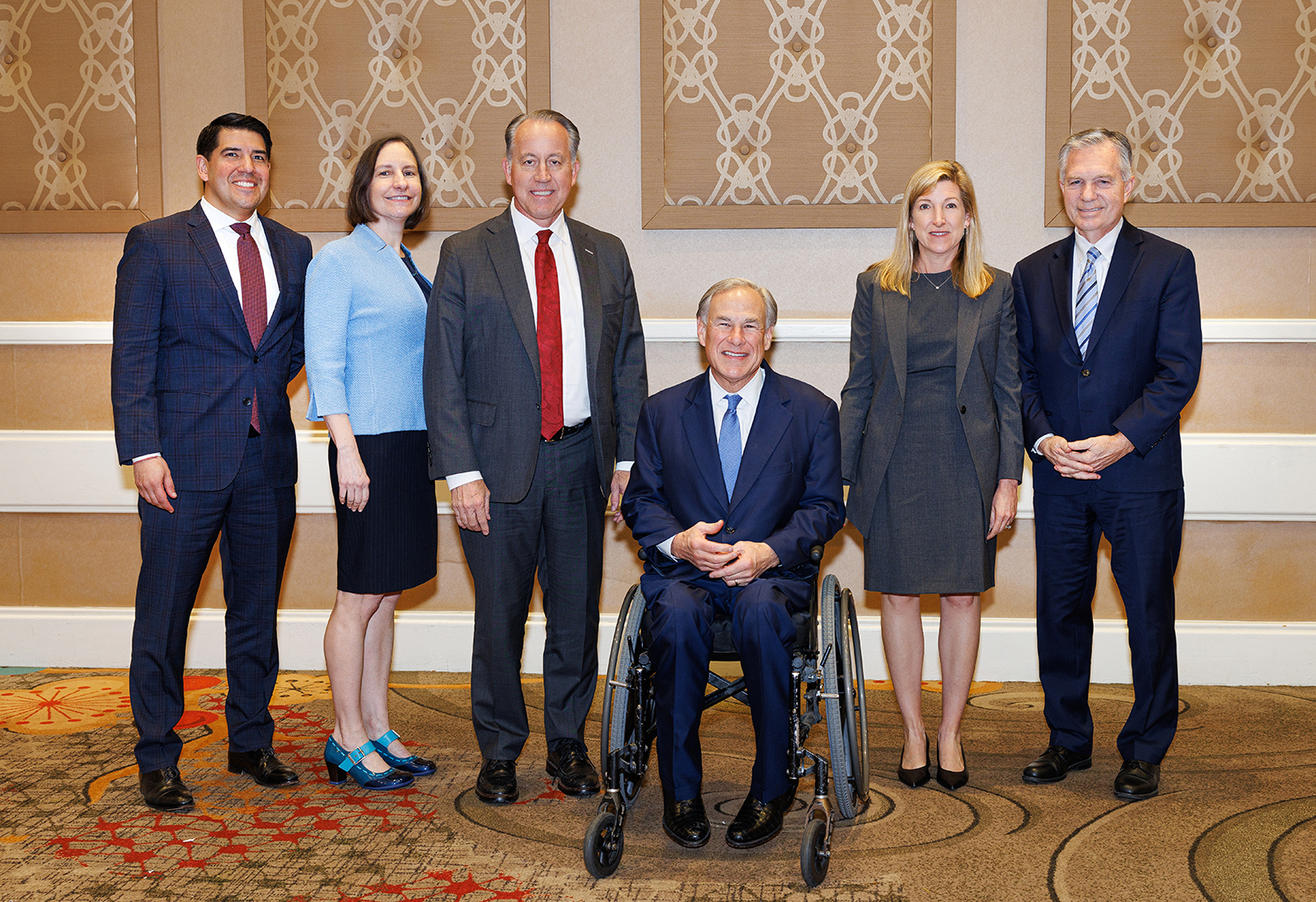
DRC staff and Board members with Gov. Greg Abbott at the 2023 State of the State event.

Texas has earned an unprecedented 12th-consecutive Site Selection Magazine Governor’s Cup, meaning the state is No. 1 for attracting the most new and expanded business facility projects in 2023.

The Lone Star State recorded 1,254 total projects in 2023—more than twice that of the second-ranked state. The Dallas-Fort Worth-Arlington (DFW) metro is home to 452 of these projects, making it the No. 1 region in the No. 1 state.

“For the past 12 years, Texas is the best state in America for economic development, and the Dallas Region plays a critical role in the state’s status as an economic powerhouse,” said Dale Petroskey, President and CEO of the Dallas Regional Chamber (DRC). “The Dallas Regional Chamber is proud to be a part of our region’s community of economic development teams who, time and again, attract and retain corporate projects that create jobs and opportunities for Texans and their families and drive the activity that keeps our economy strong.”

DFW’s claim to 36% of Texas’ 2023 corporate projects is another instance of the region punching above its weight. DFW has a 26.3% share of Texas’ population but a 29.1% share of its economy. If DFW were a country, its economic output would rank No. 25 globally, just 16 spots behind Texas’ would-be ninth place.

Texas economic development leaders at the Governor’s Cup presentation.

The DRC was invited to the Governor’s Mansion in Austin on Friday, March 1, to celebrate the Governor’s Cup with Gov. Greg Abbott. Kevin Shatley, Vice President of Economic Development, represented the DRC.

To qualify for Site Selection’s rankings, corporate projects must invest at least $1 million, create a minimum of 20 jobs, and add 20,000 new square feet of space. Of note, the DRC proudly supported two such projects in Canadian Solar and Trina Solar’s locations in Southern Dallas County.

DFW is No. 2 among top metros nationwide, trailing Chicago by 33 projects, but leads the country in projects per capita. Chicago falls to No. 4 in the per capita ranking.

“To have nearly the most total projects and still lead in per capita ranking is a remarkable feat,” said Mike Rosa, DRC Senior Vice President of Economic Development. “It shows the vastness and population size of Texas and DFW are no inhibitor to our ability to move quickly and effectively.”

Rosa pointed to the diversity of sectors and companies in DFW as a contributor to the region’s strong performance. The last 11 Fortune 500 headquarters to move here represented nine business sectors.

The DRC’s Vice President of Economic Development Kevin Shatley with the Governor’s Cup.

In its rankings, Site Selection referenced the DRC’s latest effort to continue building industry diversity in the region: a concerted life sciences and biotech economic development campaign.

“Known as home to 24 Fortune 500 HQs and 42 in the Fortune 1000, Dallas is making a name in biosciences,” the publication read. “In September, seven months after the Dallas Regional Chamber unveiled a new campaign to attract more biotech and life sciences companies, its efforts received a vote of confidence from the federal government in the form of the Advanced Research Projects Agency for Health (ARPA-H), which announced in September that the city’s Pegasus Park will serve as the physical site for one of ARPA-H’s three headquarters.”

The bid for Dallas’ ARPA-H hub—which will focus on customer experience, access, and diversifying clinical trials—was a statewide effort intrinsically supported by the DRC.

Like Petroskey, Rosa attributes DFW’s economic vitality and consistent performance in rankings and opportunities to regional economic development leaders.

“We’re enjoying the fruits of years of cooperation between a tapestry of economic development teams across our vast and great region,” Rosa said. “To consistently shine in metrics and achievement is a testament to our region’s ability to respond and execute all shapes and sizes of projects while matching them to the community that best suits their needs.”

To learn about the DRC’s economic development work, visit our website. To learn more about DFW’s economic status, explore our Economy in Brief and DFW Region Facts.

By Chatashia Brown, Manager, Diversity, Equity & Community Engagement

Women’s History Month

Women’s History Month is an annual celebration of the contributions women have made throughout American history. It began as Women’s History Week before Congress passed a law in 1987 to make March the official month to commemorate the vital role of women in the U.S.

In addition to Women’s History Month, the United Nations (U.N.) celebrates International Women’s Day annually on March 8. It was officially adopted by the U.N. in 1975. International Women’s Day is a global day celebrating the social, economic, cultural, and political achievements of women. The day also marks a call to action for accelerating women’s equality. Learn more about International Women’s Day at International Women’s Day 2024.

In Dallas-Fort Worth (DFW), women play a significant role in the workforce and the economy. Making up over 50% of the population, they contribute to 63.1% of the civilian labor force and own or co-own 36% of small businesses, employing nearly 430,000 people and generating $21.7 billion in annual payroll. Additionally, 40% of DFW women hold a bachelor’s degree or higher. Recognized as the No. 2 U.S. Metro for growth of women business owners, DFW’s women are driving innovation and economic progress, shaping the region’s future.

Best Practices for Celebrating Women’s History Month in the Workplace

      • Acknowledge and celebrate women. Women’s History Month is a great time to highlight the contributions and achievements of women in various fields. This can be done through internal communications, social media posts, or dedicated events where employees can learn about and celebrate the accomplishments of women past and present, fostering a culture of appreciation and recognition.
      • Direct resources to women-owned businesses. Supporting women-owned businesses is a great way to empower women economically. During Women’s History Month, organizations can actively seek out partnerships with and allocate resources to women-owned businesses, thereby contributing to economic empowerment.

Ramadan

Ramadan is a month-long observance for Muslim communities around the world. During this month, Muslims commemorate the revelation of the Qur’an by engaging in heightened worship, prayer, and reading of the Qur’an, making it a time of profound spiritual renewal and growth. The exact dates of Ramadan vary each year, as they are based on the lunar Islamic calendar. This year, Ramadan is expected to begin on the evening of Friday, March 22, and will conclude on the evening of Saturday, April 20. Throughout this month, some Muslims fast from dawn until sunset, abstaining from food, drink, smoking, and sinful behavior. The end of the Ramadan fast is celebrated as Eid al-Fitr, the “Festival of the Breaking of the Fast.” Many Muslims attend a religious service, visit relatives and friends, and exchange gifts on this day.

Best Practices for Acknowledging Ramadan in the Workplace

      • Educate your team. As millions of Muslims worldwide observe the Islamic holy month of Ramadan, it presents a meaningful opportunity for organizations to demonstrate support for their Muslim colleagues. A fundamental step in fostering an inclusive environment is education. Informing your staff about Ramadan and what it entails can promote empathy and understanding.
      • Be flexible. Because fasting can affect energy levels and productivity, offering flexible working hours or the option to work from home can help accommodate those observing the fast. For guidance on best practices, the Society for Human Resource Management (SHRM) provides resources on religious accommodation in the workplace.
      • Be mindful of meeting and event timing. A great way to demonstrate support for fasting employees is to avoid scheduling mandatory meetings with meals or events around food during fasting hours. If possible, try to arrange work-related meals after sunset.

Equal Pay Day

Equal Pay Day symbolizes how far into the new year women must work to be paid what men were paid the previous year. Equal Pay Day for all women should be Dec. 31, but it’s not. This year, Equal Pay Day is Tuesday, March 12. Started by the National Committee on Pay Equity in 1996, the goal of Equal Pay Day is to raise awareness about the gender wage gap. Despite the efforts of the Equal Pay Act to eliminate pay discrimination, the wage gap remains.

Currently, women earn 84 cents for every dollar that men earn. That gap increases for Black women, making 69 cents, and Latinas, making 57 cents. In 2022, The Equal Pay Day Calendar was updated to include a broader cross-section of women, including those who work part-time or seasonally, to represent a more accurate picture of how the gender pay gap impacts diverse communities. Read more here.

To learn more about equal pay day and the gender wage gap, read & watch:

Fair Housing Month

April is recognized as National Fair Housing Month to commemorate the passage of the Fair Housing Act of 1968, which prohibits discrimination based on race, religion, national origin, disability, or family status. This year, we commemorate the 55th anniversary of the passage of the Fair Housing Act. Prior to the passage of the act, redlining of neighborhoods contributed to housing segregation, food deserts, and opportunity gaps in wealth, school, and health care for groups deemed to be off-limits for issuing mortgages. Despite the legislation, which is an extension of the Civil Rights Act of 1964, discrimination can still be found in certain communities for buyers and renters.

To learn more about fair housing month and the fair housing act, read & watch:

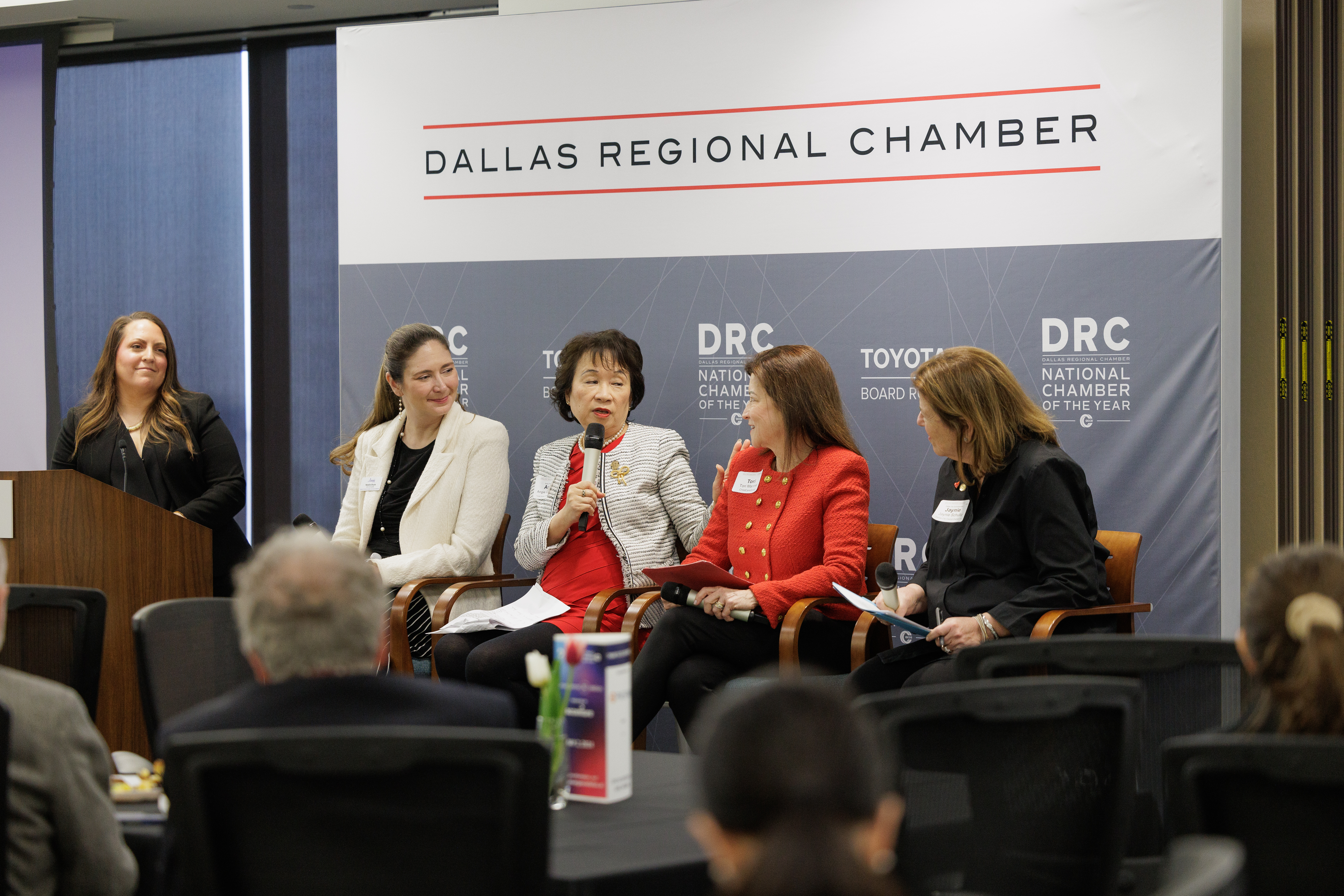
Panelists Natalie Boyle, Rep. Angie Chen Button, Tori Mannes, and Jaynie Schultz

By Catie George, Manager, Communications and Storytelling

The Dallas Regional Chamber (DRC) hosted its biannual State of Early Education, presented by PNC Bank, Thursday, Feb. 15, to explore the economic importance of early education and child care.

“When we talk about companies looking to move here or companies that are here, what they’re looking for is talent… and talent starts with early education,” said DRC President and CEO Dale Petroskey. “That’s why we work so hard to advocate for early education here—it’s the building block we all get started on.”

Amber Scanlan, Senior Vice President and Director of Client & Community Relations at PNC Bank, set the stage for the keynote conversation by detailing the benefits of investing in children’s education before they reach five years old.

Amber Scanlan of PNC Bank

”[The investment] shows up in their third-grade reading scores, their ability to transition from learning to read to reading to learn; it shows up in high school graduation rates; it shows up in matriculation of college; it shows up in their ability to go and earn a living wage, be a good taxpayer, and also has opportunities to help bring people out of generational poverty,” Scanlan said.

President & CEO of ChildCareGroup Tori Mannes sees the funding structure for child care providers as a critical barrier preventing children from reaping the benefits of early education.

“As it exists now, 85% of the cost of child care is paid by parents through private tuition, and parents are maxed out,” said Mannes. “The cost of living has gone up, wages have not kept pace with inflation, and parents simply can’t afford care.”

Left to right: Rep. Angie Chen Button, Tori Mannes, DRC President & CEO Dale Petroskey, Amber Scanlan, Jarrad Toussant, Jaynie Schultz, and Natalie Boyle

In the November 2023 election, Texas voters passed a proposition allowing local governments to offer qualifying child care facilities property tax exemptions to offset some of their operational expenses, which can, in turn, support lower costs for parents and caregivers. The DRC supported the passage of the proposition with its Good for Texans campaign. However, it’s up to local municipalities to implement the tax break. The Cities of Dallas and Denton are the only ones in the Dallas Region to do so thus far.

Dallas City Councilmember Jaynie Schultz charged attendees with engaging their city and county officials to encourage adoption of the exemption, as had just happened in Dallas the previous day.

“I would consider yesterday absolutely a victory, though not a complete victory,” said Schultz. “The system itself needs to be reimagined and be strong enough to be resilient to our different changes that happen over time.”

Solving the challenges facing early education and child care requires engagement from a variety of stakeholders, including lawmakers, parents, employers, and providers.

Annie’s Place is one such example of cross-sector collaboration to address child care challenges. Through a first-of-its-kind partnership with Parkland Health, the non-profit organization helps provide child care services to patients and hospital staff to ensure access to medical care.

DRC SVP of Education & Workforce Jarrad Toussant

“We have to figure out the systemic things that we can do, but we also have to figure out the patchwork quilt that’s going to get us just past this little bump right now,” said Annie’s Place Founder and CEO Natalie Boyle. “If we get in and start finding solutions that work for people in certain environments [like Annie’s Place at Parkland Hospital], then we can help bridge this gap while we figure out the big things we can all work together on. But we need solutions now.”

“I really, truly believe early childhood development is much more than a child care issue,” said Texas State Representative Angie Chen Button, who Chairs the Texas House Committee on International Relations and Economic Development. “It’s much more than just a feminine issue. It is a labor issue. It is an economic development issue. And when business people comprehend this and embrace this concept, something good, productive, and sustainable will come.”

Thank you to our presenting sponsor, PNC Bank, and our silver sponsor, Oncor.

To learn more about the work the DRC is doing in education, visit our website.

By Chatashia Brown, Manager, Diversity, Inclusion & Community Engagement 

In the heart of Black History Month, the Dallas Regional Chamber is highlighting remarkable individuals who exemplify the spirit of resilience, excellence, and leadership within the African American community. For Victor Vital, Office Managing Partner at Barnes & Thornburg LLP and a towering figure in the legal arena, this month serves as a moment to reflect on the rich history of African American contributions to the United States and the world.   

“African Americans have been so instrumental and foundational to this country,” Vital shares. “From childhood, this month has been a special [time] to reflect on our achievements and importance in this country and in the world.” 

Vital acknowledges the Black leaders and role models who have inspired him on his journey and paved the way for his success.  

“Booker T. Washington and Thurgood Marshall are the two Black leaders who have inspired me the most,” he said. “Great men; great Americans; champions for African Americans and for progress and justice!”   

Victor’s successes in the courtroom are legendary. With over two decades of practice and more than 100 trials under his belt, he is hailed as a formidable force in Dallas and across the country. 

“My experience and expertise in this space are who I am,” he emphasizes. “My daily goal is to bring who I am to the table, and I believe that necessarily fosters a culture [of diversity, equity, and inclusion].” 

For those aspiring to follow in his footsteps, Vital advises to “plant seeds for the future you desire through your intentions and dreams.” 

Despite his numerous accolades, Vital remains grounded in his commitment to honoring African Americans in his field.  

“We stand on the shoulders of giants,” said Vital. “We honor the legacy and contributions of those giants through demonstrating and embodying excellence in the spaces that have been paved for us by those who have gone before us.” 

Through his leadership, Vital continues to inspire others to embrace their heritage, pursue their dreams, and strive for a future defined by diversity, equity, and inclusion. 

By Dana Jennings, Senior Vice President, Communications, Marketing & Events

In recent years, Dallas-Fort Worth has experienced a rapid expansion in the information technology and health care industries. The growth shows no signs of slowing in the coming decade, and the DFW region needs a projected 130,000 more qualified workers to prevent unfilled jobs from hampering economic growth in the same timeframe.

The Dallas Regional Chamber, with support from Bloomberg Philanthropies, has launched a new tool to help the region’s key players in workforce development meet this need.

The new DFW Health Care and IT Talent Pipeline Portal provides expansive, up-to-date data on the supply of and demand for talent for middle-skill jobs.

“Tackling a challenge begins with a shared understanding of it,” said Jarrad Toussant, DRC Senior Vice President of Education and Workforce. “Employer and education partners across the region need meaningful labor market data to inform the instruction, advising, training, recruitment, and development of our regional talent base. The DRC is excited to offer this free-to-use resource to help coordinate efforts to ensure employers have the talent they need while increasing living wage attainment for people living and working in the Dallas Region.”

Middle-skill jobs are careers that require technical education and training beyond the high school level without a need for a four-year college degree. These jobs are critical to Dallas’ economy, comprising more than half of all jobs, and Dallas’ fastest-growing industries need a ready workforce equipped to fill these roles. However, a staggering 53% of Dallas students either do not complete high school or do not enroll in post-secondary and thus do not meet the qualifications for these high-demand, high-wage jobs, resulting in nearly 300,000 unfilled jobs in our region.

The DFW Health Care and IT Talent Pipeline Portal provides stakeholders with the most up-to-date information on jobs and careers, skill gaps for specific roles, program completion by institution, job trends/forecasts, and much more. The custom portal is designed to help make data-driven strategy decisions for tackling regional talent needs for a broad range of users:

      • Workforce & Economic Developers
      • Counselors & Advisors
      • Policymakers
      • Recruiters/Employers
      • Education & Training Administrators
      • Employer Outreach & Engagement Specialists

In IT and health care in DFW, middle-skill jobs provide average salaries of $50,000-$95,000. By improving efforts to position workers and future workers to fill these roles, education and workforce institutions help increase the number of young adults set to earn a living wage, increasing economic mobility and decreasing the number of DFW adults living in poverty.

DFW has added 1.3 million jobs in the past decade, making it the leading U.S. region for job growth, and the region’s population is on pace to overtake Chicago as the No. 3 metro area within the next decade.

Despite this prosperity, Dallas County has the seventh-most number of residents living in poverty. Only between a quarter and a third of young adults are projected to make a living wage.

“We cannot import our way to a skilled talent pool,” Toussant said. “We must build skills for middle-skill IT and health care jobs within our local talent pipeline to support continued growth while building critical economic mobility for all of our citizens. We believe uniform access to data through the DFW Health Care and IT Talent Pipeline Portal moves us closer toward this goal.”

The DFW Health Care and IT Talent Pipeline Portal is an initiative of Dallas Thrives, which was launched by the DRC and the Commit Partnership in 2020 to double living wage attainment for young adults in Dallas by 2040.

Through its strategic focus on Education, Talent & Workforce, the DRC fosters collaboration between the local business community and educational institutions to meet regional industry needs.

If you are interested in learning more, visit the Dallas Thrives website or read the Dallas Thrives Update Report. Learn more about the DRC’s work in Education and Workforce on our website.

By Catie George, Manager, Communications & Storytelling

Access to quality child care is a critical component of our regional infrastructure, much like access to broadband and water. However, a survey from the Texas Association for the Education of Young Children suggests that more than 40% of Texas’s child care providers are at least somewhat likely to close within the next year, due in part to the expiration of federal relief funding that sustained child care providers throughout the pandemic.

To alleviate the challenges facing child care providers, the DRC supported the passage of Senate Bill 1145 (West, 89R) during the 88th Texas Legislative Session to create a constitutional amendment to provide property tax exemptions for qualified child care providers across the state.

Ahead of the November 2023 constitutional amendment election, the Dallas Regional Chamber launched the Good for Texans campaign to support the passage of Proposition 2—the ballot item created by SB 1145—to allow jurisdictions to provide property tax exemptions for local qualified care centers. Proposition 2 was widely supported throughout the state, passing with 65% of the vote, but especially so in Dallas County, where the measure was approved by 72% of voters.

Now, it’s time for local jurisdictions to adopt the optional exemption.

What it means to adopt Proposition 2

Child care facilities across the state are facing challenges due to an unstable and often insufficient financial model, driven by high occupancy costs. Providing child care providers property tax relief will offer vital relief to providers in North Texas and help ensure access to affordable and quality child care for our communities.

To be eligible for the exemption, a provider must participate in Texas Rising Star (TRS), the state’s child care quality rating system, and maintain at least 20% of their enrollment for children receiving assistance through the state’s child care subsidy program. The tax exemption will reduce local property tax levies on child care providers by at least 50% where it is adopted, with the potential for local jurisdictions to exempt up to 100%.

As a result, high-quality child care facilities serving families most in need will see a reduction in their operating expenses, and child care operators not currently participating in the TRS or state subsidy system will be incentivized to opt into both, further increasing the overall quality and accessibility of child care.

The business case for adopting Proposition 2

Lack of child care is a major barrier to workforce participation for parents. A 2021 report from the U.S. Chamber of Commerce found that 35% of workers in Texas who quit or planned to quit their jobs did so because of challenges accessing child care.

For working parents, the affordability of quality child care, in addition to availability, can prevent access to child care services. In Texas, the average annual cost for infant care is nearly $11,000, but providers still struggle to make ends meet.

What the business community can do to support adoption

The Dallas Regional Chamber applauds the regional jurisdictions that have recently adopted the exemption, setting a strong example for other cities and counties in North Texas.

      • City of Denton – 100% exemption adopted Tuesday, Feb. 6
      • City of Dallas – 100% exemption adopted Wednesday, Feb. 14
      • Dallas County – 100% exemption adopted Tuesday, March 5

To take effect for the current tax year, remaining municipalities likely need to adopt the exemption by the end of April. It is critical for families, community leaders, and employers to advocate to their local city councils and county commissioner’s courts to ensure the timely adoption of this important exemption.

To help aid this measure’s adoption, contact your municipal officials and express your support.

If you are interested in learning more about how you can support the adoption of child care tax relief in North Texas, visit the Child Care Tax Relief website. If you have any questions, email Michael Wood at mwood@dallaschamber.org.

By Catie George, Manager, Communications and Storytelling

As the first Black female CEO in the history of the NBA, 2024 Dallas Regional Chamber Board Chair Cynt Marshall always celebrates her culture, especially during Black History Month (BHM) in February.

“As a Black person, this month is meaningful to me because it allows others to learn about my heritage and the life of my ancestors,” said Marshall. “I celebrate BHM by reflecting on a moment in Black history every morning in February. I make sure to attend, at a minimum, a weekly BHM event… I celebrate by singing the Negro National Anthem every day, and I take time to really reflect on the words.”

Raised in central California, Marshall has fought for diversity since her days as the first Black cheerleader at the University of California, Berkeley. Her strong drive for equality came, in part, from her mother.

“My mother is my role model. She taught me faith, resilience, optimism, perseverance, and the value of a strong work ethic,” Marshall said. “She instilled in me the beauty of compassion and taught me the importance of lending my head, hand, and heart to others.”

Other leaders who influenced Marshall include Chuck Smith, a legendary pastor, and Priscilla Hill Ardoin, a professional who works in the diversity, equity, and inclusion space. Marshall’s influences have motivated her to break down barriers, and she doesn’t plan to slow down any time soon.

“My vision is that our workplace, including our court, is a place where every voice matters and everybody belongs,” said Marshall. “My vision is that fairness and equality undergird the work we do in the NBA and are table stakes to live, work, and play with us.”

Marshall furthers her vision by also mentoring and championing other Black women.

“I’m hyper-focused on ensuring that while I might be the ‘first’ in many things, I won’t be the last. I spend time helping others crystallize their dreams, document goals, and develop a game plan,” said Marshall. “Fortunately, I have the ability to place Black women in leadership positions, and I do not hesitate to put them in positions that they are qualified for.”

As we celebrate the past during BHM, Marshall believes it is also essential to look to the future.

“My excitement for the future comes from a belief in the spirit, smarts, and inclusive nature of our youth. My hope and optimism for the Black community also stems from a belief in humanity,” said Marshall. “I am excited about the opportunities that are being created, made available, and seized upon for and by the Black community. I’m excited by the recognition that Black culture is American culture, too.”

Probe CX, a customer experience (CX) and digital transformation organization, uncovers the key to success in today’s competitive market: infusing empathy and emotion into customer experiences through intelligent automation.

As Group Executive for the Americas Tracey Hinkle spearheads strategic growth initiatives, market development, partnership strategies and operational excellence, propelling the organization towards new horizons.

How does Probe CX help its clients build value?

In today’s ever-evolving landscape of customer experience, the pursuit of innovation and operational effectiveness is paramount. At Probe CX, we play a pivotal role in reshaping how businesses interact with their customers, positioning ourselves not merely as a solution provider but as an agent of transformation.

Probe CX operates at the convergence of cutting-edge technology and human-centric strategies, challenging and redefining traditional paradigms of customer engagement. Through the implementation of advanced technologies such as artificial intelligence-driven and sentiment analysis, we empower businesses to decipher intricate customer behaviors and anticipate their needs.

Our suite of services, including customer journey mapping, tailored CX strategy development, and robust implementation plans, enable businesses to deliver highly personalized customer experiences.

By furnishing businesses with actionable insights and strategies customized to their unique requirements, we facilitate growth, foster customer loyalty, and optimize operational efficiencies.

What differentiates Probe CX within your industry?

What distinguishes Probe CX from other industry players is our unique blend of innovation, expertise, and unwavering commitment to excellence. Our approach transcends mere technology deployment; it revolves around a deep understanding of both businesses and their customers.

We prioritize understanding our clients’ objectives, ensuring that our solutions seamlessly align with their overarching vision. At Probe CX, we are strategic partners deeply invested in our clients’ success. Our commitment to ongoing evolution ensures that we stay ahead of industry trends, consistently delivering value.

What benefits does Probe CX enjoy by doing business in the Dallas Region?

What we find most enjoyable about conducting business in the Dallas Region is the dynamic and thriving business ecosystem that perfectly complements Probe CX’s operations. The combination of innovation, diversity, and a forward-thinking mindset aligns seamlessly with our core values.

But it’s not just the flourishing business environment that we appreciate. The Dallas Region’s cultural richness and the collaborative spirit of its community create a conducive atmosphere that promotes both growth and creativity within our organization.

Why did Probe CX become a DRC member?

Probe CX team members in one of our office locations.

Probe CX’s choice to become a member of the DRC reflects our dedication to actively participate in and enrich the local business community. We believe in contributing to the vitality of the region, and the DRC’s extensive network, resources, and strong advocacy for business growth resonate with our goals.

Our membership with the DRC not only helps us thrive but also enables us to make a meaningful contribution to the regional economy, fostering a mutually beneficial partnership.

How has Probe CX changed in the past five years?

Over the past five years, Probe CX has undergone a significant transformation. We have expanded our service portfolio to five countries with over 19,000 team members, embracing emerging technologies to enhance our offerings. Our client base has also grown to over 700, reflecting the effectiveness of our solutions in driving tangible business results.

Our ability to embrace innovation and adapt to changing market dynamics has been pivotal in our journey. As we navigate the evolving landscape of customer experience, we remain steadfast in our commitment to empower businesses, redefine industry standards, and cultivate enduring relationships in the dynamic Dallas business environment.

By Jarrad Toussant, Senior Vice President of Education & Workforce, and Elizabeth Caudill McClain, Senior Vice President of Talent Strategies

The Dallas Regional Chamber (DRC) officially launched its 2024-2026 strategic plan, “Building Tomorrow Together,” in January. Our senior leaders penned blogs about each of the four focus areas of the new plan, the track record of success they are building on, and what they will focus on in 2024.

Jarrad Toussant, Senior Vice President of Education & Workforce
Elizabeth Caudill McClain, Senior Vice President of Talent Strategies

The DRC has long made the case that the economic success of our region is dependent on the quality of our talent pipeline, from early childhood through K-12 and higher education to a career.

We’ve tackled many initiatives and advocacy endeavors in pursuit of a stronger talent pipeline, and we’ve made great strides that have led to major expansions in our Education, Talent & Workforce strategic work for the 2024-2026 strategic plan with the aim to serve our members while also benefitting our region.

A historic budget surplus presented the 88th Texas Legislature in 2023 with an unprecedented opportunity to invest in our educational institutions. The DRC’s Education & Workforce team, in close collaboration with our Public Policy team, spent significant time at the Capitol advocating for investment during the regular session and the subsequent special sessions —and it paid off.

The legislature passed nine key bills amounting to $4.5 billion invested in Texas’ education systems, including an investment in pre-K-12 curriculum reform and a new higher education research funding stream to support innovation in the region. Our recently published DFW Higher Education Review backs up our claim that Dallas-Fort Worth is the No. 1 region for higher education in Texas and showcases the sort of innovation this investment will support.

In a big win, the legislature passed House Bill 8, which allocates $700 million to community college funding and marks a transformational shift in the way Texas funds community college systems to a focus on student and employment outcomes. The bill’s passage marked the culmination of a two-year effort by the DRC and our members.

The DRC’s Good for Texans campaign helped pass an optional property tax exemption for qualifying child care facilities, which we believe will help provide more sustainability and lower costs for parents and caregivers. This is yet another tool in our belt as we work toward expanded access to quality child care for our communities.

New data from last year suggests efforts by the DRC and our community partners to strengthen the region’s talent pipeline are working. Since 2012, the number of young adults in Dallas County earning an associate degree and a living wage has increased by 10 percentage points and 6 percentage points, respectively. Improvement in these areas is a key goal of our Dallas Thrives initiative, which aims to break the cycle of poverty by helping more young adults attain a living wage.

We’re deeply proud of the progress we’ve made through our strategic commitment to education and workforce, and we’ll continue to strive for progress in these areas under the 2024-2026 strategic plan—but with a new formalized commitment to talent.

In response to feedback from DRC members, we’re elevating and prioritizing how we support companies’ efforts to implement processes and systems that get them the talent they need. This includes connections to and resources for recruitment and retention strategies and upskilling and reskilling current members of the workforce.

Of course, the DRC’s Leadership Programs are a key part of this strategy as they provide the programs and coaching necessary to develop the leaders our companies need while priming them to serve the needs of our region—a win-win for the Dallas Region.

With support from Bloomberg Philanthropies, we’ll soon launch a new Talent Pipeline portal, which will provide unique analytics to help support better talent pool development and access in the health care and IT sectors—which both experience challenges in recruiting quality talent in our region.

To further support the talent pipelines for IT and health care, the DRC will relaunch our widely regarded regional industry marketing campaigns, “Say Yes to Health Care in Dallas” and “Say Yes to Tech in Dallas”. This relaunch will introduce new outreach and remarketing content targeting young adults in the Dallas region to increase exposure to high-wage, high-demand occupations.

We’re also reshaping our Talent Attraction Council to be the Talent Task Force, allowing us to expand our work and support to our member companies to include talent retention and development.

Our teams will be working closely together to maintain and grow the education and workforce support you’ve come to expect from the DRC while growing our strategies for talent recruitment, retention, and development to make sure our companies have high-quality educated workers while helping ensure all current and future workers of the Dallas Region have the chance to lead a fulfilling life and career.

By Matt Garcia, Senior Vice President of Public Policy

The Dallas Regional Chamber (DRC) officially launched its 2024-2026 strategic plan, “Building Tomorrow Together,” in January. Our senior leaders penned blogs about each of the four focus areas of the new plan, the track record of success they are building on, and what they will focus on in 2024.

Matt Garcia, Senior Vice President of Public Policy

For the past several years, Texas, and particularly the Dallas Region, has enjoyed a level of growth and prosperity not seen in many other parts of the country. Our state’s business-friendly climate and the region’s diverse industries can take much of the credit for this—but it takes work to make sure companies and people alike have what they need to thrive now and into the future. That’s what the DRC’s Public Policy team works toward each day.

Our focus on Public Policy under the DRC’s 2024-2026 strategic plan fortifies our commitment to advocating for policies and outcomes that preserve Texas’ economic advantage and support a prosperous life for Texans.

We came into 2024 with some important wins under our belt that set us—with our members, partners, and elected officials at all levels of government—up to keep building for a bright future for us all.

The regular session of the 88th Texas Legislature saw 32 DRC priority bills passed, many of them detailed in the DRC’s Legislative Index. Importantly, the DRC successfully helped pass a critically needed, new, transparent, and accountable statewide economic development incentive program to help attract more companies and jobs to the Dallas Region.

Lawmakers utilized the state’s historic budget surplus to pass several pieces of legislation to make investments in our state’s future, putting the final decision for these investments in the hands of voters with November’s constitutional amendment election. The DRC launched the Good for Texans campaign to help pass eight important propositions—and they did. Together, these propositions enhance our quality of life, grow our economy, improve our infrastructure, and lower our property taxes.

We also advocated for $20 million for a new Regional Law Enforcement Training Center on the campus of UNT Dallas and additional funding for the behavioral health hospital operated by UT Southwestern. Each of these measures provides critical support to the health and safety of our region.

The list of wins and impacts goes on—because the DRC knows we can’t sit on the sidelines when it comes to public policy. We tracked each of the 246 days spent in the legislative session in 2023 to make sure nothing went unnoticed, and we engaged the business community every step of the way through sold-out events, including one with Gov. Greg Abbott, and our largest-ever Austin Fly-In.

Legislators want to hear from companies about the impact of their work. Our legislative wins were direct results of that engagement by our members, who are our best advocates.

Our work, with support from our members, has helped us build credibility in the public policy sphere, which positions us to keep making good progress under the new strategic plan.

In 2024, we’ll relaunch our Infrastructure Task Force to continue to promote investments in infrastructure. This is a direct result of feedback we heard from our members during our weekly calls throughout the legislative session in 2023.

Through the task force, we’ll be working beyond the traditional roads and bridges to various needs to support our state’s continued growth, such as water and broadband. We also know that technology policy is exploding because of new industries like artificial intelligence, the need for more data centers and increased energy capacity which we will be proactive and influence throughout the next several years.

In 2024, we’ll maintain and intensify our focus on civic engagement with a new iteration of our Voter Engagement Toolkit, which helps people get informed and engaged through an unbiased education on the voting process.

Additionally, we’ll be working on a new initiative that encourages individuals from the Dallas Region to represent and serve on boards and commissions throughout the State of Texas to voice the concerns of the Dallas Region. Until now, there has been no strategic effort to involve more people from our region in this way statewide.

Dallas is the fastest-growing region in Texas, and we are doing our part to make sure that the economic environment stays consistent and attractive to the business community. We are thinking strategically about our future and preparing for the continued growth of the region to support prosperity for all Texans.

By Latosha Herron Bruff, Senior Vice President of Diversity, Inclusion & Community Engagement

The Dallas Regional Chamber (DRC) officially launched its 2024-2026 strategic plan, “Building Tomorrow Together,” in January. Our senior leaders penned blogs about each of the four focus areas of the new plan, the track record of success they are building on, and what they will focus on in 2024.

Latosha Herron Bruff, Senior Vice President of Diversity, Inclusion & Community Engagement

2023 was a year of great impact for diversity, inclusion, and community engagement in the Dallas Region. As we look back at the progress made and look forward to our goals, I can confidently say you will see intentional commitments to diversity and inclusion in all things the DRC does under our 2024-2026 strategic plan.

Last year, the DRC hosted eight Southern Dallas County Vision Tours, which are designed to showcase the region as one of the Dallas Region’s greatest business opportunities. In 2023, our Vision Tours resulted in more than $2 million in direct economic impact and investment across Southern Dallas County.

Southern Dallas County will be home to Canadian Solar’s manufacturing plant in Mesquite and Trina Solar’s manufacturing plant in Wilmer, both announced in 2023 with help from the DRC. Combined, these projects initially promise 3,000 well-paying jobs and $450 million of capital investment.

We also launched our Southern Dallas County Economic Development guide in 2022. The first of its kind, this guide aggregates all the relevant news stories around Southern Dallas County to tell you who is coming and what is being built, so you can have everything at your fingertips.

Our Southern Dallas County Economic Development Guide has the latest on who and what is coming to Southern Dallas County.

This past year, the DRC also leaned into the work of addressing food insecurity and food deserts. We worked with Tom Thumb, our City of Dallas leaders, and our Economic Development team to bring Tom Thumb and The Shops at RedBird together to build a new, 50,000-square-foot store opening in 2025. We are incredibly happy about this development, which promises to not only increase access to fresh food but also train and hire from the community. This is a transformative project that we hope will spur other opportunities.

Over the past year, the DRC hit a stride with how we connect business and public safety, which contributed to successfully advocating for lawmakers’ investment in the Regional Law Enforcement Training Center at UNT Dallas—work we proudly did alongside our Public Policy team.

We also pressed for more inclusive communications. The DRC released the first Spanish translation of the Voter Engagement Toolkit to promote civic engagement across communities, and Dallas Innovates published its first-ever bilingual story about an entrepreneur in Southern Dallas County.

I’ve just shared a lot worth celebrating—and I’m proud to say it’s not an exhaustive list. In 2024, we will build on this momentum and tackle new opportunities that promise to help make the Dallas Region’s business community more diverse and inclusive.

We’ll launch a campaign to help dispel the myths about and reshape the narrative around Southern Dallas County—which are among our greatest challenges when it comes to driving economic growth there.

In early 2024, the DRC will release a first-of-its-kind Disability Inclusion Toolkit to be a resource and a guide for all our member companies to understand how they can bring more inclusion to the workplace around disability. One in four employees has a disability, whether seen or unseen. We must make our spaces comfortable so people can feel like they can disclose a disability, and we need to make sure our companies are prepared to create an environment where people can thrive, no matter their ability. This year, we’ll transform the State of DEI into the Inclusion Conference all about disability inclusion.

All our DICE accomplishments are possible because of the Tomorrow Fund, which fuels the work we do. The Tomorrow Fund directly supports our focus areas of work. We call it the Tomorrow Fund because a lot of our work considers the future of the region and what we can do to make it the best it can be for all people. Without your investments, there’s a lot we can’t get done.

As 2024 begins, our team has already begun doing the work to ensure that everyone has an opportunity to grow and thrive in the Dallas Region.

To learn more about the DICE team’s work, visit our website and explore our new strategic plan.

By Mike Rosa, Senior Vice President of Economic Development

The Dallas Regional Chamber (DRC) officially launched its 2024-2026 strategic plan, “Building Tomorrow Together,” in January. Our senior leaders penned blogs about each of the four focus areas of the new plan, the track record of success they are building on, and what they will focus on in 2024.

Mike Rosa, Senior Vice President of Economic Development

Over the past three years, the DRC and the Dallas-Fort Worth (DFW) Region have built great momentum in economic development and secured several major wins—which sets us up nicely as we formalize our focus on Prosperity & Economic Development under the DRC’s 2024-2026 strategic plan.

Our region continues to lead the nation in job growth, with 602,000 net new jobs over the last five years. That’s 59,000 more jobs than second-place Atlanta and third-place Houston combined.

In 2023 alone, the DFW Region saw 55 companies locate or expand here—a pace we’ve kept for the last several years. We are particularly proud 22 regional cities landed at least one of these wins in 2023, meaning that the whole region has a share of the prosperity we are seeing. Cities in our region are winning by doing a great job of contributing to our collective success.

Nine of these projects landed in Southern Dallas County, including the new Canadian Solar and Trina Solar plants—each of which is projected to contribute 1,500 jobs to the nearly 300,000 tech jobs now in DFW.

Our region’s brand on the life sciences and biotech stage was elevated in 2023 when we earned two major federal designations in as many months. The DRC proudly provided key economic development, research, and policy support for Texas’ successful bid to bring the Advanced Research Projects Agency for Health, known as ARPA-H, Customer Experience Hub to Dallas’ Pegasus Park. The win validates, amplifies, and accelerates the DRC’s focus on growing the life sciences and biotech sectors as we move into 2024.

Shortly after the ARPA-H news, the White House and the U.S. Department of Commerce designated Dallas as a tech hub, the only winning bid in Texas. The DRC’s Research & Innovation team, led by Senior Vice President Duane Dankesreiter, was instrumental in showcasing our region’s potential for growing our nation’s semiconductor production.

Our work over the past several years has positioned the DFW Region as a destination for business and innovation—and our strategic work in Prosperity & Economic Development for 2024-2026 will help us make certain the ecosystem that makes that possible is sustained and thriving.

We’ll work to ensure local companies and talent enjoy an ecosystem that promotes innovation while helping them grow and prosper. We want to hear from our members and partners throughout the region about what they need from an economic development perspective to continue to grow.

We’ll also work to ensure we’re meeting with local companies to assess their needs and growth potential. To do that, we’re going to add two new marketing trips in our own backyard to meet with companies already here, in addition to our trips to California and New York.

Of course, we’ll continue to work on the corporate recruitment that’s important to our region. We recognize the importance of working with our Education, Talent & Workforce team to ensure that both local and incoming talent are prioritized. Without a healthy workforce, economic prosperity wouldn’t be possible. We also already have our eye on developing economic policy for the 2025 legislative session.

Finally, a hallmark of a strong economy is the ability to grow innovation from your own dirt. To support this, the DRC will continue to foster innovation opportunities and increasingly look to bring startups and universities into the fold. Building on the successes of 2023, life science and biotech present important opportunities to cultivate the future economy in the Dallas Region.

We are hitting the ground running in 2024 and look forward to working with our DRC members and community economic development leaders every step of the way. Whether you’re new to the region or a seasoned member of our community, we’d love to work with you to advance Prosperity & Economic Development in the Dallas Region.

By Catie George, Manager, Communications & Storytelling

More than 1,200 business leaders and elected officials attended the Dallas Regional Chamber’s (DRC) biggest event of the year Wednesday, Jan. 17. The 2024 Annual Meeting, presented by the Dallas Mavericks, celebrated the DRC’s progress over the last year and looked ahead to opportunities for the business community.

“This is our chance. This is our once-in-a-lifetime chance to work together to make real progress against our biggest challenges and change the future for many in our community for generations to come. Let’s use this sweet moment in time to make things better,” said DRC President and CEO Dale Petroskey, speaking to the Dallas Region’s record economic prosperity evidenced by 55 corporate locations and expansions in 2023 alone and Dallas leading the nation in job growth.

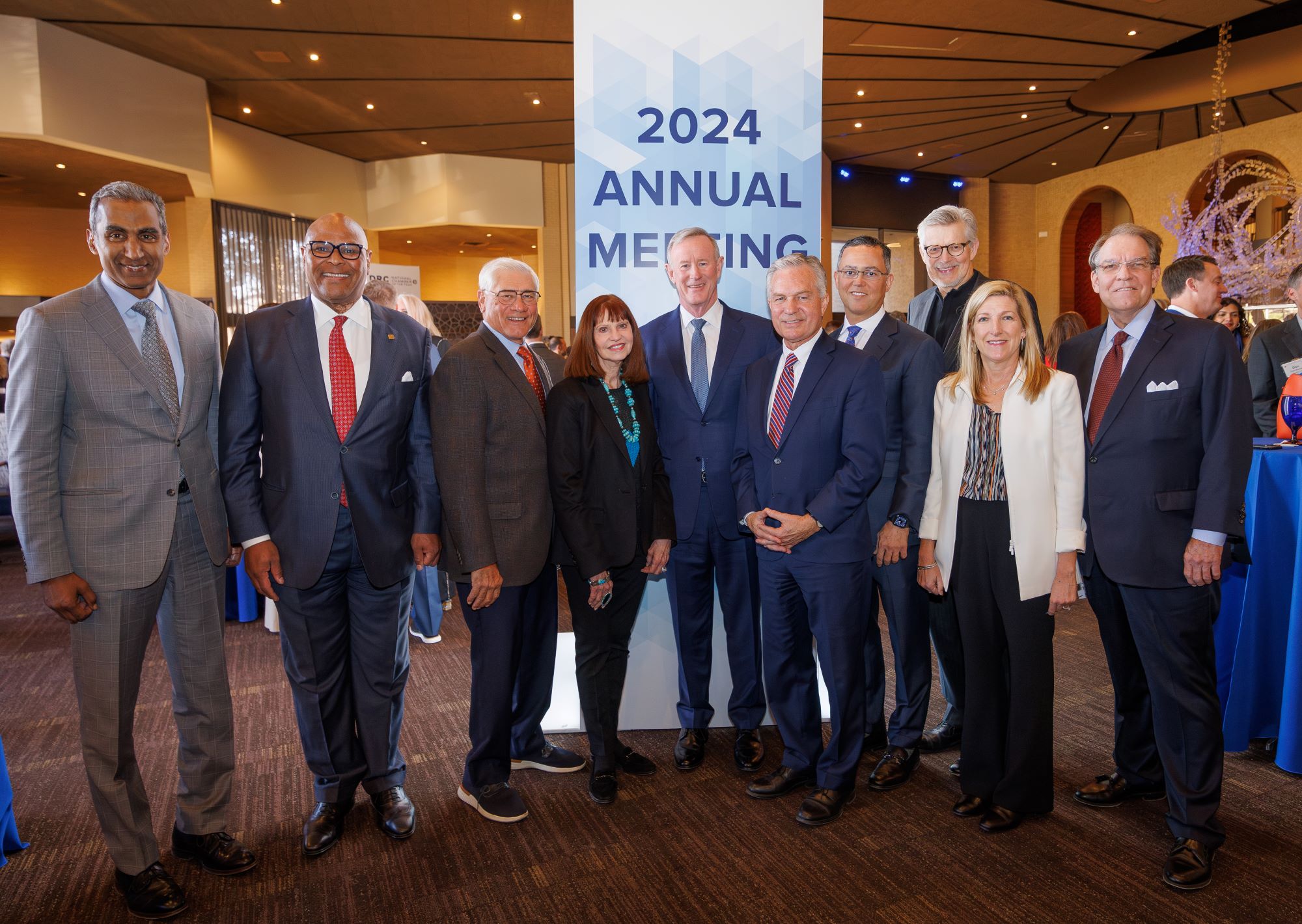
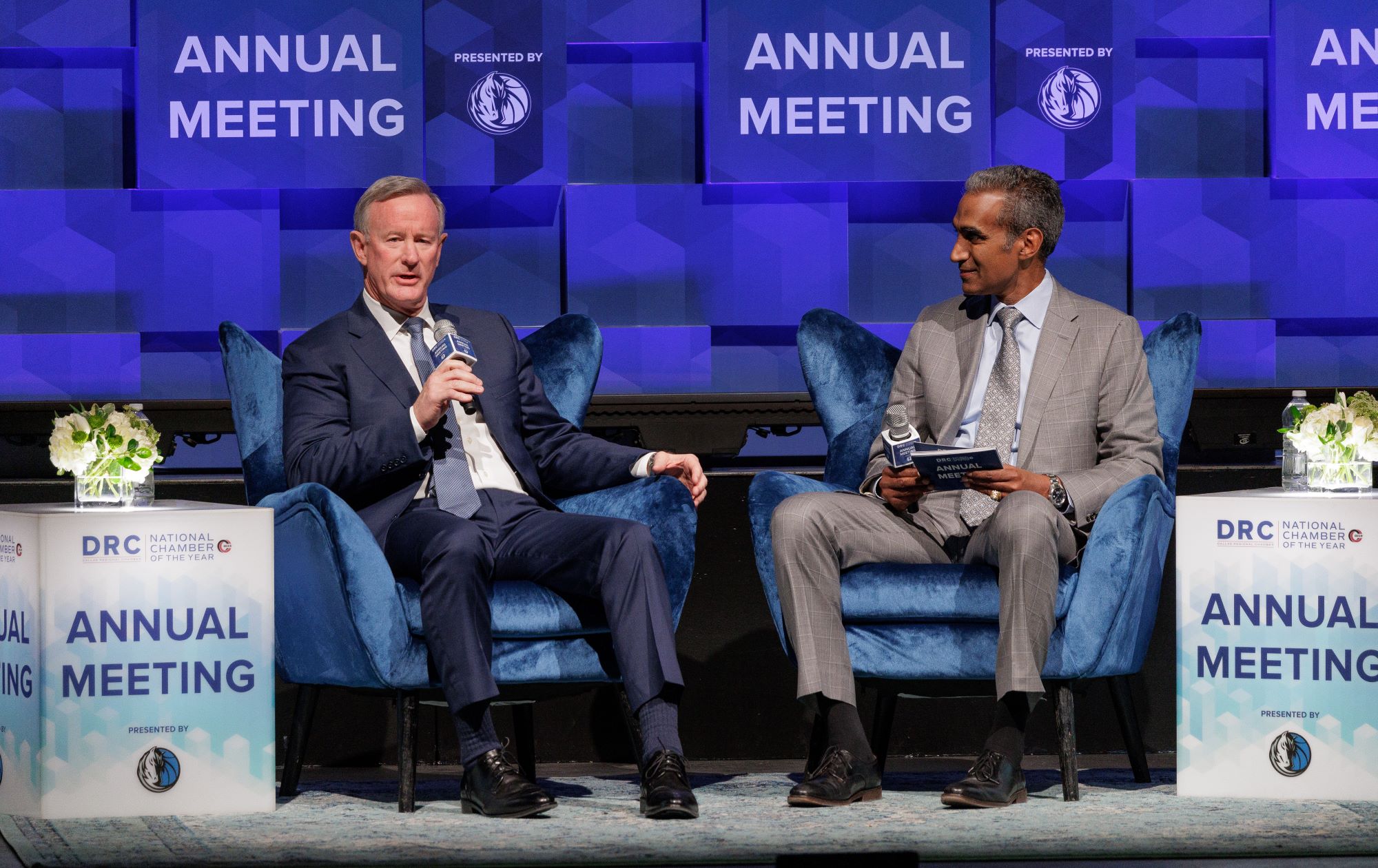
Past DRC Board Chairs with Admiral William H. McRaven.

The 2023 DRC Board Chair Rafael Lizardi, CFO of Texas Instruments, showed attendees a video featuring top DRC members recapping key successes of the past three years as he closed out his tenure. The Annual Meeting featured a keynote conversation with retired U.S. Navy four-star Admiral and five-time New York Times bestselling author William H. McRaven, who discussed his philosophies and lessons about leadership and service in a conversation with Bob Pragada, CEO of Jacobs and 2022 DRC Board Chair.

“When in command, command. When you’re in charge, you have to make tough decisions,” shared McRaven. “You have to take in all the best information you can, you have to assess things, but at the end of the day, as a leader, it’s your decision. You can’t be constrained by too much fear.”

McRaven shared stories about the military operation he led to eliminate Osama bin Laden, his career as the Chancellor of the University of Texas System, and how business leaders might draw lessons from his career.

“One thing you learn in the military, and I know it’s true in corporate America as well, is you find the best people you can and surround yourself with them,” McRaven said. “Whenever I was in a tough situation, somebody had always been in that situation before. Go find that person who has that experience. Bring them in, listen to them, talk to them. All the books and all the training in the world, nothing wrong with that, but there’s nothing quite like experience.”

Veterans in the audience were honored via a special shoutout by DRC COO & CFO Angela Farley.

“In honor of Admiral McRaven, we are using today’s event to recognize and celebrate the impact of our country’s active-duty reservists, veterans, and their families. We know many of you have served your country, and we so appreciate your service and all you do to make the business community stronger every day,” said Farley.

Combined Arms, NextOp, and the University of Texas at Arlington’s Veteran Business Outreach Center exhibited  at the event to help the business community understand how they can hire and meaningfully engage veterans.

In addition to the keynote conversation between McRaven and Pragada, the new 2024 DRC Board Chair Cynt Marshall, CEO of the Dallas Mavericks, shared her charge for the coming year.

“We harness our power and seize the moment to create a blueprint for building a prosperous future for all,” Marshall said. “So, in the spirit of positivity and optimism, my call to action is to seize the moment. Now is our time. Now is the time to close the chapter on the tale of two cities and create one Dallas.”

Admiral William H. McRaven and Jacob’s Bob Pragada

Marshall’s call to action included focuses on education, narrowing Dallas’ wealth gap and health disparities, corporate social responsibility, and a goal to make the Dallas Region the “most inclusive place in the country.”

Both Marshall and Petroskey spoke to the issue of opportunity gaps that exist within companies, communities, and educational institutions.

“We won’t be the kind of community we should be or can be until everyone has the same opportunities,” Petroskey said before introducing the DRC’s 2024-2026 strategic plan called “Building Tomorrow Together,” the roadmap to improving the quality of life for all people in the Dallas Region.

“One thing we’ve learned being in Dallas is that when we want to take on an opportunity or a challenge, nothing can stand in our way,” said Petroskey.

Watch this video to learn about the 2024-2026 strategic plan in the words of DRC leaders or visit our Priorities pages. Read blogs by DRC senior vice presidents to learn about significant achievements of 2023 and their priorities for 2024: Prosperity & Economic Development; Public Policy; Education, Talent & Workforce; and Diversity, Inclusion & Community Engagement.

The 2024 Annual Meeting was presented by the Dallas Mavericks. The speaker sponsor was Hillwood. Platinum sponsors were American Airlines; Jacobs; and McKesson.  VIP reception sponsor was KPMG. Happy hour sponsor was PwC. Gold sponsors were Axxess; Deloitte; EY; Texas Instruments; and Thompson Reuters. Silver sponsors were Amazon; Capital One Bank; FORVIS LLP; Haynes and Boone; LLP; JBJ Management; The Men and Women of Hunt Consolidated, Inc.; Oncor; Southwest Airlines; Toyota Motor North America; The University of Texas at Arlington; and Wells Fargo. Bronze sponsors were Amegy Bank of Texas; Arcosa; Bank of America; DHD Films; Grant Thornton LLP; Locke Lord LLP; Texas Capital Bank; The University of Texas at Dallas; and Verizon.

By Annette Addo-Yobo, Manager, Leadership Programs

Are you curious about the secret recipe that turns ordinary leaders into extraordinary trailblazers? Join our LEAD YP leadership development program to unravel the art of cultivating personal greatness. Through a hands-on curriculum, LEAD YP deepens young professionals’ understanding of their leadership style and primes them to grow into leaders who champion the Dallas Region.

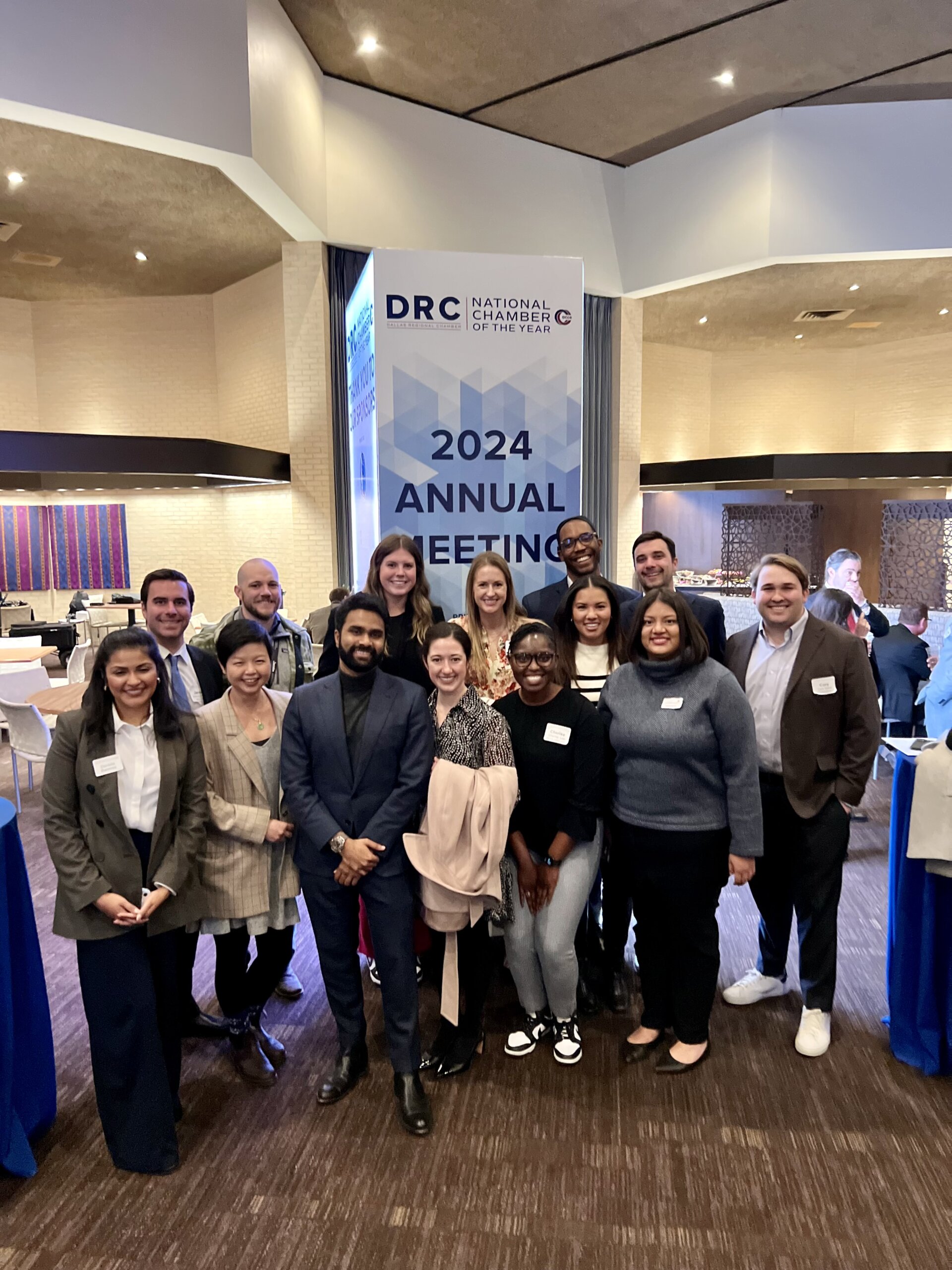
LEAD YP alumni at the DRC’s 2024 Annual Meeting.

Here are three reasons why LEAD YP is your next step in professional and personal leadership development:

1. Training

LEAD YP provides monthly training on personal leadership, branding, coaching, and feedback. Each month, a unique class day gives participants insight into a different aspect of the work the Dallas Regional Chamber does to help make the Dallas Region extraordinary, and it highlights ways they can contribute to these efforts.

2. Connection

LEAD YP members will connect and build relationships with other like-minded individuals and young professionals in the Dallas Region who are both lifelong learners and emerging leaders. This opportunity is well-suited for people just beginning in their careers, those seeking more professional connections, or anyone hoping to make like-minded, new friends!

3. Service

Graduates of LEAD YP will have the opportunity to serve on the Young Professionals Advisory Council at the Dallas Regional Chamber to develop their skills further and have an impact on young professionals in the Dallas Region.

Applications close Wednesday, Feb. 14, so apply today and don’t miss out on an incredible opportunity to join the next generation of change-makers. For questions regarding LEAD YP, contact Annette Addo-Yobo at aaddoyobo@dallaschamber.org.

By Catie George, Manager, Communications & Storytelling

Following the brutal death of James Byrd in 1998, the Leadership Dallas Alumni (LDA) Board of the Dallas Regional Chamber (DRC) wanted to bring people of different backgrounds together. They founded America’s Dinner Table (ADT) to encourage communication about race relations, educate attendees, and empower people to develop diverse relationships.

“Similar to [the murder of] George Floyd, this was the impetus for a group of business professionals to say, ‘What is it we can do to make real change in our community?’” said Latosha Herron-Bruff, Senior Vice President of Inclusion & Community Engagement at the DRC. “And they wanted to start with how we can have conversations about race and racism.”

The first ADT dinner was hosted on Oct. 7, 1999, and was originally known as Dallas’ Dinner Table. 25 years later, ADT is still making significant changes now as a national initiative, one dinner at a time.

“If we’re not having conversations with people who look different than ourselves or having conversations about the underlying issues that are a part of everything that we work on, then we’re never going to make progress to increase quality of life,” said DRC Senior Vice President of Talent and Workforce Elizabeth Caudill McClain. “We can’t work together on issues facing our region if we’re not sitting down, breaking bread, and connecting to each other, specifically around issues of race and disparities.”

Every year, ADT hosts a signature event for Martin Luther King, Jr. Day. This year, the virtual experience will explore the concept of how we should be living out Dr. King’s dream. There is no charge to attend this event.

“We ask the DRC staff to participate in the MLK Day event. It’s a safe space for people to have open, curious, and courageous conversations around something that is not always easy to talk about,” said Herron-Bruff. “We should be honoring Dr. King’s legacy by continuing the work. This should be a day on, not a day off.”

These dinners focus on gathering a small group of diverse participants to participate in a conversation led by an expert.

“They have people who are trained and certified to have these facilitated conversations to bring a deeper understanding of each other, to help people have an exercise in empathy,” said Herron-Bruff.

This kind of experience is important anywhere, but especially in a city marked by historical segregation like Dallas.

“I believe that we can’t talk about economic prosperity or quality of life without talking about race or the history of the region because the climate we’re living in was built off of that history,” said Caudill McClain. “I see the conversations that happen at ADT as critical steps to get the work done because we are addressing and identifying root causes of issues while also building relationships between people to build trust and move the needle forward.”

Since its founding, ADT has stayed involved in the DRC’s work. Later this year, ADT will participate in a Leadership Dallas class day. The connection with the LDA board also makes ADT one of the special organizations formed out of the DRC’s leadership pipeline.

“LDA has over 2,400 alumni, and time and time again, we see people go through the LD program and then build community impact initiatives,” said Caudill McClain. “They go through LD, they form a connection to the community, and then make lasting change. LDA works hard to connect the past and present for the good of the future, and ADT is a perfect example of a future that is better because of LDA’s leadership.”

To learn more about the DRC’s Leadership Programs, visit our website.