By: Chatashia Brown, Manager, Diversity, Equity & Community Engagement 

Asian and Pacific Islander Heritage Month 

Asian and Pacific Islander (AAPI) Heritage Month celebrates the diverse cultures and accomplishments of those who trace their roots to Asia and the Pacific Islands. It is a time to acknowledge and pay homage to the contributions AAPI Americans have made to society and culture. The month of May was chosen to mark the arrival of the first known Japanese immigrant to the United States on May 7, 1843. AAPI Heritage Month began as a week-long celebration first recognized in 1978 and was extended to a month-long recognition in 1990. AAPI heritage includes over 40 countries and 25,000 islands in the Pacific Ocean.   

Best Practices for Celebrating AAPI Heritage Month in the Workplace

Jewish American Heritage Month 

Each May, the U.S. celebrates Jewish American Heritage Month, a time to honor the significant contributions and achievements of Jewish Americans. This observance recognizes the profound impact Jewish individuals have had on America’s history, culture, science, innovation, and art. Jewish American Heritage Month gained official recognition in April 2006, following resolutions passed by both the House and Senate and a proclamation by President George W. Bush

Best Practices for Acknowledging Jewish American Heritage Month in the Workplace 

      • Provide opportunities for education. Invite speakers or historians to discuss the impact of Jewish Americans on local and national levels. Workshops can also focus on understanding Jewish traditions, holidays, and community challenges, enhancing employees’ cultural competency.
      • Encourage collaboration with Jewish organizations. Partner with local Jewish museums, libraries, or cultural centers for authentic and educational exhibitions or events that can be hosted at your workplace to enrich your employees’ understanding of Jewish history and culture.  
      • Understand and combat antisemitism. Learn about the history of antisemitism, the steps you can take to confront it in your community, and the work being done by organizations across the country. 
      • Read & watch: 
Pride Month 

Pride Month, observed every June, celebrates LGBTQ+ identity, culture, and resilience. It commemorates the 1969 Stonewall uprising in New York City, where patrons of the Stonewall Inn fought against police harassment, sparking widespread protests. This month is a time for reflection on the ongoing struggle for LGBTQ+ rights and a celebration of the progress made. During Pride Month, cities worldwide host parades, marches, and events to celebrate LGBTQ+ pride and raise awareness of community issues, providing a platform for individuals and allies to advocate for equality, acceptance, and visibility.  

Best Practices for Celebrating Pride Month in the Workplace

Juneteenth 

Juneteenth, a blend of the words June and nineteenth, is a federal holiday observed on June 19, celebrating the end of slavery in Texas. It marks the day in 1865 when Union soldiers arrived in Galveston to announce that the Civil War had ended and all enslaved individuals were now free. Texas was the first state to declare Juneteenth an official celebration in 1979, and President Joe Biden signed the legislation that made Juneteenth a federal holiday in June 2021.  As we celebrate Juneteenth, it’s important to reflect on its historical significance and the continued fight against systemic racism and oppression. 

Best Practices for Acknowledging Juneteenth in the Workplace

By Catie George, Manager, Communications & Storytelling

The Dallas Regional Chamber (DRC) hosted its Annual Leadership Luncheon on Wednesday, April 3, at Pegasus Park. The event gathers alumni of Leadership Dallas (LD) to reconnect and celebrate the upcoming graduation of the LD Class of 2024, presented by Grant Thornton.

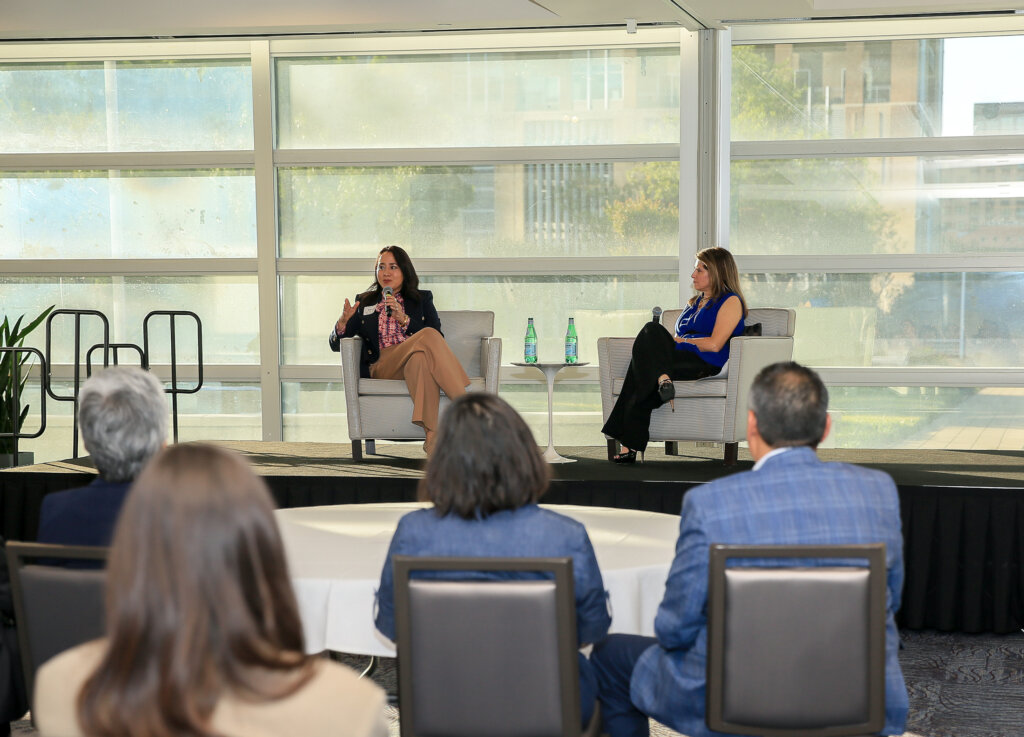
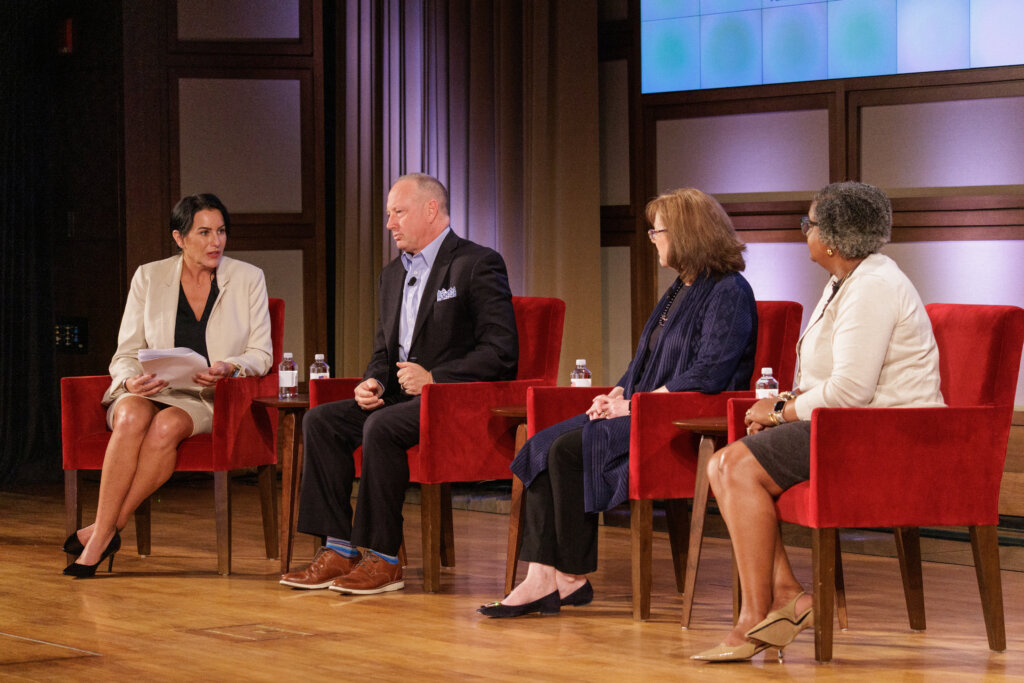
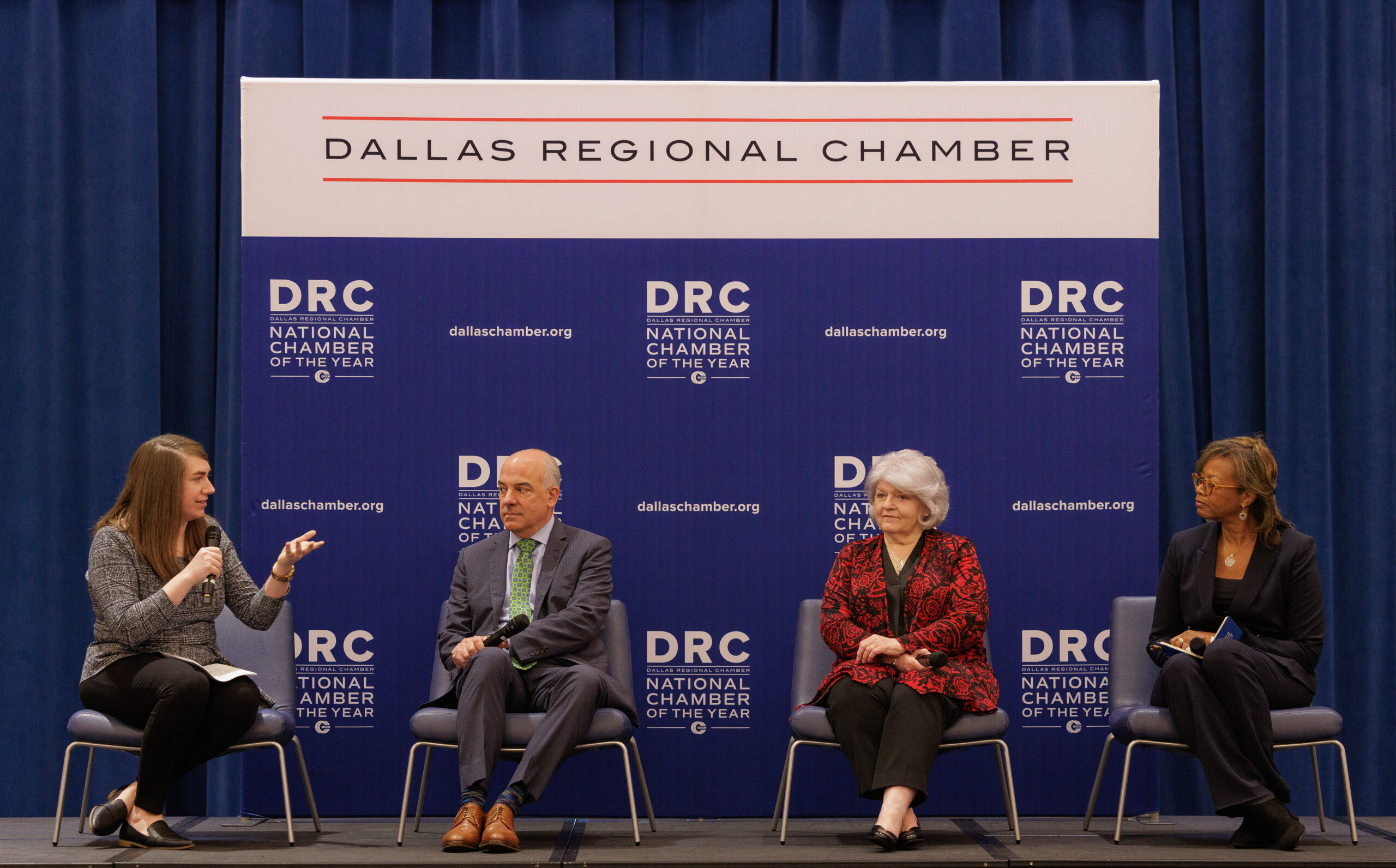
Jonathan Blum, Lyda Hill, and Nicole Small in conversation.

As the Dallas Region’s premier leadership program, LD selects 55 individuals each year through a competitive process based on proven leadership potential within their organization and the community to participate in a 10-month program designed to unlock leadership potential and inspire class members to elevate engagement within their organizations and communities.

The program has had more than 2,300 participants in its history, and 18% of the DRC’s board members are made up of LD alumni.

“From tackling education and workforce disparities to fostering economic growth, the collective efforts of Leadership Dallas Alumni have left a lasting mark on the region,” said DRC COO & CFO Angela Farley. “The impact of Leadership Dallas extends far beyond individual accomplishments. It’s about coming together as a community to address challenges and create opportunities for all. Through collaborative projects and community engagement, Leadership Dallas has helped build a more inclusive and prosperous region.”

Jonathan Blum, LD ’16, Partner at Holland & Knight LLP, and Chair of Leadership Dallas Alumni, led the keynote conversation between Lyda Hill, LD ’82 and Dallas Entrepreneur and philanthropist, and Nicole Small, LD ’04 and President & CEO of LH Capital/Lyda Hill Philanthropies to discuss leadership, innovation, and community impact.

“Telling the story about North Texas is really important,” said Small. “Being able to get engaged with the [Dallas Regional] Chamber and the Leadership Dallas class opened my world to people I’d never met, to organizations I’d never heard of, and to projects that I needed to learn about.”

Telling the North Texas story, specifically as it relates to life sciences, has led to some major wins for the region.

“We’ve been working closely with the chamber this past year to really try to tell the life sciences story. We have incredible life sciences here,” said Small. “It allowed us to attract an organization like [the Advanced Research Projects Agency for Health or] ARPA-H, which is the federal agency that’s giving away billions of dollars to advance science more quickly. [It] has definitely been a really exciting thing because I think had we not had [Pegasus Park, the ARPA-H headquarters site] and had not had this project, Dallas would have never been on the map to win.”

The discussion wrapped up by touching on how LD alumni can continue contributing to the Dallas Region after their time in LD.

“Find something that looks interesting, that looks different, that you didn’t know anything about, that you want to learn because you are the one that’s going to benefit,” said Hill. “You’ve got skills, so find out what’s needed and see if you can check in and learn to do it, because I promise you, you will have a great time and you will feel so much better when you see the difference that you can make.”

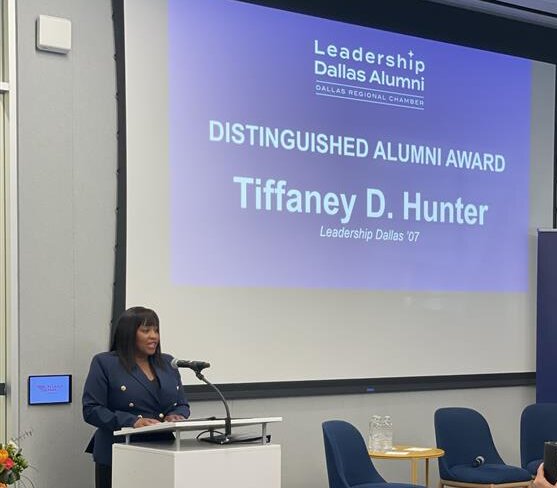
Tiffaney D. Hunter accepting her Distinguished Alumni Award.

During the event, Tiffaney D. Hunter, LD ’07 and communications professional, was announced as the 2024 Distinguished Alumni Award winner. This award acknowledges her contributions and commitment to the community, her demonstrated exceptional leadership qualities, and her positive impact on the Dallas community.

“My Leadership Dallas experience was one of growth and transformation,” said Hunter. “Our role as graduates is to always lift as we climb and to bring others along this amazing Leadership Dallas journey.”

To learn more about Leadership Dallas, visit our website. Alumni looking to get involved in the LDA Council should email Olympia Newman at onewman@dallaschamber.org.

Thank you to the LD ’24 Presenting Program sponsor, Grant Thornton. Thank you to our silver sponsor, Amazon.

By Dylan Guest, Director, Communications

The third installment of the Dallas Regional Chamber’s (DRC) Community Connections series focused on fostering growth and connections among Latina entrepreneurs, the fastest-growing segment of entrepreneurs in the United States. During the event, attendees were also inspired by a remarkable success story from within the community.

“It’s important to recognize the invaluable contributions of Latinas,” said DRC Senior Vice President of Diversity, Inclusion, and Community Engagement Latosha Herron Bruff. “They are makers of culture in the U.S., and their impact on entrepreneurship and contributions to our economy cannot be overstated.”

The event was Thursday, April 11, presented by Turner Construction Company, and hosted by the Federal Reserve Bank of Dallas (Dallas Fed).

Representatives from the Dallas Fed welcomed the event’s attendees and provided insights into the bank’s inclusion efforts and actionable resources on how to do business with them.

Fireside chat between Nancy Galvan and Maricarmen Tamez.

“The Fed’s mandate is to promote a healthy economy characterized by price stability and maximum employment – for everyone, no matter their background or identity,” said Silvia Siqueira, Assistant Vice President of Diversity, Equity & Inclusion, People and Culture at the Dallas Fed. “The work we do as a bank to achieve our mandate is supported by a talented, diverse, and inclusive workforce. Diverse perspectives create better outcomes, and by bringing as many voices as possible around the table, we facilitate more inclusive conversations, information sharing, and policymaking.”

Charles Price, Senior Supplier Diversity Program Manager of the Financial Management Group – Procurement at the Dallas Fed, then elaborated on the bank’s commitment to supplier diversity and its “Doing business with the Dallas Fed” program.

“We know the value and wealth that having a diverse supplier base brings, not only to our district but to our community,” said Price. “We cannot say that we are a community leader if we don’t do business with people in our community. Having diversity in our spending is essential.”

The discussion then transitioned into a fireside chat with Nancy Galvan, Owner of Unica Enterprises LLC, moderated by Maricarmen Tamez, Community and Citizenship Director at Turner Construction Company.

Galvan began the chat by explaining her inspiration for becoming an entrepreneur.

Galvan started Unica in 2007 as a part-time janitorial service while working full-time as a Contracts Administrator at Bell Helicopter. She chose to enter the janitorial industry after her extensive research showed a significant demand for cleaning services in the Dallas Region, the ability to work at night after her day job, and the lower startup costs.

Her day job also sparked an idea, but one that took several years to achieve.

“I was so grateful for my day job, but it also taught me one strategic move – that I would sell to the Federal Government,” said Galvan.

Silvia Siqueira, Maricarmen Tamez, Nancy Galvan, and Latosha Herron Bruff.

Now, Unica boasts a diverse portfolio of clients, including the U.S. Federal Government, the Department of Defense, the City of Irving, and more. In addition, Unica grew from just one employee to close to 110 today.

In a room full of other entrepreneurs and business-owners, Galvan left some parting tips.

“Be very thoughtful and strategic and try to have money in the reserves,” said Galvan. “Once you’re ready and have everything planned out, just take the plunge. If you’ve thought it through and know what you’re capable of doing, then always bet on yourself. No one will work harder for you than yourself.”

Community Connections, a recurring DRC event series, empowers Latinas by elevating their impact in the business world while embracing their cultural diversity.

To learn more about the DRC’s Diversity, Inclusion, and Community Engagement Team’s work, visit our website.


By Catie George, Manager, Communications & Storytelling

The Dallas Regional Chamber (DRC) hosted its first Talent Talk of the year, presented by BGSF and Holmes Murphy, on Wednesday, March 20. The event was focused on the Dallas Business Journal’s Best Places to Work designation and featured companies that had received the honor. If you missed it, take a look at the key takeaways below.

  1. Finding talent is a challenge for everybody.

With over 770,000 current job openings in Texas, filling those roles is a major challenge.

“It’s a problem that stems from growth and innovation, while some cities in the regions of this country are dealing with problems from stagnation of the population,” said Dallas Business Journal’s Editor-in-Chief Will Anderson. “But it’s still a challenge, and one that rightfully demands a lot of time investment.”

  1. Know your culture.

“[Culture is] critical. It’s why you join a company, but it’s also why you stay at a company,” said Taylor Bretl, Manager of Talent Acquisition at Slalom.

Culture as a means of recruitment is also a great way to stand out in a competitive market.

“Our best representatives of our culture are our people,” said Cynthia Ball, Director of People Operations at The Crowther Group. “We have to be competitive, especially in construction. We’re all looking for the same type of person. We have to be very direct and full of intent in sharing and living what our culture is.”

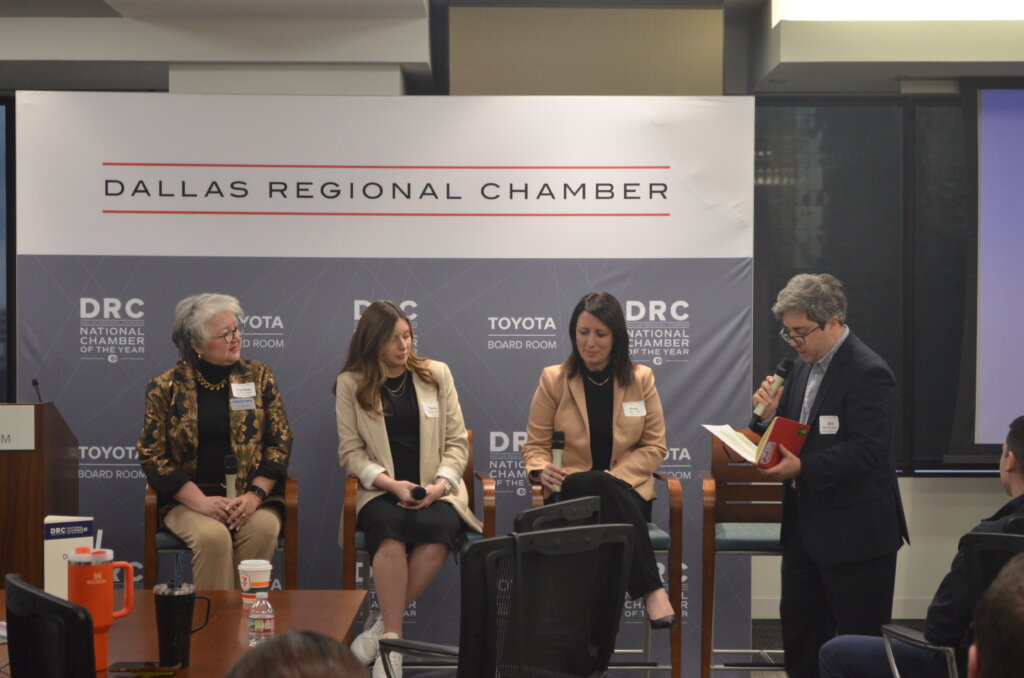
Cynthia Ball, Taylor Bretl, and Amy Tice in conversation with Will Anderson.
  1. Embrace change and challenges.

From a pandemic to an artificial intelligence boom, all industries have experienced major challenges over the past five years. It’s important to remember that adjustments are continually necessary.

“Personally, professionally, from a corporation standpoint, everything’s a work in progress,” said Amy Tice, Chief People Officer at Ryan, LLC. “Just because you put a lot of blood, sweat, and tears into a program, and it was exactly what you needed then, that does not mean it wasn’t successful when you need to evolve it 18 months later, or you need to evolve how you have practices or what you’re doing.”

  1. Communicate clearly and be honest.

While working to fill roles, it is important that companies are clear on their expectations and properly convey that to applicants.

“I think transparency shows that if you’re setting them up for success, you want the best for them,” said Bretl. “The transparency piece is so vital. But I think, too, that a lot of it comes with building a supportive workplace and looking at what that looks like when it comes to attracting talent.”

Elizabeth Caudill McClain, Senior Vice President of Talent Strategies at the DRC.
  1. The DRC can help with your talent needs.

“We have expanded our focus on talent. For the past 15 years, we’ve focused on education and workforce and talent attraction, really working alongside our educational institutions to make sure that you have the talent you need coming from our education systems,” said Elizabeth Caudill McClain, Senior Vice President of Talent Strategies at the DRC. “But what we heard from you all in the strategic planning process was, yes, and we need more. We need more support in the entire talent life cycle, not just from education systems but also for attracting, retaining, and developing talent.”

To get help from the DRC for your talent and workforce needs, visit our resources page.

Thank you to our presenting sponsors, BGSF and Holmes Murphy. Thank you to our corporate sponsor, KEIRUS by KJE. Thank you to our featured employers, OCC and Medical City Healthcare.

To learn more about what the DRC is doing to retain and attract talent to the Dallas Region, visit our website.

By Catie George, Manager, Communications and Storytelling. 

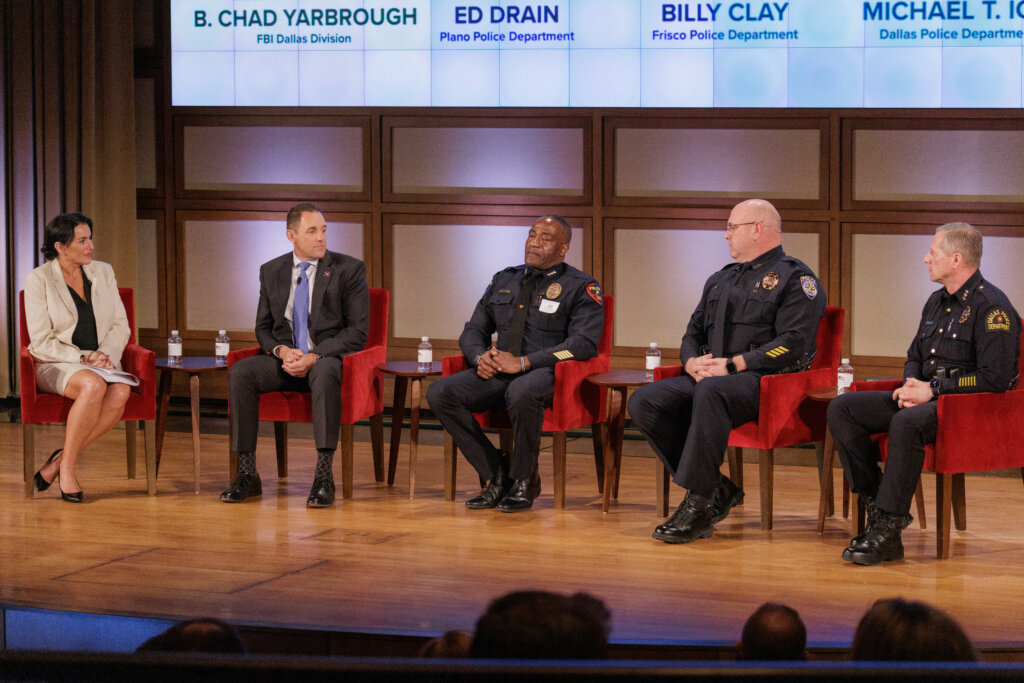
The Dallas Regional Chamber (DRC) hosted its third annual State of Public Safety, presented by Texas Instruments and Ashford, on Tuesday, March 26, at the George W. Bush Presidential Center.


Chief Greg Stevens gives his keynote.

“I believe that the state of public safety in Texas is still very strong. However, I don’t think we want to just rest on that,” said Chief Greg Stevens, the new Executive Director of the Texas Commission on Law Enforcement. “[Senate Bill 1445, or the Sunset Bill] empowered TCOLE with raised expectations and increased regulatory authority. But most significantly, from my perspective, it provided a very clear mission for TCOLE and a clear direction. I thought that’s something I want to be involved in because I see some great opportunity and a great path forward for not just Texas law enforcement but for Texas public safety for Texans, the people that live and work here, the many people that are moving here, and the people that visit our great state.”

Transparency is key as Dallas faces recent population growth, which has the Dallas-Fort Worth (DFW) Region on track to becoming the third-largest city in America by 2030.

“Not only are we still growing as a population of residents and houses, but our visitor population is growing. So, trying to maneuver officers into the areas that are needed and making sure that not only our citizens but also our visitors are taken care of is a challenge that comes with that,” said Assistant Chief of the Frisco Police Department Billy Clay. “When it comes down to it, we’re all in this together as a region.”

Representatives from the Dallas, Frisco, and Plano Police Departments and the Dallas FBI speak about public safety.

Authorities in the region are working together to address the challenges they face collaboratively, making the DFW area truly unique in its approach to public safety and policing.

“We exchange information about what’s going on in our cities and what we’re seeing in crime, and it just makes us all better,” said Plano Police Chief Ed Drain. “We can all learn from each other. We rely on Dallas for a lot of resources and help, so we’re really fortunate in that regard to be working in this area. You don’t have a lot of competition.”

The lack of competition makes Dallas stand out on a national scale, as well.

“I’ve been all over the country and stationed in multiple locations,” said FBI Dallas Division’s Special Agent in Charge B. Chad Yarbrough. “I will tell you that the law enforcement in North Texas, at the federal, state, and local levels, is by far the best I’ve ever seen. The leadership here is something every citizen should be proud of.”

The discussion then transitioned to focus on the 77,000 individuals released from incarceration each year and their relationship to the workforce. Re-entry policies and support are currently lacking, to the disappointment of experts and those affected.

“Once they come out, they need to have the tools [to succeed], and they’re not given much when they come out,” said Texas Rep. Rhetta Bowers (D-Dallas).

One tool needed is simply the opportunity to succeed.

“I think the more [employers] understand the benefits of hiring someone with a background, what protections can be put in place, and maybe looking at additional legislative policies that we can put in place or protections for employers, that’s the road we need to go down,” said Christina Crain, Founder, President, and CEO of Unlocking Doors, a nonprofit that works to reduce crime through collaboration.

The second panel discussing re-entry policies.

Employers like JPMorgan Chase & Co. are working to make substantial changes to their hiring practices for people with criminal backgrounds.

“Over the last four years, over 10% of our hires have been justice-impact hires… These are career pathways with jobs and benefits, with opportunities to advance and get promoted. We’ve found that they’re great employees, they’re grateful, and they can have a lot of opportunities in different positions,” said Vice President of Government Relations at JPMorgan David Emerick. “I’ve always said that if JPMorgan Chase could hire somebody with a criminal background, just about anybody can.”

Thank you to our presenting sponsors, Texas Instruments and Ashford. Thank you to our media partner KRLD. Thank you to our silver sponsors, Oncor and Thompson Reuters.

To learn more about the work the DRC is doing in Public Safety, visit our website.

By Catie George, Manager, Communications & Storytelling

In the upcoming City of Dallas bond election, voters can approve a $1.25 billion investment across 10 areas of need to improve Dallas now and into the future. The Dallas Regional Chamber joins Dallas Mayor Eric Johnson and trusted community partners in calling on voters to vote “yes” on all 10 propositions, A-J, of the bond package.

Together, Propositions A-J will help maintain and improve the city’s infrastructure to support a high-quality life for all people—with no new costs for taxpayers. City of Dallas officials have pledged to use tax dollars it already collects annually, without raising the tax rate for residents.

Each of the 10 propositions on the ballot marks a unique, multi-million-dollar investment in an area of need, with more than three-quarters of the proposed funds allocated to roads, parks, and public safety. Read a description of each of the 10 propositions here, and view a detailed map and listing of proposed projects here.

Notably, Proposition F provides $50 million in funding for the new Regional Law Enforcement Training Center, for which the DRC has been a strong advocate.

2024 Dallas Bond Propositions - A-E Summary 2024 Dallas Bond Propositions - F-J Summary

Ensuring Dallas citizens enjoy a high quality of life is critical to the prosperity of our region and the companies that do business here. This bond package invests in the areas that make Dallas a great place to play—such as parks, libraries, arts, and cultural facilities—and a great place to live—such as street improvements, flood protection, public safety, and affordable housing. The ability to lead a high-quality life in the city helps ensure our talent pool remains strong.

If you live in the City of Dallas, you might see other items on your ballot, such as school board elections. To preview your ballot and make your plan to vote for this and all upcoming elections, visit the DRC’s Ballot Builder. This tool helps you research your ballot, check your voter registration status, and find your most convenient polling location.

Early voting is Monday, April 22-Tuesday, April 30. Election Day is Saturday, May 4. Additional information, including polling locations, can be found here.

By Olympia Newman, Managing Director, Leadership Programs

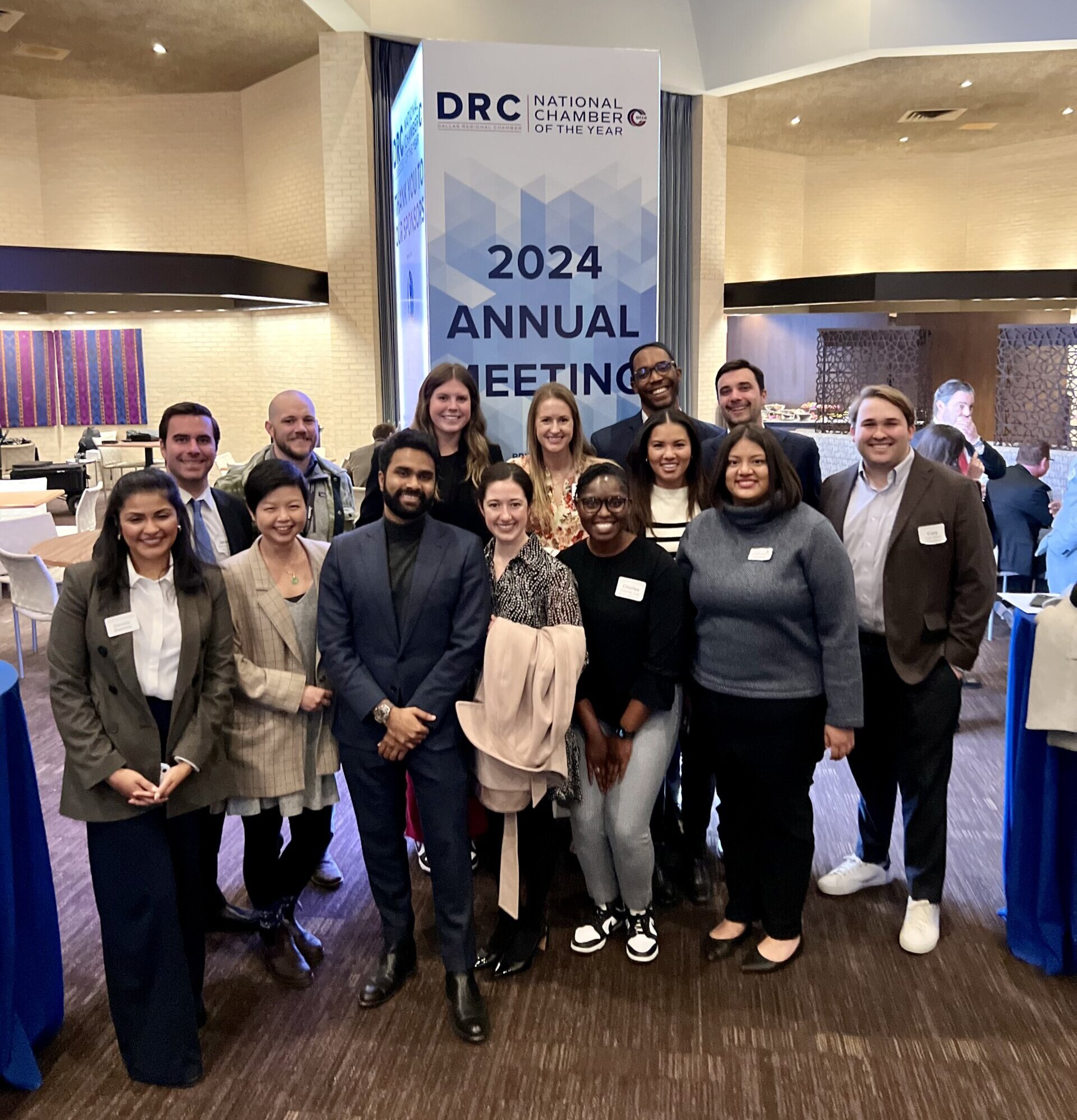
LEAD YP alumni at the DRC’s 2024 Annual Meeting.

In the vibrant leadership development landscape, mission-aligned programs have an undeniable impact. These intentionally structured initiatives incorporate an organization’s mission to create ambassadors who champion its cause with a deep understanding of its vision. The Dallas Regional Chamber (DRC) exemplifies this concept, pioneering mission alignment through its leadership programs to forge a legacy of champions. We shared our cutting-edge approach with our peers at the 2023 Association of Chamber of Commerce Executives Convention.

However, the DRC’s mission-aligned Leadership Programs go beyond rhetoric; they actively nurture leaders who embody our values and advocate for our cause through intentionally designed leadership programs, including LEAD YP and Leadership Dallas. Our companies get the leaders they need, and so does our region.

LEAD YP: Developing leaders who develop the region

LEAD YP, a dynamic six-month program, targets young professionals to equip them with the tools and insights needed for leadership in the Dallas business community. Participants develop essential leadership skills and gain a deep understanding of regional challenges and opportunities through sessions carefully tailored around DRC focus areas, empowering them as catalysts for positive change.

Leadership Dallas: An incubator for change-makers

Leadership Dallas, the region’s premier leadership program, immerses participants in practical experiences, enabling them to confront real-world issues within the region. By collaborating with the DRC peers and regional leaders, participants gain invaluable insights into the DRC’s mission and their role in advancing it.

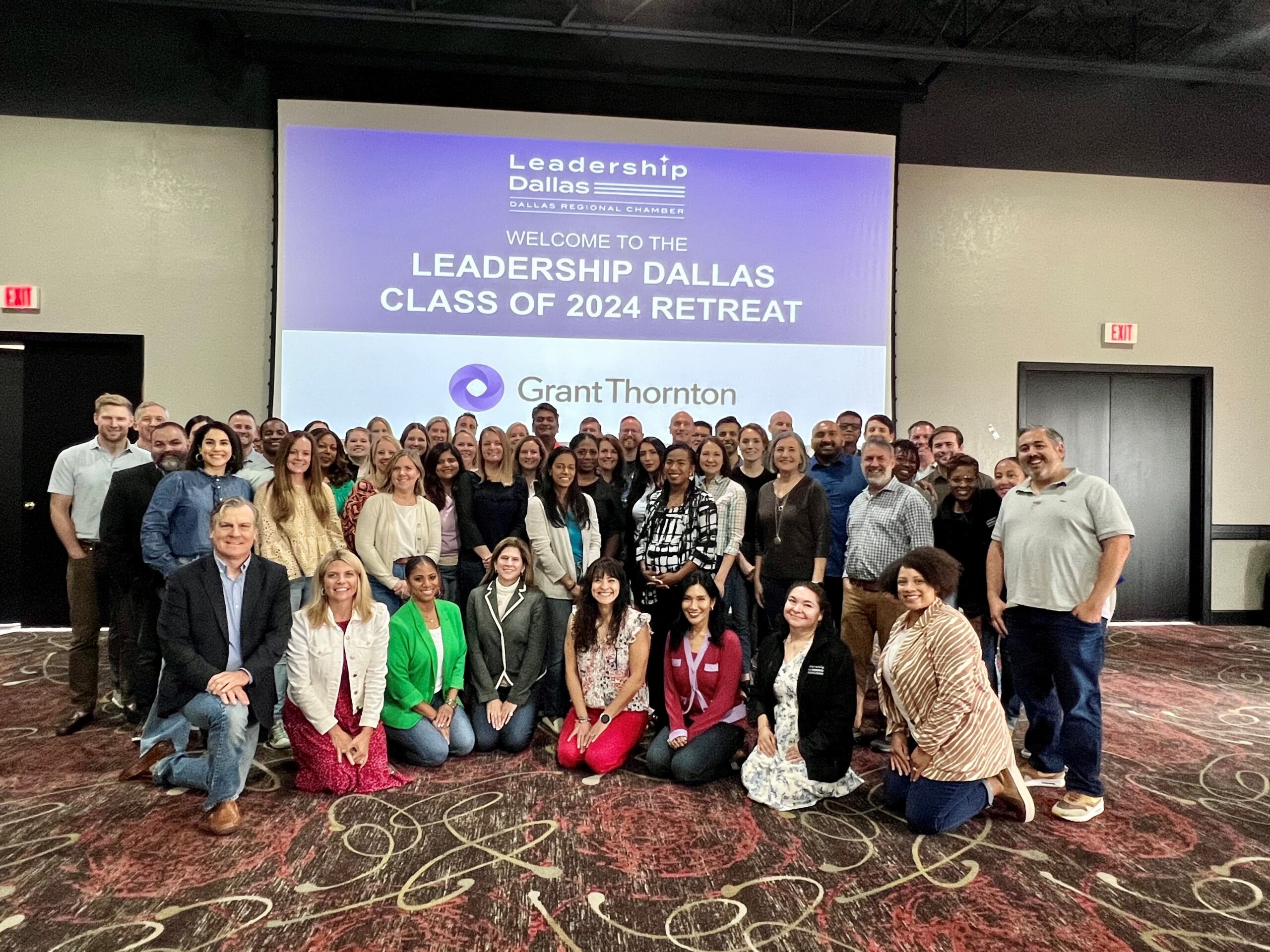
LD ’24 at their class retreat.

The program serves as a strategic investment for employers and organizations, offering benefits such as talent development, enhanced leadership skills, and expanded networks. By participating in the program, employees gain valuable insights, industry knowledge, and leadership capabilities that directly contribute to their professional growth and success.

Building long-term advocates

What sets these programs apart is their strategic approach to long-term engagement. Graduates seamlessly transition from LEAD YP to Leadership Dallas, continuing to engage with the organization through various channels. As a result, the DRC boasts an actively involved network of alumni who shape the future of the DRC and the Dallas Region at large.

The impact of committed leaders

The impact speaks volumes. Following the 2023 LEAD YP program, 100% of participants reported a comprehensive understanding of the DRC’s mission, with 94% expressing intent to increase their engagement. Similarly, after completing Leadership Dallas, 98% of participants reported a deep understanding of the DRC’s mission, with 98% expressing intent to enhance their engagement. On our DRC boards, councils, and taskforces, over 200 member companies proudly count leadership program alumni among their ranks, and 18% of the DRC Board of Directors counted as Leadership Program alumni.

LD Alumni at the LD Welcome Reception.

Through these mission-aligned initiatives, the DRC cultivates leaders and fosters a culture of advocacy and collaboration, building a legacy of champions deeply vested in the success and prosperity of the Dallas Region.

Moreover, active involvement in leadership programs acts as a powerful retention tool, fostering employee loyalty and engagement by providing unique opportunities for personal and professional advancement. With access to a diverse network of leaders and decision-makers, participants can leverage their experiences to drive innovation, collaboration, and organizational success.

Mission-aligned leadership programs transcend individual development; they represent a collective force for positive change, transforming ambassadors who lead with purpose and passion.

Learn more about the DRC’s Leadership Programs here. Ready to embrace intentional program design and cultivate organizational champions? Reach out to onewman@dallaschamber.org to access the Mission-Aligned Programs Framework.

Takeaways from the 2024 International Leadership Summit

By Latosha Herron Bruff, Senior Vice President, Diversity, Inclusion & Community Engagement

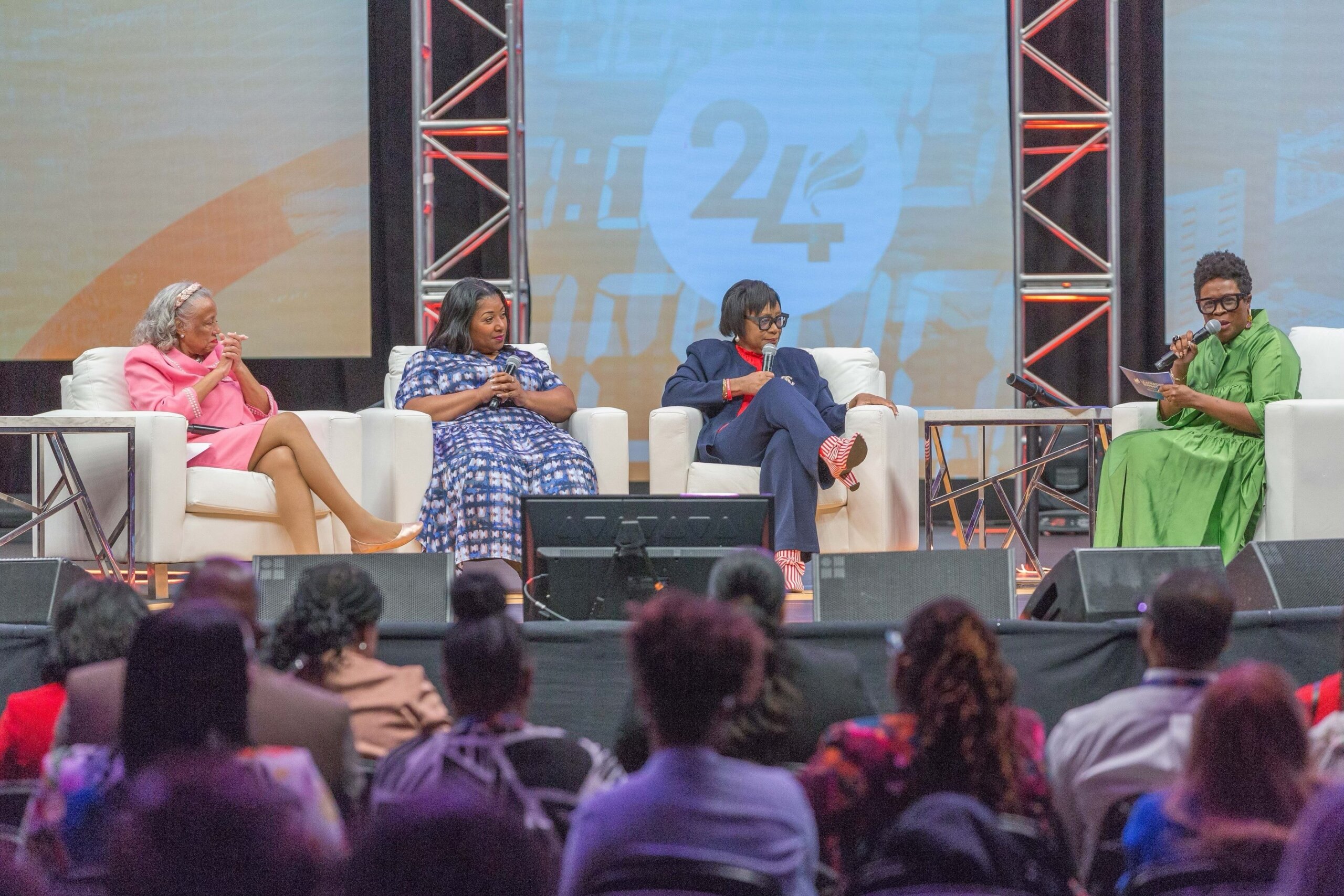
I had the pleasure of moderating a panel for the 2024 International Leadership Summit in March. The panel, “The Right Time for Belonging: Embracing a Fresh Perspective on DEIA,” focused on the role of diversity, equity, inclusion, and accessibility (DEIA) in the workplace. Read my takeaways from the panel below.

Herron Bruff moderating the panel.

1. Fostering a more inclusive environment is critical for businesses and corporations.

The panel featured three inclusive and successful leaders. Each emphasized the importance of leaders creating an inclusive environment through DEIA to form a true sense of belonging. Margo J. Posey, President and CEO of the DFW Minority Supplier Development Council, said that everyone’s voices need to be heard to create that belonging.

“The tone starts at the top, and if I’m the CEO of an organization, which I am, I have to make it clear that this matters,” said Cynt Marshall, CEO of the Dallas Mavericks and 2024 DRC Board Chair. “If you get the culture right, if you get diversity right, if you lead with inclusion, if you have a diverse workforce—all of that, your results will follow.”

Creating this environment requires oversight.

“We know in corporate America, if you can’t measure it, it’s not moving,” said Windy Oliver, Executive Vice President at Wells Fargo. “So, make sure there are accountability metrics around.”

2. To create a sense of belonging, include mentorship.

“People do business with people they know, like, trust, and have a relationship with,” said Posey, which is why it is important to emphasize connection through mentorship. Those connections turn into economic opportunities.

For minorities trying to break into the business world, mentorship is also helpful for development.

“There are different levels of mentoring. What a first-level entrepreneur needs is not what [everyone] needs,” said Posey. “All mentoring is good, but some are better than others. And you have to know what it is that you need.”

3. Go beyond what is just required with supplier diversity.

Supplier diversity, or using minority- or women-owned businesses as suppliers, is not just the right thing to do, but also economically advantageous, said Posey.

“By continuing to utilize minority businesses, it would add over $9 trillion to the gross national product within the next 8 years. It would add another eight million jobs for all people,” Posey said.

Supplier diversity will lift every business that participates.

“We need to make sure that our large businesses are truly doing business with our diverse businesses,” said Marshall. “If you want your business to thrive, and if you want to be successful, and if you want to be a part of the solution, and if you want to make things better, then you’ll do it.”

4. Now is not the time to slow down on DEIA work.

Diversity, equity, and inclusion (DEI) are under scrutiny. But leaders in DEI will tell you that this is the time to step on the gas, not slow down.

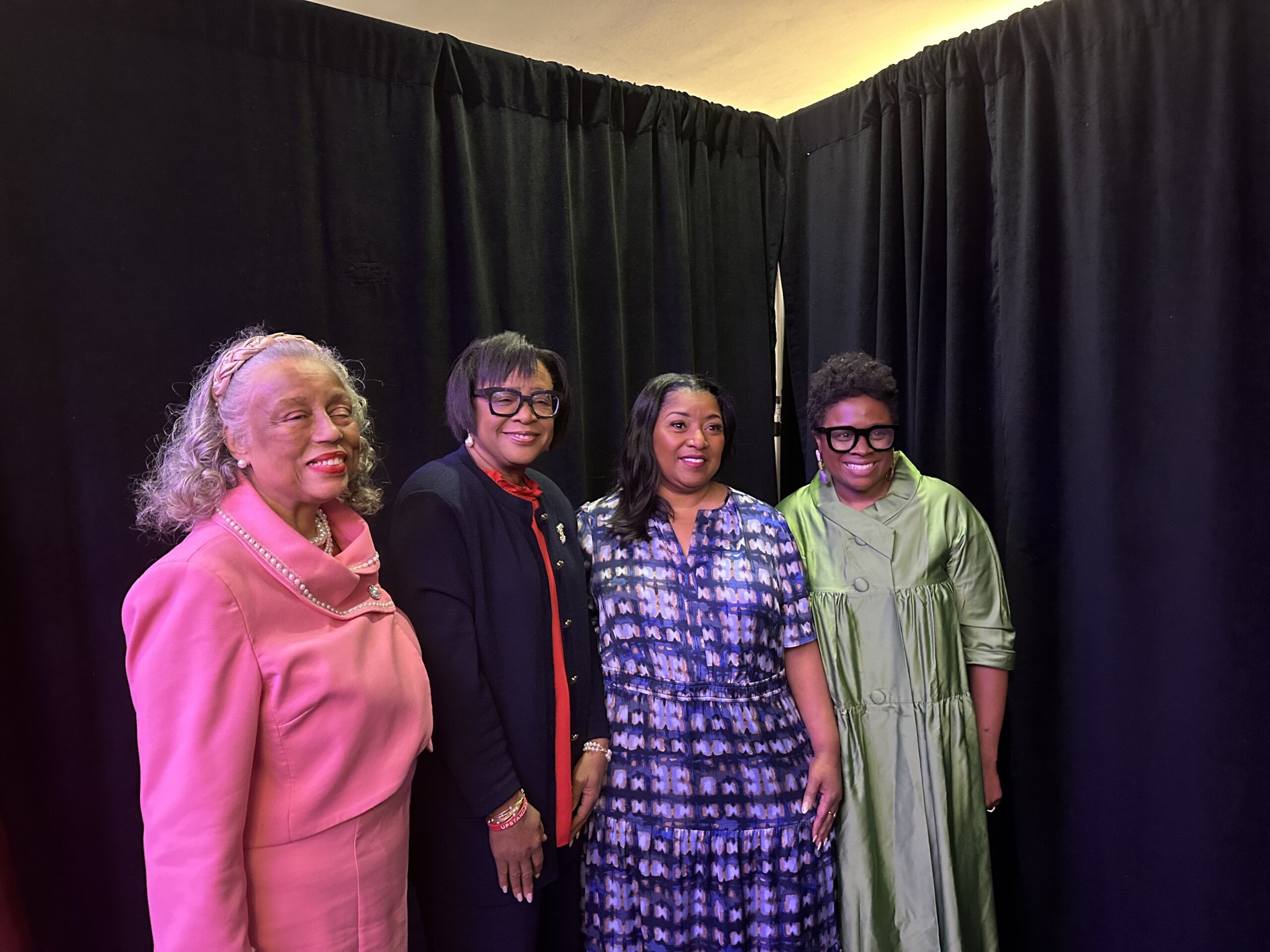
Margo J. Posey, Cynt Marshall, Windy Oliver, and Latosha Herron Bruff

“Minorities now have additional threats to their opportunities to do business in the federal government’s space,” said Posey.There are major attacks on supply chain inclusion, and supply chain inclusion is all about economics, so it’s critically important that leaders from the private sector speak up and have their voices heard.”

Slowing down DEI work will significantly impact our economy.

5. Start with Dallas.

In Marshall’s first address as DRC Chair, in front of around 1,300 business leaders, she let it be known that the DRC is pushing on the gas when it comes to diversity, inclusion, and belonging. She set the DRC’s mantra for the year: to seize the moment.

“Seize the moment to really get rid of the tale of two cities in Dallas, where you can go to one zip code and the life expectancy is 58 years, and just 10 or 15 minutes away, the life expectancy is 85 years old. And that’s because of systemic issues that we must identify and address,” said Marshall. “As a region, as business leaders, we’re going to seize the moment to close the gap and to get rid of these disparities and make Dallas the place that everybody is talking about.”

Dallas is taking it upon itself to address those challenges head-on.

6. There is a lot of hope for the future of DEIA.

Despite the challenges we face, the panelists were optimistic that the future of DEIA is bright.

“One of my favorite Martin Luther King, Jr. quotes is, ‘the time is always right to do what is right.’ We do it because it’s right,” said Oliver. “Sometimes corporations have to lead the way… we’re doubling down.”

We have an opportunity to do great things and the right leaders who will help us get there.

“The future for us is about our children. It’s about making sure that we close the gaps in these communities. It’s about making sure everyone has access,” said Marshall. “Our workplace promise at the Mavs, and we carry it out to the community as well, is every voice matters and everybody belongs.”

To learn more about the diversity and inclusion work the Dallas Regional Chamber is doing, visit our website.

Improving is a complete IT services company dedicated to positively changing the perception of the IT professional. They offer cutting-edge solutions through IT consulting, software development, and agile training to help their clients prosper and achieve their most challenging technology goals.

How does Improving help its clients build value?

We help enterprises and organizations solve their most complex technology challenges through modern software development, technology consulting, agile training, and team augmentation services. Our innovative solutions have helped thousands of our clients realize their tactical and strategic business objectives, allowing them to achieve great new heights in a competitive and ever-changing market. We aid our clients in understanding the impact of their latest initiatives, deploying new applications, and assimilating these things into their teams with ease. We are dedicated to educating and supporting businesses every step of the way, setting them up for a bright and successful future.

What differentiates Improving within your industry?

Improving is redefining the landscape of modern technology. Our expertise converges to meet our clients’ technological challenges with a unique focus on stakeholder value and usability. Our unique approach integrates advanced areas like platform engineering, artificial intelligence/machine learning, and modern data strategies with core business functions such as agility, automation, and collaboration. This synergy ensures functional software and a complete transformation of a business’ processes and output.

Trust is also at the forefront of everything we do at Improving. Not only do we want our employees to have access to open communication, personal growth, and shared rewards, but we want this with our clients, too. Incorporating trust into all aspects of our company has resulted in extensive, sustainable growth, which is why our success is a consequence of our involvement.

What benefits does Improving enjoy by doing business in the Dallas Region?

Dallas remains one of the top thriving business communities in the United States, and Improving has been fortunate to work with countless companies of all sizes and industries on their business solutions. Dallas’ growth over the years has brought new organizations into the city’s ecosystem and strengthened our ability to connect with emerging industries that have established roots here.

Why did Improving become a DRC member?

Improving has called Dallas home since our inception in 2007. While we have offices throughout North America, Dallas will forever be a special place to us! It’s the location of our headquarters and where we have worked for millions of hours on projects while supporting multiple local industries, including financial services, automotive, and construction.

As one of the most respected business organizations in the U.S., our partnership with the DRC strengthens our relationship with the local community. As a passionate supporter of the Conscious Capitalism business philosophy, we believe our stakeholders go beyond our clients and into the community. Membership with the DRC is a wonderful way to build trust and relationships with people in our area.

How has Improving changed in the past five years?

Our sustained growth since our inception has landed us on the Inc. 5000 list for 14 years, and with this growth, we have needed to change our programs and how we scale our company’s culture. It remains one of our top commitments to our employees to create a great place to work, which includes education and mentorship. With this in mind, we have developed PATH, an innovative and highly custom career planning program unique to each employee’s goals. This has allowed our Improvers to reach new heights, both professionally and personally.

By Catie George, Manager, Communications & Storytelling

At the beginning of this year, the Dallas Regional Chamber (DRC) formed the Tech Policy Task Force in response to the vital role Dallas-Fort Worth (DFW) high-tech companies play in the economy and the need for their voice to be heard in Austin and Washington, D.C.

“We also know that technology policy is exploding because of new industries like artificial intelligence, the need for more data centers, and increased energy capacity, which we will be proactive about and influence throughout the next several years,” said Matt Garcia, Senior Vice President of Public Policy at the DRC, in a recent blog.

The Tech Policy Task Force addresses the rising challenges and concerns in this space after the DRC and its members noted legislators’ increasing interest in artificial intelligence (AI), mobility, data privacy, and cybersecurity during the last legislative session.

“The DRC has always had the ability to convene thought leaders and experts in the technology space. Their advocacy is nonbiased, member-driven, and always mindful of how technology can make an impact locally and beyond,” said Michelle Miller, Market President at Verizon and Chair of the Tech Policy Task Force. “Dallas continues to be a hub of innovation with technology at the core. This enables the DRC to have experts across multiple industries offer input on how to leverage technological advancements for the greater good of the region and across the world.”

The task force’s first meeting was in February, during which members received insight into existing regulations and discussed local, state, and federal policy issues.

During the meeting, Representative Giovanni Capriglione, Chairman of the Innovation & Technology Caucus in the Texas Legislature, noted that he requested information for upcoming AI legislation to be considered in the 89th Session of the Texas Legislature.

Following this charge, the DRC convened the Tech Policy Task Force members to draft comments in response to the request. The comments highlighted the efficiencies AI can yield and provided guidelines for a risk-based approach to legislation.

The comments also emphasized the importance of implementing state and local initiatives aimed at fostering partnerships in research and innovation to encourage further investment and innovation in the DFW area and throughout Texas. Such initiatives are integral to positioning the region and state as a premier center for AI innovation.

The task force will serve to educate about and advise the DRC’s policy positions that have a tech focus.

“Lack of understanding, especially around technology, can cause fear and stifle innovation. Removing ambiguity through education and advocacy allows for fruitful discussion, leading to further innovation and more rapid technological advancement,” said Miller. “Often, technological change can seem intimidating; thus, it is incumbent on the experts and thought leaders to articulate the benefits in a way that those less familiar can feel comfortable with.”

Task force members include experts and industry leaders from Verizon, Amazon, and other DRC member companies.

The next Tech Policy Task Force meeting will be on Wednesday, May 22. To inquire about joining this or other DRC task forces, email Cary Bailey, Director of Member Engagement, at cbailey@dallaschamber.org.

To learn more about the DRC’s work in Public Policy, visit our website.

By Dylan Guest, Director, Communications

Say Yes to Dallas, created by the Dallas Regional Chamber (DRC), promotes the Dallas Region as an attractive destination for talent, businesses, and investment by showcasing the region’s vibrant culture, diverse business community, economic strength, and amenities that make it an ideal living destination.

Young professionals continue to “say yes” to Dallas.

The talent attraction and retention campaign can help companies in the Dallas Region “say yes” to prosperity. Keep reading to learn three reasons how Say Yes to Dallas can help you hire and retain top talent around the region.

1. Streamlining access to top talent

As a talent attraction initiative, Say Yes to Dallas places a high importance on showcasing job opportunities for local and outside talent. It provides a centralized location for job seekers to explore employment options in the Dallas Region, making it easier for local companies to connect with qualified candidates.

Trending industries in the region, such as health care, are also emphasized with their own pages, which include education and training programs, skill breakdowns, salary information, and available jobs. The ever-evolving Recruiting Toolkit provides a wealth of valuable information for recruiters as well.

Companies can also be highlighted as a “Featured Employer.” This gives the company a personalized page and targeted social media posts on Say Yes to Dallas to promote local job postings and feature stories/articles, videos, and any other assets of its choosing. To become a Featured Employer, please contact Rebecca L. Robinson at rloredo@dallaschamber.org.

2. Keeping top talent

Once you have good talent hired, the next step is retaining it.  Fortunately, Say Yes to Dallas supports companies for talent retention, too.

Through the platform’s Essentials Guide, employers and recruiters can provide talent with all the information they need about living in the Dallas Region. This includes interactive maps with information on the region’s 200+ cities and counties, transportation guides, education and schooling options, and an innovative cost calculator tool that allows users to calculate their cost of living compared to other regions across the country. Transitioning to a new region can be overwhelming, but Say Yes to Dallas simplifies the process by providing comprehensive resources to help others navigate the Dallas Region with confidence.

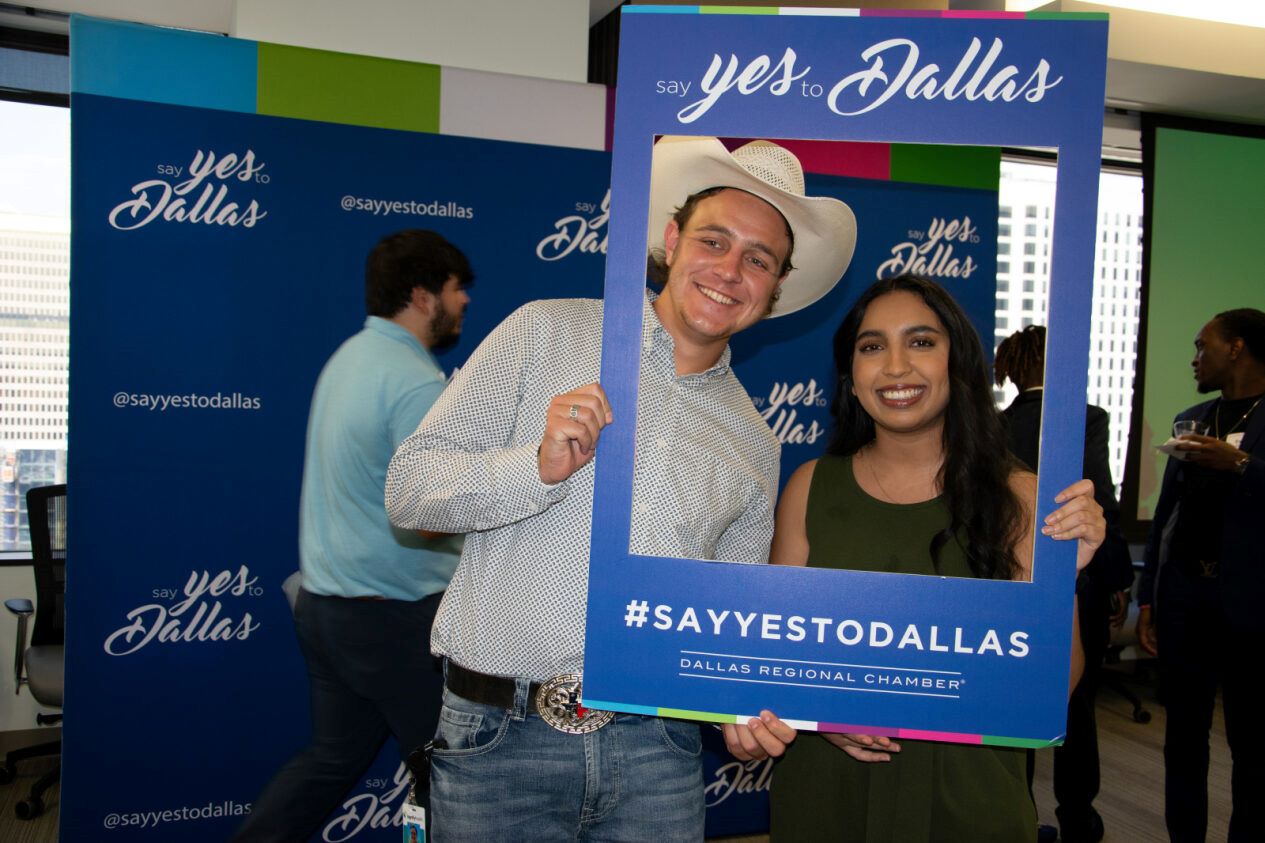
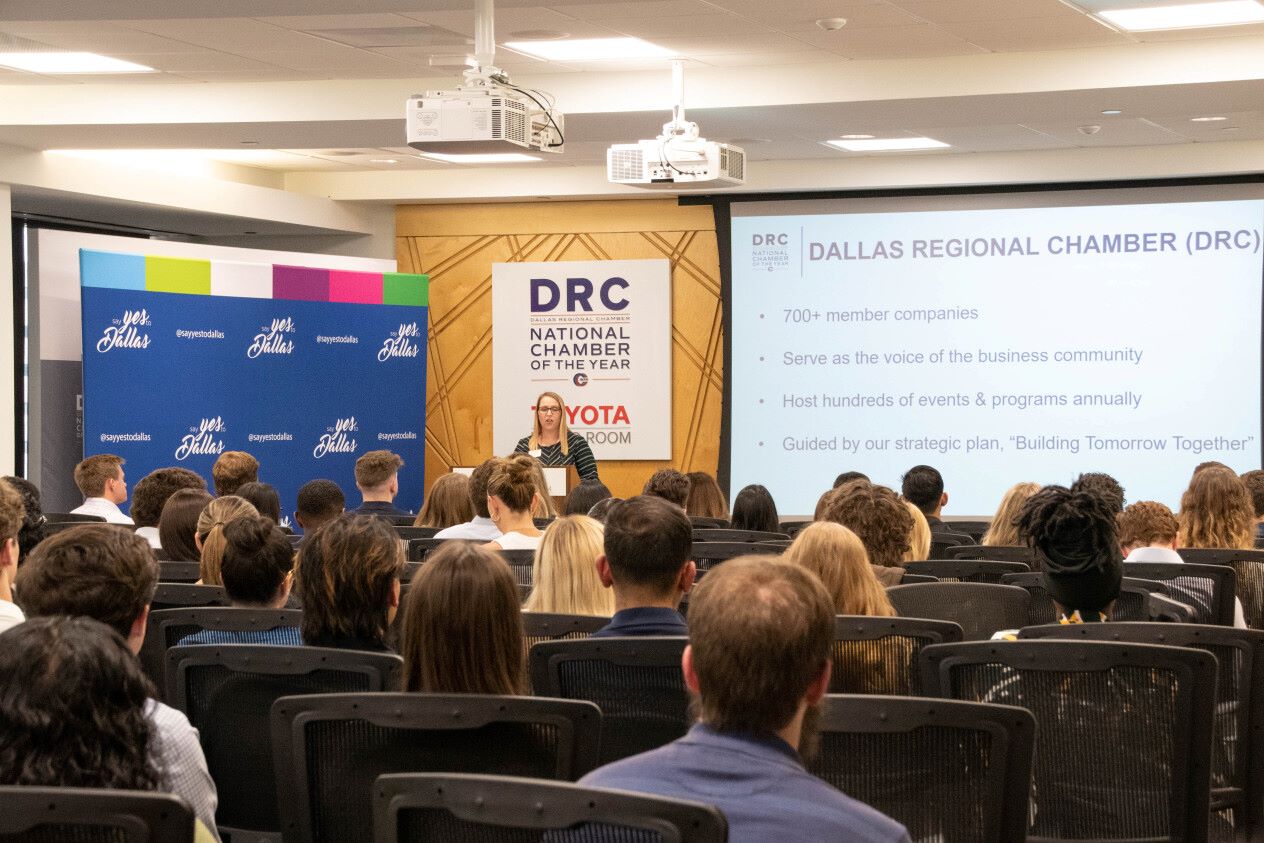
A Say Yes to Dallas event at the DRC.

The Harvard Business Review affirms that employees having time for their passions is crucial to employee retention, and the Dallas Region has boundless opportunities for employees to enjoy their life outside of the office. Say Yes to Dallas contains detailed, up-to-date information on the region’s parks and outdoor areas, cultural activities, food and drink locations, major events, and more, all in one place. Additionally, My Dallas Story, another valuable resource on the platform, features stories from locals on what makes the region the dynamic hotspot that it is.

3. Enjoy the benefits of economic, professional development

Professional development opportunities organized by Say Yes to Dallas also take place regularly, such as intern mixers and networking opportunities alongside the DRC’s Leadership Programs. The website’s trending industries pages also include a list of low-cost and tuition-free skill-development programs, facilitating the workforce’s potential for upskilling and reskilling.

Say Yes to Dallas is a boon to the region’s economic development by fostering a talent pipeline for existing local companies and incoming ones, a priority in the DRC’s 2024-2026 strategic plan. The importance of this commitment continues to grow as Texas and the Dallas-Fort Worth metro lead the way in corporate projects across the country. 

Say Yes to Dallas is a talent attraction initiative of the DRC committed to attracting and retaining talented workers from around the world. To learn more about the DRC’s priorities, visit our website.

The Dallas Regional Chamber (DRC) has announced the LEAD YP Class of 2024.

The 54 members of the LEAD YP Class of 2024 represent a diverse group of companies and industries. They were selected through a competitive application process based on their commitment to enhancing their leadership skills and their professional background, community involvement, and educational background.

Through a hands-on curriculum, LEAD YP deepens young professionals’ understanding of their leadership style and primes them to grow into leaders who champion the Dallas Region.

“Our leadership programs, including LEAD YP, develop the leaders of tomorrow our companies and region will need,” said Dale Petroskey, DRC President and CEO. “The ambitious members of the LEAD YP Class of 2024 are investing in their professional and personal growth while gaining the skills necessary to foster our region’s continued prosperity.”

The LEAD YP program provides monthly training on personal leadership styles, leading through change, personal branding, and the Predictive Index Behavior Assessment. Each month, a different class day gives participants insight into aspects of the DRC’s work and priorities and highlights ways they can contribute to these efforts.

A class retreat kicks off the program in April, followed by a class day every month until graduation in October. Upon graduation, participants will have the opportunity to serve on the Young Professionals Advisory Council at the DRC to further develop their skills and have an impact on other young professionals in the Dallas Region.

“LEAD YP is the secret recipe that turns ordinary leaders into extraordinary trailblazers,” said Annette Addo-Yobo, Manager of Leadership Programs at the DRC. “We’re excited to welcome this new class in their next step in professional and personal leadership development.”

The members of the LEAD YP Class of 2024 are:

First Name Last Name Company/Organization
Adam Aldeen OCC
Adeyemi Adewuyi Locke Lorde LLP
Amanda Koif AECOM
Audrey Thompson BCG
Benjamin Content HUB International Texas. Inc.
Brad Phelps McKesson
Brandi McDowell The Crowther Group
Brittany Gorman American Airlines
Bry Mabry American Heart Association
Carl Reeves Lone Star Park at Grand Prairie
Cassie Pool Turner Construction Company
Cassie Walker Bank of America
Chase Cree Jacobs
Cody Cravens Haynes and Boone, LLP
Davidson Sutherland Bonton Farms
Dea Pennington 7-Eleven, Inc.
Elizabeth Corley Communities Foundation of Texas
Evan Denton DHD Films
Hayden Meredith JPMorgan Chase & Co.
Henal Lad Wells Fargo
Holland Behn Verizon
Ignacio Bustamente Arcosa
Jasmine Baskin Microsoft
Jason Kelliher Criado & Associates
Joe Lavis Whitley Penn
John Jenkins North Texas Food Bank
Jon Rafpor Montfort Capital Partners
Joseph Kolka FORVIS
Kara Walton DFW International Airport
Katie Kuri Children’s Health
Kelly Pahl Texas Instruments, Inc.
Kyle Gies UMB Bank
Martin Marshall UT Southwestern Medical Center
Mary Blake ICON Pharmaceuticals
Mia Blackman Crow Holdings
Monica Orona Russell Reynolds Associate
Natalie LaDriere Bank of Texas
Nick Van Zee Texas Capital Bank
Nicole Garcia PwC
Payton Schlachter Hillwood, a Perot Company
Rosa Arriaga Mr. Cooper Group
Ruben Reyes Target
Ryan Boyd University of Texas at Arlington
Ryane Read Lockton Companies
Sara Medina Dallas Regional Chamber
Sequena Alexander T.D. Jakes Foundation
Shelby Taylor Carrington Coleman
T.J. Hales Bell Nunnally
Theodore Graves Dallas Mavericks
Tony Thrower Blue Cross and Blue Shield of Texas
Trenton Newell Fidelity Investments
Virginia Hall Capital One Bank
William Ellert Susser Bank
Wynn Doughtie Frost

For more information on LEAD YP, visit our website.

By Dylan Guest, Director, Communications

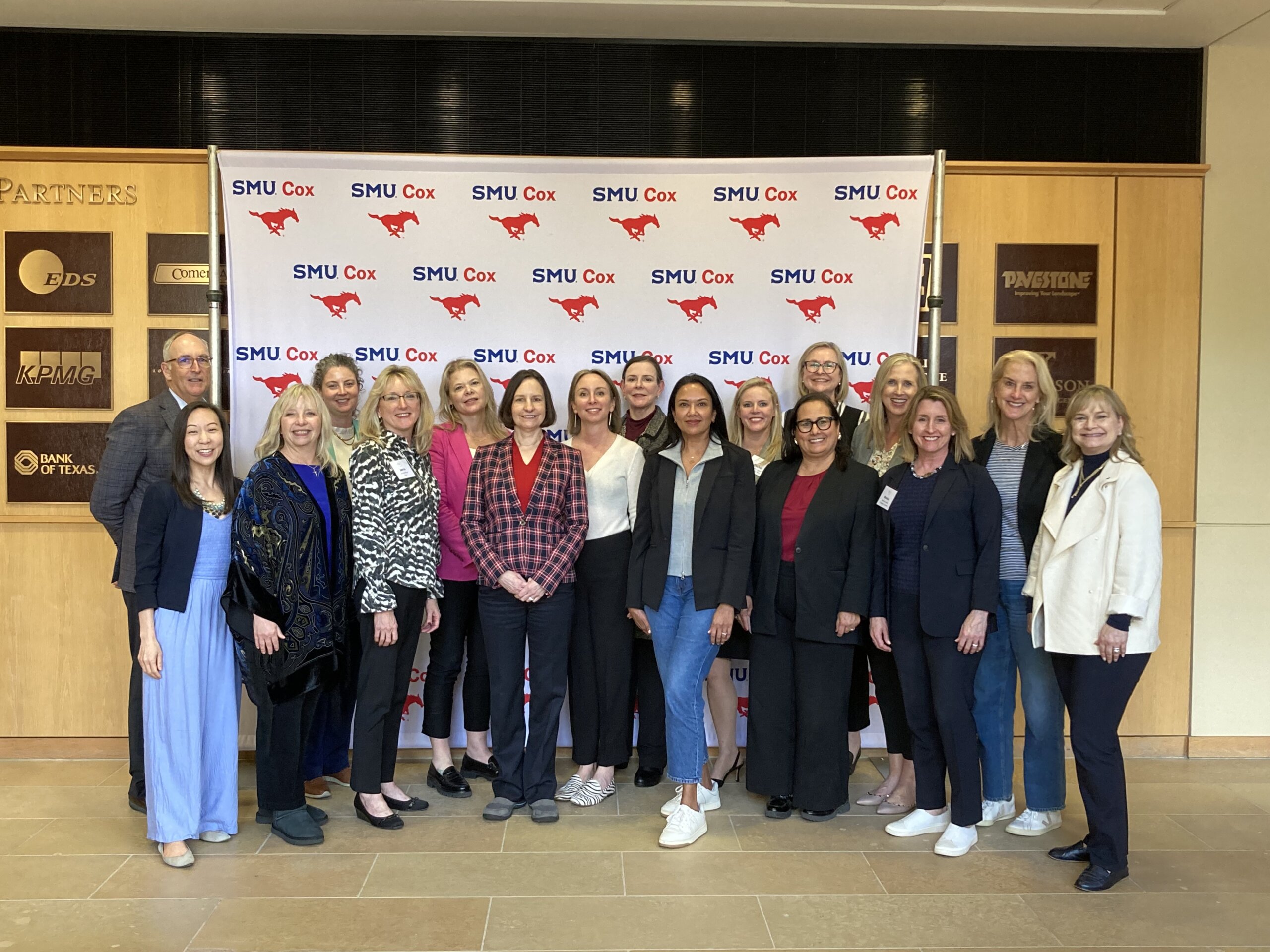
Members of EWR and SMU representatives.

The Dallas Regional Chamber’s Executive Women’s Roundtable (EWR) got an insider look at the soon-to-be-unveiled David B. Miller Quadrangle at Southern Methodist University (SMU) Tuesday, March 19.

EWR provides a unique opportunity for professional businesswomen and business owners to expand their networks, exchange ideas, and advance their careers. Through exclusive events and gatherings, participants gain access to high-profile projects, organizations, and leaders throughout the Dallas Region, learning invaluable insights about key business and economic developments. Furthermore, the collaborative environment created by members fosters mentorship, support, and personal growth.

EWR members in attendance included representatives from the DRC, AT&T, Boeing, Morgan Stanley, the Dallas Morning News, Hillwood, and more.

Dean Matthew B. Myers, Managing Director of Corporate Relations & Strategic Partnerships Lisa Tran, and Executive Director of Marketing Lacey Jeffrey from the SMU Cox School of Business were part of the tour as well.

U.S. News ranked the SMU Cox School of Business as the 33rd best business school in the country in their 2023-2024 Best Business Schools rankings. With an alumni network exceeding 65,000 members in the Dallas Region, the university plays a vital role in driving economic development and supplying skilled talent to the area. EWR attendees had the opportunity to explore the newly remodeled and expanded facilities, immersing themselves in the cutting-edge facilities and learning spaces that will produce many of the leaders of tomorrow.

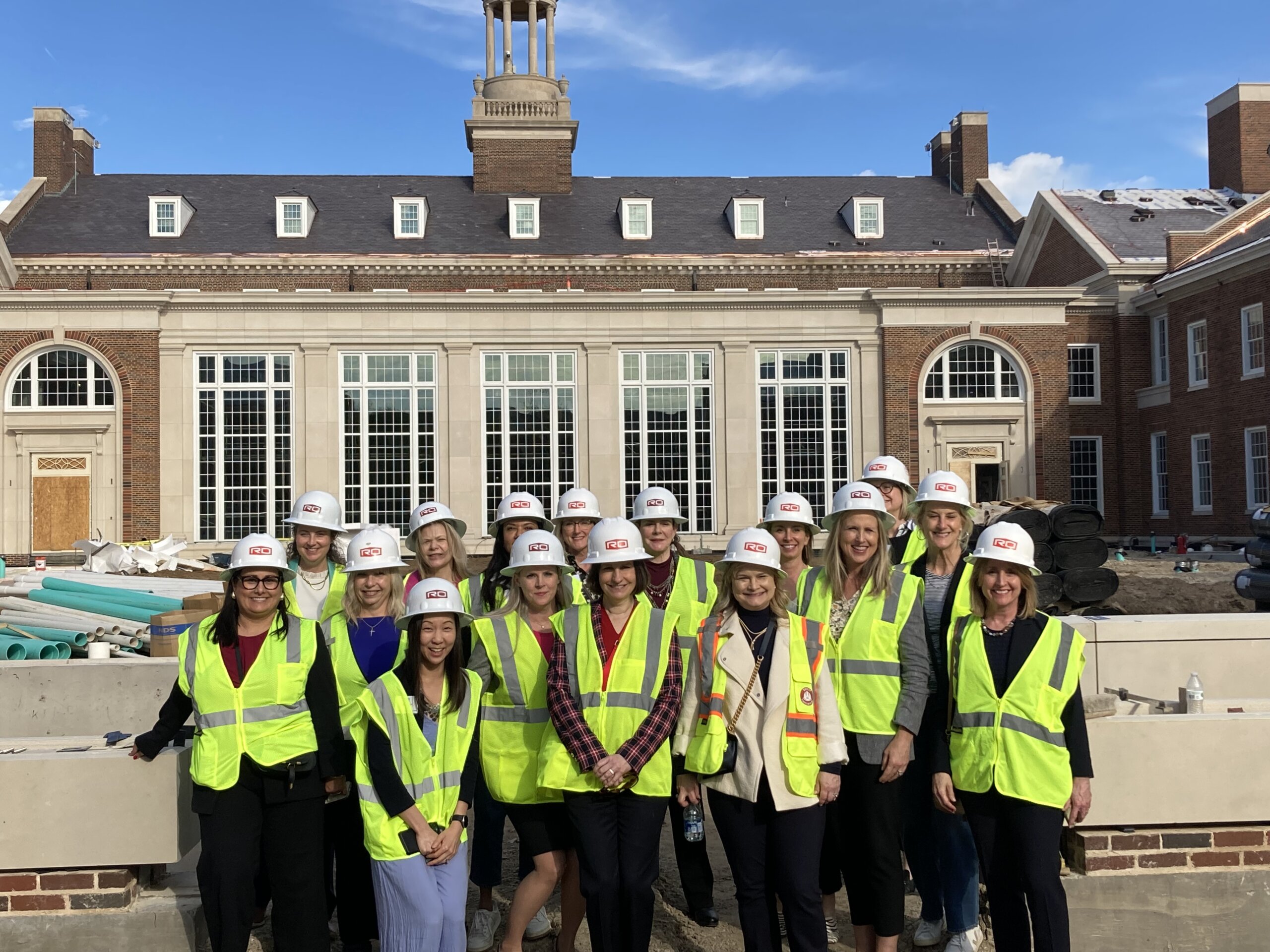
Members of EWR and SMU representatives in front of the ongoing development.

Attendees particularly lauded the focus on natural lighting throughout the facilities, where 90% of office spaces boast windows, and the comprehensive technology upgrades that promise to keep classrooms and meeting rooms at the forefront of innovation.

Additionally, design was a major draw to the group, specifically the remodeling’s emphasis on accessibility while still staying true to the buildings’ architectural legacy.

With a focus on empowering women and driving positive change in the business community, EWR is an essential resource for ambitious women looking to excel in their careers and make a meaningful impact in their organizations and beyond. Members represent a diverse array of industries and professional roles and are active in the Dallas Region.

To explore membership requirements and become part of EWR, visit our website.

By Catie George, Manager, Communications & Storytelling

The Dallas Regional Chamber (DRC) hosted the first Tomorrow Fund Investor Breakfast of the year on Wednesday, March 6.

DRC President & CEO Dale Petroskey and DFW Airport CEO Sean Donohue.

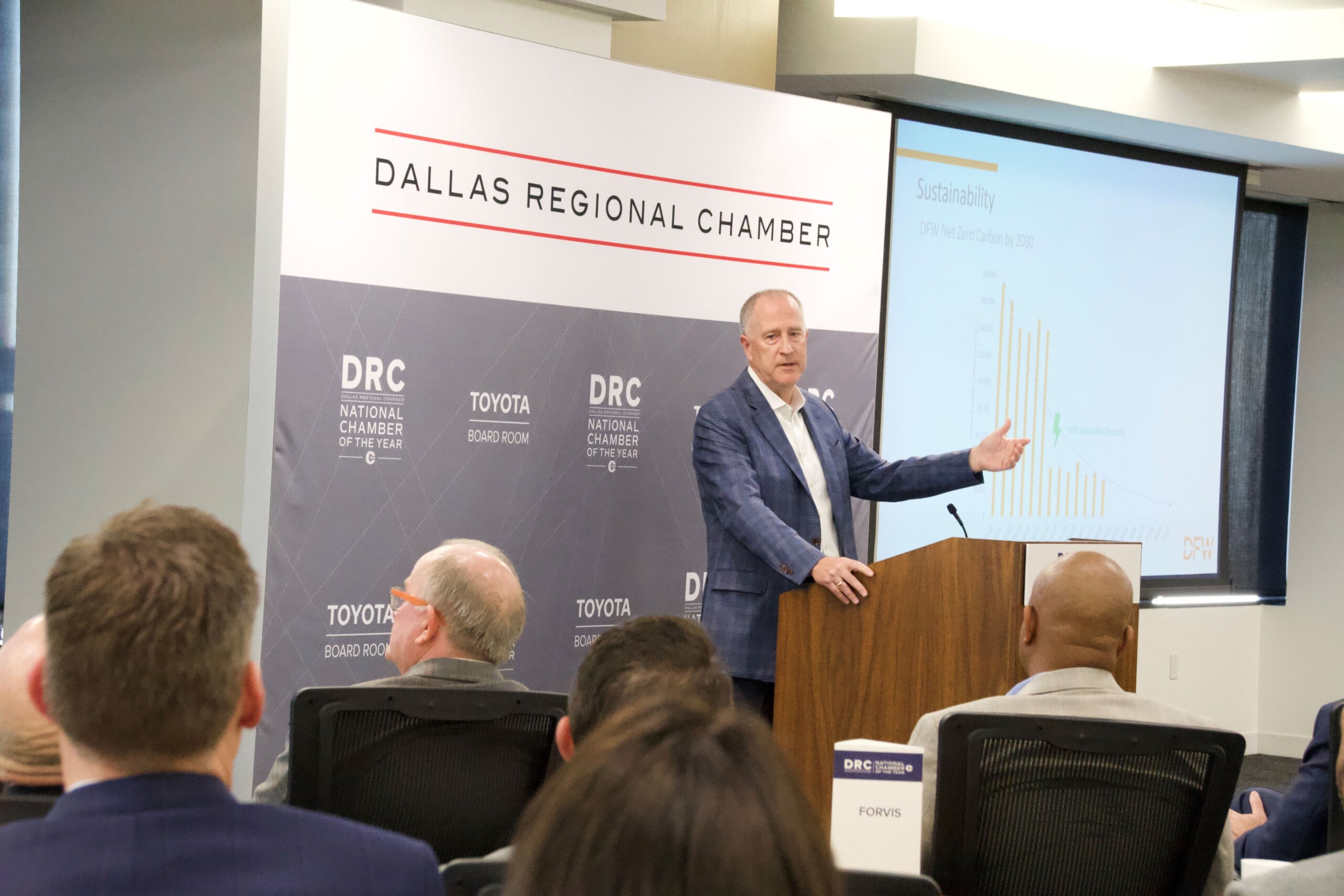
As the morning’s keynote, Dallas-Fort Worth International Airport CEO Sean Donohue commemorated the airport’s 50th anniversary.

In addition to exclusive briefings, DRC’s Tomorrow Fund Investor Breakfasts also provide the opportunity to recognize companies and organizations spurring economic growth in the Dallas Region.

Trina Solar announced plans for a major photovoltaic plant in Wilmer in September 2023, an investment of over $200 million. The 1 million-square-foot plant is expected to create 1,500 well-paying jobs.

“Our commitment to Dallas and the state of Texas is not just an investment in infrastructure, but a testament to our belief in the region’s potential,” said Morgan Peng, Deputy General Manager at Trina Solar, as he accepted the award.

“I wish to extend my heartfelt gratitude to everyone present here, the city of Wilmer, to Dallas, the chamber, and to the great state of Texas. Your support and collaboration have been instrumental in bringing this vision to life. Together, we are not just building a factory, we are laying the foundation for a sustainable future.”

The second Building Tomorrow Together award of the day went to Bonton Farms for its Grocery Connect service, which was launched in partnership with Kroger to provide an online grocery ordering and pickup service with free delivery options.

Building Tomorrow Together award winners with DRC staff.

Grocery Connect will help bring fresh and nutritious food to low-income urban neighborhoods and address food deserts in Southern Dallas County. Bonton Farms President Gabe Madison urged participants to get involved.

“Join us in this effort so that we can not only transform this community but also replicate this across the country,” Madison said.

The launch of Grocery Connect was supported by the Leadership Dallas Class of 2024’s involvement with Bonton Farms to develop and advance the organization’s Food Desert Action Plan to help mitigate food insecurities.

Above and beyond DRC membership, the DRC’s Tomorrow Fund makes possible the DRC’s strategic efforts to improve the quality of life for all people while enhancing the business climate and economy of the Dallas Region. By investing in the Tomorrow Fund, DRC members expand their company’s impact on the region.

“As Tomorrow Fund investors, you support [the DRC’s work],” said Petroskey. “That’s the only reason we can do this work, and we can’t thank you enough for that.”

Become a Tomorrow Fund investor.

Thank you to FORVIS and Suffolk, sponsors of the first Tomorrow Fund Investor Breakfast of 2024.

By Elizabeth Caudill McClain, Senior Vice President, Talent Strategies

Elizabeth Caudill McClain, Senior Vice President of Talent Strategies

As companies struggle to fill their open positions, promote from within, and retain employees, the Dallas Regional Chamber is working to strengthen the talent pipeline in the most in-demand sectors in the Dallas Region’s labor market. Two key ways to do this are through upskilling and reskilling.

Upskilling is teaching workers new skills to enhance their existing role or advance into a higher-wage role in their field, while reskilling involves teaching workers new skills to transition into a different role or industry.

Together, these strategies have proven to have multifaceted returns on investment for businesses that invest in these programs for their employees.

Here are reasons why companies should consider upskilling and reskilling programs.

1. Increased productivity:

According to a study by the Association for Talent Development, companies that invest in employee training and development experience 24% higher profit margins than those that don’t.

2. Enhanced employee performance:

An IBM report found that organizations with a strong learning culture outperform their peers in employee productivity and innovation.

3. Adaptability to technological changes:

With rapid technological advancements, companies that invest in upskilling are better positioned to adapt to new technologies, increasing their agility and market competitiveness.

4. Innovation and creativity:

A study by PwC found that 44% of employers estimate that a changing need in skillsets will disrupt workers in the next five years. Upskilling and reskilling programs can foster innovation by ensuring employees have the necessary skills to drive creativity and problem-solving within their organization.

5. Cost savings on recruitment:

Caudill McClain moderating a panel at the 2022 State of the Workforce.

The cost of employee turnover, recruiting, and onboarding can be high. On average, U.S. businesses lose $1 trillion annually due to voluntary turnover. Investing in existing employees can be a cost-effective strategy, and upskilling can contribute to employee retention and reduce costs related to recruitment.

6. Elevate company brand:

A commitment to employee development can enhance the employer brand, making it more attractive to potential hires. This positive image can contribute to the company’s long-term success.

7. Compliance and risk mitigation:

Upskilling can help employees stay compliant in industries with rapidly changing regulations, reducing the risk of legal issues and penalties.

8. Customer satisfaction:

Well-trained employees are better equipped to meet customer needs, leading to improved customer satisfaction and loyalty.

The Dallas Regional Chamber elevated our commitment to talent strategies with the launch of our 2024-2026 strategic plan, and you can read more about the work ahead of us here.

If you’re interested in setting up upskilling or reskilling programs, I’d be happy to help you. Our Leadership Programs are also a great resource for employee development.

By Dylan Guest, Director, Communications

The Texas Internship Challenge is a partnership between the Texas Workforce Commission, the Texas Education Agency, and the Texas Higher Education Coordinating Board. Through its online platform, the challenge incentivizes employers to provide paid or for-credit internships by facilitating access to a diverse and motivated local talent pool free of charge while streamlining the process for students to discover and apply for available opportunities.

Why should companies participate in the Texas Internship Challenge?

Employers who participate in the challenge and utilize the platform gain access to a local talent pool by directly listing their internships on the Texas Internship Challenge platform for free. This also allows a company to address their staffing needs while demonstrating their commitment to supporting talent development and fostering growth within their community.

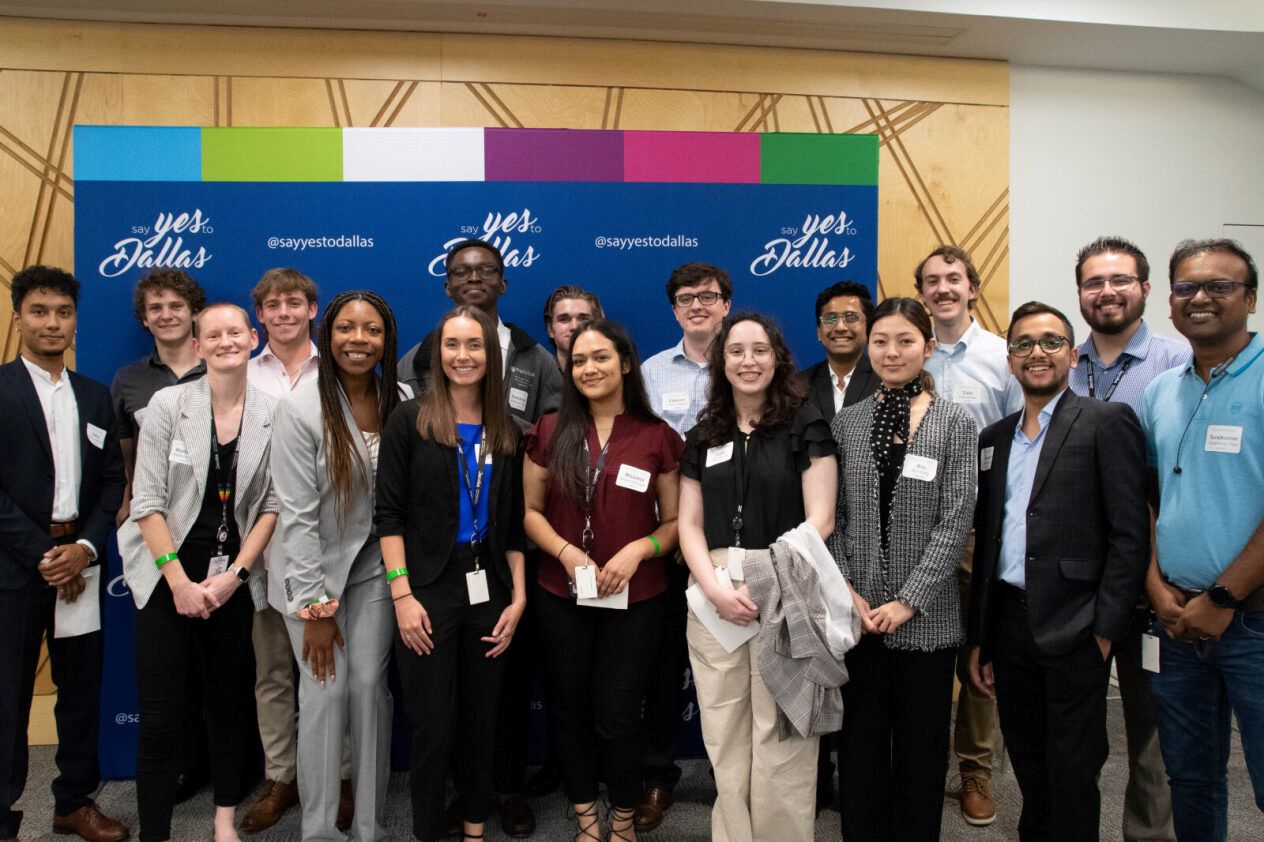
Local interns at a Say Yes to Dallas event at the DRC.

Additionally, a highlight of the platform is the Virtual Recruiter tool, which allows employers to create specified search alerts for qualified candidates, match their internship listing and skill requirements with the candidates, and instantly review any resumes they match with or find.

The challenge’s platform provides a diverse range of readily available local labor market insights, including facts and summaries on specific areas, industries, occupations, and educational fields. This empowers users with comprehensive data for informed decision-making and strategic planning regarding hiring. Employers can also seamlessly integrate their internship listings into their hiring sites and social media accounts.

To get started, head to the website and click the ‘Sign In/Register’ button located at the top right corner. Next, scroll down to option three to create a user account for an employer. Once you’ve selected this option, fill out your information, and you’re all set to begin!

Why should companies offer paid internships?

Providing paid internships not only benefits companies in the short term but also creates a strong foundation for the future success of a company and its region.

For employers, internships create a valuable avenue to scout talent, train candidates for full-time roles, and create career-ready assets for the company. The emphasis on career readiness, a core priority of the Dallas Regional Chamber (DRC) and Dallas Thrives, significantly enhances a region’s talent pipeline, benefiting both the workforce and companies.

Providing compensation to interns not only attracts top applicants but also boosts their motivation and instills in them a sense of ownership and responsibility, driving them to make meaningful contributions. With proper guidance and support, paid interns can become career-ready and have the potential to become invaluable contributors.

Hiring interns can also alleviate future recruiting challenges for companies, with 70% of interns being retained by the same company where they completed their internship, according to career planning site Zippia. A company’s stability and growth is directly related to employee’s qualifications and retention, topics covered in the DRC’s 2023 State of the Workforce event.

Internships can help prevent unfilled jobs from impacting the regional economy by equipping students with essential workplace skills, professional experience, and industry knowledge, ultimately readying them for a smooth transition into full-time employment upon graduation.

Through its strategic focus on Education, Talent & Workforce, the DRC fosters collaboration between the local business community and educational institutions to meet regional industry needs. Learn more about the DRC’s work in Education and Workforce on our website.

Boingo Wireless, a total connectivity partner, shares a behind-the-scenes look at its new headquarters at The Star in Frisco and discusses how the company is bringing world-class connectivity to Texas.

How does your company help other businesses become more effective?

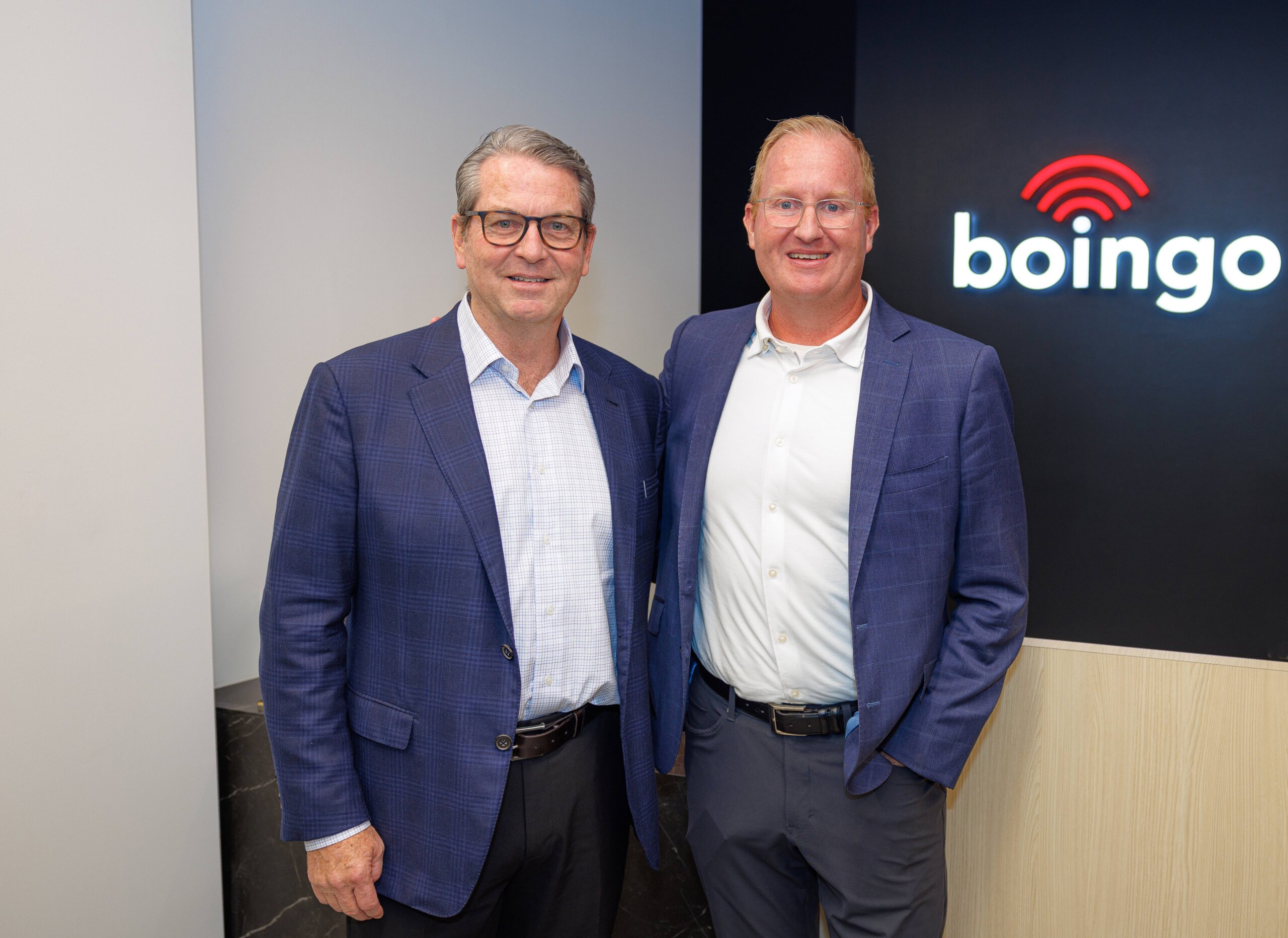
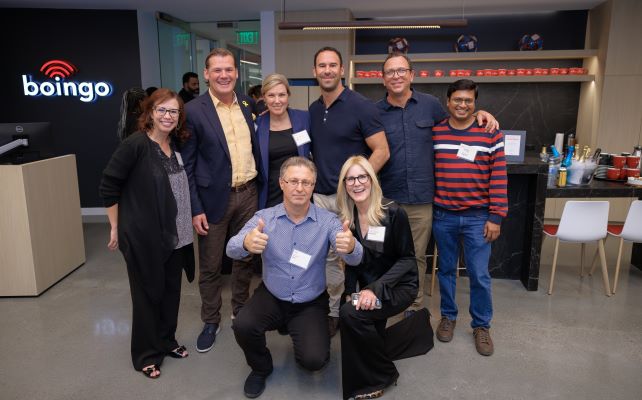
Boingo Wireless CEO Mike Finley and Mayor of Frisco Jeff Cheney celebrate the opening of Boingo’s headquarters at The Star in Frisco.

Business in the 21st century requires connectivity. Boingo designs, builds, and manages state-of-the-art connectivity infrastructure for airports, transit hubs, stadiums, military bases, hotels, hospitals, and commercial properties. For over 20 years, we’ve pioneered wireless networks that set the standard for fast, reliable connectivity. This connectivity enables enterprises to transform digitally, from strong cellular coverage for mobile devices to cashless transactions and artificial intelligence tools.

In Texas, Boingo’s presence continues to grow. We’re proud of our hometown customers, like the beautiful new Omni PGA Frisco Resort, home to PGA of America. Boingo has also deployed robust connectivity at Sheppard Air Force Base, the largest and most diverse training base in air education and training command, and provides world-class Wi-Fi and cellular networks at Austin FC’s Q2 Stadium, Dallas Love Field Airport, and Austin-Bergstrom International Airport.

How does your company realize your mission?

We focus on our people and our innovation. Boingo employs the best in the business and has established a culture of innovation with a passion for solving complex wireless challenges.

What differentiates your company from others in your industry?

Boingo Wireless employees gather at the company’s new Frisco office.

We do it all. Wi-Fi, 5G, distributed antenna systems (DAS), small cells, towers, and private networks. Boingo brings all leading wireless technologies together under one managed platform to deliver reliable, seamless, and secure coverage. From design to deployment and daily network management, we help businesses deploy best-in-class communication infrastructure to power all their connected needs. Our converged, neutral host model combined with our 20-plus years of experience makes Boingo one of one.

What do you enjoy most about doing business in the Dallas Region?

Texas has welcomed Boingo with open arms, and we’re happy to be here. We’ve set up brand new headquarters at The Star in Frisco. Dallas has a thriving business community that positions Boingo closer to key customers, enabling us to attract high-tech talent and collaborate with a number of technology partners in the state.

How can regional businesses get engaged with your company?

We hope regional businesses won’t hesitate to reach out to our team. You can email the Boingo team directly at sales@boingo.com.

Is there anything else you would like to highlight?

Boingo is recruiting talent with network, cloud, edge computing, IoT, data analytics, business development, and account management experience to support continued growth in Frisco and throughout Texas. To explore career opportunities with Boingo, we invite you to visit boingo.com/careers.

Sindhu Avalokita

By Catie George, Manager, Communications & Storytelling

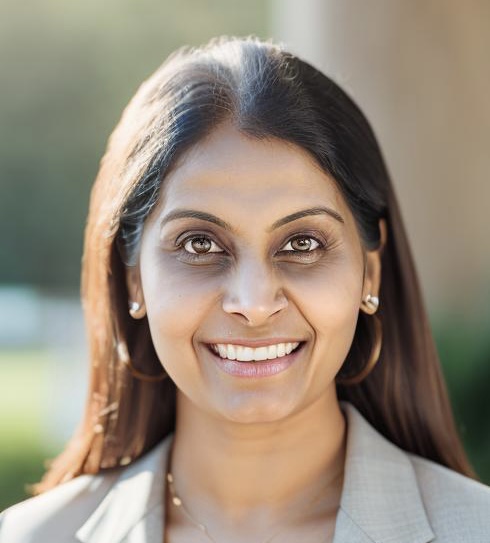
To celebrate Women’s History Month, Jacobs Vice President & Director of Operations Sindhu Avalokita shared her experiences, planned celebrations, and guidance for others with the Dallas Regional Chamber.

“It is critical for us, as women, to put ourselves in the driver’s seat of this conversation as much as we possibly can to psychologically gain control and be in a position of influencing our careers and our next steps,” Avalokita said. “It’s always a good time, in my opinion, to look beyond what’s in front of us or around us, which may very well be very positive from an equality and equity standpoint, and recognize that there’s a whole world out there where there is much work left to be done.”

At Jacobs, that work includes an emphasis on women in STEAM, or science, technology, engineering, arts, and mathematics. While there has been progress and more of an acknowledgement and understanding of what women might come across as challenges in the workplace, more needs to be done to help move the needle on deep-set biases and potential impediments to growth so we retain and grow women in the workforce.

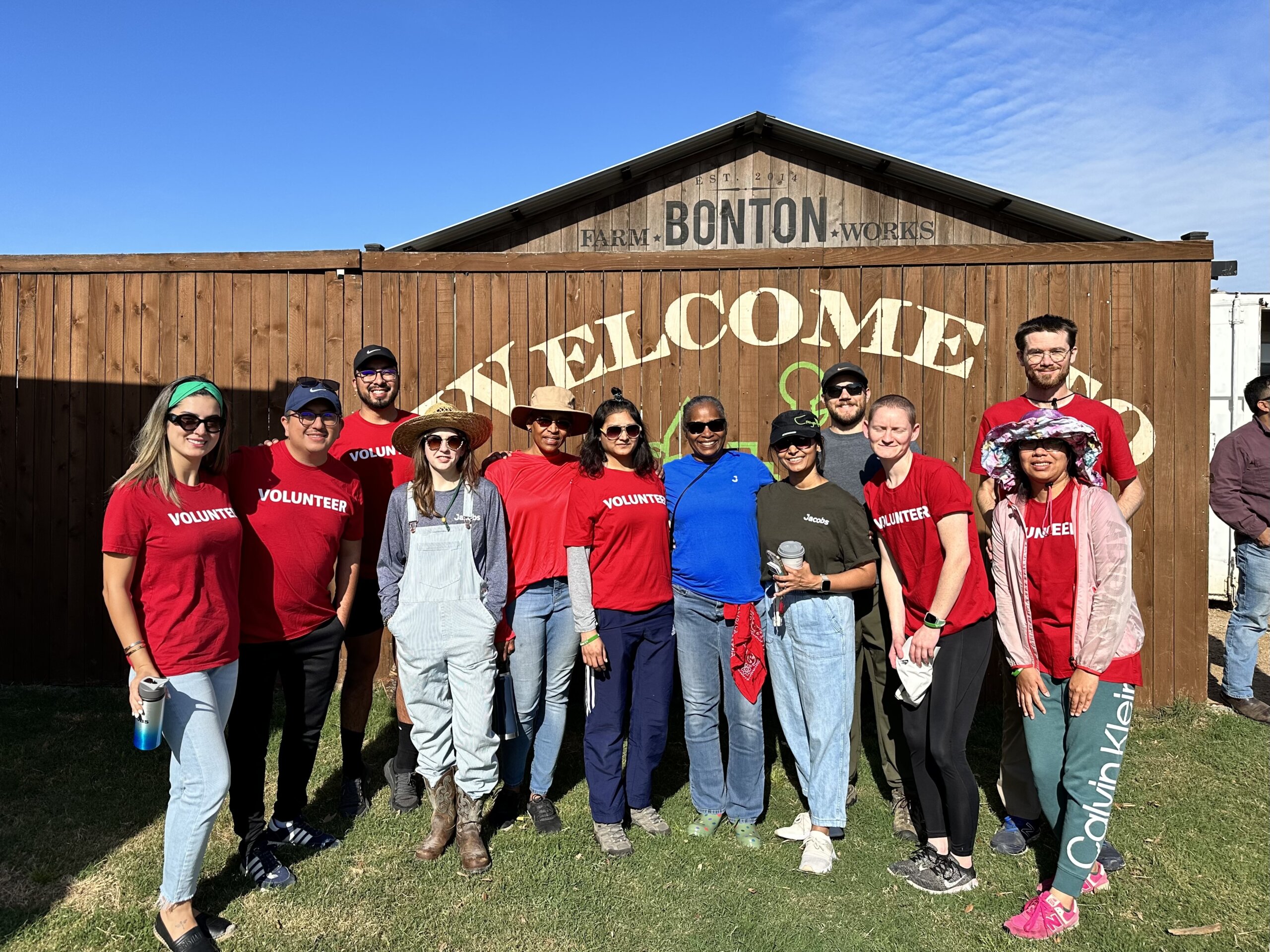
Avalokita and team volunteering at Bonton Farms.

“I personally put the onus of support on each of us. As individuals in organizations, regardless of role, gender, or background, we have an opportunity with every interaction to support and lift one another,” she said. “So, while company policies, key performance indicators, and other measures are critical in this case, as individuals, we have a far greater everyday impact than we think on whether a working woman feels valued, stays employed, or steps up or down from a leadership position.”

Supporting women begins with curiosity and understanding, according to Avalokita.

“Without this understanding, exposure, or the experience of having ‘walked in those shoes,’ policies and training can fall flat,” she said. “Especially in the fast-paced world we live in, I want it to be understood that none of us are perfect; we all make mistakes and learn from them, and the idea of ‘having it all’ is a mirage at best.”

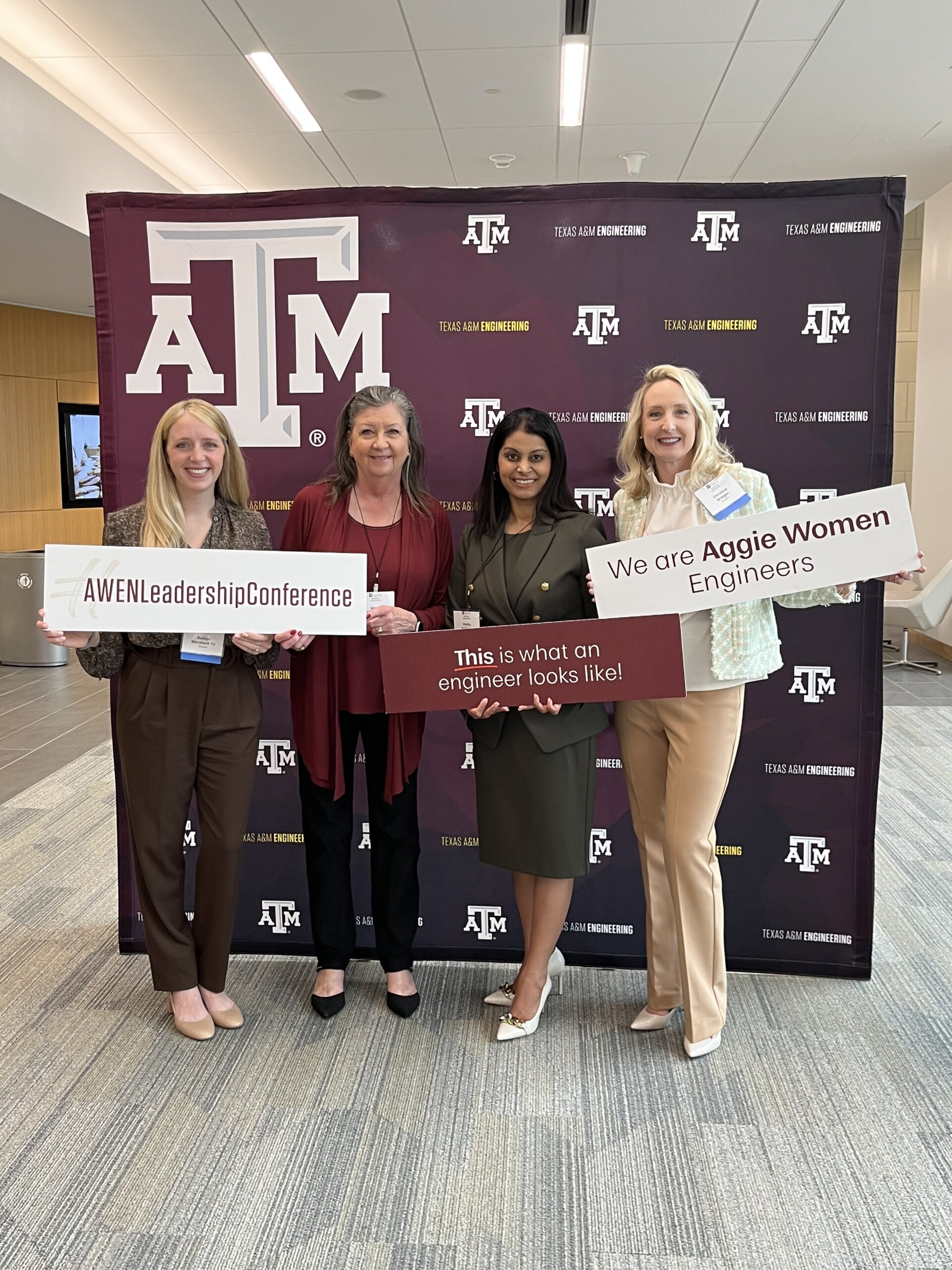
Avalokita at the Aggie Women Engineers Network Leadership Conference.

Avalokita’s own work and leadership styles aim to mirror these truths.

“I practice working and leading through authenticity, vulnerability, and kindness,” she said. “It is important to me that these principles don’t come across as counter to driving and delivering results. All of it can be done, and these are not mutually exclusive traits.”

She said mentoring is also very important for all women at all levels of the workforce.

“I’m a huge proponent of informal, situation-based mentoring. Nothing like learning in the heat of the moment!” Avalokita said. “It is critical, of course, to have a network of diverse folks to be able to call upon for this model to work, and that takes time, energy, and investment on our part to make happen.”

Avalokita’s experiences have made her stronger and more self-confident and helped her career.

“Self-doubt can get in the way more often than not, especially when surrounded by folks who might be more experienced or [who] don’t look or sound like you,” said Avalokita. “It took me a while to own my identity and my background, recognize their full strength, and turn this into a positive in my career. But this has helped me be more conscious about my values, my drivers, my principles, what I am comfortable with, and when to say ‘no.’”

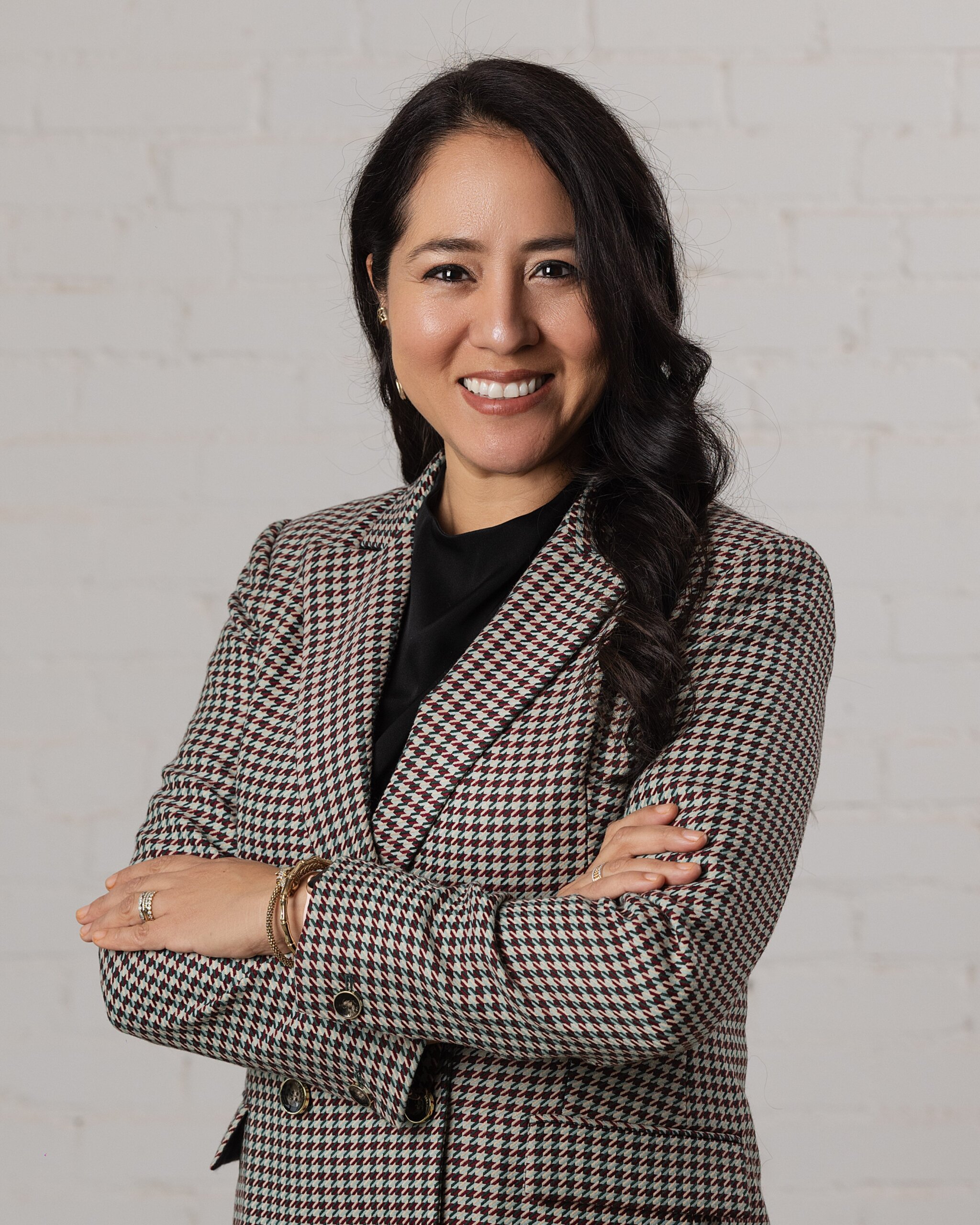
Nancy Galvan

By Catie George, Manager, Communications & Storytelling

March is Women’s History Month, and Nancy Galvan, Owner of Unica Enterprises, shared her experiences and celebrations with the Dallas Regional Chamber.

“Women’s History Month holds profound significance for me, personally and professionally. Personally, it’s a time to reflect on the struggles and achievements of women who came before me, paving the way for my own entrepreneurial journey,” said Galvan. “Professionally, Women’s History Month is an opportunity to celebrate the contributions of women in business and highlight the importance of gender diversity in a corporate world.”

Women’s History Month is also a time to focus on making positive change, according to Galvan.

“It reinforces my commitment to fostering a supportive and inclusive work environment where women can thrive and excel,” said Galvan. “It [also] serves as a platform to advocate for policies and initiatives that promote gender equality and empower women entrepreneurs.”

Gender equality and inclusivity are Galvan’s major hopes for the future of women in leadership roles.

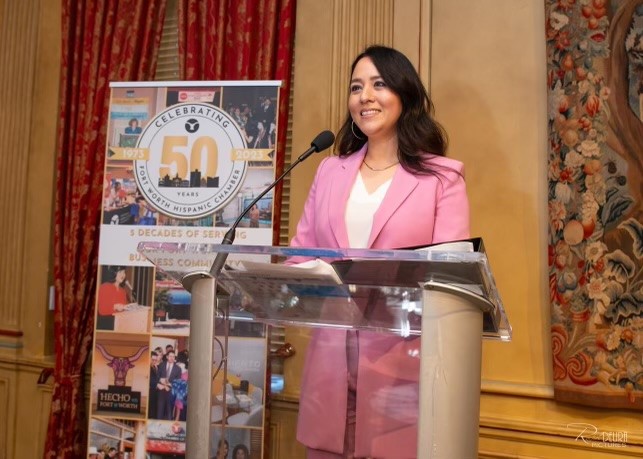
Galvan speaking at a Fort Worth Hispanic Chamber event.

“I envision a future where women have equal representation and opportunities to lead across all sectors, including business,” says Galvan. “I hope to see more women breaking barriers, shattering glass ceilings, and occupying top executive positions in companies of all sizes. Additionally, I aspire to foster a culture that values and supports the diverse perspectives and talents that women bring to leadership roles.”

Galvan encourages mentorship and networking, which has also helped her in her journey.

“Through guidance, support, and shared experiences from mentors, I have gained valuable insights and confidence in navigating challenges and seizing opportunities within my industry,” said Galvan. “Networking has provided access to a diverse community of professionals, fostering collaboration and opening doors to new partnerships and ventures. These connections have expanded my business opportunities and challenged stereotypes and biases, empowering me to pave the way for other women in entrepreneurship.”

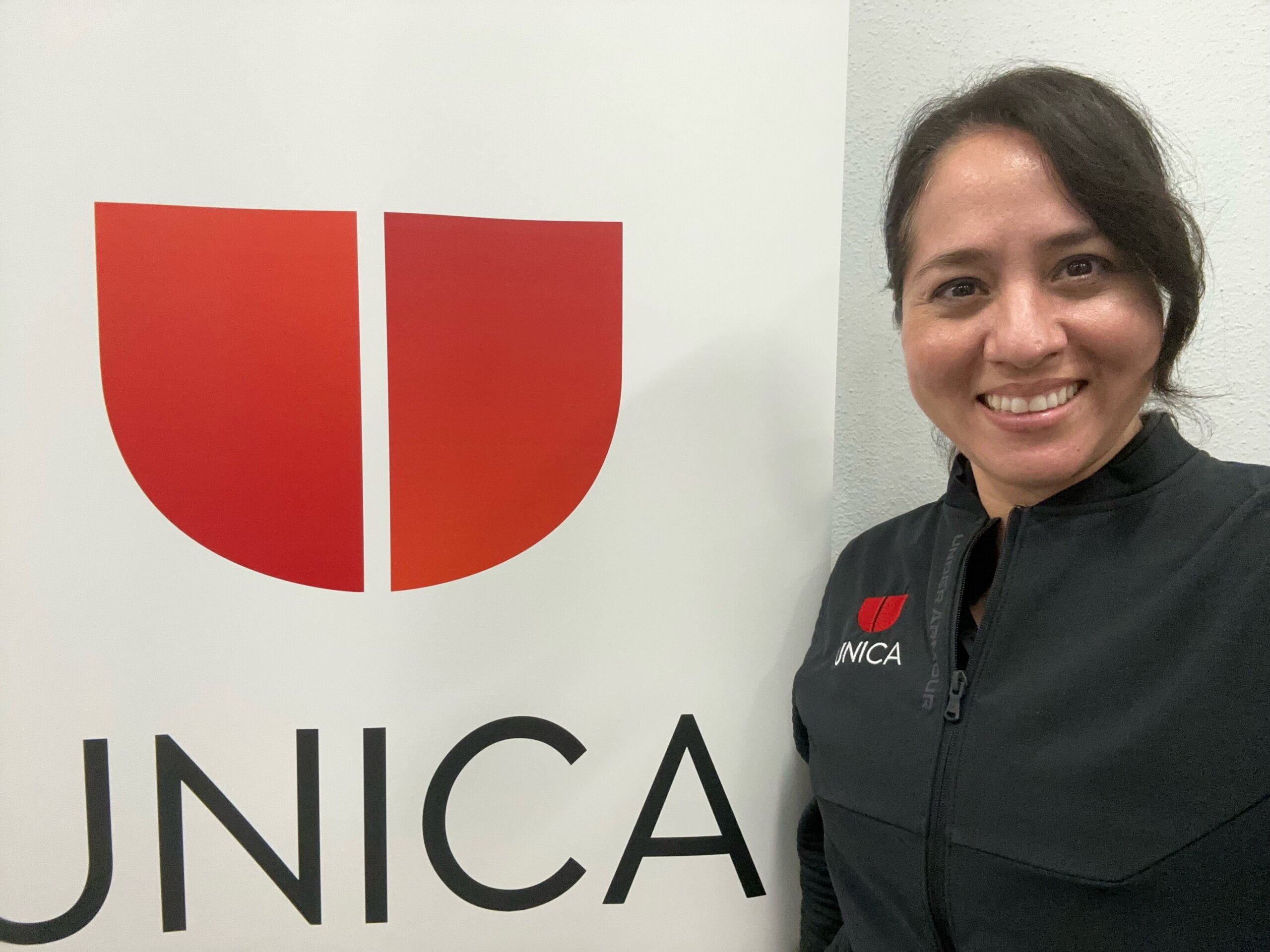
Galvan with the Unica logo.

One of her personal icons she looks to is Madam C.J. Walker, an early entrepreneur and the first self-made millionaire woman.

“Walker’s pioneering spirit, resilience, and entrepreneurial vision serve as enduring inspirations to me as a business owner. Her remarkable journey from adversity to success resonates deeply, motivating me to persevere and innovate in my own entrepreneurial endeavors,” said Galvan.

For women looking to excel, Galvan offers some sage advice.

“Embrace challenges as opportunities for growth rather than obstacles, and never be afraid to speak up and advocate for yourself,” she said. “Continuously invest in learning and skill development to stay ahead in a rapidly evolving world. Most importantly, stay true to your passions and values, and don’t be discouraged by setbacks or societal expectations. Remember, your unique perspective and experiences are assets that can drive innovation and change in your field. By staying resilient, persistent, and authentic, you can overcome any barrier and achieve your wildest dreams!”

By Catie George, Manager, Communications & Storytelling

January 2024 marked the 50th anniversary of the first passenger flight to the Dallas-Fort Worth International Airport (DFW Airport) and kicked off a year-long celebration. For the Dallas Regional Chamber, the airport’s golden anniversary marks half a century of one of the region’s most impactful economic engines.

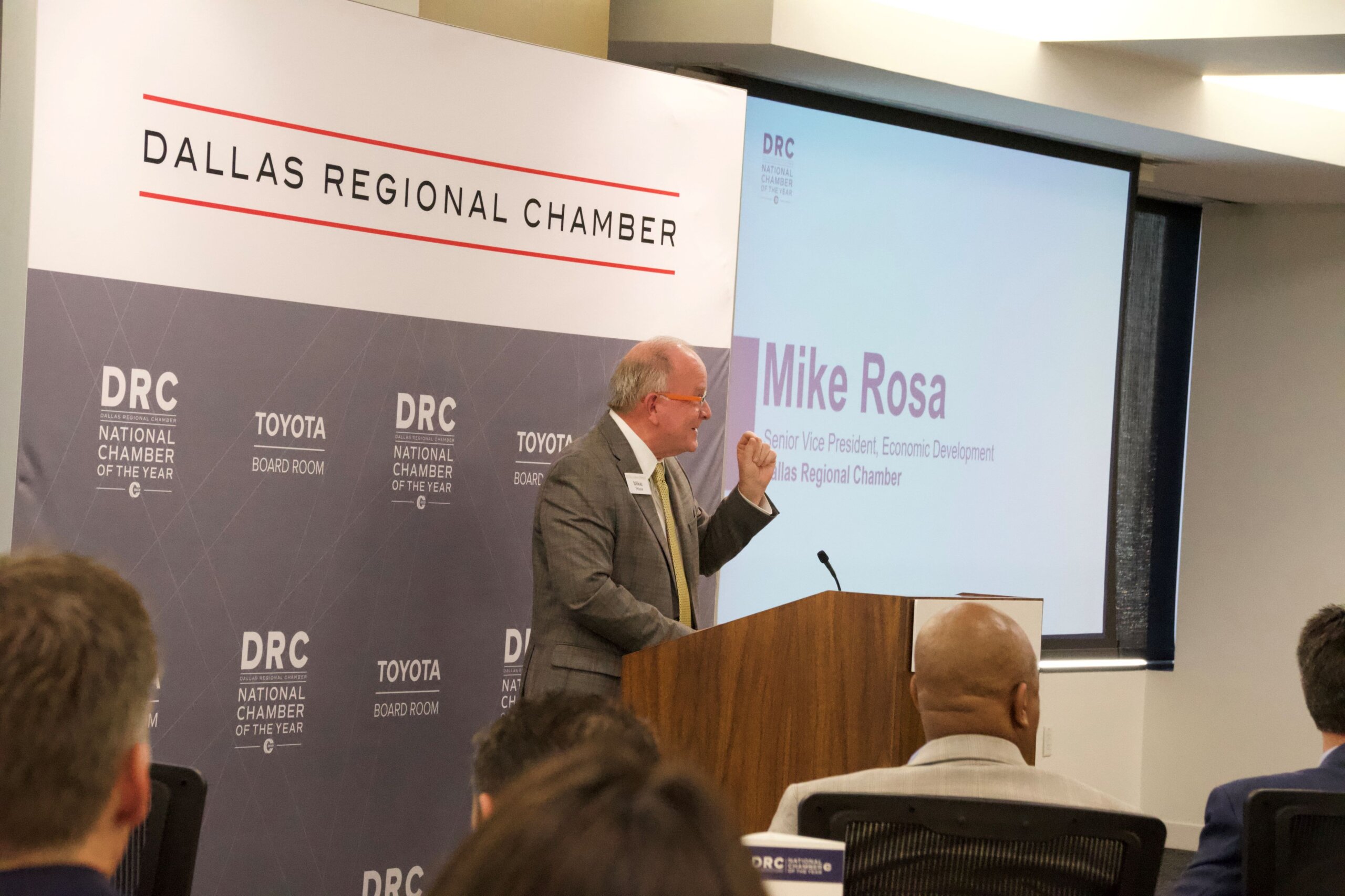
DRC SVP of Economic Development Mike Rosa

The region’s largest, the country’s second busiest, and the world’s third-largest airport is vital to all of North Texas, directly and indirectly supporting 634,000 jobs and $38 billion in payroll. In addition, DFW Airport travelers added approximately $24 billion to the local economy, which resulted in more than $5 billion in state and local tax revenues. DRC Senior Vice President of Economic Development Mike Rosa added that the true economic impact is likely more.

“It is hard to measure the penetrative impact of something so ingrained in our region. It would be like trying to estimate the impact of our geographic location,” said Rosa. “The impact of DFW Airport is enormous, and I suspect even greater than what can be estimated or shown in an economic impact report.”

In 1964, the Civil Aeronautics Board ordered Dallas and Fort Worth to consider a joint airport. With the active participation of the DRC and Fort Worth Chamber of Commerce, the DFW Airport was agreed upon. To build the airport, voters needed to, and ultimately did, approve a $7.5 million bond package for land purchases – a crucial step that materialized due to the DRC’s strong championship of the package.

“They gave us 17,000 acres in the middle of nowhere at that point. And 60 years ago, aviation was a slice of what it is today,” said CEO of DFW International Airport Sean Donohue at a DRC Tomorrow Fund Investor Breakfast. “And for them, for those visionary leaders, to say, we’re going to give you all this land, was an extraordinary decision that enabled the airport to now become the second busiest airport in the world.”

CEO of DFW International Airport Sean Donohue

Ten years later, in 1974, DFW Airport opened to airline traffic. The airport initially had four terminals, three runways, and 66 gates on 17,500 acres—the largest airport in the world at that time.

Four years later, the DRC set out to improve the taxi services in the region, especially those closer to the airport, because many visitors relied on taxi cabs as their primary source of transportation. The DRC’s work in this area also helped address broader transportation concerns.

In 1982, DFW Airport lost its largest operator, Braniff Airlines, and 66 landing slots. After this setback, the DRC began to get involved with the Federal Aviation Administration (FAA) regulations. DRC board members and staff successfully lobbied the FAA to return and reallocate 50 of those slots to other operators.

At the turn of the century, DFW Airport opened an international cargo center and a perishables facility. That same year, DFW was the fastest-growing international port of any kind due to its superior geography and international facility warehouses.

“In the 36 years I’ve been in economic development in this region, there has been no single factor that has been more consistently responsible for the economic growth of this region than DFW Airport,” said Rosa. “It’s invaluable to companies considering moving here, and it’s a huge selling point. It’s also great for companies already here looking to expand their business.”

Today, DFW Airport hosts 171 gates flying to 257 destinations, services 27 airlines, has five terminals, and averages over 200,000 daily passengers.

DRC President & CEO Dale Petroskey with Donohue

“In 2019, we set a record at DFW of 73 million customers. Last year, we had 82 million. So, that’s 15% higher than our previous record,” said Donohue. “By the end of the decade, we forecast 100 million. I don’t think it’s out of the question.”

Notably, DFW Airport was the first North American airport to achieve carbon-neutral status and is the largest carbon-neutral airport in the world. This commitment to sustainability was recognized in 2020 when the airport received a United Nations Global Climate Action Award.

In 2022 and 2023, DFW Airport was recognized as the best in the country for its customer service.

“As DFW Airport celebrates its 50th anniversary, the DRC celebrates alongside the airport by recognizing the history, impact, and success of the past as we look forward to the next 50 years.

“We already have the plan for the next 20 years that will allow us to keep growing, and that’s really critical for us. We can never be a constraint for this region,” said Donohue. “We always have to be ahead of the growth, but we’ve got to do it in a reasonable manner and do it in a smart manner, in a cost-effective manner, and that’s what we plan on doing.”