By Catie George, Manager, Communications and Storytelling

The Dallas Regional Chamber (DRC) partnered with Dallas Independent School District (ISD) Tuesday, Oct. 17 to host the 23rd annual Principal for a Day (PFAD), presented by Capital One for the 14th year.

PFAD matches business and community leaders with an elementary, middle, or high school in Dallas ISD based on the participant’s areas of expertise, interests, and the school’s need. The participant gets to experience a day-in-the-life as principal in a local school.
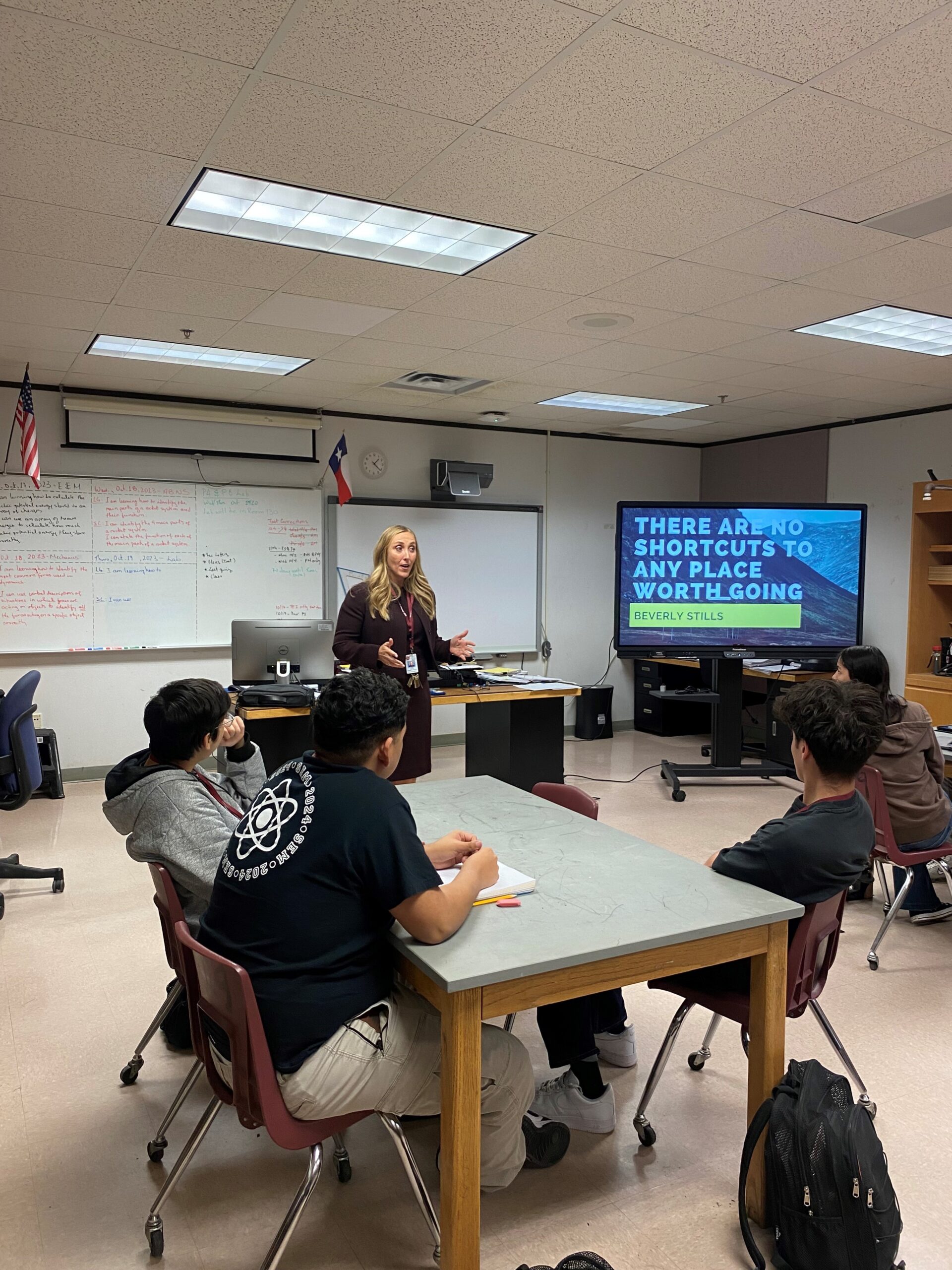
Amazon’s Vickie Yakunin speaks to students at Townview

“Our mission at the DRC is to help make the Dallas Region the best place in America for all people to live, work, and do business. That all starts with a strong public education system,” said DRC President & CEO Dale Petroskey. “More often than not, a high-quality education leads to a good job and a good life. That’s why the DRC is so proud of our partnership with Dallas ISD because they have become a model for urban school districts in America.”

This year, nearly 200 business and civic leaders from around the Dallas Region served as volunteer principals at Dallas ISD schools.

During his PFAD experience, Tellis Bethel, Group Vice President and Chief Social Innovation Officer for Toyota North America, visited classrooms, learned about upcoming school events, and discussed school-wide curriculum at the West Dallas STEM School.

Toyota partnered with Dallas ISD and Southern Methodist University to open the school in 2018 to offer project-based, hands-on learning to address STEM gaps in learning. West Dallas STEM School’s principal and assistant principal discussed how they are encouraging teachers to have a more hands-off approach in the classroom to allow learning to happen as children come to solutions by struggling through the problem with their peers in this new learning approach.

“It’s no surprise there’s a parallel in the course of the corporate world,” Tellis commented, as employee ownership in training becomes more and more important. Allowing students and employees to grapple with a concept enhances their learning.

Throughout the day, participants got to teach classes, share school-wide announcements, meet with student organizations, attend school performances, read to students, observe teacher and administrative planning sessions, and participate in several other activities.

Vickie Yakunin, Head of Community Affairs for the North Texas Region at Amazon, was the principal at Townview School of Science and Engineering. She visited Townview earlier this year to surprise two high school seniors with Amazon’s Future Engineer Scholarships. As principal for a day, she spoke to a class of seniors about her job, college, and the Amazon scholarship, which awards students $40,000, an Amazon internship, and a mentor.

“At Amazon, we believe education is the most important driver of future success and economic prosperity in our community,” emphasized Yakunin.

After the school day was completed, participants gathered for a reception hosted at Gilley’s Dallas, sponsored by Amazon. There, participants and their partner principals reconvened alongside elected officials and other civic leaders to discuss their experiences and encourage further participation in Dallas ISD.

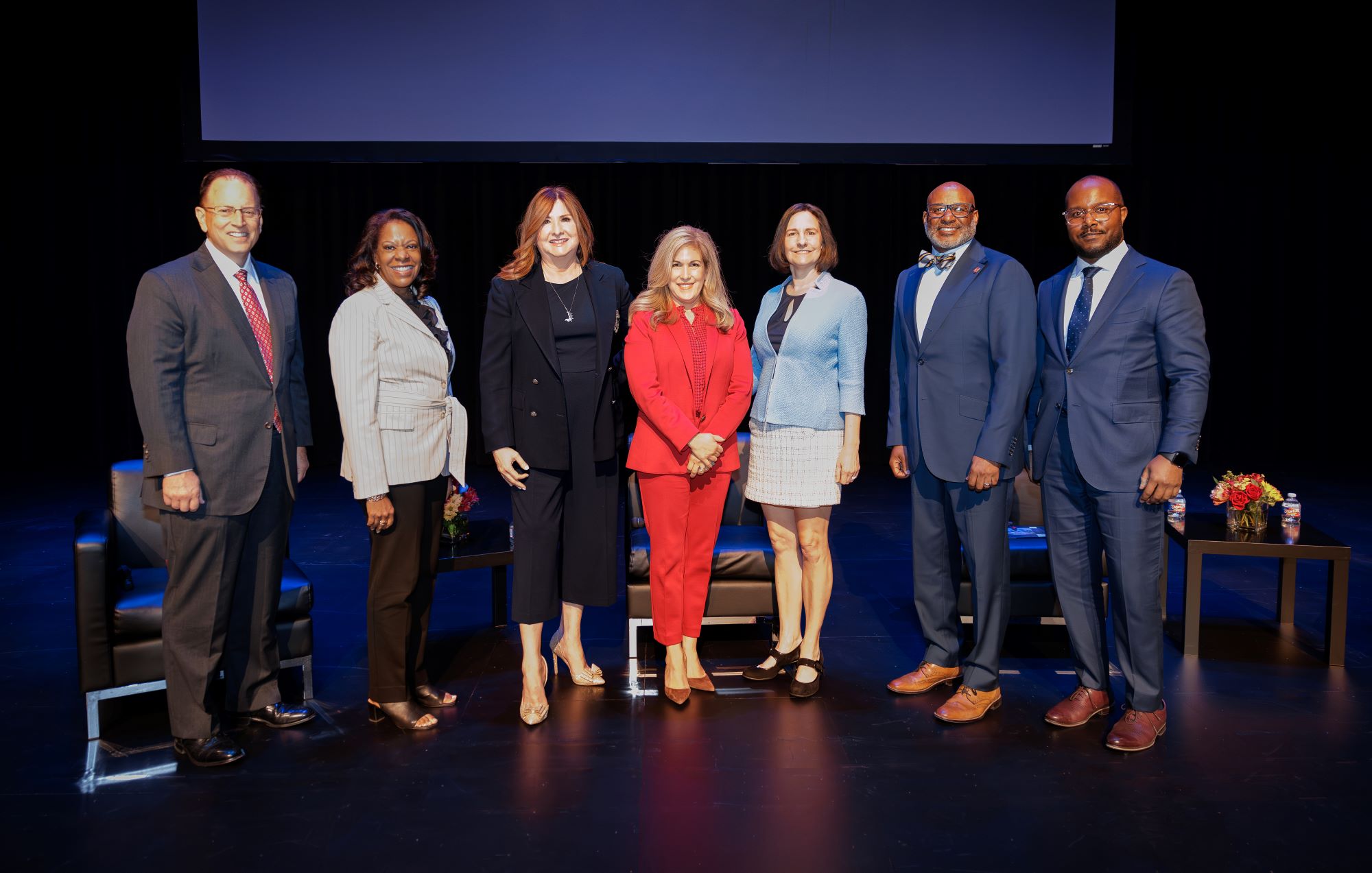
At the reception, participants heard DRC President & CEO Dale Petroskey, event sponsors, and Dallas ISD Superintendent Stephanie Elizalde.

PFAD reception

“There is something that absolutely unites all of us, and that is that we know a strong public education is the foundation to economic mobility in our city and in our community,” said Elizalde. “Our teachers are the program and principals are the platform from which everything is supported.”

Future involvement and lasting connections between the companies and organizations and the schools they volunteered at are some of the key objectives of Principal for a Day.

“Get to know what’s happening with our students in our future workforce, create opportunities to build a future workforce, and create some linkages between what we can offer as industry to the organizations that provide education to our students,” said Andrella Thomas, Social Innovation Manager at Capital One.

Visiting Dallas ISD’s schools and engaging in the work it takes to run a public school gave many participants a newfound respect for the public school system.

“What I saw today was inspiring. I was reminded that hard work still matters and that no matter what zip code you live in, you have a chance to succeed if you focus on your goals,” said Yakunin. “Be persistent, believe in yourself, and show up every day; roll up your sleeves and do the hard work. That was demonstrated to me throughout all the students that I met in my experience today.”

Thanks to the PFAD presenting sponsor, Capital One, and the reception sponsor, Amazon. Thank you to the Dallas Independent School District for their continued partnership.

To learn more about the work the DRC is doing in Education & Workforce, visit our website.
Commemorate, learn about, and engage in upcoming diverse and cultural holidays through the resources and local events below.

Saturday, Nov. 11: Veterans Day

The Dallas-Fort Worth Metroplex is home to over 352,000 veterans, according to the U.S. Department of Veterans Affairs. That’s nearly a quarter of Texas’ entire veteran population. With such a large community living in our region, the Dallas Regional Chamber is proud to support and celebrate our nation’s veterans—especially on Veterans Day, Saturday, Nov. 11.

Originally called Armistice Day, Veterans Day began in 1919 to commemorate those who fought in World War I. President Woodrow Wilson chose the date of Nov. 11 in recognition of the armistice agreement that ended the war. As the decades progressed, the term “armistice” failed to account for soldiers involved in World War II and the Korean War. At the urging of veterans’ service organizations, President Dwight D. Eisenhower officially changed the name of the holiday to Veterans Day in 1954 and released the first Veterans Day Proclamation honoring all American veterans of all wars.

Despite the long history of Veterans Day, veterans today face challenges upon completing their service and returning to civilian life—in health care, housing, and the workplace. In 2022, although the unemployment rate for veterans (2.8%) was lower than for nonveterans (3.6%), the U.S. Department of Labor reports that only 47.9% of the veteran population participated in the workforce compared with 64.7% of the nonveteran population. To ensure that veterans are prioritized by their employers, companies can create policies that address veterans’ specific needs and allow them to capitalize on their unique skill sets.

Below are some resources to learn more about veterans and how to hire and support them in the workplace.

Read and Watch:

Events:

How to Hire and Support Veterans in the Workplace:

November: Native American Heritage Month

Native American Heritage Month is celebrated every November to honor the many contributions Indigenous people have made to the United States.

Across the country, there are 574 federally recognized Native American tribes. Three federally recognized tribes live on reservations in Texas: the Alabama-Coushatta, Tigua, and Kickapoo. North Texas was the original home of many tribes, including the Caddo, Comanche, Kiowa, Tawakoni, and Wichita.

After Congress passed the Indian Relocation Act to encourage Native Americans to move into urban centers, including Dallas, in 1956, over 10,000 people from 82 tribes moved to the area. By 1983, about 20,000 Native Americans—or half of Texas’ Native American population—were living in West Oak Cliff and East Dallas. Today, Native Americans and Alaska Natives make up roughly 1% of the total U.S. population and the figure increases to 2.6% when two or more races are included. In the Dallas Region, Native Americans and Alaska Natives make up .08% of the population and 2.3% when including two or more races.

National efforts to honor Native Americans began in 1914, when Red Fox Skiuhushu, of the Blackfeet tribe, traveled from state to state on horseback to advocate for a dedicated day of observance. He secured endorsements from 24 state governments, and New York was the first state to celebrate “American Indian Day” in May 1916, with many other states following suit.

By 1986, Congress had extended the holiday to a week. Then in 1990, President George H. W. Bush declared November to be Native American Heritage Month. The City of Dallas recognized Indigenous Peoples’ Day for the first time in 2019.

As we progress through the month of November, the Dallas Regional Chamber is proud to celebrate the Native American community in our region. Below are more resources to learn about observing Native American Heritage Month, especially in the workplace.

Read and Watch:

Events:

Ways to Engage:

By Catie George, Manager, Communications and Storytelling

The Dallas Regional Chamber (DRC) hosted its final Executive Circle of 2023 Wednesday, Oct. 11, at the Dallas Tower Club. Sponsored by McKesson and Texas Mutual Insurance Company, the event featured a keynote conversation between David Pillsbury, CEO of Invited, and Dale Petroskey, President & CEO of the DRC, and on the rebranding of Invited, formerly ClubCorp, and industry disruption.

Founded in 1957, then-named ClubCorp was revolutionary to the private club industry.

“It’s odd to think about a country club as being disruptive. But in 1957, if you wanted to join a club, let me tell you what mattered: the color of your skin, where you lived, what religion you were, and who your parents were,” said Pillsbury. “[ClubCorp Founder Robert] Dedman said, ‘I have a different vision, and that vision is if you can write a check, you can join this club’.”

When Pillsbury took over ClubCorp in 2018, he felt the ClubCorp name had become stale as corporations became less trendy. The name accurately reflected the business but not the spirit of what the company hoped to be. So, in 2022, ClubCorp became Invited, and Pillsbury led the disruption to better align with the original purpose Dedman imagined.

“When I think about disruption, ironically, we simply went back to our roots, and it is like what is old is new again,” said Pillsbury. “In many ways, it’s easier to do that than to do something that’s totally new because what we are doing now isn’t new. It’s going back to where we started.”

Purpose-driven disruption does not mean a completely blank slate, Pillsbury elaborated.

“We drag along all those wonderful elements, legacy elements, that are part of our history and our culture, and we try to leave behind the baggage that has accumulated over time and get as much of a fresh start as we could,” he said. “I think it’s really just identifying the things that are the good roots that need to be watered.”

As the largest owner of golf and country clubs in the United States, Pillsbury said that Invited is focused on creating micro-communities made up of people who have shared passions.

“We spend most of our energy making sure that we’re delivering on those things that we know are important to the people that have embraced these micro-communities,” Pillsbury said. “Golf is a platform to build a micro-community.”

Country clubs often serve as the center for the surrounding community or micro-community, so it is important that club managers and employees buy into the new vision of Invited and pass that vision on to members.

“A club is a private community center. That’s what it is. We are a nexus of activity for that local community. We are an extension of the home. Everything from anniversaries to birthdays to celebrations of life to weddings, we are just incredibly involved in all aspects of what happens in a community. So, we say to our teams, you need to be a community leader,” said Pillsbury. “Our people have embraced it because it’s consistent with our purpose, which is inviting people to an environment where we facilitate building relationships and enriching lives.”

Pillsbury went on to say that while disruption can be difficult, it pays off if doing it for the right reasons.

“When you least expect something to happen, you get completely disrupted,” said Pillsbury. “We identified things that were true to the core of the company and nurtured them and brought them along… I think we did the right thing. I feel good about the decision [to disrupt].”

Thank you to the Executive Series presenting sponsor, McKesson. The Q4 Executive Circle was sponsored by Texas Mutual Insurance Company and Crowe LLP.

Learn more about how to get involved with the DRC on our website

By Catie George, Manager, Communication and Storytelling

The Dallas Thrives coalition hosted a partner meeting at the Dallas Regional Chamber’s (DRC) offices Tuesday, Sept. 26. Dallas Thrives is a coordinated effort to double the number of young adults earning a living wage in the Dallas Region by 2040.

“When you’re able to double the living wage attainment here in Dallas County, it would yield $4 billion of additional [gross domestic product] and over $40 million of additional sales tax,” said Brendan McGuire, Regional President at “Not to mention the additional outcomes, including reduced poverty, reduced dependence on entitlements, economic mobility, and increased overall resilience.”

Dallas Thrives is a joint initiative launched by the DRC and the Commit Partnership to collaborate with DRC member companies to identify pressing industry needs to inform educational offerings and workforce development programs.

“Total employment in this region is 10% greater than it was pre-pandemic. That is an amazing statistic that we should all be proud of,” said CEO and Chairman of the Commit Partnership Todd Williams. “Texas still has over 1 million job openings… We didn’t get here overnight. There’s no silver bullet in this work. It’s a series of steady efforts made by lots of people in this room to get there.”

Williams delivered the keynote presentation at the meeting, supported by PNC Bank. Williams’ presentation included several statistics demonstrating Dallas County’s progress in several key education and workforce benchmarks. Since 2012, the number of young adults in Dallas County who have an associate degree or higher has increased by 10%, the number of young adults in Dallas County experiencing poverty has declined from 18% to 12%, and living wage attainment among young adults in Dallas County has grown from 24% to 30%.

“We’re going to keep measuring these [outcomes] every year, but I also want to highlight that this is not just due to our own growth in our own pipeline. This is also due to the people in this room and others who moved here, who were educated elsewhere, to fill the jobs that we need,” said Williams.

McGuire also pointed out how important early education is for students in the long term. In 2014, Dallas leaders, school districts, and community organizations came together to increase pre-K enrollment. The effort increased enrollment by 250%.

“It’s neat to see the industry catch up to the importance of pre-K because when you intervene early, you can set that child up for positive outcomes throughout their academic journey and later in life,” said McGuire. “Certain studies would tell you that $1 invested in early education can yield $17 to $18 of lifetime return. So, it’s quite remarkable to see that Dallas in our region [see that return] right up front.”

Beyond early childhood education, Williams says it is important to create touchpoints throughout the entire educational pipeline for students to have the most career exposure possible to set them up for success.

“Kids need to understand what is available to them. We need to make sure that we are in front of them as early as middle school to help them understand their options,” said Williams. “We have to expose our kids to careers, and that means apprenticeships, internships, as much as possible.”

In high school, encouraging students to earn a credential in addition to their diploma is becoming increasingly relevant to career readiness.

“The credentialing, the certificates, that’s the way of the future. Tell me what you can do, tell me what skill you can bring to the workforce space,” said Lynn McBee, Workforce Czar at Workforce Dallas.

More students in Dallas are graduating with some type of credential or professional certification every year. However, Dallas ISD’s Chief of Strategic Initiatives Dr. Brian Lusk warned attendees not to overstate the statistics.

“We realize getting a student a credential is going to put them in a position to either continue on their schooling or continue on to a career, which is critically important,” said Lusk. “To talk about numbers is great, but when you talk about students and experiences, you can bring emotion to the table and change lives. It feels different.”

DRC Senior Vice President of Education & Workforce Jarrad Toussant shared his personal relationship with this coalition.

“Having grown up in Pleasant Grove, to have the opportunity to come back to my home city and to advance this work has been one of the most important things I’ve done in my career,” said Toussant.

The DRC , including PNC Bank, Amazon, United Way of Dallas, JPMorgan Chase, Bloomberg Philanthropies, the Commit Partnership, and Bank of America. And thank you to the Dallas Thrives Steering Committee, the Commit Partnership, Child Poverty Action Lab, Dallas College, Dallas ISD, United Way of Dallas, UNT at Dallas, Workforce Solutions Greater Dallas, and Workforce Dallas.

If you are interested in learning more, visit the Dallas Thrives website or read the Dallas Thrives Update Report. Learn more about the DRC’s work in Education and Workforce on our website.

Co-Founder and CEO of Kanarys Mandy Price sat down to tell the DRC about her business. The award-winning technology platform is focused on providing the tools organizations need to create long-term systemic change around inclusion and belonging challenges in the workplace.

Tell us about your business.

Kanarys provides insights, data, and resources to help companies improve inclusion and belonging in the workplace so every employee feels like they belong and can thrive at work. A category leader in data-driven solutions, Kanarys transforms workplaces by providing the framework, benchmarking, and data companies need to incorporate best-in-class inclusion strategies into every area of their organization.

Mandy Price, Co-Founder and CEO

In addition to its technology platform, Kanarys offers research capabilities and collaborative partnership opportunities through its team of workplace inclusion and belonging experts. No matter where you are on your journey, Kanarys can help create meaningful change and impact in your organization.

How does Kanarys help other businesses become more effective?

Kanarys has transformed numerous workplaces using their extensive data, improving workplace experiences for tens of thousands of employees. Kanarys is building inclusive work cultures by giving employees a platform to talk about their workplace experiences and providing companies with the technology to develop, manage, and measure inclusion and belonging metrics on an ongoing basis. We measure our impact through the success of our customer partners.

For example, over the last two years, we have supported a leading company in the retail space to enhance inclusion and belonging commitments across their organization through measurable actions. This included standardizing their talent acquisition process by putting in place standardized interview questions and scorecards to help eliminate bias from the interview process. By implementing these mindful steps, their time-to-hire rate decreased by double-digit percentages, while representation in their Executive Development Program increased greatly.

What differentiates Kanarys from other companies in your industry?

Kanarys is a true innovator and leader in workplace inclusion and belonging and has been instrumental in transforming workplaces for tens of thousands of employees. Based on our own experiences as people of color in the workplace, my co-founders and I knew firsthand that current initiatives were not enough and needed to be reimagined. Companies have been doing work to improve diversity, inclusion, and belonging in workplaces for decades, but very few have been able to quantify what has worked and why.

Kanarys’ solutions ensure a data-driven approach to areas like talent acquisition, retention, performance reviews, pay practices, and organizational policies and practices, enabling companies to create interventions and programs that are precise, measurable, and result in systemic transformation.

What is the best part about doing business in the Dallas Region?

Kanarys staff

One thing that’s special about the North Texas community is how diverse, talented, and robust the startup ecosystem is. The City of Dallas is one of the few cities that has put forth initiatives, like Mayor Eric Johnson’s Task Force on Innovation and Entrepreneurship, to fuel diverse startups and drive inclusive venture capital investment. Dallas also provides a startup package that includes more than $500,000 of in-kind offerings to help D-FW founders start, build, and grow their businesses. This sets our city apart.

Why did you decide to become a DRC member?

The Dallas Regional Chamber’s (DRC) goal to drive diversity, equity, and inclusion in businesses across the Dallas Region deeply aligns with Kanarys’ mission. This kind of work can provide all Dallas residents with better career opportunities and can make our city’s workforce stronger and more equitable. I believe that collaboration is essential to creating meaningful and long-lasting change. By being a member of the DRC, I have been able to work alongside D-FW leaders who share the same unwavering commitment to creating a more inclusive, equitable, and prosperous Dallas Region.

How has your business changed in the past five years?

In 2018, I stepped aside from my career as a successful Harvard-educated attorney to co-found Kanarys. I was inspired to change the world around me and help workplaces examine the way they do things at a foundational level.

My co-founders and I knew that data could help solve workplace inclusion and belonging issues and inequities, and we knew we could build a technology platform to solve this. In just four years, Kanarys has grown from an idea to a category industry leader that serves major customers and several Fortune 500 companies.

By Catie George, Manager, Communications & Storytelling

For Hispanic Heritage Month, President and CEO of the Irving Hispanic Chamber of Commerce Mary Ann Kellam sat down with the Dallas Regional Chamber to discuss the historical importance of the holiday, how businesses can get involved, and her connections to her own Hispanic heritage.

Hispanic Heritage Month began as Hispanic Heritage Week in 1968. Twenty years later, President Ronald Reagan extended the holiday to be a month long.

“At that time, there was a demand for greater inclusion, representation, and acknowledgment that Latinos play an important role in the United States,” said Kellam. “With a growing number of Hispanics in the U.S., it’s important that the history is kept alive for future generations of Americans.”

The Irving Hispanic Chamber of Commerce honors the contributions of Hispanics by continuing to advocate for education and economic development in the Hispanic community. Kellam recently celebrated 10 years as President and CEO in October. Through her role, she focuses on helping Latinos in business succeed.

“The number of Latinos starting businesses is the highest of the startup population in America. Within that group, Latinas are starting businesses faster than the men,” said Kellam. “I want to make sure that they are starting businesses properly so they can succeed. With the help of Dallas College, we now have small businesses going through business classes and getting certified, so hopefully they can see that as a steppingstone to a better education.”

The Irving Hispanic Chamber of Commerce partnered with Dallas College in June 2022 after seeing how many businesses were missing key financials, could not apply for grants or funding, had no knowledge of human resources, or had other issues during the pandemic. The partnership will help provide a pipeline of education and workforce opportunities for residents of Irving.

The chamber also launched a Small Business Resource Center within their offices to provide one-on-one support and assist small businesses with whatever they might need.

Kellam encourages other businesses to get involved in any way they can.

“There are always opportunities for the business community to support and address challenges within the Hispanic community. I wish small businesses could learn to be more well-rounded. Sometimes they are so focused on making that next dollar that they miss that opportunity,” said Kellam. “I am working hard at helping them understand what is out there for them to learn and become more knowledgeable in their own business by getting involved in their community.”

Kellam herself helps Latinos in the upcoming generation through some of the organizations she supports.

“Most of my support in the Dallas Region has been around young, Hispanic girls—empowering them and showing them the road to a college education and a rewarding career. One organization I’ve been involved with since 1990 is the Hispanic Women’s Network of Texas,” said Kellam. “I have served many different roles in the past years, including Dallas Chapter President and State Chair of the Board. I still support it to this day.”

She also emphasizes the importance of older Latinas in corporate America. She is a member and huge supporter of DFW Hispanic-100, which serves as a catalyst for increased participation of Hispanic women in employment, procurement, and social issues.

As a third-generation Texan of Spanish and Mexican descent, Kellam was raised without much connection to either country. When she moved to Dallas, however, she was introduced to the Hispanic heritage she was not around growing up.

“There are so many variances to the Hispanic culture that if you weren’t raised in it, it’s very hard to follow each country,” she said. “Now that I know so much more about the culture, I am very happy to see that society is supporting and enjoying the culture, and that our future kids will know the rich history that is the Hispanic heritage and the cultural aspects of being a Latino-/Hispanic-/Spanish-/Mexican-American.”

By Dana Jennings, Senior Vice President, Communications, Marketing & Events

The Advanced Research Projects Agency for Health, known as ARPA-H, announced Tuesday, Sept. 26, that Texas will be home to the ARPA-H Customer Experience Hub. The hub will be physically located at Dallas’ Pegasus Park.

The announcement is the culmination of a two-year statewide collaborative effort, which included key supports provided by the Dallas Regional Chamber (DRC) – an extension of the DRC’s focus on growing the life sciences and biotech sectors in the Dallas Region.

Pegasus Park in Dallas

“This news confirms what the Dallas Regional Chamber has known and worked toward for some time now: the Dallas Region is becoming a powerhouse for life sciences and biotechnology innovation,” said DRC President and CEO Dale Petroskey. “Bringing this hub to Pegasus Park takes this to the next level and will bring many more job opportunities to the Dallas Region. The Dallas Regional Chamber is very excited about this win, and we will do everything possible to support the success of this great opportunity.”

ARPA-H was established by the U.S. Department of Health and Human Services to accelerate better health outcomes for all people through the development of high-impact solutions to society’s most challenging health problems.

“Its intention is to drive innovation to commercialization and reduce the timeline to get cures in the hands of patients,” said Kelly Cloud, DRC Vice President of Economic Development – Life Sciences.

The Customer Experience Hub in Dallas will focus on customer experience, access, and diversifying clinical trials for ARPA-H projects.

Austin, Houston, San Antonio, and Fort Worth each joined Dallas in the consortium behind Texas’ ARPA-H bid. The DRC provided key economic development, research, and policy support that supported the collaborative effort. The DRC sees the ARPA-H hub as a valuable catalyst to continue building on momentum in the life sciences and innovation spheres in the Dallas Region.

“[The ARPA-H hub] is one more arrow in the quiver of the life sciences community here,” said DRC Senior Vice President of Research and Innovation Duane Dankesreiter. “It elevates [the region’s] role in the life science conversation.”

The DRC signed a letter of support early in the bid process and remained engaged throughout the endeavor. The DRC’s Research and Innovation team provided research and data showcasing why Texas, and Dallas in particular, was the ideal choice for the ARPA-H hub. The insights provided – most stemming from the DRC’s Life Science Economic Development Guide – highlighted diverse patient populations, vast networks of world-class health and research institutions, a culture of collaboration, and an easily accessible location.

The DRC’s Public Policy team brought elected officials into the statewide effort to support the bid, leveraging DRC events and meetings with lawmakers to host conversations about ARPA-H.

“Our role in this was promoting the region, as well as the entire state,” said Matt Garcia, DRC Senior Vice President of Public Policy. “This positions Texas, and particularly Dallas, to be on the forefront of developing cutting-edge technologies. It puts Dallas on the map as a true center of biotech creativity and business.”

The DRC’s involved support resulted in Mike Rosa, DRC Senior Vice President of Economic Development, being selected to represent all Texas chambers involved in the bid in a presentation to the selection committee in June.

“This is a real marker that we have arrived in the life science space and launches us to grow that sector even more,” said Rosa.

The DRC pledged to leverage staff resources to connect ARPA-H to businesses, universities, and health care providers from around the Dallas Region.

Pegasus Park, the physical location of the ARPA-H Customer Experience Hub, is a 26-acre life science and social impact-focused campus in Dallas. Dallas’ hub is one of three, and each will have a network of partners, or spokes, that actively support ARPA-H mission-based programs. The ARPA-H Customer Experience Hub is operated by Advanced Technology International, with a network of almost 1,000 consortium members throughout Texas and all 50 states.

“Many partners across the state supported this effort, so this moment is another example of how Texas’ collaborative spirit leads to more and more opportunities for our people and our companies,” said Petroskey.

The other two ARPA-H hubs include the Stakeholder and Operations Hub in Washington, D.C., and the Investor Catalyst Hub in Boston.

In the News

Read what the media is saying about ARPA-H and the DRC.

By Catie George, Manager, Communications and Storytelling

The Dallas Regional Chamber (DRC) hosted its annual State of Public Education, presented by Toyota Motor North America and Wells Fargo, Tuesday, Sept. 19, at the Moody Performance Hall. The event engaged Dallas Region business leaders with key public education topics.

“A high-quality education is foundational to achieving a fulfilling life and career, and our public schools are essential to that pipeline,” said Angela Farley, DRC CFO and COO. “That’s why the DRC is a proud partner and advocate for public education and why our team works so closely with school districts throughout the region that work hard every day to prepare our students for college, career, and military readiness.”

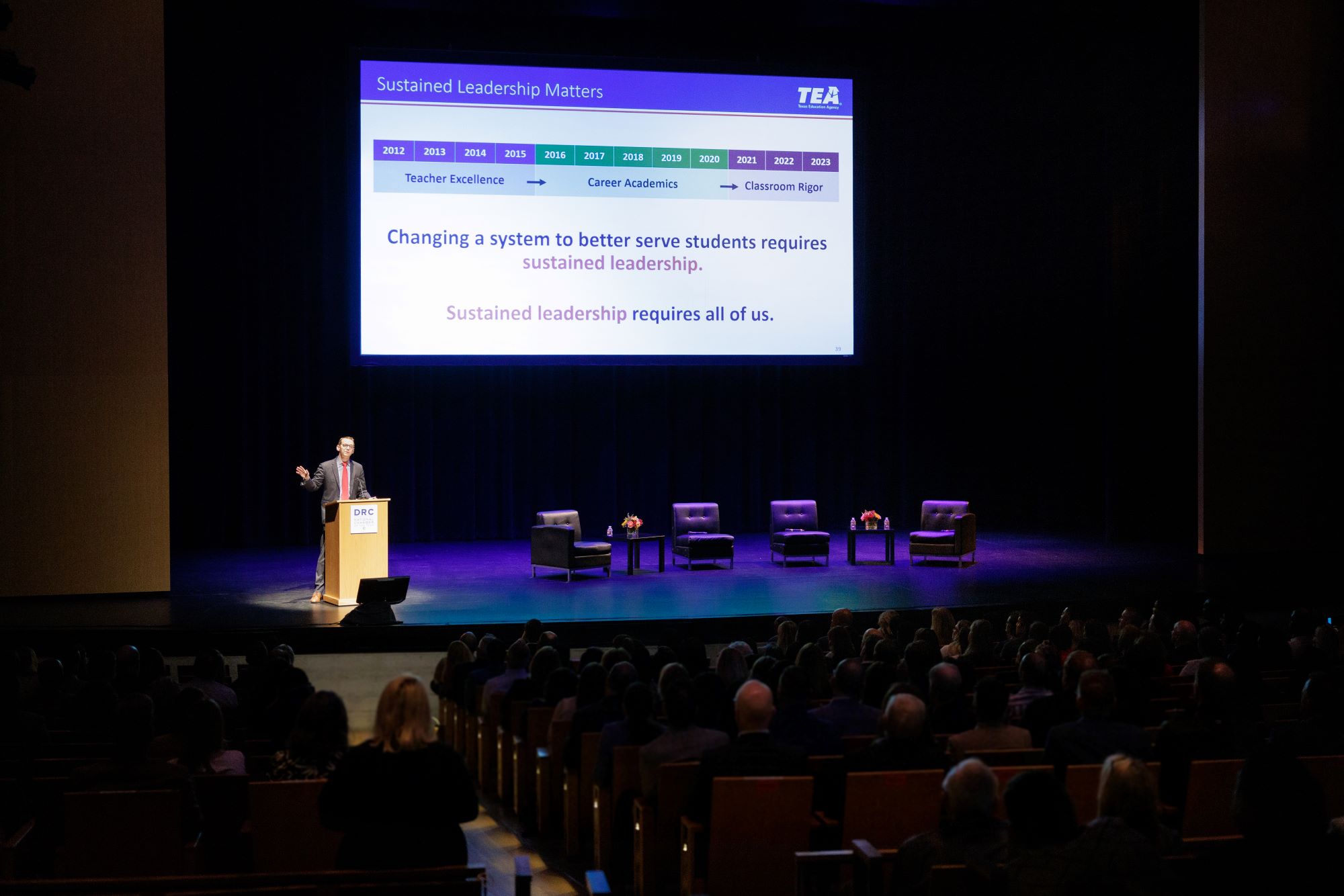
Texas Commissioner of Education Mike Morath served as the event’s keynote speaker. In his presentation, Morath emphasized the importance of public education for the more than five million children in Texas who benefit from it.

“We want all of our children to be successful in our system of public education so that after they graduate, they are prepared for whatever journey they wish to pursue in life, be that directly into college or directly in the workforce, into the military, whatever that is. And when we say all, we legitimately mean all,” said Morath. “We don’t mean unless you are born in an inner city, unless you are born in rural Texas, unless you are Black or brown or you come from a household that doesn’t speak English, literally. All children need to be prepared for success. This is the unifying mission of public education.”

The event also included a panel discussion between three regional superintendents, in which they concurred that ensuring students graduate from the public education system ready to enter and thrive in life after high school is the highest priority.

“We want our kids to graduate with options. We want them to graduate with an associate degree, a high school diploma, a STEM endorsement, or an industry-based certification because the more options you have, the better off you are with understanding what you want to do for the rest of your life,” said Cedar Hill ISD Superintendent Dr. Gerald Hudson. “If we can help you find your passion while you’re in high school, then you’re going to enjoy the rest of your life… So, we want to make sure our kids understand what opportunities are out there for them while they still have that playing field.”

Morath’s keynote focused on the most pressing issues facing Texas’ public schools, including strategies for hiring and retaining quality teachers.

“The teacher in the classroom is the single most important in-school factor that affects student outcomes,” said Morath. “There is no way that we materially improve these numbers without improving the way that we support and retain our teachers. It comes down to two key things: pay and working conditions.”

Dallas ISD Superintendent Dr. Stephanie Elizalde concurred.

“If we don’t have effective teachers, we cannot get our work done,” said Elizalde.

By introducing a performance-based pay system for teachers, Dallas ISD has closed its teacher turnover gap with the state despite a significantly higher rate of student poverty. In 2013-14, the teacher turnover rate in Dallas ISD exceeded the state’s rate by more than 5 percentage-points. During the height of the pandemic during the 2020-21 school year, statewide teacher turnover exceeded attrition rates in Dallas ISD.

“It is the only school system in the state of Texas to date that has made this change, where not everybody gets a raise every year. And instead, pay is entirely driven based upon performance,” said Morath. “And as a result, Dallas has seen a significant reduction in turnover. Their teachers are sticking around a lot longer than they used to. This is better for our teachers, but the thing is, it’s a lot better for our kids.”

A study by the National Bureau of Economic Research, cited by Morath, bears this out. Compared to its peer districts, who have seen stable student achievement since 2015 – when Dallas’ performance-based compensation system was introduced – outcomes in Dallas ISD have steadily improved.

Morath also shared that reading levels have recovered to and largely exceed pre-pandemic levels, but there is still a way to go in math.

“We say that all children, when we support them properly, can learn and achieve at high levels,” said Morath. “Schools are making improvement, but this is hard work… it’s the most important work that we do, and we’ve got to do it right.”

Dallas schools’ new approach to graduating kids with their high school diploma, work experience, and their associate degree was also praised by the commissioner.

“Dallas is leading the nation in this transformation towards career readiness,” said Morath. “We have seen a quadrupling in the number of children statewide that are graduating high school with an associate degree in the state of Texas. This is a huge, life-changing opportunity for so many kids.”

Dr. Theresa Williams, Superintendent of Plano ISD, shared that, while there is always room for improvement, it’s important to recognize the strides being made in Dallas Region’s public schools.

“We welcome rigor. That’s what it’s all about. And we want great learning environments for our kids,” said Williams. “Our teachers will do whatever they need to do to ensure that our kids are getting what they need, but we need to recognize the hard work and celebrate the great accomplishments that our kids are making.”

The State of Public Education was presented by Toyota Motor North America and Wells Fargo. Dallas College, Oncor, and The Commit Partnership also contributed as silver sponsors to this event.

If you want to learn more about the DRC’s work in public education, visit our website.

In this blog, Richard Namme, President and CEO of Nabro Furnished Housing, discusses his 15-year journey of providing corporate housing in Dallas. Drawing from the surge in migration trends from California to Texas, he delves into the role of furnished housing in the new age of mobile workforce, emphasizing Dallas’ growing economy and its implications for businesses.

How does your company help other businesses become more effective?

With increasing migration from California to Texas, businesses require immediate yet comfortable housing for their mobile workforce. Nabro Furnished Housing taps into this need by offering fully furnished, strategically located homes in Dallas, enhancing the relocating experience. This aids businesses in ensuring their employees have a smooth transition, fostering better productivity and satisfaction.

What differentiates your company from others in your industry?

Nabro stands out with its dedication to unparalleled customer service, grounded in the rich tradition of Southern hospitality. Recognizing that people spend a significant chunk of their day in their homes, Nabro prioritizes:

      1. A commitment to serve guests with excellence.
      2. Central and accessible housing units in the DFW area, equipped with modern amenities.
      3. Emphasis on privacy and security with gated communities, reserved parking, and private entrances.
      4. Tastefully furnished units tailored for the contemporary, traveling professional.
      5. Constant innovation and training to enhance guest experiences.

What do you enjoy most about doing business in the Dallas Region?

Dallas is a hub of growth and opportunity. The influx of professionals, especially from California, drawn by affordable housing and larger spaces presents a ripe market for businesses like Nabro Furnished Housing. Serving relocating professionals in a region that offers cost-effective living, combined with the vibrant economic backdrop of Dallas, makes doing business in the area both rewarding and exciting.

Why did you decide to become a DRC member?

The Dallas Regional Chamber (DRC) offers unparalleled resources for businesses in the DFW area. Its pivotal role in connecting local and relocating businesses, coupled with its knowledgeable team, makes it an invaluable platform for networking and fostering partnerships. Nabro’s association with DRC is a strategic move to further its reach and collaborate with like-minded entities.

How has your business changed in the past five years?

In the past five years, Nabro has witnessed transformative growth. From initially establishing its footing in the furnished housing sector to now being a leader in providing homes that cater to the unique needs of the mobile workforce, the journey has been profound. With the changing landscape of business and migration trends, Nabro has adeptly evolved its offerings, ensuring it remains at the forefront of the industry.

By Catie George, Manager, Communications and Storytelling

As the Dallas Market President for Capital One, Jorge Calderon is the first Hispanic Market President at a top 10 bank. Calderon, who is a member of the Dallas Regional Chamber’s Board of Directors, has a track record of growing sales-centric businesses. To help celebrate Hispanic Heritage Month, Calderon told the DRC how he approaches honoring Hispanic heritage and diversity – and how the two impact his personal outlook.

Through his role, Calderon drives Capital One’s philanthropic engagement efforts, and he believes it is critical for the business community to support the Hispanic community.

“In our great city of Dallas and in our great state, we continue to benefit from robust economic development. My hope is that we use this moment to bless the sections of our state and city that need economic stimulus, like Southern Dallas County and in communities of color,” said Calderon.

For Calderon and Capital One, recognizing Hispanic Heritage Month means being inclusive to the entire Hispanic community year-round.

It’s important to honor the many cultures that make up the growing and vibrant Hispanic community. At Capital One, we are committed to implementing workplace policies, investing in the community, and amplifying the voices of the Hispanic community year-long,” said Calderon. “We are driven by our mission to change banking for good.

Capital One offers Hispanic associates the tools to thrive through , their Hispanic Business Resource Group. HOLA leads the Hispanic Leadership Development Program and Hispanic Leaders Coaching Program, which support associates to achieve their full career potential.

Capital One’s Community Impact and Investment and Campus Recruiting teams have also partnered closely with the Hispanic Association of Colleges and Universities (HACU) to host 50 students from HACU-member institutions. Students attended leadership and development workshops and networked with like-minded peers, recruiters, and leaders, as well as volunteers from Capital One’s BRGs. HACU has increased Capital One’s student and grad program pipeline with many of these students applying for open roles at Capital One.

Calderon also personally participates in the Capital One University Crossroads program, which provides first-generation high school students with access to college preparation coursework, as well as university leaders who can provide guidance on how to navigate college and financial aid. The program helps support dedicated and hard-working parents who may not know the ins and outs of the college experience.

“My passion in business and in life is to be a role model for professionals, colleagues, and friends,” said Calderon. “I was once a product of a similar program, and I am an ardent supporter of this approach and believe that it can change the orbit of future generations, specifically for those in the Hispanic community.”

Capital One has been engaged over the last 15 years with the DRC’s Principal for a Day program. This valuable program is a chance for business and civic leaders to share their knowledge with school staff while learning more about local public schools, and experience what a typical school day is like. Calderon has participated in Principal for a Day multiple times.

Calderon also discussed the importance of mentors and sponsors throughout his career.

“A mentor is a coach, or someone who wants to see you get better at what you want to do personally or professionally, while a sponsor has the influence to give access to new professional or development opportunities,” said Calderon, echoing the definitions expressed at the recent Young Professionals event in June.

“I wouldn’t be here had I not had great mentors and sponsors early in my career. It is a life-long journey,” said Calderon. “Relationship building past your education puts you in the best position to get the job you want or that opportunity that will take you to the next level.”

While reflecting on his own experience, Calderon also encouraged companies to give back.

“Truly invest in the community and give back. After years in leadership roles, I have made it my mission to give back to others,” said Calderon. “I always ask myself how I could help others, create awareness, and try to do what I can to help those that look like me gain access to leadership opportunities.”

Michael Wood, Managing Director, Education & Workforce

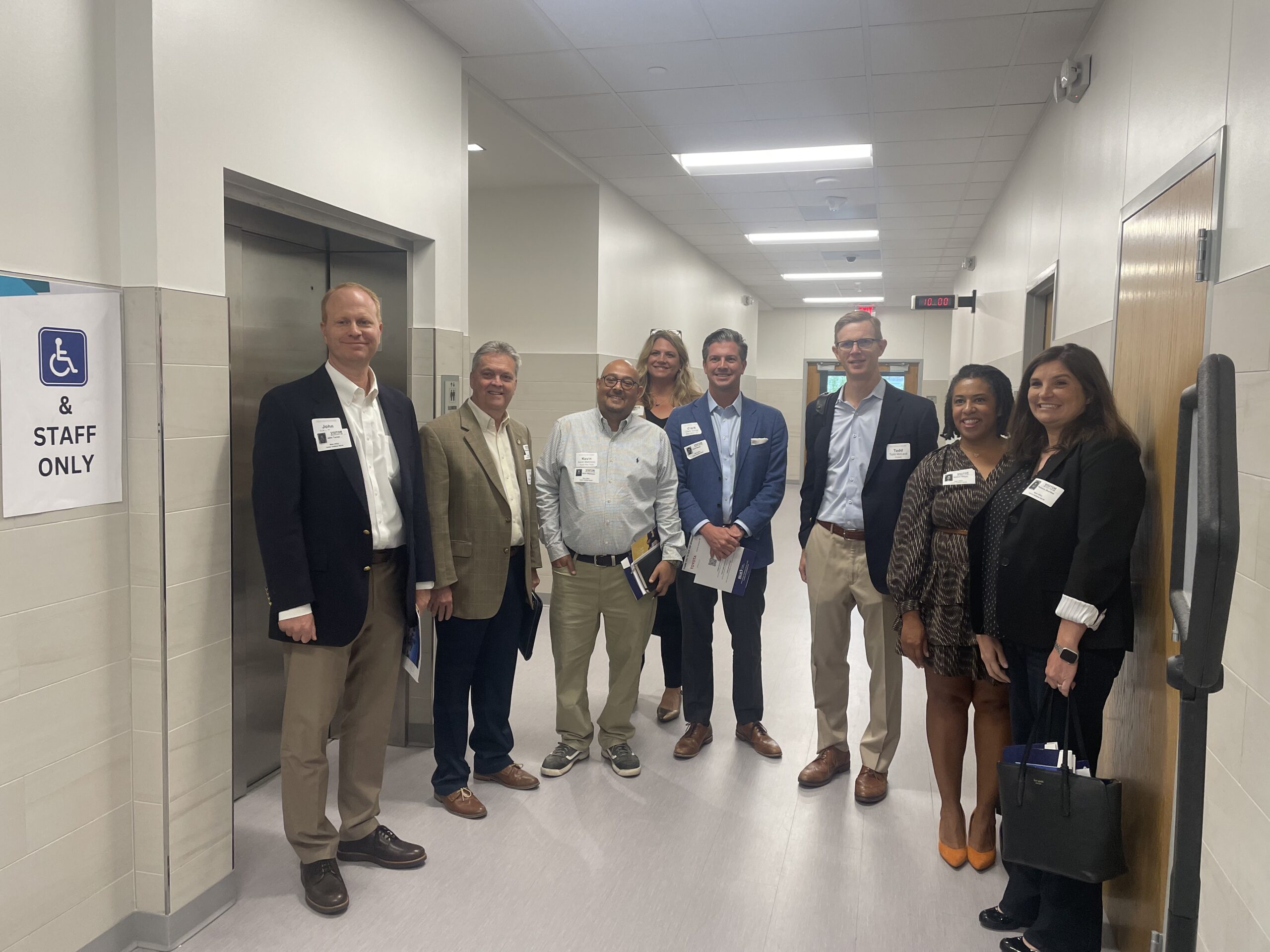
Members of the DRC Education & Workforce Council at Dallas ISD Career Institute North.

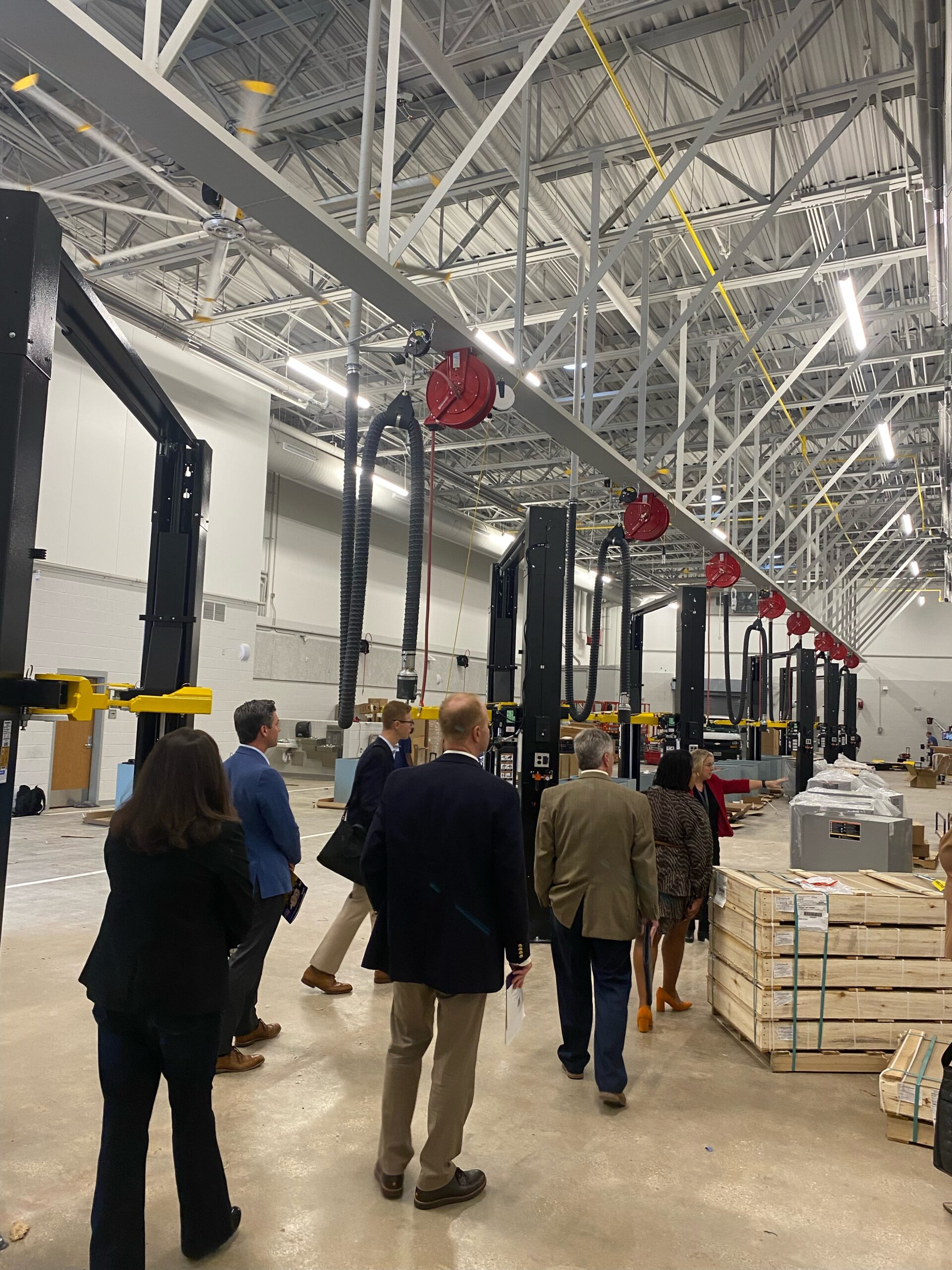
The DRC hosted members of its Education and Workforce Council at Dallas ISD’s Career Institute North campus on Tuesday, Sept. 12.

Funded by the 2020 Dallas ISD bond program, Career Institute North is one of four planned career and technical education hubs that will service every high school in the district by providing students access to a variety of career and workforce training pathways that are not available at their home campus. These programs are designed to supplement a student’s standard course load and enable the attainment of industry-specific certifications aligned with high-demand, high-wage occupations upon high school graduation.

“Dallas ISD’s commitment to career readiness is admirable,” said Jennifer Chandler, Dallas Market President and Head of Philanthropic Solutions for Bank of America and Vice Chair of the DRC’s Education and Workforce Council. “As a business community, we need to continue to lean into our public schools to form partnerships that help prepare students for the jobs of tomorrow, especially those in our own companies.”

Presently, Career Institutes North, South, and East are operational, although Career Institute North is the only campus that is fully complete. Career Institute South will be finished for the 2024-2025 school year, followed by Career Institute East in 2025-2026. Career Institute West will open its doors in fall 2026.

The Career Institutes are similar in spirit to Dallas ISD’s robust Pathways in Technology Early College High School, or P-TECH, program, which also aims to equip students with a postsecondary degree or credential upon high school graduation. Career Institutes are unique, however, in the hands-on experience they offer students. Each Career Institute campus features state-of-the-art equipment and industry experts, helping students obtain hands-on experience in their chosen industry pathway.

Currently, Dallas ISD’s Career Institutes serve just over 5,000 students. Enrollment is projected to surpass 15,000 by the 2029-2030 school year. As a result, Dallas ISD expects its already-impressive percentage of graduating seniors earning an industry-based certification, or IBC, to also improve. Just 3% of the class of 2020, or 243 students, earned an IBC. Three years later, 61% of the class of 2023, or 5,229 students, met this benchmark.

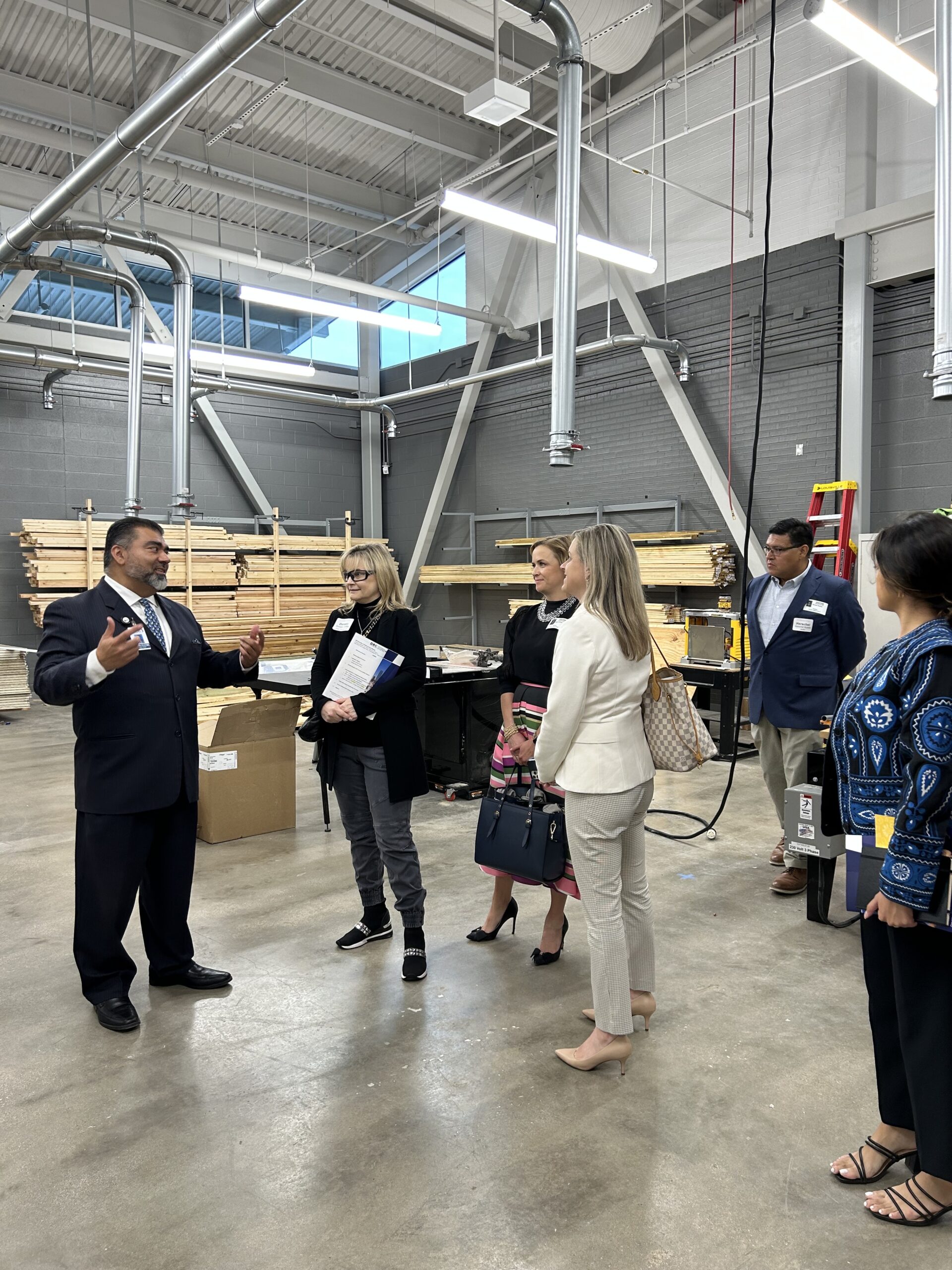
Oswaldo Alvarenga, Dallas ISD, discussing Career Institute North’s construction pathway with DRC members.
Jean Laswell, Director of Career Institute North, showing DRC members the campus’ auto shop.

“For too long, college and career readiness has been viewed as an ‘either/or,’ but it should be a ‘both/and,’” said Dr. Stephanie Elizalde, Superintendent of Dallas ISD. “Our Career Institutes, which allow students to pursue both an industry credential and credits that can stack toward a postsecondary degree, are a big step in the right direction.”

Career Institute North serves students from Conrad, Hillcrest, North Dallas, Thomas Jefferson, and W.T. White high schools and offers programs of study in 16 distinct industries. Industry pathways were selected based on projected supply, demand, and earnings using regional labor market data.

The Career Institute North campus resides in the former Walnut Hill Elementary School. Classrooms are filled with heavy machinery and equipment, from an aviation wing complete with flight simulators and drones to health science labs with hospital beds, dental chairs, and “smart” mannequins that can be programmed to exhibit symptoms.

Building the campus came with challenges. Compared to a typical school, Career Institute North is a much more complicated build, requiring different specifications for different rooms to ensure safety and alignment with industry standards. For example, the construction shop required specialty ventilation to mitigate sawdust accumulation from woodworking, and the windows above the welding classroom needed shades to protect potential onlookers from harmful light.

Industry experts have had a direct impact on Career Institute North. Dallas ISD consulted directly with practitioners on campus design and construction. In addition, many of the instructors at Career Institute North are also industry experts rather than classically trained educators to ensure that the curriculum is as up-to-date as possible with current industry practices. While Dallas ISD provides instructional coaching to these practitioners, many are already well-versed in teaching from managing teams in the field or through prior experience with apprenticeship programs, which are common in trade professions.

For more information about Dallas ISD’s Career Institutes, please contact the DRC Education and Workforce team at education@dallaschamber.org.

The Advanced Research Projects Agency for Health, known as ARPA-H, today announced that Dallas’ Pegasus Park will serve as the physical site for one of ARPA-H’s three headquarters. The Dallas hub will focus on customer experience, access, and diversifying clinical trials for ARPA-H projects.

Dale Petroskey, President and CEO of the Dallas Regional Chamber, said the following:

“The news of ARPA-H’s Customer Experience Hub coming to Dallas confirms what the Dallas Regional Chamber has known and worked toward for some time now: the Dallas Region is becoming a powerhouse for life sciences and biotechnology innovation. Bringing this hub to Pegasus Park takes this to the next level and will bring many more job opportunities to the Dallas Region.

Many partners across the state supported this effort, so this moment is another example of how Texas’ collaborative spirit leads to more and more opportunities for our people and our companies. The Dallas Regional Chamber is very excited about this win, and we will do everything possible to support the success of this great opportunity.”

The Dallas Regional Chamber provided key economic development, research, and policy support throughout the ARPA-H bidding process, including presenting to the selection committee.

By Catie George, Manager, Communications and Storytelling

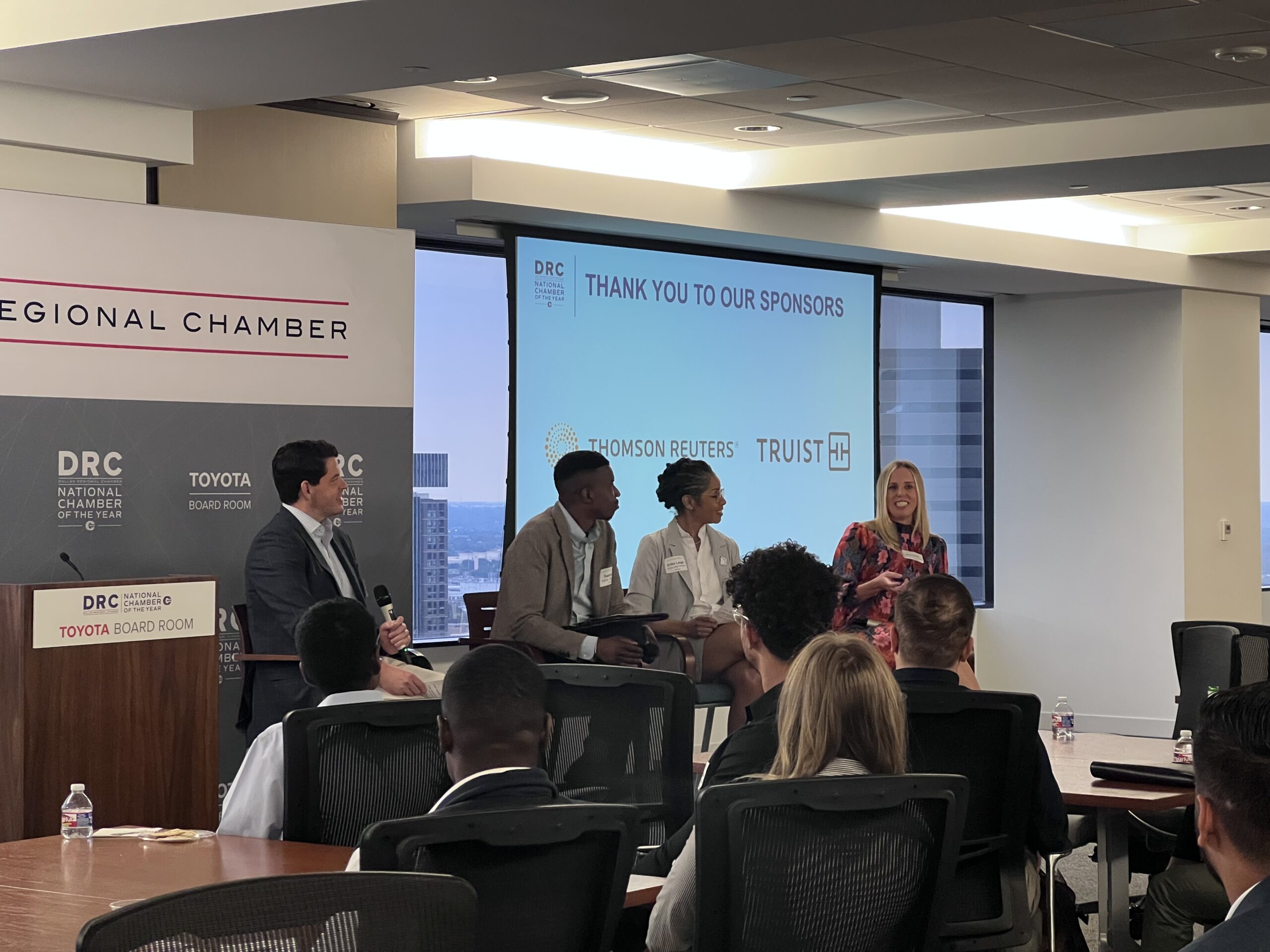
The Dallas Regional Chamber (DRC) hosted its Young Professionals (YP) General Membership Meeting Tuesday, Sept. 12, at DRC headquarters. The meeting connected young professionals and provided insight into how to make the most of a DRC YP membership.

“YP is made up of over 300 emerging leaders from many different industries, and we contribute to the DRC’s mission to improve the quality of life in our region by providing monthly programming that’s focused on topics that are relevant to our young professionals,” said Olympia Newman, Managing Director of Leadership Programs at the DRC. “We also encourage service through volunteerism, civic engagement, and local advocacy, and we facilitate relationship building and collaborative partnerships.”

Attendees heard from three established YP members and the 2023 YP Chair Mark McKendrick, Employee Health & Benefits Advisor at Marsh McLennan Agency, about their YP experiences.

“What attracted me to YP and the Dallas Regional Chamber is that I wanted to learn more about business in Dallas,” said McKendrick. “In the last twelve years, there’s been over 250 businesses and headquarters that have moved to the Dallas-Fort Worth area. There’s so much opportunity out here.”

Danielle Reynolds, Business Development Manager at Whitley Penn, highlighted the value of plugging into the DRC through YP.

“What kept me with the Chamber is it really is an organization that grows with you as your career progresses and grows,” said Reynolds. “I think it’s an organization that’s intentional with the work that they do. I think the access they give young professionals is huge.”

In addition to professional development, YP promotes community service through service days. In May, YP members partnered with Tango Charities for Feed the City to make meals for unhoused individuals.

“Why I’m a part of this organization is because we’re not just making connections within these four walls, but we’re stepping out and we’re doing things to impact our communities,” said Erika Leigh Nobles, Lease Administration Manager at Colliers. “Even though we may not ever see the homeless people that we made sandwiches and chips for, we still were a part of something big that day.”

The panelists agreed fully committing to YP activities and opportunities is key to maximizing membership.

“You really can get a lot out [of YP] based on what you put in,” said Gene Mance, Jr., Senior Project Program Manager at AT&T. “It’s not only for career advancement, but you can make a lot of friends. It’s about establishing real and authentic relationships, and I think that’s very important,” said Mance.

The young professionals at the meeting were assured that they had already started their professional development journey and were encouraged to keep going.

“Y’all showing up here tonight is the hardest part. You have to show up, you have to go for it,” said Reynolds. “You have to be all in on what you’re doing, or else you’re not going to get the most out of it.”

To become a Young Professional, contact leadership@dallaschamber.org. Learn more about YP on the DRC’s website.

By Catie George, Manager, Communications and Storytelling

The Dallas Regional Chamber (DRC) hosted a Tomorrow Fund Investor Breakfast, presented by Holmes Murphy, in its offices Wednesday, Sept. 13. The event, hosted quarterly, is for investors in the DRC’s Tomorrow Fund, which powers the DRC’s mission work.

“We work each day to help make the Dallas Region better tomorrow than it is today,” said DRC President and CEO Dale Petroskey. “That’s why we call it the Tomorrow Fund… We host these breakfasts to connect you—our Tomorrow Fund investors—with the people, companies, and concepts that help shape the future of our region.”

The Q3 event honored innovation’s role in the Dallas Region.

“The sign that we’re a prosperous region is that we’re able to grow businesses from our own soil and innovate businesses,” said Petroskey on the importance of innovation in the Dallas Region. “And innovation is what’s going to set us apart even further from every other market in the country.”

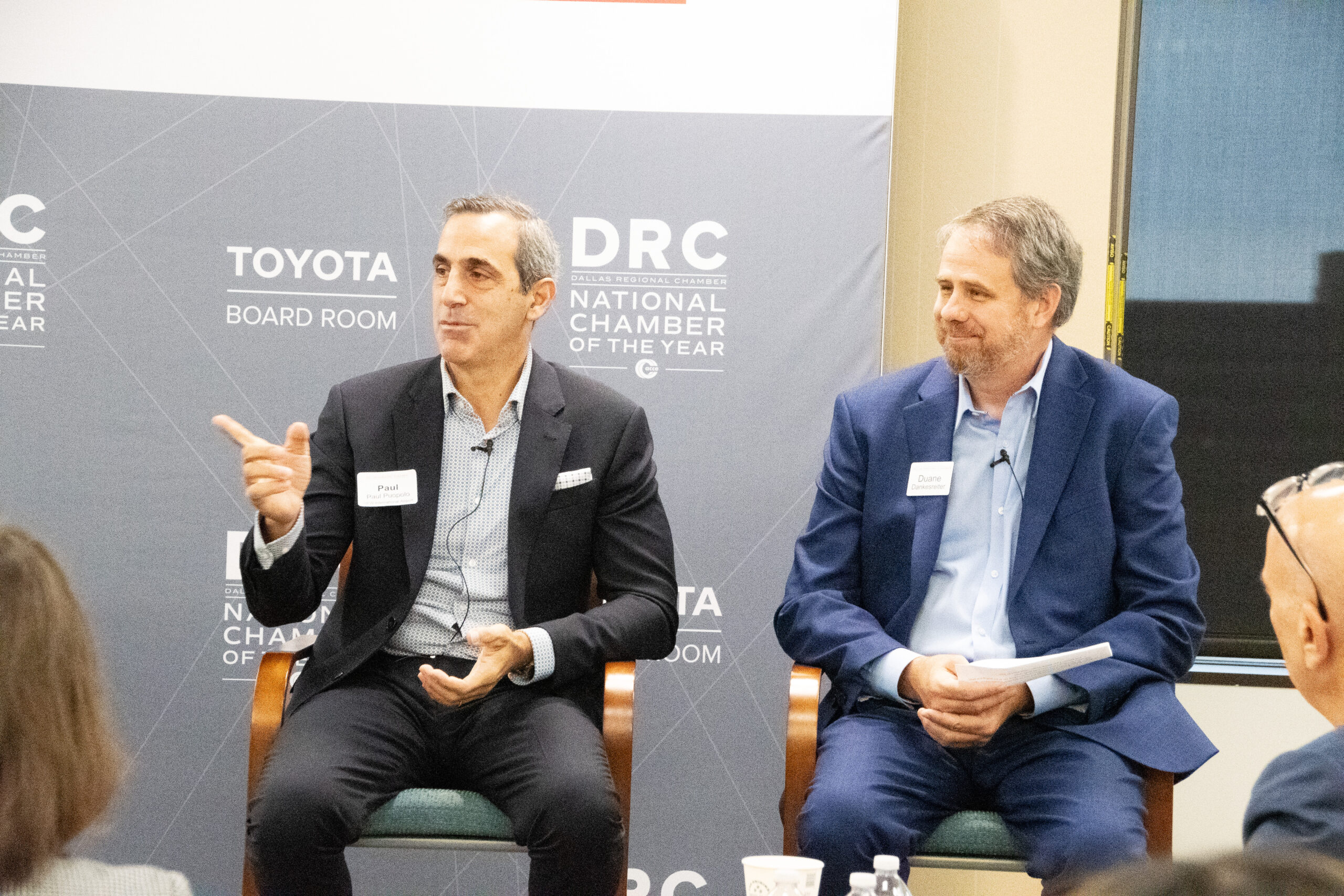
The featured speaker of the meeting was Paul Puopolo, Executive Vice President of Innovation at Dallas-Fort Worth International Airport (DFW International). Puopolo shared how DFW International has approached innovation and made the case for other companies to do the same, starting with appointing a dedicated person and/or team to develop innovative solutions within a company.

“The biggest challenge for companies is managing today’s challenges while keeping up with the unpredictable future. You need leaders in the organization and people who can think not only about the present value of your company but the future value — and that is not easy to do,” Puopolo said. “But innovation and a full innovation function that can help you future-proof your organization, that can help you build business resiliency, is what we do [at DFW International].”

Puopolo warned against the temptation to view innovation as a side project, or not prioritize it, within a company.

“If everybody says that they’re innovative, then nobody’s responsible for innovation,” said Puopolo. “Research shows innovative cultures lead to competitive advantage. It’s not hard to see that, but you have to have good leadership. You have to have people who are willing to take managed risks at your organization, and you have to have a sense of urgency. You can’t just wait. These technologies are moving so fast.”

Puopolo gave an example regarding the ideation of autonomous vehicles in DFW International and spoke to how developing innovative technologies requires looking ahead at infrastructure to support them.

“We doubled down on autonomy two years ago. We saw that the future of mobility is going to be autonomous. It’s going to be connected, it’ll be electrical, and it’ll probably be some form of shared,” said Puopolo. “An interesting thing about autonomy is that it needs a network. We invested in the 5G network last year because we saw all this technology coming, and it needs a different network. And so, private 5G network is what we’re rolling out, and that was critical for us to be in the autonomous and the mobility space.”

Following Puopolo’s presentation, the DRC’s Vice President of Economic Development – Life Sciences, Kelly Cloud, shared an update on the DRC’s campaign to recruit more companies and jobs in the life science and biotech sector to the Dallas Region – an effort that capitalizes on existing strengths.

“We have the seventh most life science and biotech jobs in the U.S., the fourth most engineering jobs, and we have one of the most diverse economies. There’s a lot of translational talent there,” said Cloud.

She emphasized that the Dallas Region life sciences ecosystem is established and waiting to help those who want to take advantage of it.

“There’s a lot of people who have their head down, working very, very hard on their discovery and their innovation, where they don’t come up for air and realize there is a whole ecosystem here that wants to help you and wants to support you and wants you to grow,” said Cloud.

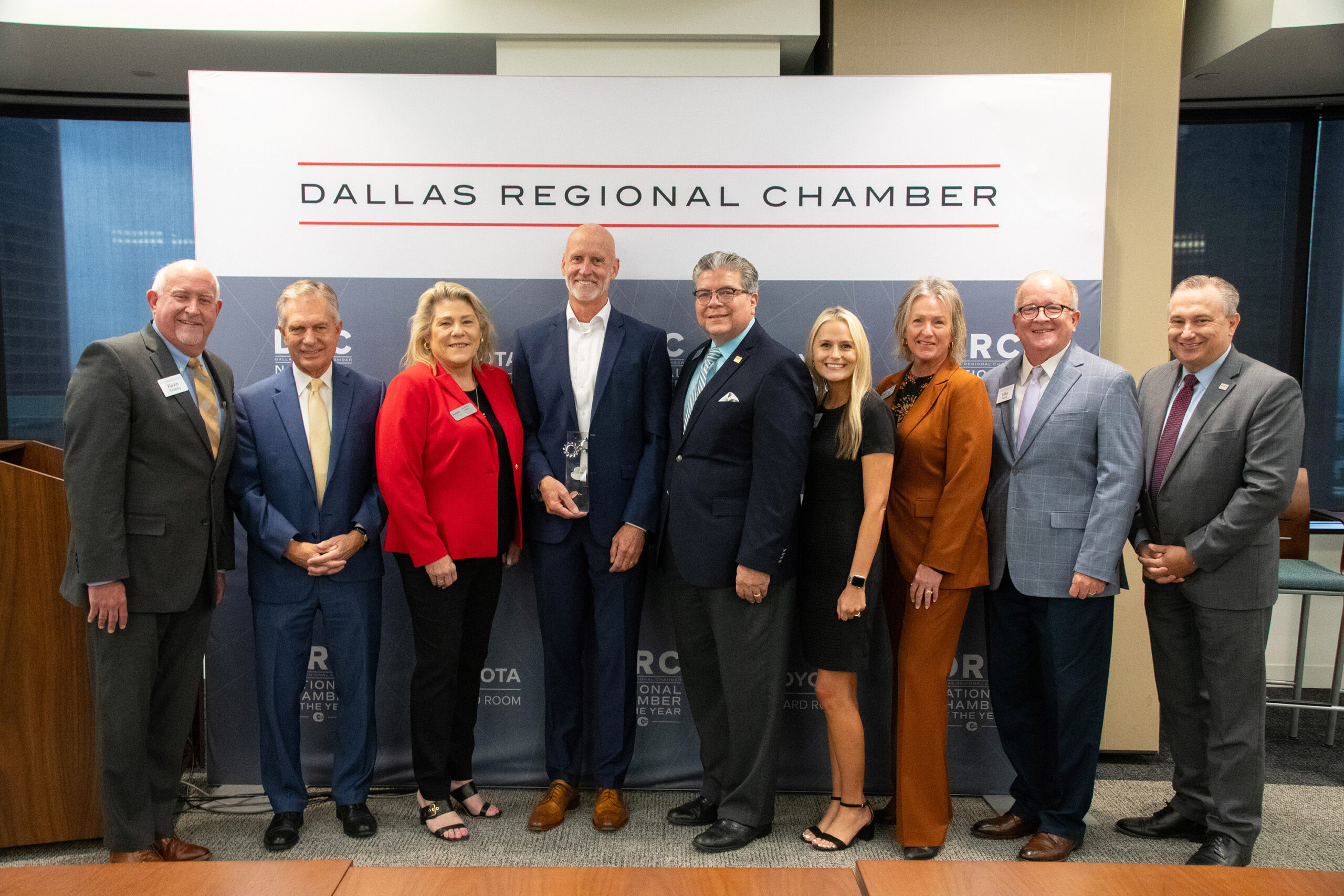
Also during the event, the DRC presented Canadian Solar with a Building Tomorrow Together Award. The company announced in June its first U.S. manufacturing plant will be in Mesquite – creating 1,500 jobs for Southern Dallas County. On Monday, Sept. 11, Trina Solar – a competitor company of Canadian – announced plans for a major photovoltaic plant in Wilmer, also in Southern Dallas County.

Canadian Solar’s Director of Special Projects Rusty Schmit sees a competitor moving in nearby as a net positive for the Dallas Region.

“The great news is Texas is becoming the solar capital of the country,” said Schmit. “And the fact that more companies are coming is going to help develop the supply chain and help us succeed.”

Read more about Canadian Solar and Trina Solar’s plans and why they are good for the Dallas Region.

To invest in the Tomorrow Fund and support the DRC’s strategic efforts to improve the quality of life for all people in the Dallas Region, contact memberinfo@dallaschamber.org. Investing in the Tomorrow Fund grants you access to quarterly investor breakfasts.

By Catie George, Manager, Communications and Storytelling

The Dallas Regional Chamber (DRC) hosted the State of Diversity, Equity, and Inclusion, presented by JPMorgan Chase and Accenture, at the Dallas Holocaust and Human Rights Museum Tuesday, Sept. 12. The signature event brought together industry leaders and regional professionals to share insight into maintaining commitments to diversity, equity, and inclusion (DEI) despite changes and challenges to continue working to narrow opportunity gaps to improve quality of life for all people in the Dallas Region.

“At the Dallas Regional Chamber, our reason for being is prosperity for all. That means making sure that those who are here have the opportunity to grow and thrive even more,” said Dale Petroskey, DRC President and CEO. “We won’t be all we can be, or reach our full potential as a community, until we close the opportunity gaps. The work never ends. We will never stop working until those gaps are closed and everyone in this community has a shot at the prosperity going on here.”

In his welcome remarks, Petroskey announced the DRC is ending the year with $300,000 more for DEI than when it started, thanks to investments by member companies. Axxess got the ball rolling with a $100,000 challenge grant in May. Capital One, the Dallas Stars, the Law Offices of Erika N Salter, P.C., Frito Lay, and Texas Instruments each made contributions to match Axxess’ challenge, and the Dallas Mavericks chipped in an additional $100,000 to continue their resounding support of the DRC’s DEI program of work.

“We can’t thank you all who stepped forward to do this work enough,” said Petroskey.

The sold-out, third-annual event opened with a fireside chat between Forest T. Harper Jr., the President and CEO of INROADS, and Cynt Marshall, CEO of the Dallas Mavericks.

“No matter your ethnicity, no matter where you’re coming from, you just want access to equity… So that’s what INROADS has been focused on,” said Harper.

INROADS helps create pathways for ethnically diverse high school and college students to enter the workforce and start their careers by arranging internships and connecting students to mentors. In the discussion, Harper shared some metrics demonstrating the program’s success, namely that INROADS alumni are outpacing white counterparts by 40% in net worth and 12% in homeownership rates.

Even with the program’s success, Harper had a charge for companies.

“Widen the highway, corporate America,” said Harper, speaking to pathways for diverse individuals. “You own the pipeline.”

The second panel featured Nimesh Jhaveri, Executive Vice President and Chief Impact Officer of McKesson, Cece Cox, CEO of the Resource Center, and Joseph Hernandez, Senior Director of Diversity, Equity & Inclusion at TIAA. The conversation was moderated by Dannetta Bland, North America Board Effectiveness and Sustainability Lead at Accenture, and led with talk about the progress that has been made and where DEI is going.

“We need to look at what others before us have accomplished. We have to look and appreciate the shoulders that we stand on. Those folks didn’t stop,” said Hernandez, speaking to the women’s rights movement. “They kept going because they knew that if they stopped, things would only get worse.”

“Our commitment to DEI stems from a deeply rooted tradition of doing well by doing good. We love this community, we live in this community, we work in this community,” Jhaveri added. “The past is really helping shape our future. We can’t rewrite history, but what we have learned is that we have the power to write the next chapter as we work to build a more equitable and just society.”

The panel also touched on DEI in education, and how it contributes to the workforce.

“Without the opportunities for a young person in university to be seen and heard, have their questions answered, explore their identity, however they identify, or have their identities affirmed, is really going to be detrimental to the ability to recruit and to acquire talent that has had a full college and academic experience,” said Cox. “In order to have the most educated, loyal, equipped, and talented workforce, they need to feel seen and heard and included.”

The panel also emphasized the importance of community for those who work in DEI.

“It’s important that we work with folks from other companies, from other organizations, folks like the DRC, that are willing to help us and get the right tools in place, the right practices in place,” said Jhaveri. “It’s important that we get into forums like this, and we share our experiences, we share what is working, what is not working, and how we can do it together in a better way.”

During an overview of the DRC’s progress and accomplishments in the DEI space since 2020, Latosha Herron Bruff, Senior Vice President of Diversity, Inclusion & Community Engagement, shared that a key focus of DEI for the DRC and the Dallas Region going forward should be disability inclusion. According to the Centers for Disease Control and Prevention, 90 million U.S. adults live with a disability, and the U.S. Census shows the unemployment rate for disabled individuals is double that of non-disabled individuals.

“That means we have work to do in this area, and the DRC wants to put energy and effort into the next year and developing partnerships with a lot of you to move the needle,” said Bruff before announcing the DRC will release a Disability Inclusion Toolkit in early 2024.

“Disability inclusion is not tolerating people with disabilities but creating a workplace where they feel welcome, comfortable, and appreciated,” said Bruff. “We want to bring businesses a step ahead and help find that diverse talent.”

“Today’s State of DEI program shows that the promise we made three years ago [with the creation of the DEI Council at the DRC] is being carried forward and that we’re committed to that work,” said John Olajide, President and CEO of Axxess and former DRC Board Chair. “I have no doubt that we will realize our goals to make the Dallas Region the most prosperous region in the country for all people.”

The State of Diversity, Equity, & Inclusion was presented by JPMorgan Chase and Accenture. Gold sponsors included American Airlines, Axxess, KEIRUS BY KJE, Oncor, and Thompson Reuters. Silver sponsors included American National Bank of Texas, Kanarys, and the Law Offices of Erika N. Salter, P.C.

If you are interested in learning more about the DRC’s Diversity, Inclusion, and Community Engagement work, visit the DRC website.

If you would like to help the DRC with its Disability Inclusion Survey, visit here.

Tell us about Texas Tech University Health Sciences Center (TTUHSC) and the university’s presence in Dallas.

We are bringing the TTUHSC mission and vision to the metroplex so students in Dallas and surrounding areas can attend TTUHSC programs locally.

What should the Dallas Region’s business community know about TTUHSC?

We have roughly 400 students enrolled in our nursing programs and 150 students enrolled in our pharmacy programs each academic year who are living and working in the DFW metroplex.

We also partner with key health care organizations across the region to provide real-world experience to our students. We want to prepare our students to meet the demands of today’s health care environment while also seeking to support the communities we work in through research, clinical resources, and health education.

Why is TTUHSC’s presence important for the Dallas Region?

We recognize the dire need to address healthcare disparities and produce well-prepared, highly qualified professional nurses and pharmacists to meet the industry shortages. We are helping address the nursing and pharmacist shortage across the country by producing high-quality nursing professionals at all levels and high-quality pharmacy professionals who are well-prepared. We are innovative and strategic in ensuring our graduates are prepared to transition effectively into practice.

Additionally, we partner with the community to serve those around us. We seek to provide educational opportunities to a diverse population of learners. We contribute to advancements in health care through research, practice, and quality improvements. We also offer a telehealth institute across the region.

What is new at TTUHSC Dallas?

The TTUHSC Dallas Campus is currently undergoing renovations to create more classroom space and partnership opportunities.

Tell us more about the upcoming nursing simulation center.

We are planning to open a new nursing simulation center in the next year. This center is targeted toward meeting academic needs, as well as providing more opportunities to collaborate with the community. This includes exposing prospective students to health care education opportunities education as early as middle and high school.

Anything else you would like to add about TTUHSC?

Many people do not realize that TTUHSC has a campus in Dallas, offering School of Pharmacy and School of Nursing, as well as a nursing program in Mansfield. Students from throughout North Texas can participate in TTUHSC pharmacy and nursing programs without having to move to West Texas. We will continue to evaluate opportunities to expand our programs and create partnerships throughout the North Texas region.

By Mike Rosa, Senior Vice President, Economic Development

In June, Canadian Solar announced it will establish a large photovoltaic module manufacturing plant in Mesquite. Trina Solar announced plans for a major photovoltaic plant in Wilmer on Monday, Sept. 11.

The Dallas Regional Chamber played a big part in the recruitment of both projects.

Our first contact with Canadian Solar was in 2017 when the DRC welcomed company executives and aligned with our allies in Mesquite to showcase the preferred facility and all Mesquite had to offer.

Our work with Trina Solar began several months ago through our longstanding relationship with a site location consultant working on behalf of the company.

It’s great to work alongside community allies, workforce and education partners, and DRC chamber members to engage and win projects like these. We are excited about the job and business opportunities these projects create for our region—especially those in Southern Dallas County.

Combined, the two projects initially promise 3,000 good-paying jobs for the Dallas Region. Additionally, jobs will be indirectly created when these manufacturers induce other companies, like suppliers, to locate and expand nearby. Plus, retail and service businesses and jobs will be supported by thousands of families with expanded incomes.

These projects are big and impactful. They represent a total of 1,750,000 square feet of space and $450 million of capital investment, which also boosts the tax base in the region.

Manufacturing is important to our regional economy. When products are made in the region and sold mostly outside of the region, new dollars flow back in to keep our economy healthy and growing.

Our region is home to nearly 300,000 manufacturing jobs, more than anywhere else in Texas. We also boast the most diversity in what we produce. From semiconductors, aircraft, trucks, and cars, to food, beverages, and pharmaceuticals, the diversity and success of our manufacturing base is a big ingredient in the secret sauce that makes our regional economy outperform all others in recent years.

The solar energy sector is relatively new and, like life sciences and other emerging sectors, will be an important part of our regional economy in future years.

Southern Dallas County has a strong base for manufacturing. The area is already home to companies like Dal-Tile and Gatorade in Dallas, Niagara in Lancaster, Solar Turbines in DeSoto, American Leather in Dallas, and more. Our Southern Dallas County Economic Development Guide highlights these and all the other companies operating there.  Now, we can add Canadian Solar and Trina Solar to the list.

Our region’s best and brightest future is for all people to have access and a path to good jobs and a good life, and for all our cities and neighborhoods to prosper. When good jobs by the thousands become available near people who need them most, lives and families can be forever made better. A rising tide in Southern Dallas County lifts all boats in this region.

By Catie George, Manager, Communications and Storytelling

The Dallas Regional Chamber (DRC) hosted the second annual State of Public Safety, sponsored by Texas Instruments, Thursday, Aug. 31, at the University of North Texas (UNT) at Dallas. The signature DRC event featured public officials, safety experts, and legislative representatives in conversation about their commitment to public safety to support continued prosperity for the Dallas Region.

“We believe companies are only as strong as the communities in which they operate, and one of the most important tenets to every strong community is a fair, transparent, and trusted public safety system,” said Rafael Lizardi, 2023 DRC Board Chair and Chief Financial Officer of Texas Instruments, to kick off the event. “We also believe that the business community has a shared responsibility to make our region a safe place to live and work for everyone. That starts with conversations like the ones we’ll be having today with law enforcement, first responders, and academic and public policy experts.”

The first panel discussion between UNT Dallas President Bob Mong and Dallas Police Chief Eddie Garcia highlighted the new Regional Law Enforcement Training Center, which will be built at UNT Dallas and serve as a regional training facility.

“The fact that it’s a regional facility, to be able to assist other agencies, is something that will be a shot in the arm not just for the city of Dallas, but for the whole area,” said Garcia. “Our communities don’t want us to go away. They want us to be better as a profession, there’s no question about it. But we have to hold ourselves accountable as a department. And we do that.”

Funding for the training center was a priority for the DRC during the 88th Texas Legislative Session. Advocacy efforts ultimately helped secure $20 million in funding for the facility, which will replace Dallas’ outdated police training academy. The current academy was billed as a temporary solution when it opened in 1990 and has not been renovated since.

President Mong also anticipates the new facility to be successful because of UNT Dallas’ approach to collaboration throughout the region.

“I look at us as a work in progress, which is a good thing. We’re not steeped in ‘this is the way we’ve always done things.’ We’re very collaborative,” said Mong. “I’m happy to say that while criminal justice enrollment around the country is spotty, it’s up and down, ours has been growing.”

Chief Garcia also revealed that contrary to national statistics, violent crime is down in Dallas. Garcia attributes this to a data-driven policing approach, as well as consistent support from the Dallas mayor, city council, and city manager.

With several retail companies in the room, Chief Garcia addressed the Dallas Police Department’s approach to managing the “epidemic” of organized retail theft.

“We’ve dedicated two detectives from our financial crimes unit to be involved. Intelligence gathering is key,” Garcia said, adding that this issue being widespread offers the opportunity to compare mitigation strategies with national and other local law enforcement entities.

The second panel featured Texas Representative Victoria Neave Criado, Assistant Dallas Fire Chief Tameji Berry, and Executive Director of the Caruth Institute Jeff Spivey. They kicked off the panel with a nod to the DRC.

“The Dallas Regional Chamber has been a strong partner in our bipartisan Dallas area legislative delegation,” said Criado. “We really appreciate it whenever y’all come down to the Capitol and talk to us about issues that are important to you. I think this partnership has been helpful as we move forward legislation that impacts our entire region.”

One piece of legislation the panel discussed in detail was a bill that opens the pool of applicants to the Dallas Police Department to allow legal permanent residents to apply in hopes of addressing the staffing shortage in law enforcement.

“The recruitment and retention of police officers is a national issue that no one has an easy answer for. However, just because we have a vacancy in an organization, just because we need a rear end in that seat, doesn’t mean we should lower our standards,” said Berry. “And this legislation really set forth some standards so that the men and women in these communities know the police officers we’re hiring are the best and the brightest… And just as with the legislation, it’s not lowering the bar, it’s just doing something a little bit different.”

Knowing the sacrifice police officers and firefighters consistently make, the audience was curious how to best support them and get involved in public safety.

“I would encourage you, from a business standpoint, to encourage your employees to really understand the inner workings of public safety, not just what they read or see on social media or in the mass media, but really being involved,” said Spivey.

“I think that if the business community continues to advocate for mental health for the entire infrastructure, that would be a great start,” Berry added. “And then look at what it is you have that you can leverage to support us.”

DRC Senior Vice President of Inclusion and Community Engagement Latosha Herron Bruff closed out the program with some final encouragement to the audience to get involved.

“Public safety is an economic imperative,” said Herron Bruff. “It is important for the business community to align with public safety to make sure that we not only concern ourselves with the prosperity of the region, but we consider how to make our region stronger and safer.”

The State of Public Safety was presented by Texas Instruments alongside Target and Thompson Reuters as gold sponsors and Oncor and Toyota Motor North America as silver sponsors.

If you are interested in learning more about DRC priority areas, visit the DRC website. Join us for future events by visiting our events page.

By Catie George, Manager, Communications and Storytelling

In response to the rapid rise in accessibility to artificial intelligence (AI) tools, the Dallas Regional Chamber (DRC) convened a panel of AI experts for its Q3 Executive Circle event, presented by McKesson, on Tuesday, Aug. 22, at AT&T’s Dallas headquarters.

The conversation, which took place in front of business leaders from the Dallas Region, shed light on the impact of AI on how companies do business and shared practical insight into how companies can navigate and utilize AI.

“So much is happening in this space; it’s a broad topic,” said Nancy Avila, Chief Technology and Information Officer at McKesson and 2024 DRC Board Chair. “The adoption of ChatGPT brought to light artificial intelligence in this day and age. It took them two months to get 100,000,000 users last year… When I think about AI, speed is a critical factor… With the ability to use data to have a whole new level of interaction, how do we think about that?”

The panel featured industry experts David Williams, Assistant Vice President of Automation for AT&T Business Solutions; James Harding, AI and Machine Learning Specialist for Google North America; and Sindhu Avalokita, Vice President of Operations at Jacobs. Corbett Guest, President and Chief Strategy Officer of Imaginuity, served as the event’s moderator.

“[The AI revolution] promises to potentially be bigger than the Industrial Revolution, which is a lot to take in,” Guest said, setting the stage for the discussion. “It’s a big change our society is about to go through.”

In the past few years, the rapid rise of AI has left many companies and businesses wondering how to integrate the technology while maintaining security and privacy.

While Williams and Harding brought the perspective of companies leading the development of AI for business and personal applications, Avalokita shared the perspective of a company using AI to optimize operations. She said the employee experience is an important factor when considering adoption.

“I think that there is a lot more fear than excitement in the system. It should be vice versa. And so, I think for leaders and companies, how do you lead people alongside?” said Avalokita. “When you bring people alongside, I think that goes a long way.”

“No one can see a problem perfectly from one vantage point. We need every single person,” Williams concurred. “I want the administrative person listening to the technical discussion because there’s probably something we’re going to miss on the field… You need every single perspective.”

As Avalokita sees it, AI has the promise to improve the employee experience by taking on some of the day-to-day tasks that occupy employee time so they can spend more time in the “think tank.”

“Let’s engage employees with the high-value conversations where we need emotional intelligence, judgment, and experience. Let the AI tools do the manual stuff for us,” said Sindhu.

Williams agrees, saying AI can help employees do more enjoyable work.

“There was a little bit of fear, ‘is this going to do something to my own job?’ Well, you know what? [AT&T’s competitors] are trying to do something to your job, too. So, let’s get to it,” said Williams.”

Harding says Google, as a developer of AI technology, and many of its peers are considering access and equity in rollout.

“Our goal is to make information available and make sure that everyone has access,” said Harding. “As we release this technology, we want to make sure that it is accessible… [and] Google is trying to be very responsible.”

Avalokita cautions that the issue of AI accessibility starts with ensuring every American household has access to reliable, affordable internet. Companies are trying to address the digital divide through a variety of ways.

“Outside of AT&T, we’ve done a lot with trying to close the digital divide. There’s a lot of work to be done,” said Williams. “We try to provide great internet access, as well as computers and other technology and devices so that folks not only have access to it, but the device to use it. Then we also put workshops in those learning centers so that folks can learn how to use those devices.”

One thing is clear about AI: it is not slowing down any time soon.

“This thing is just getting started. If you think it’s moving fast now, it’s not. This is the school zone,” said Williams. “Once they get this train set on the track, it will not be an Amtrack. It’s going to be a bullet train. And so, I would encourage all of you to embrace it sooner than later because as the train starts moving faster it might be a little harder to catch on.”

This DRC Q3 Executive Circle event was presented by McKesson alongside Bridgepointe Technologies as the event sponsor and Imaginuity as the moderator sponsor.

If you are interested in becoming a member of the DRC Executive Circle, learn more on the DRC website.

Bay Immigration Law represents startups and entrepreneurs in their search for creative immigration solutions to meet their short- and long-term business goals. Bay Immigration Law immigration attorneys will work with families directly to achieve their immigration goals in a timely and cost-effective manner.

Yana Albrecht, Managing Partner

How does your company help other businesses become more effective?

Bay Immigration Law is a full-service immigration law firm that represents corporate clients, individual entrepreneurs, professionals, and their families in their search for creative immigration solutions to meet their short- and long-term business goals.

What differentiates your company from others in your industry?

The key benefit to working with Bay Immigration Law is expert legal advice in a collaborative setting. Managing Attorney Yana Albrecht and her team constantly listen to the clients, create the right strategy to succeed in their individual cases, and help them plan the future. With offices throughout the United States, our team members have an opportunity to periodically travel to one of our office locations so our clients feel comfortable talking with us and get assurance our firm is zealously advocating for their interests. Our law firm also works in Canada and the U.K.

What do you enjoy most about doing business in the Dallas Region?

Our law firm’s original office is in Palo Alto. Having our headquarters in the heart of Silicon Valley means many of our clients are in the technology space, in fields characterized by innovation, blazingly fast transformations, and imaginations fired with the conviction that they can do something to solve a major problem or improve conditions in the world today. When there was a question of where to open our second headquarters, Dallas was the most favored city as it has a great economy and resources for all kinds of companies. We are so excited to have our brand-new headquarters here!

Why did you decide to become a DRC member?

The DRC not only provides an opportunity to connect with local communities and businesses but also a platform to build lasting partnerships with various businesses and organizations. The DRC has been named the national chamber of the year, so there is no doubt that it is extremely valuable to be a member of such a great organization.

How has your business changed in the past five years?

We have come a long way since we founded our firm in 2012. In the past several years, our firm has experienced tremendous growth and expansion overseas. Despite our growth, we still maintain “the client-first approach,” where each client continues to get the personal attention they deserve on their case, whether from an attorney, paralegal, or other support personnel. Although the pandemic created challenges for everyone, we went into it with the mindset that it would be an opportunity for us to be more imaginative, attentive to unexpected situations, and attuned to our own growth. Our expansion has allowed us to communicate even better with our clients and diversify our services. For example, historically most of our clients are founders of startups, persons of extraordinary abilities, or skilled as managers. Obviously, they have spouses, children, and other family members that they care about. So, one of the ways we’ve consciously decided to manage our growth is by expanding our services so that we can even better address the issues of family-based immigration.