By Chatashia Brown, Manager, Diversity, Equity & Community Engagement

Martin Luther King Jr. Day

Martin Luther King Jr. Day, observed on the third Monday of January, marks the birthday of civil rights leader Martin Luther King Jr. He was instrumental in the passage of the Civil Rights Act of 1964, which outlawed discrimination in public accommodations, facilities, and employment, and the Voting Rights Act of 1965. The holiday promotes equal rights for all Americans and is marked by education about the work of Martin Luther King Jr., the struggle against racial segregation and racism, and as well as community service.

Best Practices for Celebrating Martin Luther King Jr. Day in the Workplace

      • Invest in DEI Training and Efforts
            • DEI training, conversations, and resources are all great ways to celebrate MLK Day in the workplace. Although this can and should be offered year-round, the holiday serves as a great opportunity to share your corporate values with employees and consumers.
      • Encourage or Offer Service Opportunities
            • If your organization gives employees paid time off to volunteer, or organizes volunteer activities during work hours, remind employees of those opportunities. Read more about how companies can celebrate MLK Day
      • Educate Yourself and Others about Dr. King and the Civil Rights Movement
            • Learn more about Dr. King’s role in the Civil Rights Movement, MLK Day, its history, and its present-day manifestation. You can find books and speeches written by Dr. King here: Books & Bibliography – The King Center

Events

Lunar New Year

Lunar New Year is a celebration of the arrival of spring and the beginning of a new year on the lunisolar calendar. It is one of the most important holidays celebrated among Eastern and Southeastern Asian Cultures, including in Chinese, Vietnamese, and Korean communities. Tied to the lunar calendar, the New Year typically begins with the first new moon that occurs after/near the end of January and spans the first 15 days of the first month of the lunar calendar—until the full moon arrives. Those celebrating consider it the time of the year to reunite with family. Some host religious ceremonies honoring ancestors. Family members may receive red envelopes containing money. Dances, fireworks, lantern festivals, and traditional foods are also prevalent throughout the celebrations.

Best Practices for Celebrating Lunar New Year in the Workplace

      • How we speak about cultural celebrations matters
          • Lunar New Year is not just a Chinese holiday but is celebrated by many countries that speak different languages and are of different ethnicities. Using the phrase “Lunar New Year” rather than “Chinese New Year” is more inclusive of the vast ethnicities and cultures that celebrate the holiday.
      • Respect the diversity of traditions and customs
          • Lunar New Year is celebrated differently by different groups of people, which means not everyone follows the same rituals or beliefs. Additionally, not all Asian people celebrate the holiday or recognize the zodiac. It is important to recognize the diversity within ethnic and cultural groups rather than treating them as a monolith.
      • Incorporate Asian designers, vendors, and partners in your efforts.
          • With COVID-19 impacting small businesses, especially Asian-owned businesses, Lunar New Year is a great time for companies to partner with Asian-owned businesses to help create economic opportunities for Asian business owners. Read more from Kanarys on how to celebrate the Lunar New Year in the workplace.

Events

Black History Month

Black History Month, or National African American History Month, is an annual celebration of achievements by African Americans and a time for recognizing the central role of African Americans in U.S. history. During this month, we reflect on more than 400 years of Black history in the U.S. and pay tribute to the generations of African Americans who struggled to achieve full citizenship in American society.

According to the 2022 American Community Survey, the Black or African American population in DFW represents 16.3% of the total population, or 18.2% if combined with one or more other races. The Black or African American labor force participation rate is slightly higher than the average with a labor force participation rate of 70.7%, compared to the average of 69.5%. Despite a strong labor force participation, The Black/African American community faces a higher unemployment rate of 6.3%, compared to the average of 3.8%. According to the 2021 Annual Business Survey, 3.5% of the employer firms in DFW are owned by Black or African American entrepreneurs.

Best Practices for Celebrating Black History Month in the Workplace

      • Celebrate Black History Month with everyone
            • Black History Month is a great time to organize events and activities that highlight the diversity and richness of Black culture, such as book clubs, film screenings, panel discussions, or art exhibits. These events and activities should be widely advertised to all employees, regardless of their race or ethnicity, to foster a culture of inclusion, respect, and appreciation for the humanity, culture, and complex individuality of the Black community.
      • Direct resources to Black-owned businesses
            • Organizations can support Black-owned businesses and organizations by purchasing their products or services, partnering with them, or donating to their causes. Featuring them on your website, social media, or newsletter can also amplify their visibility and impact. For a directory of Black-owned businesses, you can visit the Dallas Black Chamber of Commerce’s website.
      • Read & Watch

Events

BEST PLACE FOR WORKING PARENTS® DALLAS IS PRESENTED BY

The Dallas Regional Chamber (DRC) named three local companies as recipients of the 2023 Best Place for Working Parents® Dallas Innovator Awards.

      • Micro/Small Business (under 200 employees): BCL of Texas
      • Medium Business (between 201 and 999 employees): Grant Thornton LLP
      • Large Business (more than 1,000 employees): Parkland Health

The Best Place for Working Parents® Dallas, presented by PNC Bank, is a local partner of the Best Place for Working Parents® national initiative. The program recognizes family-friendly workplaces in the Dallas Region through a proprietary business self-assessment and aims to raise awareness of the importance of family-friendly benefits and policies for employers and workers.

The Best Place for Working Parents® Dallas Innovator Awards recognize companies whose family-friendly offerings go above and beyond the requirements for a Best Place for Working Parents® designation.

“Our mission is to lead the Dallas Region to become the best place to live, work, and do business for all people, including working parents,” said Dale Petroskey, President & CEO of the DRC. “We are proud of these three companies for demonstrating the Dallas Region’s commitment to being family-friendly and setting an example for employers throughout North Texas.”

In the standard Best Place for Working Parents® self-assessment, companies are evaluated against peer businesses of similar size and industry based upon their family-friendly offerings in 10 research-backed policies, including paid parental leave, child care assistance, and flexible working conditions, among others. In 2023, more than 120 Dallas Region companies received the Best Place for Working Parents® designation.

Innovator Award applications were evaluated carefully by an anonymous panel of judges, who scored each submission based on the comprehensiveness, innovativeness, and impact of the company’s family-friendly policies and benefits. All Dallas Region companies with the Best Place for Working Parents® designation were invited to apply for the Innovator Awards.

BCL of Texas, a statewide nonprofit that supports community wealth-building through homeownership and entrepreneurship, earned the distinction of Micro/Small Business Innovator. For a small nonprofit organization, BCL offers a comprehensive set of family-friendly benefits, headlined by a “children-in-the-workplace” policy that allows working parents to bring children of any age to the office to alleviate the burden of childcare breakdowns. This policy, introduced in 2018, helped BCL navigate workplace and school disruptions during the COVID-19 pandemic.

“I am proud of the work BCL has done to develop systems that support the work-life resiliency of our staff,” said Raquel Valdez Sanchez, Chief Operating Officer at BCL of Texas. “As a community non-profit, we want our employees to know that we are an extension of their support system, and want them to be the best working parents they can be both at home and in the office.”

Grant Thornton LLP, one of America’s largest providers of audit and assurance, tax and advisory services, earned the Medium Business Innovator distinction. The firm’s Dallas office offers a Working Parents and Allies Business Resource Group to provide peer support, resources, and best practices for Grant Thornton’s working parents. The firm also provides a back-up care benefit for employees whose care arrangements for either a child or dependent adult fall through, as well as a flexible lifestyle spending account for all employees that working parents can utilize for dependent care costs.

“This tremendous honor is a tribute to our caring Dallas teammates, especially the leaders and members of our Working Parents Business Resource Group,” said Doreen Griffith, Grant Thornton’s market managing partner in Dallas and a member of the firm’s Partnership Board. “They ensure all of our working parents have a voice at the highest levels of our organization,  which has helped our firm implement a robust suite of benefits and programs that reflect the evolving needs of our people and their families.”

Parkland Health, the public hospital system for Dallas County, was named the Large Business Innovator. Parkland’s best-in-class partnership with Annie’s Place offers drop-in childcare services for patients and certain employees of Parkland. In the future, Annie’s Place will offer full-service childcare plans for Parkland team members. Parkland also brings other benefits onsite to ensure access for employees, such as dental cleanings and eye exams.

“Parkland is proud to be on the cutting-edge when it comes to providing benefits and resources that support our team members,” said Felicia Miller, EVP, Chief Talent Officer at Parkland Health. “This recognition illustrates our commitment to addressing the holistic needs of our staff, from health and wellbeing to dependable childcare.”

The DRC is pleased to recognize these three companies for their outstanding support of working parents and encourages Dallas Region employers to follow their example in providing comprehensive, innovative, and impactful family-friendly policies in the workplace.

To learn more about the Best Place for Working Parents® Dallas, please visit the DRC’s website.

By Ben Bhatti, Vice President, Research & Innovation 

I was recently invited to participate on a panel at the Texas Higher Education Coordinating Board’s Texas Higher EDge Conference. The panel discussion was titled, “Rise of the Machines: How AI is Fundamentally Changing Higher Education and the Workforce.”  

Bhatti, second from left, speaking on the panel.
Credit: Texas Higher Education Coordinating Board

That may sound like a “Terminator” movie, but the fact is artificial intelligence (AI) is a present reality. Rapid integration of technological innovation continues to reshape industries, putting education and many jobs on the precipice of a seismic transformation—and that’s no Hollywood story.  

I’ve put together some key takeaways from the panel to help our Dallas Region companies and institutions stay on the leading edge as the swift development and integration of AI into various facets of our lives makes the conversation surrounding its impact on education and workforce systems more crucial than ever. 

Drawing on my background in law, policy, education, and technology, predicting trends of rapidly developing technologies, such as AI, is straightforward. At this stage of AI integration, our current scenario demands a nuanced approach that adapts to the integration and proactively prepares the education and workforce sectors for the transformations AI has introduced to society. Everything from the writer’s strike in Los Angeles to the auto workers’ strikes revolved around some aspects of AI and automation. 

AI isn’t merely a disruptor; it’s a catalyst for redefining the skills that will drive tomorrow’s workforce and teaching methods. From my vantage point, it’s clear that the traditional model of education requires change to align with the demands of an AI-driven economy. 

To begin, it’s important to acknowledge that AI isn’t here to replace educators; instead, it amplifies and supplements their capabilities. As a former third-grade teacher, I have experienced what it is to be in under-resourced classrooms. A teacher’s role in today’s classrooms must evolve into that of a facilitator, guiding students in navigating the vast sea of information available and developing aspects of social-emotional development and critical thinking skills. 

AI’s impact on the workforce is a different story. Businesses tend to adapt to technologies quicker than the education sector. They also make short-term decisions to please shareholders, resulting in the elimination of numerous redundant jobs, both historically and presently. A recent report from Goldman Sachs estimates that around 300 million jobs could be affected by generative AI. This translates to approximately 18% of work that could be automated globally—with more advanced economies bearing the brunt of the impact rather than developing markets. 

Legal and policy frameworks are pivotal in defining these new skill metrics, ensuring a balance between innovation and ethical application. 

Furthermore, the equality in educational opportunities provided by AI-enabled platforms presents unparalleled accessibility opportunities. But it also accentuates the digital divide and raises concerns about data privacy, emphasizing the need for robust legislative safeguards around what students are exposed to. As we have all experienced, the impact of smartphones and algorithms of social media platforms have had a mixed effect on society. These relatively young technologies have permanently and irreversibly changed the way humans live and interact with one another. 

Ben Bhatti, DRC Vice President, Research & Innovation

As someone intimately familiar with the inner workings of policymaking, I see an urgent need to craft legislation that nurtures AI innovation while safeguarding the rights and dignity of every individual within the education ecosystem and ensuring companies consider and contribute to retooling our workforce with the necessary skills to succeed in the next iteration of our economy. 

Developing a comprehensive approach that aligns legal framework and policy directives while prioritizing people and innovative educational methodologies to foster an inclusive, adaptive learning and working environment that maximizes human potential rather than producing a fear of AI job replacement is essential to address the merging of AI with education and our workforce. 

This merge isn’t a distant future but a present reality. We must create an agile, inclusive, and ethically driven policy approach to harness AI’s potential for improving our education and workforce. By doing so, we can sculpt a world that thrives in the face of technological disruption while upholding the core tenets of human progress and equity. 

The journey ahead is challenging, but it’s within our capacity to steer the course, ensuring that our education and workforce systems continue to evolve for the betterment of all while integrating innovative technologies, such as AI, as a catalyst for societal empowerment and progress. 

The DRC’s Convergence AI Dallas conference on Thursday, May 2, will dive into all the ways AI is converging with our ways of doing business. I hope to see you there. 

By Catie George, Manager, Communications and Storytelling

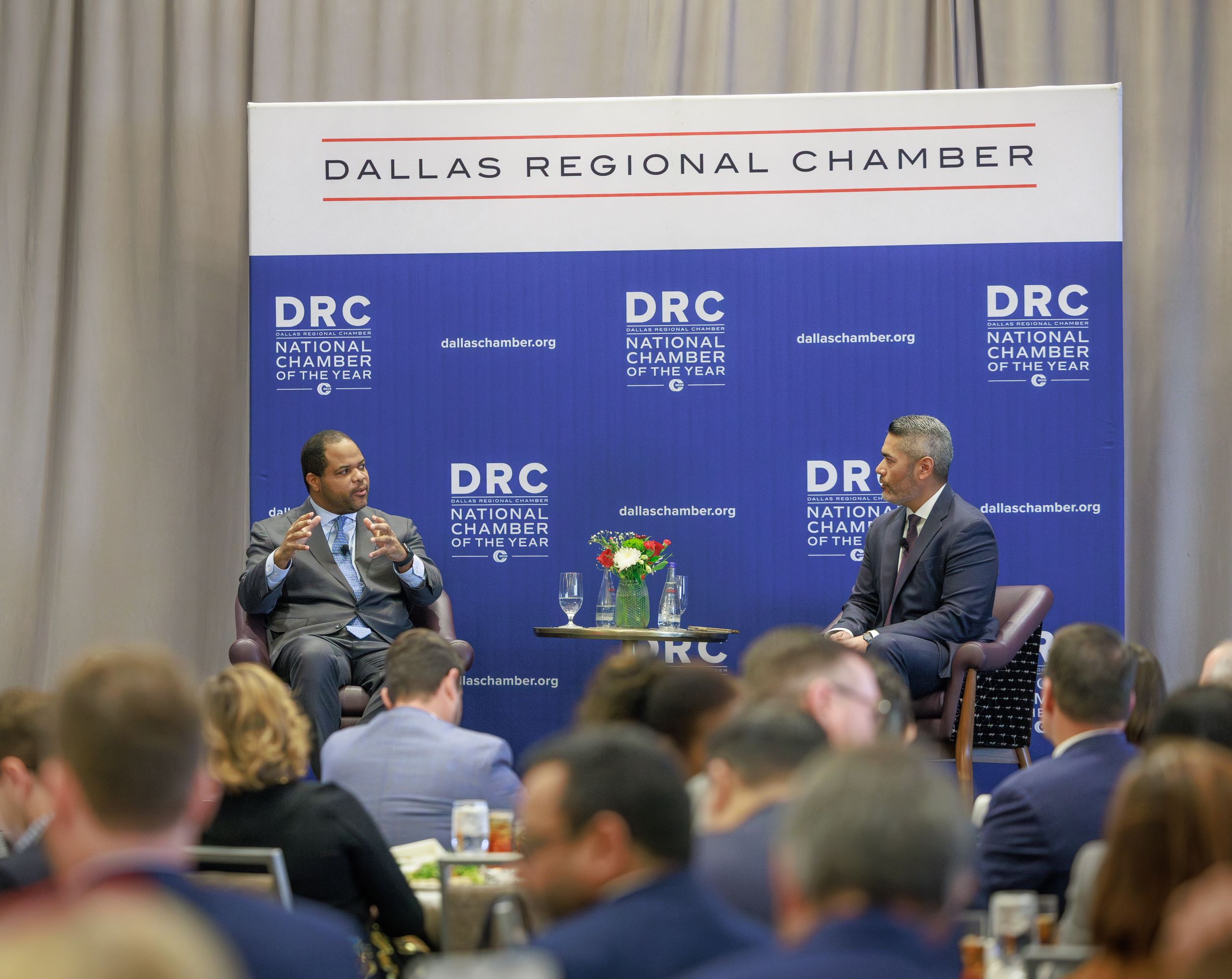
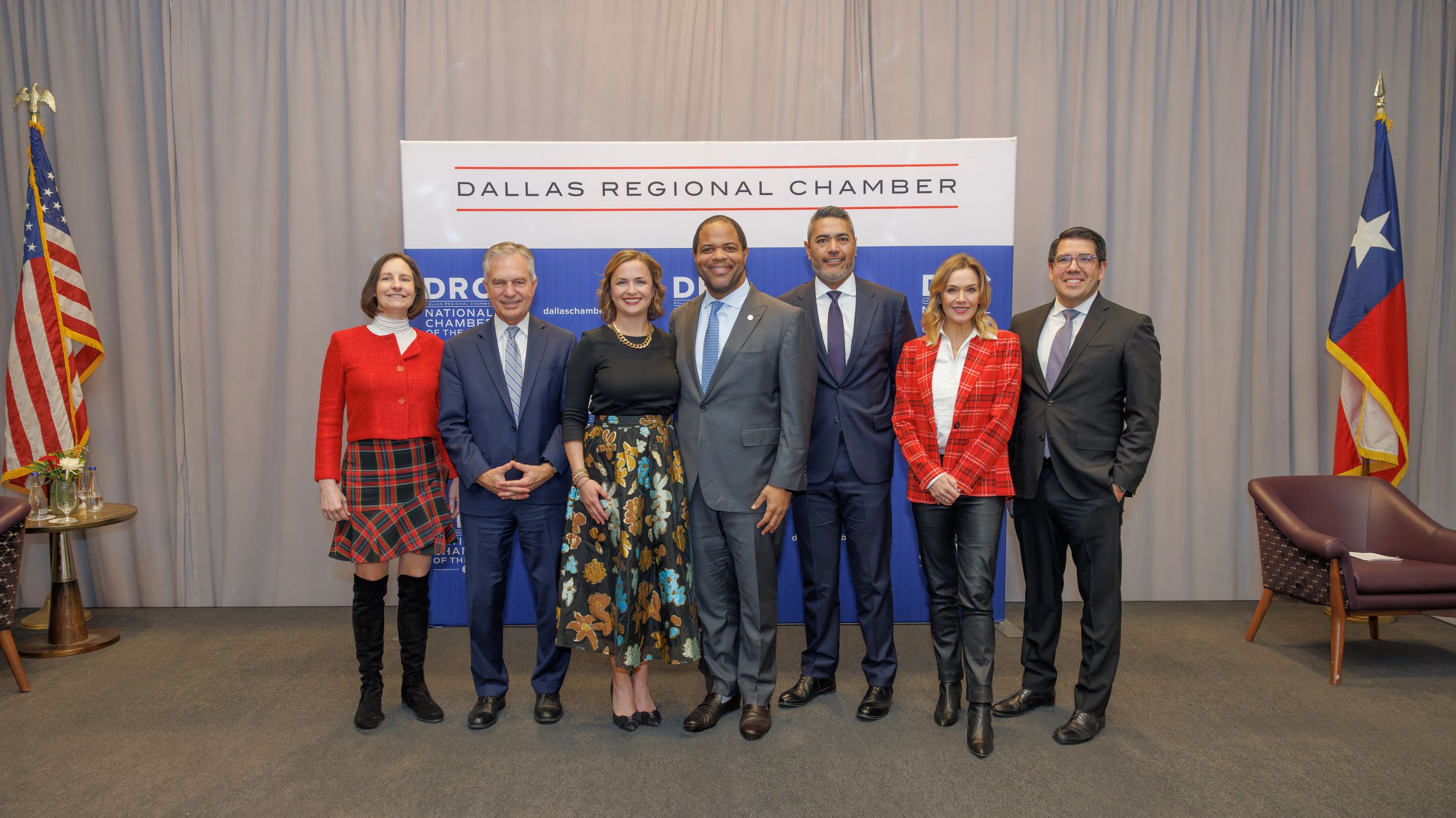
The DRC hosted its Year-End Conversation with Dallas Mayor Eric Johnson, presented by Blue Cross and Blue Shield of Texas and JPMorgan Chase & Co., on Tuesday, Dec. 12. Mayor Johnson discussed the beginning of his second term in office as the 60th Mayor of Dallas and his priorities for the remainder of his final term.

“I believe the priorities that I’ve been articulating for five years are the right priorities for the city,” said Johnson in conversation with Ollie Chandhok, Market President and Publisher of the Dallas Business Journal. “I’m just the mayor of town trying to make Dallas the best I can make it for the people who are going to come after me.”

There is no question that the future of Dallas is bright, according to the mayor.

“People are moving here in droves. The region is growing very, very quickly. We are the fastest-growing region in the country, and this city is a big part of that,” said Johnson. “We’re the draw. And it’s just such an honor to be the mayor of a city that’s that easy to sell. That’s my job, I go and sell it. But it’s a great product.”

Having been born and raised in Dallas, Johnson discussed the Dallas Independent School District, of which he is a product, and the importance of the upcoming bond election.

“You can love an entity and still criticize it; they’re not mutually exclusive. It doesn’t mean we don’t love our school system, but we ask more of it, and we are demanding of it,” said Johnson. “If we don’t [demand more], the consequence comes in the form of children who graduate from the school system and are unable to actually have a very robust career.”

Following the Mayor and City Council’s consideration, the $1.1 billion bond proposal must be approved by voters in 2024. The DRC is closely monitoring this election, especially as it concerns important infrastructure improvements.

Johnson also discussed one of his focal points while in office: growing the park system in Dallas.

“I’m a big advocate for the parks because I believe they keep families in the city. I believe it catalyzes economic development. I believe it spurs housing; people want to build near it and live near it,” said Johnson. “They’re an appeal. It’s what people want. It’s what developers are telling us they want. And so that’s why it’s so high [in my priorities].”

During his tenure as mayor, violent crime has taken a dramatic drop, in part due to Johnson’s work with Dallas Police Chief Eddie Garcia.

“What is working is the hotspot policing based violent crime reduction plan that Chief Garcia put in place with he got here,” Johnson said. “But that plan requires more bodies to expand any further than it’s being applied right now. It’s being applied very selectively right now, and the places will be the most efficient and most effective, but we need to apply it to more places that require more officers, more people. So we’ve got to hire more officers and more people.”

Despite staffing shortages preventing full coverage in Dallas, Johnson was hopeful about the state of violent crime in the future.

“Good police work stops a bad criminal after doing something once or twice that they would otherwise do ten times until they get caught. That’s why we need more officers out there to help,” said Johnson. “But nobody is closer than Dallas [in terms of] being back to pre-pandemic numbers when it comes to homicides. I mean, we’ve just made so much more progress than everybody else. We’re competing against ourselves.”

Johnson urged business leaders to stay engaged with civic fundamentals while they enjoy the city’s strong economy.

“This city is rightly perceived as being a very pro-business city, and that has to do with everybody in this room, the folks who are here from the Dallas Regional Chamber and other entities that have made this a very welcoming place for CEOs and corporations,” said Johnson. “I’d say that the main thing we need to do is not lose sight of the basics that people are looking for. Hold your city government accountable, and make sure that we know what you expect of us. We need to hear from you on a regular basis so we can continue to be a pro-business city.”

Thank you to our co-presenting sponsors, Blue Cross and Blue Shield of Texas and JPMorgan Chase & Co.; our gold sponsors, Amazon and Lockheed Martin Missiles and Fire Control; and our silver sponsors, American Airlines, DFW International Airport, Forvis LLP, Frost Brown Todd LLP, Locke Lord LLP, Oncor, Santander Consumer USA, Southwest Airlines, University of Texas at Arlington, and Verizon.

To learn more about upcoming DRC events, visit our website.

By Catie George, Manager, Communications and Storytelling

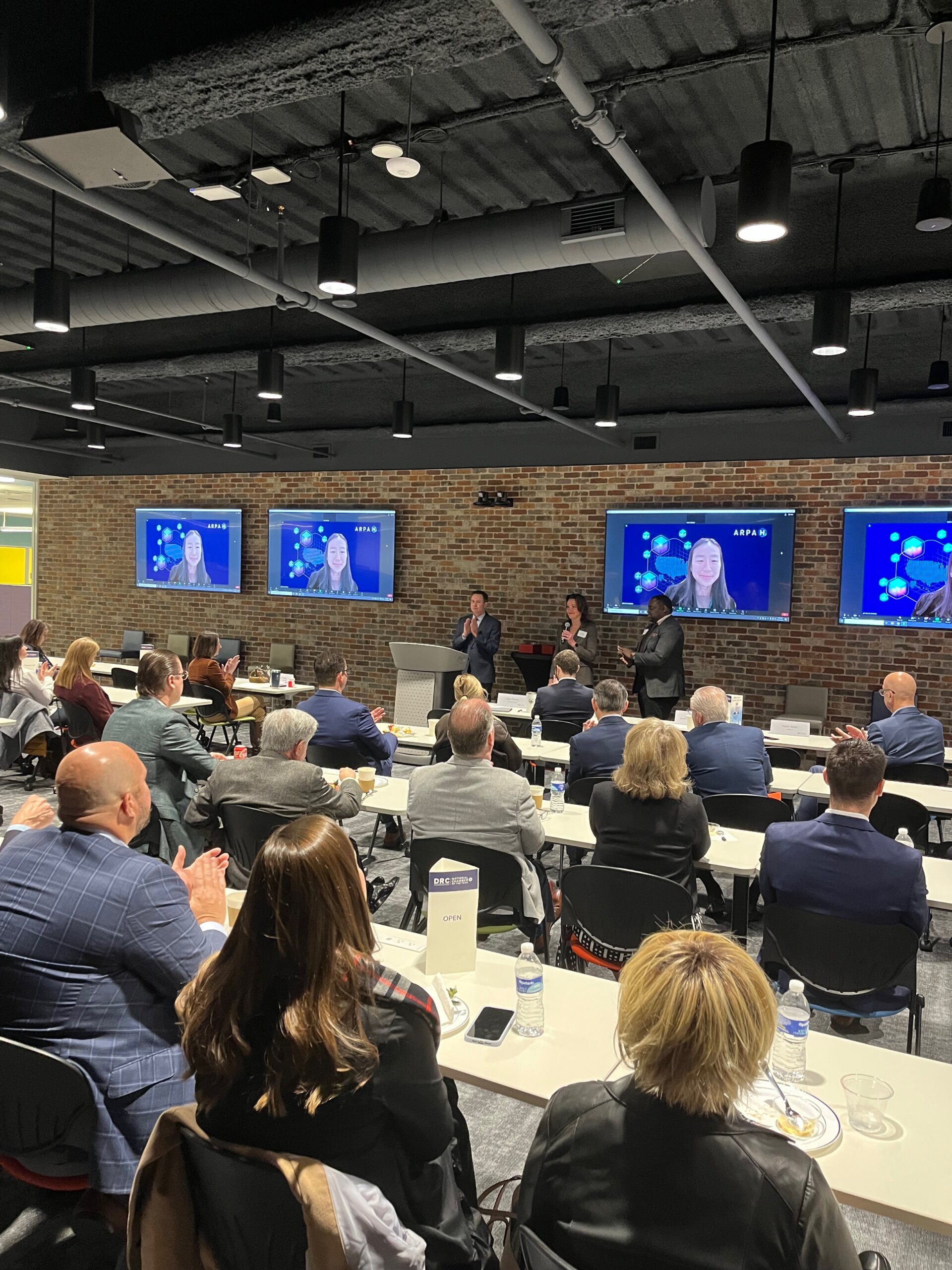
The Dallas Regional Chamber (DRC) hosted the last Tomorrow Fund Investor Breakfast of 2023 on Wednesday, Dec. 13, at series presenting sponsor Holmes Murphy’s offices.

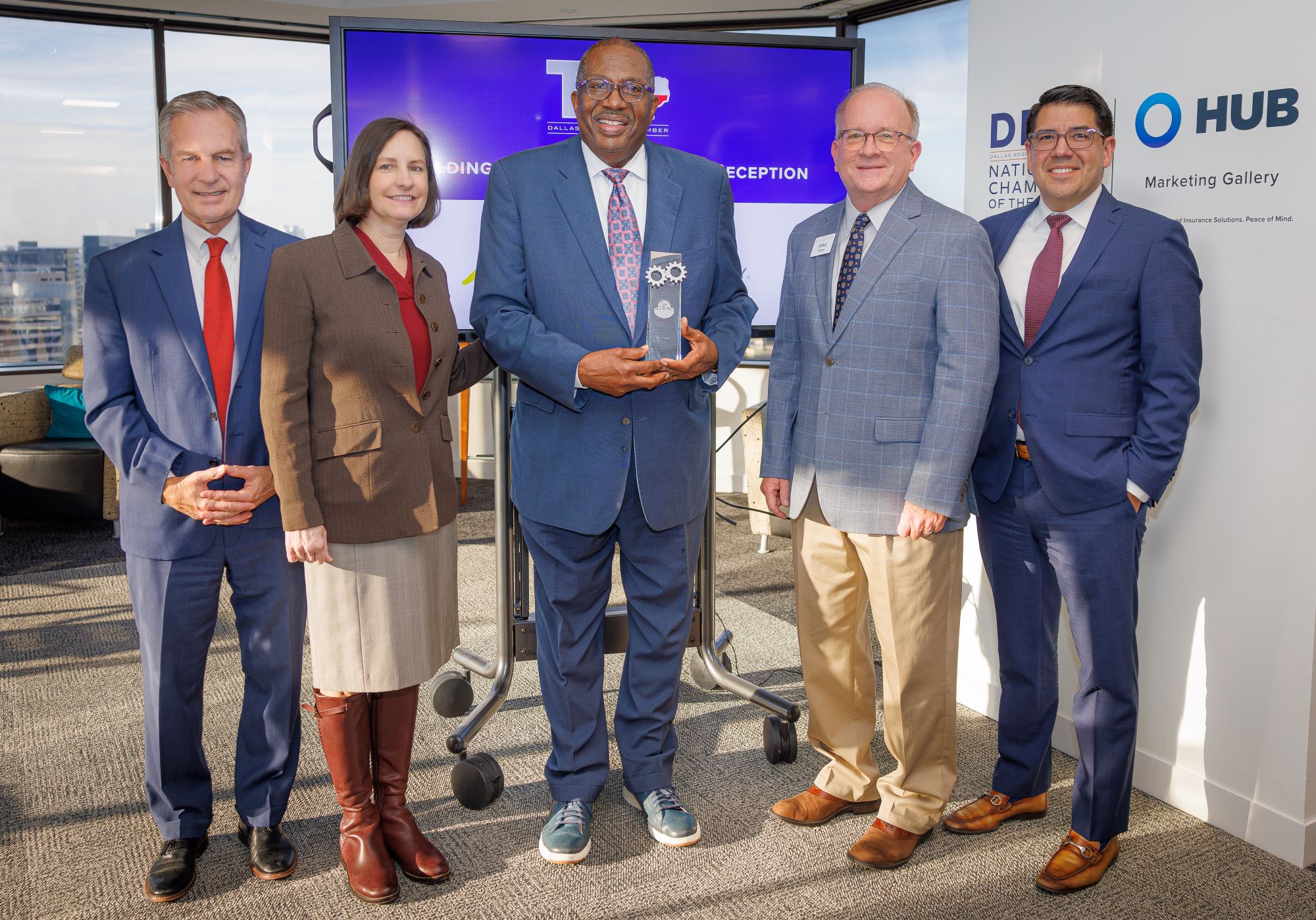
The first Building Tomorrow Together award of the morning was handed out to celebrate the selection of Dallas’ Pegasus Park as the national headquarters of the Advanced Research Projects Agency for Health, known as ARPA-H, Customer Experience Hub.

“We are so pleased to accept this recognition and really thrilled to be partnering with all of you as we think about health solutions that can help all Americans. It’s an important moment to think about how we can build tomorrow together,” said ARPA-H Director Amy Lin. “And I think a lot of the work that we do here at ARPA-H is really zeroing in on that goal. Our mission is to accelerate better health outcomes for everyone, and that includes imagining the future of health and what it could look like.”

ARPA-H will draw on the DRC and its connections to help advance these health outcomes throughout the region. This will build on relationships formed during the DRC’s intensive support of Texas’ successful bid for ARPA-H.

“The way that I see the customer experience hub and ARPA-H affecting healthcare and making it human-centric for generations is amazing and unprecedented,” said Jenny Ligon, Ecosystem Liaison for ARPA-H. “But I believe that all the amazing people that have been brought together to perform this are going to make this a wild success.”

The second Building Tomorrow Together award went to the global investment research firm Third Bridge for its new office location in Dallas.

“While we are proud of the progress that we’ve made in such a short period of time, it’s not lost on us that this recognition gives us a tremendous responsibility for continuing to be in the Dallas Region,” said Vice President of Operations at Third Bridge Ryan Kelly. “Our pledge to those of you in this room, those who may be considering a job at Third Bridge, and those who may be considering a relocation to the Dallas area: We’re ready to play our part in carrying out the DRC’s mission in all facets of growth and look forward to strengthening our relationships with current and future partners.”

The final Building Tomorrow Together award went to the series presenting sponsor, Holmes Murphy, for their steadfast support of the DRC for over 20 years as presenting sponsor of the Tomorrow Fund Investor Breakfasts. Holmes Murphy will be reallocating its investment to other areas of the DRC’s mission-driven work.

“This 20-year relationship between Holmes Murphy and Dallas Regional Chamber has taken various forms,” joked Marc Pinney, Vice President of Employee Benefits at Holmes Murphy. “But what’s important to us is the incredible work that the DRC has done for our city and the region. And as they have grown in prominence as the National Chamber of the Year, we’ve grown along with them.”

To conclude the breakfast, DRC Senior Vice Presidents walked investors through a report on the impact of the Tomorrow Fund in each priority area in 2023 and strategy for 2024.

The Tomorrow Fund makes possible the DRC’s strategic efforts to improve the quality of life for all people while enhancing the business climate and the economy of the Dallas Region. Support the DRC’s mission work and expand your company’s impact on the Dallas Region by becoming a Tomorrow Fund investor.

Thank you to our series presenting sponsor, Holmes Murphy; breakfast sponsors, Bridgepointe Technologies and Crowe, LLP; and corporate sponsor, American Airlines, Inc.

Established in 2005, B&H Engineers specializes in delivering comprehensive design solutions in the fields of Mechanical, Electrical, Plumbing, and Technology (MEPT) across a diverse commercial marketplace. Our expertise encompasses innovative and cost-efficient design solutions tailored to unique project requirements, ensuring compliance with industry standards and regulations to the benefit of all project stakeholders.

How does your company help other businesses become more effective?

B&H Engineers’ designs play a crucial role in overall project success; the significance lies in balancing performance, efficiency, and cost-effectiveness in system selections, details which are often tucked away behind the scenes until issues arise. Our responsibility in design reduces end-user operational costs while enhancing building sustainability by minimizing maintenance and downtimes, meeting or exceeding regulatory agency requirements, future-proofing technologies, enhancing occupant comfortability, and maximizing the overall equipment footprint.

As a company, our commitment to contributing to a project’s overarching success involves integrating these principles into our MEPT designs. We prioritize energy-efficient technologies and systems that address immediate project needs while also contributing to long-term financial sustainability and profitability for the end user.

What differentiates your company from others in your industry?

What truly distinguishes our company within the industry is our unwavering commitment to seamlessly integrating engineering into project teams, a distinction achieved through the effective application of our three C’s: Communication, Collaboration, and Coordination. In contrast to some firms that compartmentalize engineering as a standalone process, we recognize and embrace the interconnected nature of projects, and our approach prioritizes a holistic perspective.

Communication is the linchpin of our strategy, fostering a transparent and clear dialogue among all team members. This commitment ensures that information flows efficiently, preventing misunderstandings and creating a shared understanding of project goals and requirements.

Our emphasis on Collaboration extends beyond the engineering realm, promoting the pooling of diverse talents and expertise from various disciplines. This collaborative synergy transcends conventional boundaries, enriching project outcomes with multidimensional insights.

Integral to our approach is Coordination, where meticulous planning and execution take center stage. By coordinating every facet of a project, we minimize the likelihood of disruptions and enhance overall efficiency. This approach is particularly crucial in preventing surprise costs, mitigating setbacks, and addressing challenges promptly, thereby contributing to successful project delivery.

Our dedication to a holistic approach means that we view engineering not in isolation but as an integral part of the larger project ecosystem. This outlook allows us to adapt to dynamic project requirements, respond promptly to challenges, and deliver results that go beyond traditional engineering outcomes. Through this comprehensive and collaborative approach, we enhance the technical aspects of our work and contribute to a more cohesive and streamlined project delivery. Ultimately, our clients benefit from versatile solutions that address the intricacies of their projects while maintaining a high standard of communication, collaboration, and coordination.

What do you enjoy most about doing business in the Dallas Region?

Doing business in the Dallas Region is a perfect synergy of global talent recruitment potential and endless business opportunities. Dallas, a global business hub, offers an ideal backdrop for unparalleled business opportunities within the booming Texas economy. This optimal setting allows our company to thrive and our team to flourish professionally and personally.

Why did you decide to become a DRC member?

Our decision to join the DRC was driven by the desire to participate in an established, highly regarded, collaborative community of Dallas/North Texas businesses. This strategic membership allows us to learn, share, and grow alongside like-minded professionals. Additionally, the DRC’s efforts in economic development, policy work, and recruitment via Say Yes to Dallas align with our commitment to contribute meaningfully to the region’s business landscape. This platform elevates our engagement, enabling us to play a part in the collective success of the Dallas business community.

How has your business changed in the past five years?

Over the past five years, B&H has experienced remarkable growth and expansion, establishing ourself as a key player, particularly within the SBE/MBE/MWBE sector. Our business has seen exponential growth, providing valuable opportunities for education, experience, and career advancement for our dedicated employees. We’ve significantly broadened our client base, now spanning diverse sectors such as education, healthcare, hospitality, retail, municipal, federal, commercial, and private industries.

This strategic diversification has equipped us with a well-rounded portfolio, enhancing our resilience in the face of market fluctuations. This success has not only fortified our position in the current market but has also created a strong foundation for a sustainable future.

By Catie George, Manager, Communications and Storytelling

The 88th Texas Legislative Session and four subsequent special sessions left a lot to cover at the Dallas Regional Chamber’s (DRC) Wrap-Up Event on Wednesday, Nov. 15. Takeaways from key policy areas were discussed by state and local officials and business and community leaders to give attendees an overview of all the work accomplished this year.

Education & Workforce luncheon panel

The event began with a luncheon focused on Education & Workforce, which discussed several key wins from the legislative session.

“The legislature invested $700 million into higher education. We had additional investments made in a new entity called the Texas University Fund, which will be a $3 billion endowment that will help emerging research universities achieve their goals and increase research at their respective systems,” said Dr. Mark Ruden, President of Texas A&M University-Commerce.

While there was much to celebrate, there is still progress to be made, especially regarding teacher pay.

“Compensation is one key piece of the puzzle. We have seen the desire to expand the teacher incentive allotment for educators in Texas. This is the program that allows Texas’s top third of teachers to be paid according to their impact on student learning,” said Kate Greer, Managing Director of Policy & State Coalition of The Commit Partnership. “This is a really powerful tool to reverse the trends we’ve seen, which is our highly effective, best teachers moving out of poverty-dense areas.”

However, panelists were hopeful for how education may fare in the next legislative session.

“In the future, it would be great to come away from a legislative session where we could say all of education, the entire spectrum of it, from early childhood through the twelfth grade and then to post-secondary, had a winning legislative session. And hopefully, we can do that in 2025,” said Texas Association of Community Colleges President Ray Martinez.

Economic Development discussion

After the luncheon, a second panel focused on Economic Development.

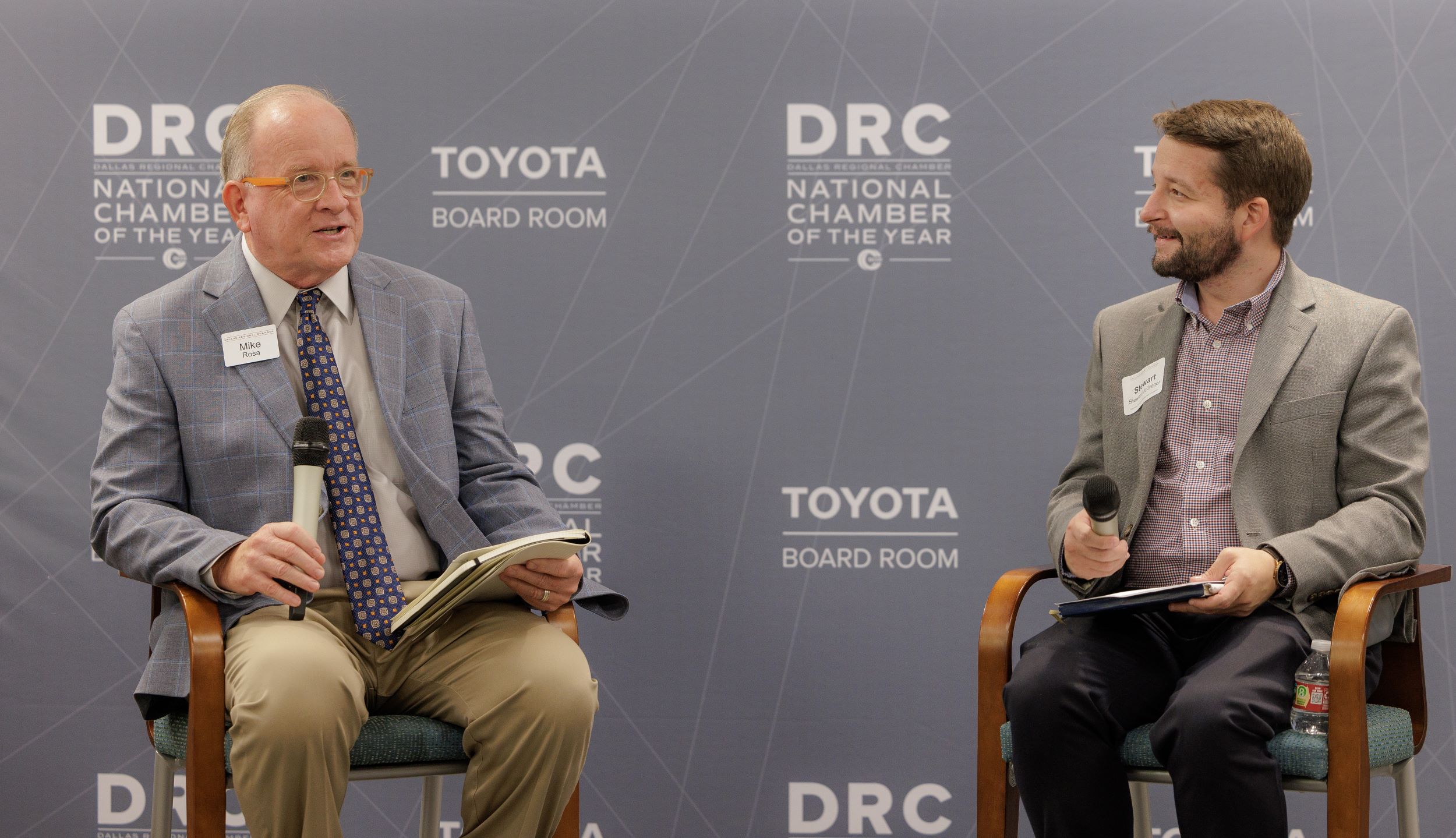
“Here in Texas, locals lead the charge when it comes to economic development,” said Executive Director of the Kaufman Economic Development Corporation Stewart McGregor. “You go to other states, and it’s very much the top-down approach where the state is heavily involved in projects, making things come together and happen.”

Carlton Schwab, President and CEO of the Texas Economic Development Council, emphasized the importance of the local aspect of the Dallas Region’s economy in comparison to other places.

“Economic development is a decidedly local endeavor in our state,” said Schwab. “Our economic development success over the last four years was because of having really great locally elected leaders supporting economic development and great professionals in this state implementing economic development activities and programs on behalf of their communities,” like the passage of HB 5, which creates a new transparent and accountable statewide economic development incentive program.

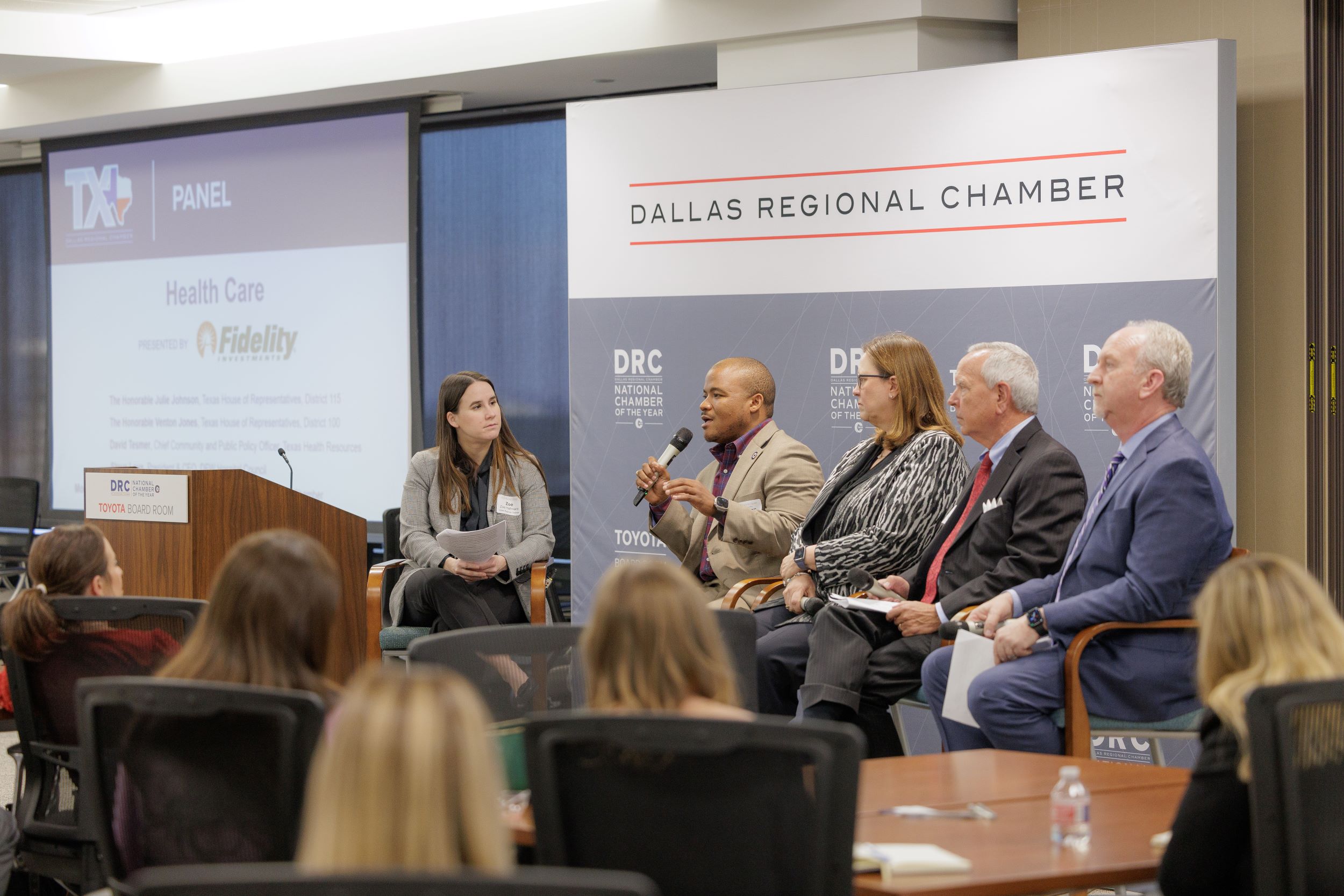
The following Health Care panel began with a discussion on additional funding for the new behavioral health hospital serving the Dallas Region and operated by UT Southwestern. The multi-session project was originally funded by the 87th legislature but had to be revisited because of increased construction costs due to inflation. The current closest behavioral health hospital is in Terrell, over 35 miles east of Dallas. This new hospital will also help alleviate the current stress put on our healthcare systems by mental health patients.

“When we look at the amount of people who are incarcerated in Dallas County Jails right now, over half of those people are facing significant mental health challenges that led them to be incarcerated, and there are no services while they are incarcerated to help them address those issues,” said Representative Venton Jones. “So instead of putting people in prison beds, we’ll be putting them in hospital beds, providing them needed services.”

Health Care panel

Equity in health care was a large focus of the panel.

“It’s one thing to have coverage, it’s another thing to have access, and we’ve got to work on it in a very balanced approach,” said Steve Love, President and CEO of the DFW Hospital Council.

Panelists agreed working through the issue of equity in health care means making it a clear priority in the legislature.

“Zip code is more important than your genetic code; where you live has everything to do with determining your health and well-being,” said David Tesmer, Chief Community and Public Policy Officer of Texas Health Resources. There are a lot of individuals in underserved communities that, if we provided coverage and access, would be able to buy food, to put gas in their cars. They’re making decisions now that say, ‘health care is number five or seven or eight on my list.’ Health care has to be an important part of this state’s priorities.”

Ultimately, health care is only going to be addressed if Texas lawmakers are encouraged by constituents to address it.

“If you want a healthier state, if you want access to health care, then you have to vote. Health care needs to be the issue you vote on,” said Representative Julie Johnson. “The business community is powerful. Your voices are meaningful, but you have to use them. And when you do use them, really good things can happen. You have such credibility; you have such opportunity and clout. You have access to political funding. You have all kinds of ways to influence the legislative process and the electoral process if health care is important enough to you.”

In the concluding Quality of Life panel, Senator Royce West and Dallas Police Department Lieutenant Julio Gonzalez discussed the new regional law enforcement training center that will be housed at UNT Dallas and the positive effects it will have on the Dallas Region.

Senator Royce West speaking with the DRC team.

“The fact of the matter is that we’re fortunate to have a better relationship now between law enforcement in Dallas and its citizenry,” said Senator West. “But we have to make certain that what’s going on in Dallas is duplicated around the state. We have to make certain that we continue to support law enforcement in Dallas and across the state.”

Lt. Gonzalez emphasized that having a regional facility will help improve standardization throughout the region and the state, to Senator West’s point.

“If you get pulled over in Burleson for a traffic violation, your experience with law enforcement should be roughly the same as if you get pulled over in Fort Worth or Dallas,” said Lt. Gonzalez. “When you have a regional academy providing training to various law enforcement agencies, it standardizes the training, and that’s important to the community.”

At the end of the half-day event, Senator West was presented with a Building Tomorrow Together award. Usually reserved for businesses, the award recognizes the positive impact he has had on economic development and his service to the Dallas Region.

Thank you to our Education & Workforce Luncheon sponsor, PNC Bank; our panel discussions sponsor, Fidelity Investments; our Building Tomorrow Together Reception sponsor, Holmes Murphy; and our silver sponsor, Haynes and Boone.

To learn more about the Public Policy work the DRC is doing, visit our website.

By Catie George, Manager, Communications and Storytelling

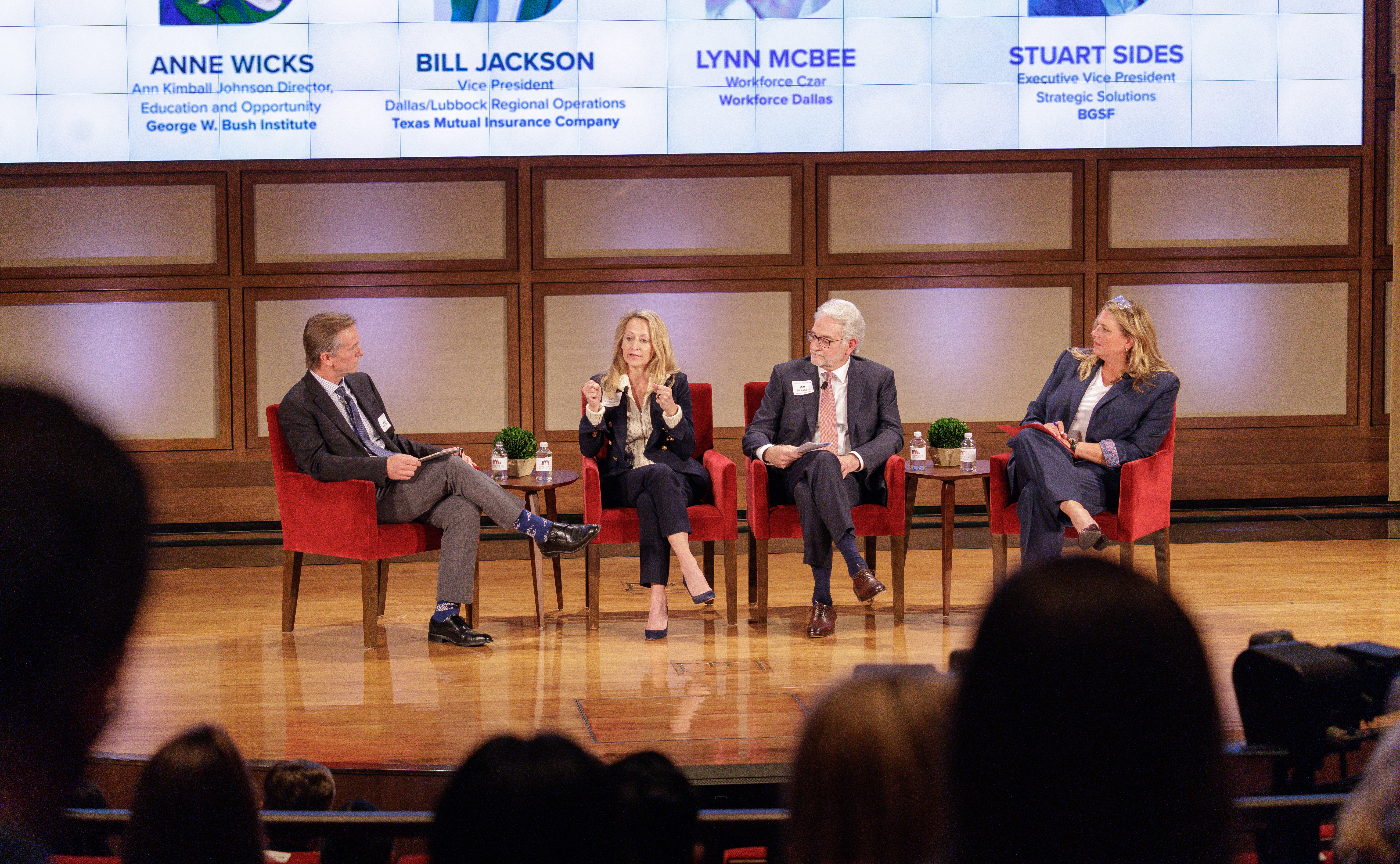
The Dallas Regional Chamber (DRC) hosted the fourth annual State of the Workforce, co-presented by BGSF and Texas Mutual Insurance Company, on Tuesday, Nov. 14, to hear from local experts on workforce development in the Dallas Region.

“The intersection of economics and education is where workforce development sits,” said Ken Hersh, President and CEO of the George W. Bush Presidential Center. “So, this is a very important topic that I’m glad that the [DRC] and all of the people here are taking seriously to try to find ways to move forward.”


The keynote address by Hilti North America’s CEO Mike McGown focused on how Hilti’s emphasis on culture strengthened their hiring and training practices.

“Culture at Hilti is unique. We see it as a competitive advantage. We spend $10 million annually on culture development,” said McGowan. “We believe that all companies have a culture, but sometimes the culture may not be what you want it to be, so we’ve decided what we want our culture to be. It’s a values-based organization. We teach our team members that their work is worthwhile.”

This culture-first approach contributes to Hilti’s 91% retention rate of talent. This high retention is important in any industry, especially construction.

“The average tradesperson in the construction industry in the United States is 56 years old, and about every three years, it goes up by a year. The problem is there are not enough young people entering into the trades,” said McGowan. “The construction industry generates 15% of global GDP and employs 10% of the global workforce.”

McGowan emphasized the solution is held within the industry itself. There are plenty of opportunities in the industry for anyone willing to try it.

“Construction is a great equalizer. In other words, people who don’t have access to a traditional education can go and apply themselves, learn a trade, and make a great income,” said McGowan. “In fact, many electricians today make more than engineers and accountants who are graduating from college.”

Another key to retention is consideration for diversity, equity, and inclusion within the workplace.

“We know that fundamentally, to be a successful company, you’ve got to have diversity, and you have to have an inclusive environment that welcomes everybody for who they are and celebrates that diversity to help ensure that we look at problems from all different perspectives and make better decisions and better outcomes,” said McGowan.

McGowan left the audience with some advice: focus on culture.

“It takes effort. It can’t be a one-time event,” said McGowan. “It has to be an ongoing process. We call it a journey, our culture journey. But I think that the money that you spend [on culture], you get back tenfold.”

Following McGowan’s keynote, the panel discussion, moderated by Executive Vice President of Strategic Solutions at BGSF Stuart Sides, further explored current labor shortages and the need for a qualified workforce.

“If you think about every 8th grader right now in the state of Texas, only about 22% of those 8th graders will go on after they graduate from high school to get a two- or four-year degree or credential of some kind to help them get a solid wage job. But we know by 2036, 70% of jobs in Texas will require some sort of credential, two or four-year degree, or something after that,” said Anne Wicks, Director of Education and Opportunity at the George W. Bush Institute. “The challenge in front of us is how do we make sure Texans are ready to access that kind of opportunity and keep our economy moving.”

Promising changes are being made to accommodate more non-traditional workers, who are essential to solving current gaps in the workforce .

“Years ago, people would not look at second-chance job seekers, but now they will,” said Lynn McBee, Workforce Czar of Workforce Dallas. “So, it’s a different day, and we’re excited about the potential of the future.”

However, there continue to be challenges to consider.

“I’d also ask all the leaders here to think about child care allowances. That really is a big burden to people working and to retaining employees to keep them happy,” said McBee. “Some type of child care allowance or onsite child care [contributes to] culture and people staying.”

The panel emphasized the importance of utilizing partnerships throughout the Dallas Region moving forward to address all the challenges discussed.

“Listen to your employees, and understand what they need,” said Texas Mutual Insurance Company Dallas/Lubbock Regional Operations Vice President Bill Jackson. “Do not be afraid to reach out to other businesses. Tackle the problems and collaborate, find those great nonprofit partnerships, and be a force for good in workforce development because it will benefit not only your industry overall, but you as well. That lifts all boats.”

Thank you to our gold sponsors, Bank of America and Hilti North America, and our silver sponsors, Dallas College, Forvis LLP, and Oncor. And thank you to our reception sponsor, PNC Bank.

To learn more about the DRC’s work on Education, Talent & Workforce, visit our website.

By Mike Rosa, Senior Vice President, Economic Development

As the year ends, I am delighted to share economic development highlights from 2023.

First, jobs. The Dallas-Fort Worth Region continues to lead all U.S. metro areas for net job growth. Over the past five years, DFW has added a total of 602,200 net new jobs, 59,000 more than the combined job growth of the metros ranking second and third – Atlanta and Houston.

Company moves and expansions contribute to strong job growth. The Dallas Regional Chamber (DRC) tracks headline-making headquarters, office, and industrial projects that locate to DFW each year. Through Q3 of 2023, 55 companies have made location announcements here, which projects to over 70 for the entire year—a pace we’ve kept for the last several years. This year’s announcements are a mix of headquarters, offices, and industrial parks, sprinkled with a few special projects like the new Universal Studios theme park and the ARPA-H headquarters.

I am glad to report that 22 regional cities have at least one win so far in 2023, and it is exciting that Southern Dallas County has landed nine projects.

Two Southern Dallas County projects are among the year’s biggest wins—Canadian Solar in Mesquite and Trina Solar in Wilmer—each creating 1,500 jobs. They combine for 1.75 million-square-feet of space and $450 million in capital investment.

Trina Solar’s new 1.25 million-square-foot facility alone is a half-mile in length.

Canadian Solar and Trina Solar are tech-based projects as well. The Dallas Region is home to 278,000 tech jobs—a third of the total tech jobs in Texas. With 59,000 new tech jobs added over the past five years, DFW leads the nation among all U.S. metro areas.

In recent years, led by Senior Vice President of Research & Innovation Duane Dankesreiter, the DRC has shaped and promoted our region’s tech and innovation brand with great data, publications, storytelling, relationships, and convenings that result in economic development opportunities, including expanding the life science sector in the region.

With Pegasus Park, the new Texas Instruments Biomedical Engineering Center, DFW International Airport’s new cold chain storage facility, and other new assets complementing our existing strengths, we see a greater opportunity for attraction, expansion, and growth of biotech and life science companies here.

The DRC built a life science website two years ago, and last year, we hired Kelly Cloud, Vice President, to focus exclusively on life science recruitment to the region. Because we laid the groundwork, we were prepared to respond to the Advanced Research Projects Agency for Health (ARPA-H) opportunity, which we went on to win against strong competition from more established life science metro areas.

The DRC supported the Lyda Hill Philanthropies team – the visionary leaders of the ARPA-H pursuit – and was trusted to make closing arguments to the ARPA-H committee on pitch day. The Customer Experience hub will be physically located at Dallas’ Pegasus Park, validating, amplifying, and accelerating the DRC’s life science focus as we move into 2024.

ARPA-H was not the only economic development program win for DFW in 2023.

Early this year, Southern Methodist University led a response to the U.S. Department of Commerce’s call for bids from existing tech-savvy regions interested in designation as a tech hub—and therefore became eligible for $70 million to fund research in critical tech sectors.

The DRC’s Research & Innovation team was instrumental in building the winning bid.

The Texoma Semiconductor Tech Hub is the only Texas win among 400 bids and 31 hubs announced by President Joe Biden and Commerce Secretary Gina Raimondo.

It has been a tremendously successful and interesting year for economic development in our region. We look forward to continuing our work in 2024!

By Catie George, Manager, Communications and Storytelling

At a recent Dallas Regional Chamber event, national experts gave insights into the Dallas Region’s economic outlook for 2024—and the year ahead looks promising.

Lynn Martin and Bob Sulentic

President of the New York Stock Exchange Lynn Martin and President & CEO of CBRE Group, Inc. Bob Sulentic gave credit to Texas’ business-friendly environment for how the state can weather periods of economic uncertainty at the DRC’s Year Ahead event, presented by OCC, on Thursday, Nov. 9.

“The environment that’s been created in the state of Texas has really allowed entrepreneurs to flourish,” said Martin, citing that Texas has 200 companies of the 2,400 listed on the exchange. “It speaks to the welcoming nature of the economic incentives accompanying Texas.”

While Texas enjoys a positive business environment, there are still challenges related to inflation. Higher borrowing costs have not only impacted residential real estate but also commercial real estate.

“We thought values would come down 15% to 20%. We now think they may be another 10%,” said Sulentic. “We also think that’s going to stabilize as we get into the middle of next year, that interest rates will come down. When interest rates come down and availability of debt is more certain, we think the capital will come back into the market, valuations will go back up, and assets will trade again.”

Encouragingly, Sulentic said that the challenges are only temporary.

“The property owners and lenders are all struggling with the same thing, which is uncertainty about values and uncertainty about where interest rates will settle at,” he said. “The buildings are still there, and the base of buildings are still growing and growing as the global economy grows. They have just stopped trading for a while. When the capital comes back, the assets will start trading again.”

While some were concerned about the current state of the economy and a possible recession, Sulentic and Martin emphasized there is no recession in sight.

The DRC’s Dale Petroskey, Ray Perryman of The Perryman Group, and the DRC’s Duane Dankesreiter at our VIP reception. Perryman was our featured speaker during the reception

“This is not like the Great Financial Crisis, this is not like what we saw in the 1990s. It’s more like, in my mind, when we saw the dot-com bubble burst,” said Sulentic.

Martin added that the whole U.S. economy was strong, not only Texas.

“The market is starting to very slowly reopen,” she said. “The strength of our U.S. markets, the ability to raise capital and liquidity, transparency and depth in those markets, we can’t lose sight of that.”

Martin and Sulentic also added that businesses that can adapt well will thrive.

“The volatility of change may ebb and slow, but change is constant,” said Martin. “As long as businesses can remain nimble and quarter to their North Star, the long-term businesses work out.”

The hour-long discussion left attendees with a positive outlook for the 2024 year.

“Many economists are surprised at the resilience of this economy,” said DRC President and CEO Dale Petroskey. “Here in the Dallas region, we continue to be a magnet for people and companies who want to move here. We’re growing more than any other market in the United States by far, and no sign is slowing down.”

Read more coverage about the event from The Dallas Morning News and Bloomberg.

Thank you to our presenting sponsor, OCC, and silver sponsors, Axxess and Forvis LLP.

To learn more about the work the DRC is doing, visit our website.

Jim Springfield, President of Blue Cross and Blue Shield of Texas, is Chair-Elect

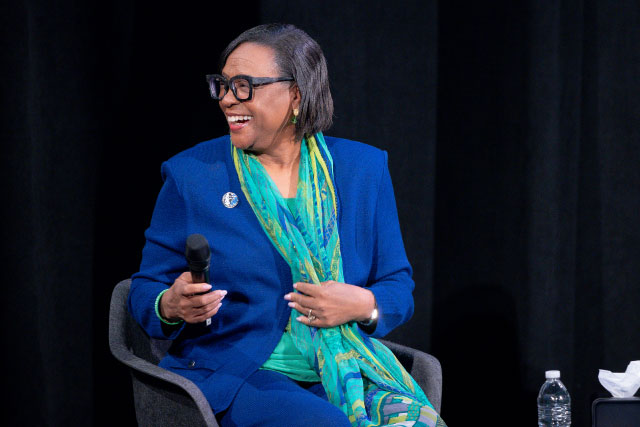
The Dallas Regional Chamber (DRC) Board of Directors has named Cynt Marshall, CEO of the Dallas Mavericks, as the 2024 Chair of the Board, effective Jan. 1.

Marshall speaking at the DRC’s 2023 State of DEI.

In her one-year term as Chair, Marshall will preside over the DRC’s efforts to improve the quality of life for all people in the Dallas Region. Marshall will make her first address as Chair at the DRC’s 2024 Annual Meeting 3-6:30 p.m. Wednesday, Jan. 17, at the Music Hall at Fair Park.

“What an honor to serve as DRC Chair for the upcoming year,” said Marshall. “Since moving to Dallas, the DRC has welcomed me with open arms, and I’m grateful to be a part of all the work they do in the region. I look forward to progressing our promise of economic empowerment to all communities of Dallas.”

A long-time business leader and champion for diversity and inclusion, Marshall joined the Mavs as CEO in 2018; since then, the Mavs have twice received the NBA’s Inclusion Leadership Award. Marshall’s career includes a 36-year tenure at AT&T, including roles as Senior Vice President of Human Resources, Chief Diversity Officer, and President of AT&T North Carolina. She served as the most recent Chair of the Board of Dallas CASA to provide permanence and stability for children in North Texas.

Marshall is a graduate of the University of California, Berkeley, and her first book, “You’ve Been Chosen,” was nominated for an NAACP Image Award following its release in September 2022.

“Cynt is a champion for the entire Dallas Region and has been a great friend to the DRC since she joined the Mavs,” said Dale Petroskey, DRC President and CEO. “She played a key role in launching the DRC’s work in Diversity, Inclusion & Community Engagement and our commitment to growing economic prosperity in Southern Dallas County and has been its biggest supporter since. Cynt is a force for good and one of the most dynamic business leaders in our community. We look forward to making even more progress for the good of our region with her as Chair.”

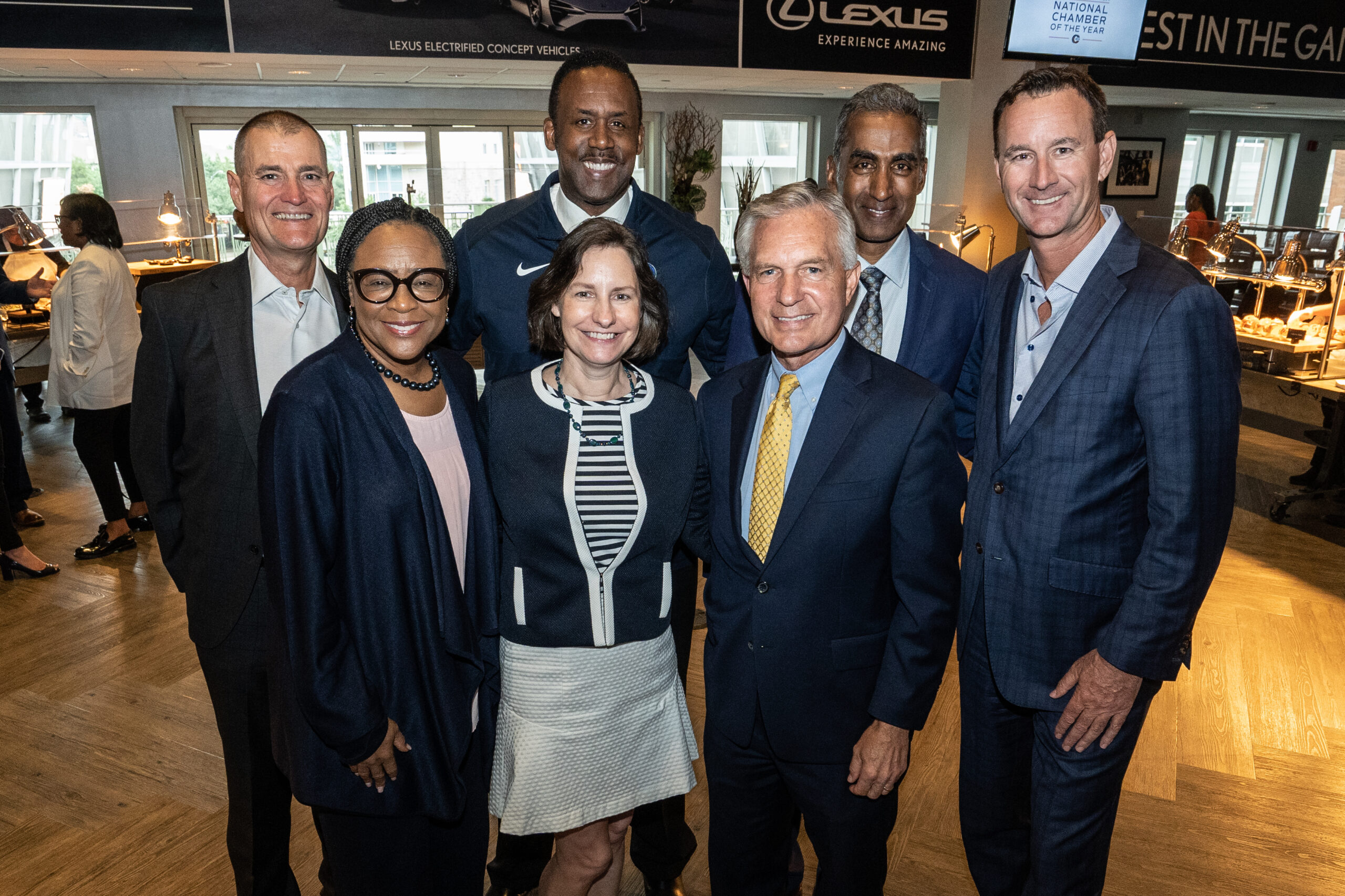
Front: Marshall with DRC’s Angela Farley and Dale Petroskey; Back: Dallas Region sports leaders and past DRC Board Chair Bob Pragada of Jacobs.

Marshall succeeds 2023 Board Chair Rafael Lizardi, Senior Vice President and Chief Financial Officer for Texas Instruments, who will remain a member of the Board and Executive Committee.

The DRC Board also selected Jim Springfield, President of Blue Cross and Blue Shield of Texas, as the 2024 Board Chair-Elect. Springfield will assume the Chair position on Jan. 1, 2025.

“Jim has been committed to the DRC’s public policy and advocacy work, and he really knows how to work with lawmakers to promote a high quality of life for the people we serve,” said Petroskey. “He’s the perfect choice to serve as Chair in 2025 when the 89th Texas Legislature is in session.”

As is the DRC’s custom, Marshall, as Chair, and Springfield, as incoming Chair, will co-chair the DRC’s Diversity, Inclusion & Community Engagement Council in 2024.

“At Blue Cross, we share the Dallas Regional Chamber’s vision for a strong economy, developing the future workforce—and creating a wonderful quality of life for the North Texas region,” said Springfield. “It’s an honor to be selected as the chamber’s 2024 Board Chair-Elect. I look forward to participating in the important and necessary work the chamber is doing daily to drive economic growth and foster collaboration between the business community, educational institutions, and workforce development organizations in order to move this region forward.”

To view a complete list of DRC Board members, please click here.

By Catie George, Manager, Communications and Storytelling

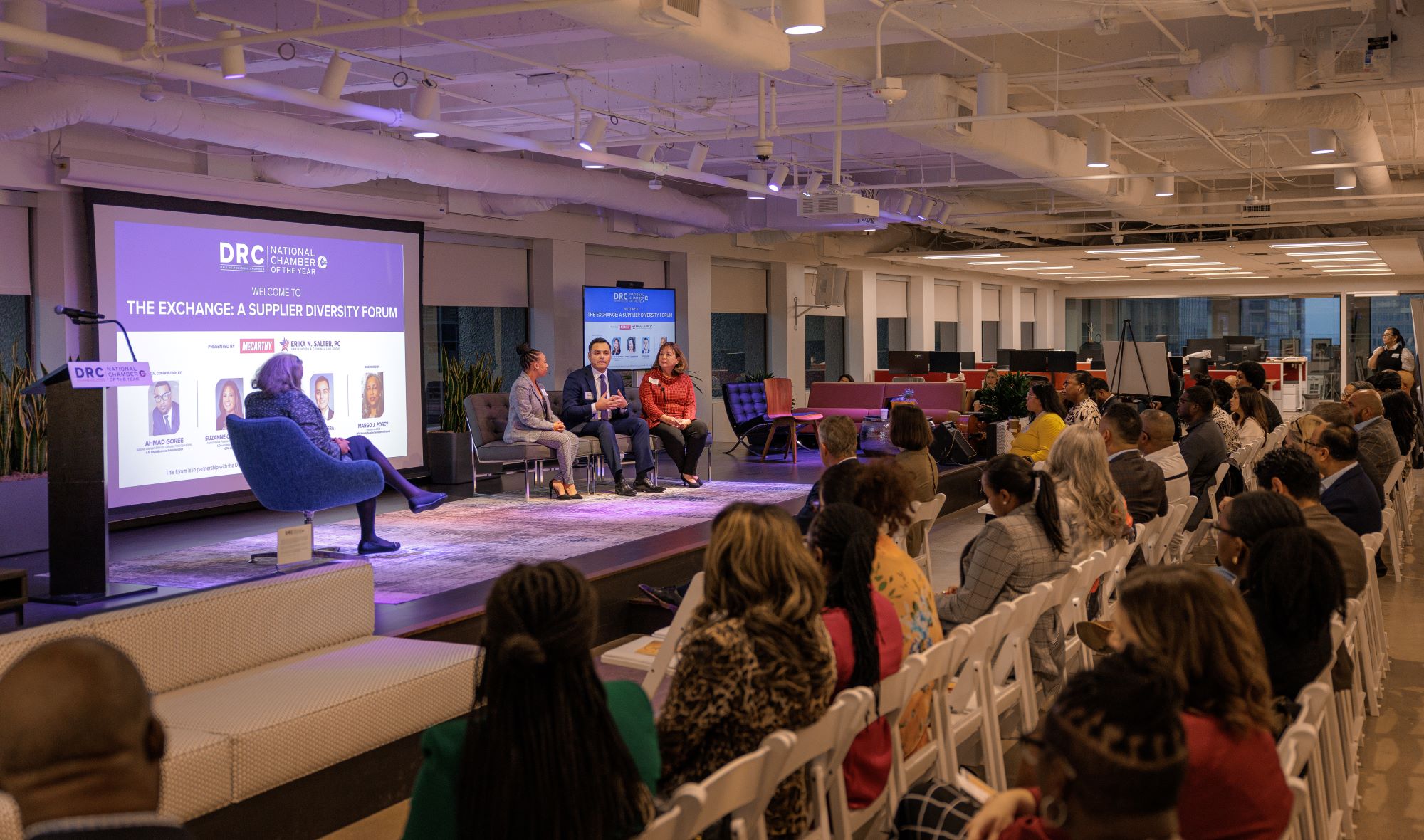
Business leaders, suppliers, and contractors connected to find opportunities to increase supplier diversity in the Dallas Region Thursday, Nov. 9, at the Dallas Regional Chamber’s The Exchange: A Supplier Diversity Forum.

The program, presented by McCarthy Building Companies and the Law Offices of Erika N. Salter, P.C., highlighted supplier diversity as an asset for companies.

“Connecting companies that need suppliers with diverse suppliers is a competitive advantage because it grows that company’s customer base while the work gets done,” said DRC President and CEO Dale Petroskey. “It gives opportunities to many deserving people who may otherwise never have been considered for those opportunities. Our goal [at the DRC] is to connect the dots between companies looking for suppliers and qualified suppliers to work with those companies to build their businesses.”

Supplier diversity is especially important as the U.S. continues to become more diverse.

“Not a lot of large law firms in the country focus on minority businesses and understand the importance of where the country is going in terms of a more diverse population,” said Efrain Vera, Associate Attorney at McGuireWoods LLP.

The forum attendees were led in an activity by Ahmed Goree, Lead Economic Development Specialist at the U.S. Small Business Administration, to connect diverse suppliers and procurement professionals in attendance.

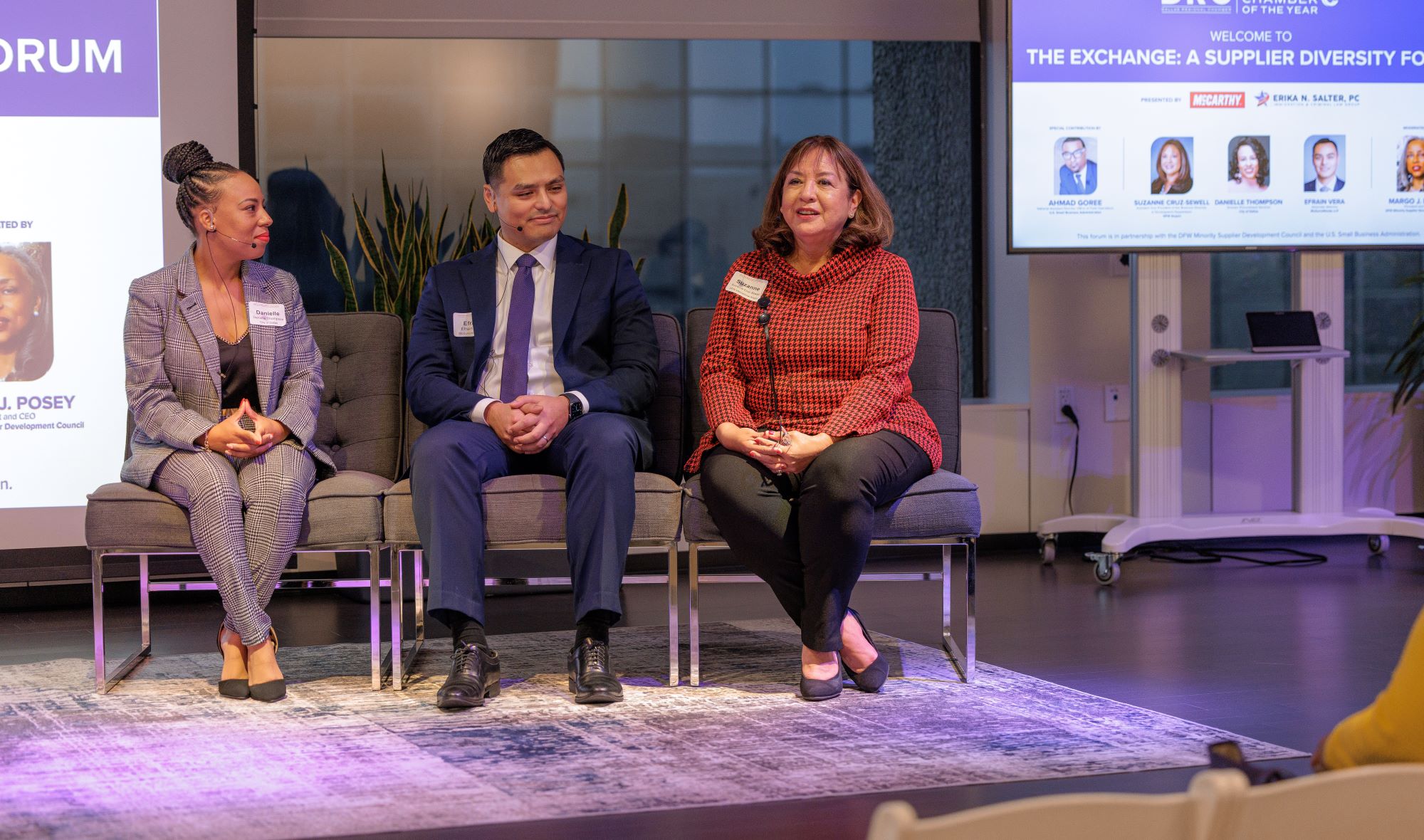
“We all know that people do business with people that they know, people that they like, and people that are connected to them in their network,” said Danielle Thompson, Director of Procurement Services at the City of Dallas. “So, we’re trying to facilitate building networks for our firms who don’t have them.”

The forum also offered plenty of encouragement for those working at increasing their diversity and inclusion.

“Supply chain inclusion is not easy… there are obstacles all-around and all the way. But we don’t let that get in our way because supply chain inclusion has economic impact for our entire country,” said President of the DFW Minority Supplier Development Council Margo J. Posey. “It’s about the economic impact that it has on our local area, our region, and most importantly, our country.”

If the equity gap, the difference in how successful minority businesses could be compared to where they are now, could be closed, Posey said, it would create over 9 million jobs in Texas alone.

“Partner with us and give us the insight that you have, and that will help all of us have this holistic success that’s actually rooted in relationships and a true investment in diversity and inclusion,” said Thompson.

Suzanne Cruz-Sewell, Assistant Vice President of Business Diversity & Development at DFW International Airport, said truly successful supplier diversity starts at the top.

“Our supplier diversity program is a leadership commitment; it is a commitment across the organization. You have to be very passionate about supplier diversity because the advocacy efforts for these programs are never-ending,” said Cruz-Sewell. “The success of our program at the airport results from the leadership commitment and the 1,112 advocacy organizations we partner with.”

Attendees were also encouraged to avoid negative preconceptions and give Women- and Minority-owned Business Enterprises a chance.

“People think that all minority-owned businesses are small. That’s not the case,” said Posey. “A lot of minority-owned businesses are great when it comes to skill set, knowing their craft, and being able to deliver on their product.”

American National Bank of Texas and Regions Bank served as silver sponsors for The Exchange.

If you want to learn more about the work the DRC’s Diversity, Inclusion & Community Engagement team is doing, visit our website.

By Catie George, Manager, Communications and Storytelling

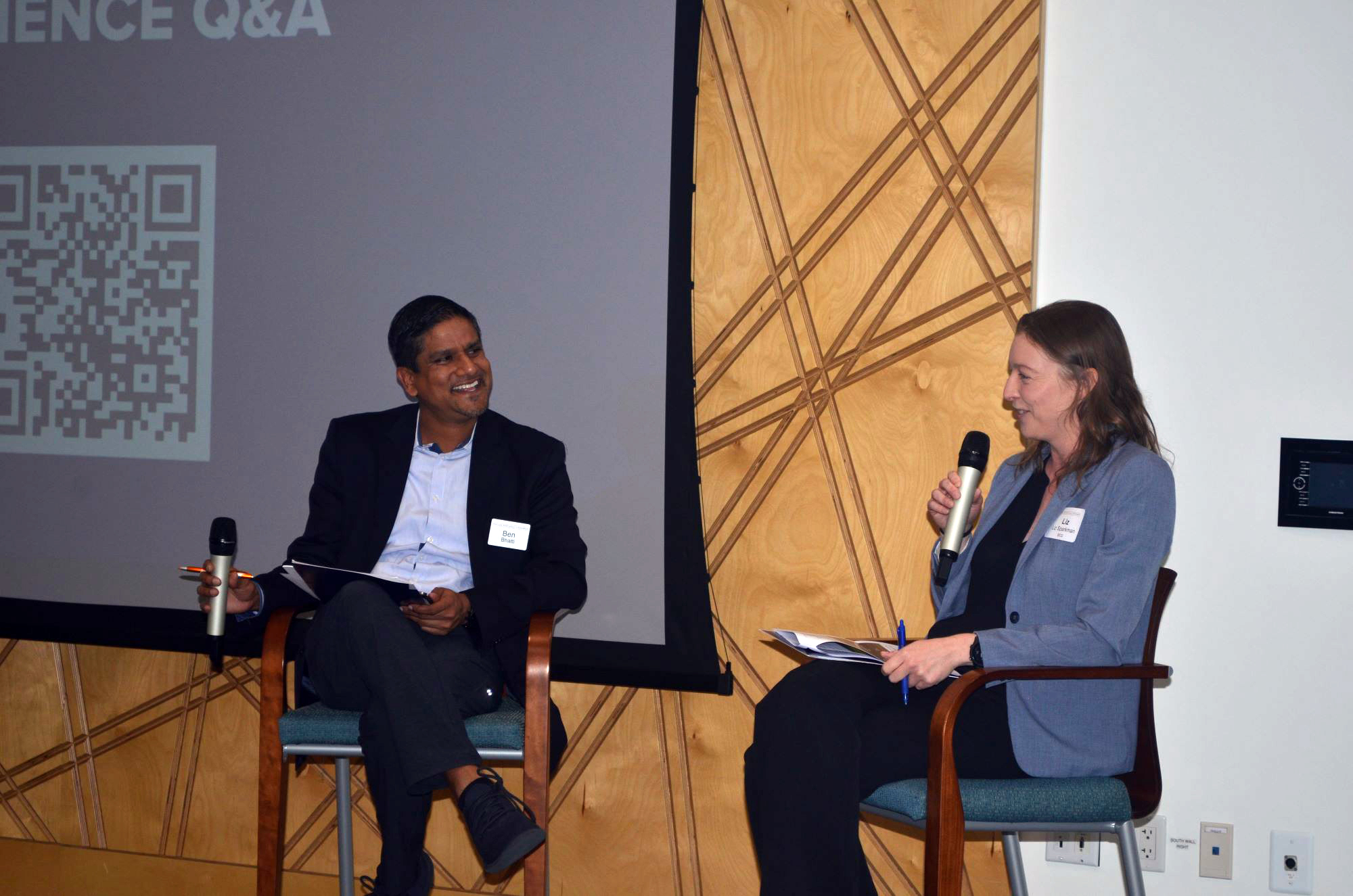
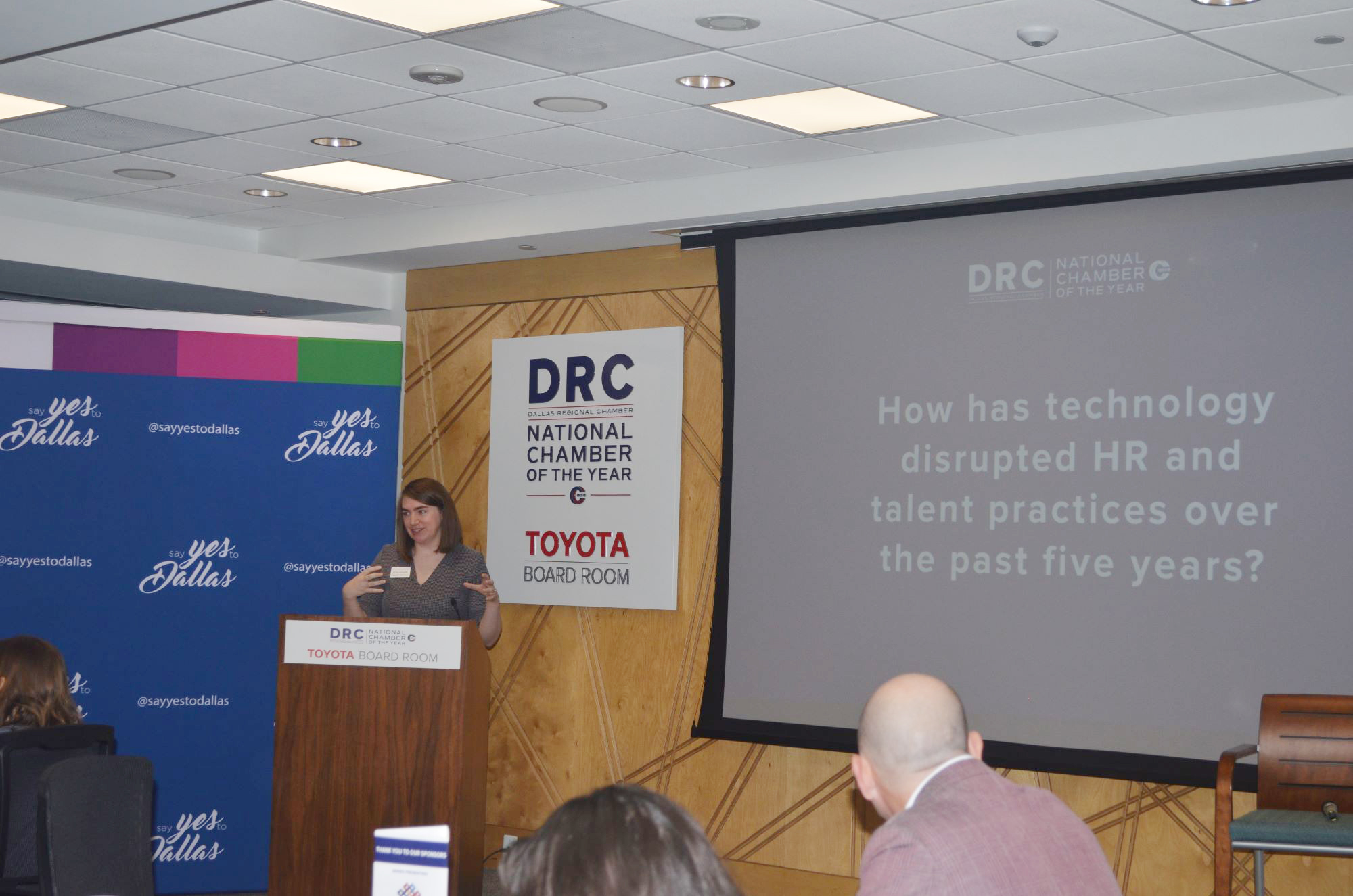
The Dallas Regional Chamber (DRC) hosted Liz Sparkman, Principal at BCG, at its final Talent Attraction Talk of the year on Wednesday, Nov. 1, to discuss the influence of technology, and specifically artificial intelligence (AI), on business and human resources.

“I think generative AI is only at the beginning,” said Sparkman. “I would predict that generative AI will have a greater impact in the long term when we think within human resources. Specifically, after analyzing all of the different tasks that is performed within HR, there could be a 20% to 30% productivity improvement.”

DRC VP of Innovation Ben Bhatti and BCG Principal Liz Sparkman

Generative AI is unique in that it can produce content. It broke into the public consciousness in a big way with the release of ChatGPT in November of last year, and has since become a staple of conversation regarding future technology.

Sparkman also discussed the specifics of how AI could affect the future job market, though she does not anticipate AI will take over people’s jobs on a massive scale as some critics speculate.

“We’re seeing dramatic changes and shifts of the actual tasks people are doing. I like to think about it in terms of tasks as opposed to jobs,” said Sparkman. “There will be changes in jobs and what is composed within a job, but a lot of the actual changes will be, ‘what tasks are you doing differently today versus tomorrow?’ And there will be a portion of jobs, roughly 10%, that will be massively disrupted by AI and potentially even replaced. There will be 60% of tasks that will be augmented or supported.”

Though those statistics may be concerning to some, there will also be job creation and adaptation due to AI.

“I think we will see roles emerge, like a Chief AI Ethics Officer,” said Sparkman. “I think the ability to learn will be even more important now because if we imagine that 10% of my tasks or 50% of the tasks that I do in a job today are going to be different tomorrow, I need to be able to adapt to that.”

Sparkman also dove into the specific effects AI could have on human resources within a company.

“When it comes to HR, what’s top of mind for Chief HR Officers and HR leadership is not only what changes within the HR function, but how does HR need to pivot or support a change in enterprise strategy as well?” said Sparkman. “A core frame for a process in HR is to anticipate, attract, develop, and engage. AI can impact every single stage of that process in different ways. There’s lots of efficiency gain, but you have to pick the right point.”

DRC VP of Education & Workforce and Leadership Programs Elizabeth Caudill McClain

Companies using AI still need to be mindful, Sparkman warned, especially in the HR sphere.

“Bias is a problem for humans and it’s a problem for models. Models are only as good as the data that they are trained on,” Sparkman said. “When trained on unbiased data, AI models can be more objective than humans can in some scenarios. So, there is value in pairing people and AI for diversity and equity.”

Whether it’s using AI to scan through resumes, evaluate employees, or generate data, companies should start thinking about their AI use now.

“Getting it right means starting to build an experimenting culture and starting to test and learn your way in. This is not an overnight change. You have to start to build the culture within your organization to learn what we actually need to do, what are the processes we need in place, who are the talent that we need, and how do we get them in place?” said Sparkman. “What we’re seeing is companies being intentional about setting their strategy, putting in place a center of excellence for a small squad of people who will start to experiment and then be very strategic.”

Thank you to our presenting sponsor BGSF, corporate sponsor SMU Cox School of Business, and featured employer OCC.

To learn more about the work the DRC is doing in education, talent, and workforce, visit our website.

By Dana Jennings, Senior Vice President, Communications, Marketing & Events

The Dallas Regional Chamber (DRC) presented Sen. Royce West with a Building Tomorrow Together Award during a reception on Wednesday, Nov. 15, to recognize the positive impact he has had on economic development in the Dallas Region as a member of the 88th Texas Legislature.

Sen. West with DRC SVP of Economic Development Mike Rosa

The award is traditionally given to companies that have moved to or expanded within the Dallas Region and spurred economic growth, so granting the award to Sen. West, of Dallas, is a deserved break from tradition.

During the legislature’s regular session, Sen. West played a critical role in passing DRC priority bill House Bill 5—named the Texas Jobs, Energy, Technology, and Innovation (JETI) Act—to establish a new transparent and accountable economic development incentive tool designed to help attract large corporate projects to the state.

“Senator West has been a fierce advocate for Dallas in the Texas Senate for more than 30 years, and we appreciate our partnership with him on so many issues,” said Dale Petroskey, DRC President and CEO. “His contributions to the current and future prosperity of our region are numerous, and his leadership on House Bill 5 will do two things—help our state maintain its winning economic formula while benefiting our under-championed communities.”

When the JETI Act was considered in the Senate in May, it was in danger of not passing despite a near-unanimous favorable vote in the House of Representatives. Sen. West consulted with the DRC to include a provision incentivizing companies to locate projects in federally designated Opportunity Zones, which are under-championed rural and urban communities across the state.

Gov. Greg Abbott soon after signed the bill into law on Wednesday, June 7.

“Senator West got something very important for the State of Texas and Dallas-Fort Worth across the goal line in this most recent legislative session because he saw a path to keeping us competitive for projects that can be so fruitful for Texans,” said Mike Rosa, DRC Senior Vice President of Economic Development, whose team grants Building Tomorrow Together Awards. “This award is typically given to companies; this time, it’s going to a person whose work will yield many companies and jobs for us to celebrate in the near- and long-term future.”

DRC CEO Dale Petroskey, DRC COO/CFO Angela Farley, Sen. West, DRC SVP of Economic Development Mike Rosa, and DRC SVP of Public Policy Matt Garcia

Sen. West is joined by Canadian Solar, Rudolph Foods, and Boingo Wireless as other recipients of 2023 Building Tomorrow Together Awards.

The JETI Act succeeds Texas’ previous economic development incentive tool, known as the Texas Economic Development Act, which expired at the end of 2022 after two decades of helping fuel an economic boom that included the addition of 222 corporate headquarters, hundreds of industrial projects, and 1.3 million new jobs to Dallas-Fort Worth since 2010.

Sen. West was first elected to the Texas Senate in November 1992. Since taking office, he has represented the 23rd Senatorial District on behalf of the citizens of Dallas County in the Texas Legislature. During his tenure, Sen. West has been named by Texas Monthly as one of the 25 most powerful people in Texas politics, been selected for the magazine’s biennial “Ten Best Legislators in Texas” list and has twice been named as an “Honorable Mention.” Senator West has also received mention on the Associated Press’ “Movers and Shakers” list, as well as the Texas Insider’s “Best Legislators” list.

Sen. West is Vice Chair of the Senate Higher Education Committee and is a member of Senate committees on Education Finance and Transportation.

By Catie George, Manager, Communications and Storytelling

The Dallas Regional Chamber (DRC) hosted its inaugural State of Infrastructure, presented by Jacobs, on Tuesday, Oct. 24, for local and state officials to discuss energy, water, transportation, and housing needs — and plans to address those needs with safety, security, and equity in mind.

Dr. Skylar Olsen of Zillow Group

As the Dallas Region continues to expand, so does the need to support its growing population.

“Current trends project that DFW can become the third largest metro area in the United States by as soon as 2028,” said Ron Williams, Senior Vice President and General Manager for the Americas of Jacobs. “With that in mind, infrastructure needs in the region, now more than ever, are critically important to sustaining our growth.”

The Dallas Region must plan for that inevitable growth starting now, said Nadine Lee, President and CEO of DART.

“We are literally going to bring this region to a sleeping halt if we welcome 4 million people to the region without rethinking our resources, so it’s really a critical time for us to be thinking about the future,” said Lee in a panel moderated by AJ Rodriguez of Texas 2036. “Those 4 million people aren’t going to show up tomorrow. They’re going to trickle in over 20 years, and we’re going to try to keep up with the pace of that growth. But all the while, if we’re just ignoring transportation mobility problems, we’re not only going to hurt our economic productivity in this region, we’re also going to leave a ton of people behind.”

Experts say strains on the Dallas Region’s housing needs will increase as the population grows.

“We face growing pains because people move so much more easily than we can build homes,” said Dr. Skylar Olsen, Chief Economist at the Zillow Group “At the same time, it’s a bit of a success story when we think about how far Dallas has come.”

Olsen emphasized that Dallas has the people, companies, and opportunities available to continue shaping the bright future of the region as long as business leaders and policy makers don’t lose sight of the region’s needs. Olsen’s keynote presentation focused on the affordability and availability of housing throughout the Dallas Region.

Transportation and Mobility panel featuring Moderator AJ Rodriguez of Texas 2036; Ceason Clemens of TxDOT; The Honorable Clay Lewis Jenkins; and Nadine Lee of DART.

“When we talk about affordability in a place like Dallas, what we’re basically looking at is the tension between what was here before and all the people that are going to come… There’s still a lot more need,” said Olsen. “We’ve got a lot of work still to do.”

Olsen suggested solutions like shared housing spaces, joining with others to buy houses that would otherwise be too expensive, and getting creative about housing solutions throughout the region.

In addition to housing, transportation is another important area for improvement.

“You’re here in Dallas County where twelve of our cities are DART members and another five of our cities are served by Star Transit. But we have 31 cities,” said the Honorable Clay Lewis Jenkins, Dallas County Judge. “We’ve got to look at ways to modernize the system.”

Luckily, the transportation infrastructure in the Dallas Region has funds coming from the Texas Department of Transportation.

“We are fortunate our Texas Transportation Commission approved a record Unified Transportation Plan last August. So, over the next ten years in the state of Texas, we plan on spending $100 billion on roadway construction projects,” said Ceason Clemens, Dallas District Engineer of the Texas Department of Transportation. “Of that $100 billion, $16.7 billion is coming to North Texas. We’re very fortunate to get that influx of funding.”

Adding millions of people to the Dallas Region also presents a more pressing issue: water. The DRC hosted a Tomorrow Fund Breakfast back in April that focused on the necessity of water to the region. Additionally, the Good for Texans campaign helped pass Proposition 6 in the Nov. 7 election to fund water infrastructure projects across the state.

“All of these opportunities that exist out there need a workforce. We have to be very strategic about our approach to making sure that we can have that,” said Aaron Demerson, then-Commissioner of the Texas Workforce Commission and now-President and CEO of the Texas Economic Development Corporation. “At the end of the day, economic development is impossible without water. And if you don’t have water, you got one problem.”

Investing in Texas’ Future panel featuring Moderator AJ Rodriguez of Texas 2036; George Peyton of Texas Water Development Board; and Aaron Demerson of Texas Workforce Commission.

Luckily, experts and professionals have already started working on new and innovative water sources to increase water access and availability for future North Texans.

“The state has set up several programs. The biggest one thinking about water supplies going forward is a program called the State Water Infrastructure Fund for Texas, or SWIFT,” said George Peyton, Board Member of the Texas Water Development Board. “SWIFT is a dynamic program where we are able to take a dollar the taxpayer funds and turn it into about $10 worth of infrastructure projects across the state. It works really, really well.”

Though the Dallas Region faces a variety of challenges as it continues to grow and thrive, State of Infrastructure’s panelists and keynote remained positive.

“We are uniquely blessed with folks that make a difference and take care of business to keep us moving forward,” said Demerson. “This state is going to go a very long way.”

The State of Infrastructure was presented by Jacobs. Thank you to our gold sponsors, Southwest and Toyota, and our silver sponsors, American Airlines, Carrington, Coleman, Sloman, & Blumenthal, Oncor, and Verizon.

To learn more about the work the DRC’s Public Policy team is doing, visit the DRC website.

By Catie George, Manager, Communications and Storytelling

Moving diversity, equity, and inclusion (DEI) theory into a steadfast organizational practice was the focus of a recent talk given by Gerry Altamarino, Senior Manager of Workplace Diversity at AMN Healthcare, to Dallas Region business leaders.

Gerry Altamarino, Senior Manager of Workplace Diversity at AMN Healthcare

“A common pitfall I saw in my consulting experience is that organizations fail to define what DEI means to them,” said Altamirano at the Dallas Regional Chamber’s DEI Leaders Connect meeting, adding that DEI work should be embedded in an organization’s policy, practice, and culture. “It’s not just about making commitments and goals, but also having metrics to measure when you’ve achieved those goals and when you can move on to advance the next goal. Measurement is critical.”

It’s important to continually evaluate not only progress, Altamarino says, but also other factors, such as potential bias within a company.

“We can approach DEI work through a systemic lens to address the inequality that inevitably and undoubtedly exists within all of our organizations by virtue of our organizations existing in the context of broader America and the context of humans perpetuating biases that get institutionalized,” he said. “We love to think that neutrality is a thing, but spoiler alert, neutrality does not exist.”

Altamirano encouraged each participant to walk away with a plan to formalize a DEI strategy for their business so they can move along the path from awareness to action in the DEI space.

“Once you have a strategy, you’re able to see how DEI work is good for business because it reduces attrition. It enhances our brand awareness,” said Altamirano. “If we are not proactive in our DEI approach, then how could we advance our work in meaningful ways when it matters the most?”

Altamirano concluded by emphasizing that each of the 25 companies represented consider the Dallas Region in their DEI plans.

“You’re ultimately also wanting to support your local community,” said Altamirano, “and you want your diversity to reflect the population that you serve.”

If you want to learn more about the Diversity, Inclusion, and Community Engagement work the Dallas Regional Chamber is doing, visit our website.

To contribute to our work, please participate in our Disability Inclusion Toolkit Survey to help us understand your efforts toward disability inclusion.

By Daniela Ramirez, Director, Diversity, Inclusion & Community Engagement

The second iteration of the DRC’s Community Connections: Latina Professionals event, presented by Bell Nunnally, was held on Wednesday, Nov. 1, at LERMA/ Agency. Part of a new and dynamic event series, the reception featured an intimate conversation with Florencia Velasco Fortner, President & CEO of The Concilio, and guided conversations that brought Latina professionals from different industries closer through reflections about Latin culture and shared determination to elevate more Latinas to leadership roles in the business community.

“We are ready for the next chapter of growth and collaboration for Latina professionals and to ignite new opportunities that uplift us,” said Bell Nunally Partner Dania Duncan. “We must foster meaningful relationships that shape our future.”

To celebrate Dia De Los Muertos, a vibrant holiday celebrated in Latin American countries and among Latinos in the United States, guests were invited to bring pictures to place on the ofrenda, or altar, arranged for the reception to remember ancestors that had sacrificed and paved the way to create a better future.

During a fireside chat, Fortner and Kim Cruz, Associate Attorney at Bell Nunnally, dove into the importance of acknowledging the impact of what their ancestors had accomplished and the importance of continuing to elevate others.

The fireside chat highlighted the importance of building strong relationships with collaborators, supporters, and allies, and recognized areas where Latinas need increased representation to achieve greater prosperity.

Currently, Latinas are one of the last groups, along with Native American women, in the gender pay gap, earning on average 58 cents for every dollar compared to white men. According to the Women Leading Boards Report released in 2022, Latinas are also the least represented group in company boards.

In response to these sobering statistics, Fortner encouraged and coached guests to become more visible in their workplaces. Fortner expressed that humility and gratitude, traits often placed at the forefront of Latino culture, do not have to clash with showing confidence or honoring achievements.

After the fireside chat, all guests participated in guided conversations, reflected on their various experiences related to Dia De Los Muertos, and outlined how they wanted to continue growing professionally in 2024.

If you are interested in learning more about the DRC’s Diversity, Inclusion & Community Engagement work, visit the DRC website.

The eight propositions endorsed by the Dallas Regional Chamber’s Good for Texans campaign each passed with at least 55% of statewide voter approval during the Tuesday, Nov. 7, constitutional amendment election.

The DRC launched Good for Texans to promote the passage of Propositions 2, 4, 5, 6, 8, 9, 10, and 14 among voters across the Dallas Region. Together, the propositions will enhance Texans’ quality of life, grow Texas’ economy, improve the state’s infrastructure, and lower property taxes.

“This election was important, and Texans delivered. By voting for the eight Good for Texans propositions, Texas voters have made eight great decisions to help secure a prosperous and bright future for us all,” said Dale Petroskey, DRC President and CEO. “Each of these propositions represents an important investment to keep Texas competitive and keep the Texas of tomorrow ahead of our competition.”

The DRC selected the eight propositions because each was a result of legislation the DRC engaged on during the regular session of the 88th Texas Legislature. The Dallas Region comprised an average of 19.2% of the total number of votes cast statewide in favor of the eight Good for Texans propositions.

The campaign launched in mid-October, just before early voting opened on Monday, Oct. 23. It targeted 2 million registered voters in Dallas, Collin, Tarrant, and Denton counties through digital and social media advertising driving to the campaign website— 2023TexasPropositions.com—which featured content explaining why each proposition is valuable to Texas’ future.

Good for Texans campaign ads garnered impressions upwards of 9 million. Time spent on the campaign website by visitors was well above industry average, an indication that there was meaningful engagement with the information they found there.

“I am so proud the DRC launched this campaign and that we were able to be a force for good in this election,” said Matt Garcia, DRC Senior Vice President of Public Policy. “Texas’ historic budget surplus allowed Texas voters to make important investments in our future without new costs to taxpayers—a rare opportunity. The decisions made by voters this November help us ensure Texans of today and future generations enjoy a high-quality life and that our state remains the land of opportunity.”

In addition to web-based and social media advertising, the Good for Texans campaign utilized more traditional mediums. Petroskey penned an article for the Dallas Morning News that was published at the start of the second week of early voting. Before voters’ final opportunity to head to the polls on Tuesday, Nov. 7, a half-page Good for Texans ad ran in the Sunday, Nov. 6, Dallas Morning News paper.

But the DRC did not stop there. Staff volunteered to advocate for the campaign at popular polling sites in Dallas on Thursday, Nov. 2, and election day Tuesday, Nov. 7. Team members worked in shifts to hand out informational flyers that voters could take into the polls and asked them to consider voting Good for Texans.

“Volunteering at polling sites demonstrates the DRC team’s commitment to our mission and leaning into every opportunity we have to help make the Dallas Region the best place to live, work, and do business,” Garcia said.

The Good for Texans campaign was supported by the Good for Texans political action committee. Read about the eight propositions and why they matter for Texas’ future here.

Learn more about the DRC’s public policy and advocacy work. To get involved, contact publicpolicy@dallaschamber.org.

Tell us about KEIRUS.

KEIRUS BY KJE is woman-owned, woman-led strategy consulting and leadership development firm. We are one of the few technology-enabled diversity, equity, and inclusion (DEI) firms led by a former Chief Diversity Officer of a Fortune 500 company with a team of practitioners who have decades of experience. KEIRUS partners with Fortune 500 and mid-sized companies to create workplace cultures of C.A.R.E. to Create awareness, Appreciate diversity, and Respect everyone by Embracing inclusion.

What differentiates KEIRUS from others in your industry?

Our expertise, track record of demonstrated results, and ability to customize solutions to our clients’ needs set us apart. We transform workplace cultures through accessibility, belonging, inclusion, diversity, and equity—or A.B.I.D.E.

DEI efforts drive commerce, culture, and community, yielding measurable results for organizations who prioritize these efforts. Creating lasting results are at the core of our philosophy and the reason we believe in the impact of our C.A.R.E. methodology.

We help organizations ABIDE WITH CARE and have seen the results that prove A.B.I.D.E. not only creates powerful workplace cultures, but also gives companies a competitive edge.

What do you enjoy most about doing business in the Dallas Region?

As a descendant of former sharecroppers from the historic White Rock Settlement in North Dallas, I have a personal connection to this city and region. I appreciate the diversified organizations and industries we have been able to support throughout our existence as a firm. Dallas is a transplant hub with people from all over the world, and that collective embodies our purpose.

Why did you decide to become a member of the DRC?

The power of community, networking, and relationships has been foundational to our firm, and we always want to remain connected to other business leaders within the Dallas Region as we help make a positive difference.

How has KEIRUS changed in the past five years?

2020 was pivotal to the growth of our firm as the importance of DEI became undeniable after the George Floyd tragedy. The last three years exhibited an uptick of awareness about the importance of valuing uniqueness in the workplace given the disturbance to employee retention and recruiting caused by the pandemic and the subsequent Great Resignation. In 2022, we evolved into a technology-enabled, human-centered approach through our new digital platform, KEIRUS. We combine the efficiency of e-learning with the human interaction and engagement needed for diversity, equity, inclusion, and belonging topics.

KEIRUS is a game changer, offering a multi-phase, multi-lingual approach to DEI training that evolves as the organization and its individuals grow in understanding how they can contribute to building a culture of C.A.R.E.

What are you looking forward to most in 2024 for KEIRUS?

We are looking forward to helping more organizations cultivate a culture of C.A.R.E. through our programs like ERG Connect, which enhances the impact and effectiveness of Employee Resource Groups, and The Power of Inclusive Leadership, our comprehensive leadership training program.

In 2024, we will expand our micro-learning resources that are available on the KEIRUS platform and will release enhancements to our Culture Transformation Index, an assessment tool that helps organizations evaluate their infrastructure, policies, and culture around DEI.

Anything else you would like to add about KEIRUS?

Many organizations do not experience the results of their DEI initiatives because they need a more integrated approach. KEIRUS can help you implement the practices, policies, and infrastructure that grow commerce, culture, and community using our strategic advisory support and other proven tools like our multi-year DEI training.

Diverse, equitable, accessible, and inclusive cultures increase innovation, problem-solving, and marketplace brand positioning. Through this competitive edge, you can attract and retain top talent that is engaged and productive.

PDR is the ultimate guide to navigating the evolution of how people engage and experience space. Whether helping clients attract their ideal tenants, accelerate their future resiliency, retain and attract top talent, or encourage enhanced collaboration, we bridge the gaps between where organizations are and where they want to be by addressing their space challenges. Our niche expertise and design DNA give our team the ability to see spaces from every angle and perspective. We’re more than a sounding board or a creative team. We’re dedicated partners who work to create tangible change.

How does your company help other businesses become more effective?

Through our integrated Design + Architecture, Consulting, and Brand services, we help our clients develop comprehensive solutions to make the things that matter most to an organization better, connecting people, business, and ideas. We empower business leaders to make smarter decisions, take the guesswork out of design, and provide spaces that support organizational goals and allow people to thrive.

What differentiates your company from others in your industry?

We take a unique approach to our work with clients, leveraging holistic, integrated, and human-centric principles to address all parts of a challenge. Because people are at the heart of everything we do, we tailor our design solutions around human connection and empower organizations through cultivated spaces that align purpose, culture, and place. By fully immersing ourselves in our client’s organizations, we’re able to get to the heart of their concerns, ensuring that every aspect of the project is addressed. This method allows us to deliver flexible solutions that continue to generate value over time.

What do you enjoy most about doing business in the Dallas Region?

Like Dallas, PDR is made up of distinct individuals who use their talents to come together and create something spectacular. We are honored to work in a community that continues to grow around the ideas of inclusion and enhancing the quality of life for all. We love how Dallas provides ample opportunities for businesses to build trusted partnerships through innovative, adaptable work that emphasizes quality above all else.

Why did you decide to become a DRC member?

Strengthening communities, whether through work with local partners or fellowship and forming new connections, is core to PDR’s ethos. By joining the DRC, we hope to connect with organizations that are looking to push boundaries and bring new collaborative ideas forward. With these partners, we want to help strengthen the Dallas Region by joining the conversation and ensuring that the Dallas Region continues to thrive.

How has your business changed in the past five years?

The goals of our clients have shifted, and we’ve shifted alongside them. Now, more than ever, organizations need spaces that support their goals while placing equal value on creating positive experiences for those using the space. This requires strategic thinking about the evolving ways that people interact with spaces around them. To help address these challenges, we’ve leveraged our team’s integrated expertise in Design + Architecture, Consulting, and Brand to provide clients with a 360-degree lens for every project. This ensures there is no loss of fidelity, from strategy, to design, to user experience, so that clients can move forward with confidence long after our initial work is completed.