By Amber Dyer, Coordinator, Communications & Marketing

Average reading time: 2.5 minutes

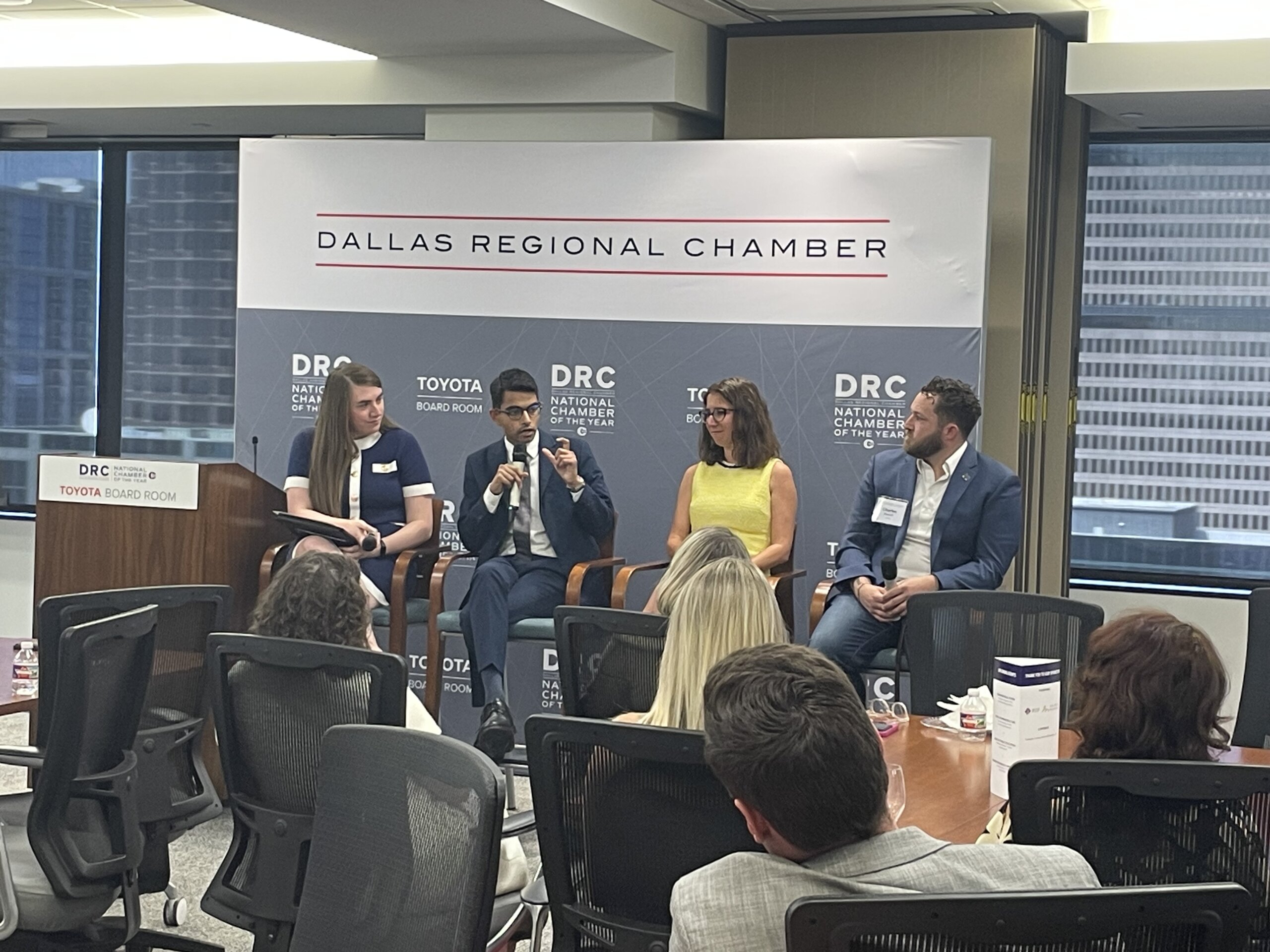
At the Dallas Regional Chamber’s Education and Workforce Council meeting, hosted Thursday, Sept. 4, at the Uplift Heights Healthcare Institute, leaders from Uplift Education and Baylor Scott & White Health examined how their Healthcare Pathways program partnership is advancing college preparedness and post-secondary success.

Strategic partnerships help prepare students for post-secondary outcomes

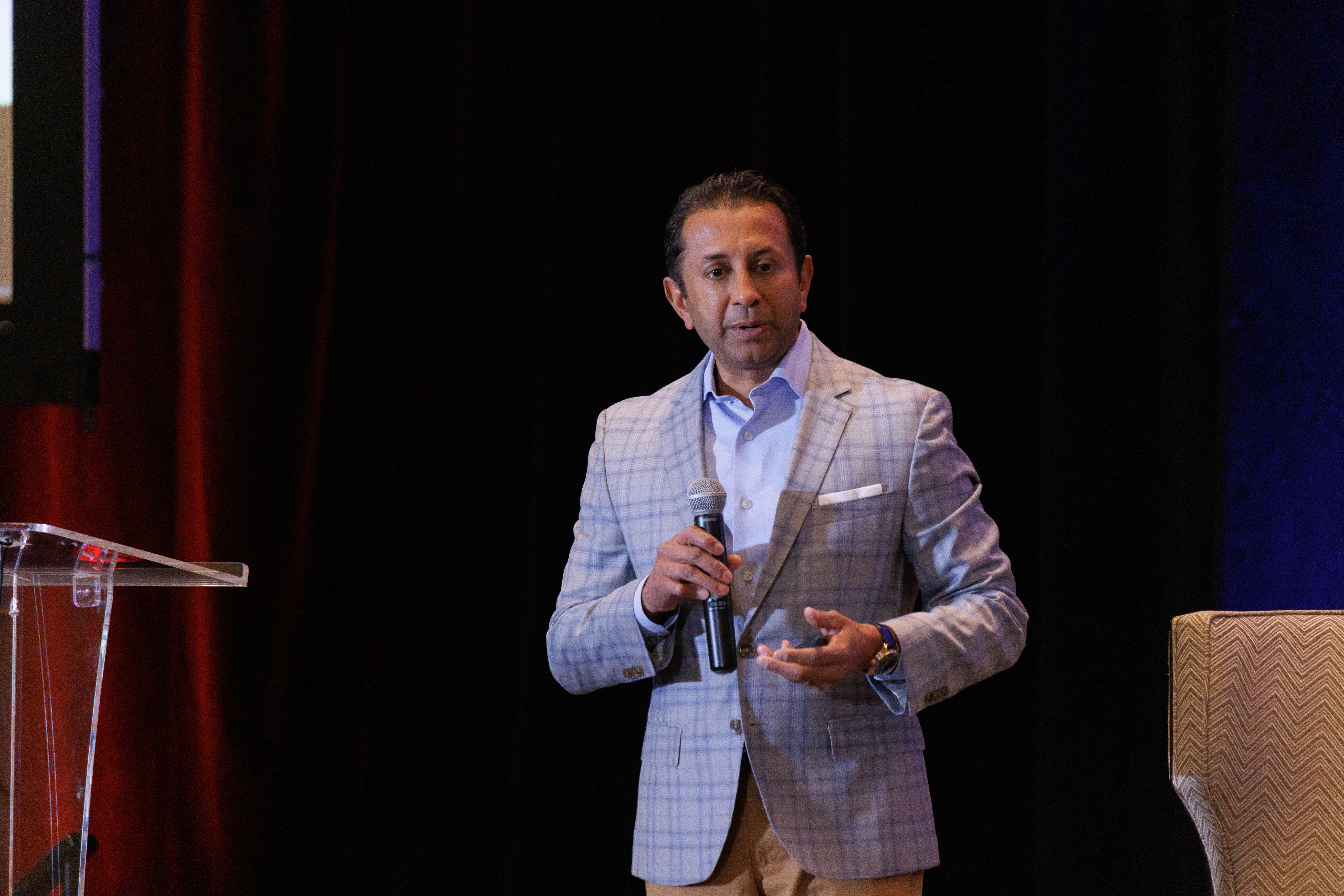
“The goal of K–12 education is to prepare youth to have lives of economic opportunity, mobility, and choice,” said Yasmin Bhatia, the outgoing CEO of Uplift Education.

When students feel supported not just by their administration and school system, but by the broader community, success is sure to follow.

To achieve this goal, Uplift Education has partnered with organizations to create programs that prepare students to navigate the ever-evolving occupational landscape.

“We bring in secondary partners to think through what degrees and certificates are that best prepare students for jobs,” said Phil Kendzior, Vice President of Workforce Development at Baylor Scott & White Health. “Once we nail those degree plans out, we can start backwards mapping all the way down to high school to prepare students for the admissions requirements for various programs.”

One such partnership is their health care workforce pipeline which is an immersive health care program that focuses on building students’ technical expertise and mindset.

“With our partners at Baylor Scott & White, we sat down and said, ‘what will it look like to prepare the future health care workforce and families?’” asked Dr. Remy Washington, incoming CEO of Uplift Education. The joint program between Baylor Scott & White Health and Uplift Education has simulation labs to recreate authentic hospital environments with real medical equipment, providing augmented learning experiences across multiple health care disciplines to prepare students for possible future careers.

“We very intentionally designed the simulation labs to look and feel like a major hospital,” said Sophia Kwong Myers, Senior Director of Career Pathways and Programs at Uplift Education. “They’re practicing how to take vital signs and how to draw blood. These are ways that we’re preparing students at an earlier age and being very innovative around the fact that we can’t have them working with patients.”

Connecting students with health care experts strengthens their support network

Beyond hands-on experience, the program exposes students to subject matter experts from various health care fields. Through their deep engagement with these experts, students will essentially become team members by graduation.

“Because of the level of involvement [students will] have with these scholars, by the time they graduate after four years, they’re already going to be part of the team,” said Kendzior. “They will already know the hiring managers; they will already have relationships. They will already be familiar with our culture and what it means to work with us. They will have realistic job previews and be ready to go.”

Programs like these demonstrate the power of partnership between education and industry, but measuring their success requires robust assessment systems. The recently introduced House Bill 8 (HB 8) from the 89th Texas Legislative Session will considerably change the state’s assessment system, leading to increased accountability.

HB 8 introduces a modernized assessment approach

Businesses throughout the Dallas Region rely on academic assessments and accountability ratings to evaluate the health of the talent pipeline and inform decisions about corporate relocations and expansions.

“By modernizing Texas’ approach to academic assessments, HB 8 will deliver clear data about educational outcomes to employers and working parents while maintaining rigorous standards for public schools,” said DRC Senior Vice President of Education and Workforce Jarrad Toussant.

By Amber Dyer, Coordinator, Communications & Marketing

Average Reading time: 2 minutes

To celebrate 25 years of Young Professionals (YP), presented by Fidelity Investments, the Dallas Regional Chamber is highlighting a series of alumni to explore their experiences in YP and the program’s impact on the Dallas Region.

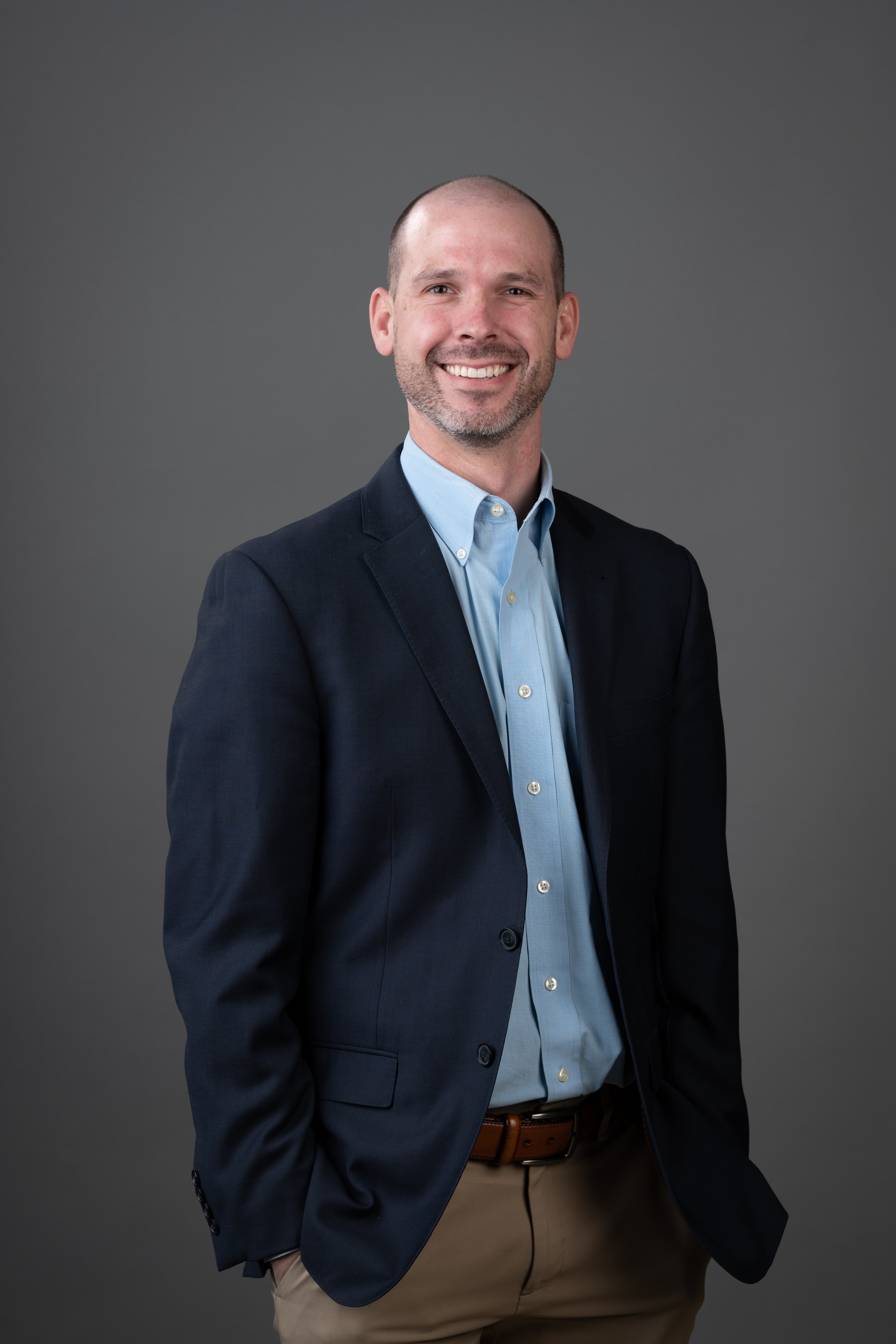
Chase Luft, Project Executive at Turner Construction Company.

Chase Luft, Project Executive at Turner Construction Company, was drawn to YP through his desire for a leadership community that shared his commitment to excellence, innovation, and impact.

“I was looking for a space outside of my company where I could sharpen my leadership perspective, expand my network, and engage with a broader cross-section of industries shaping our region,” said Luft. “The DRC’s reputation for elevating local leadership and driving real progress made YP a natural fit.”

Luft also gained valuable insight from other leaders through YP.

“Hearing from leaders across various sectors helped me realize that leadership challenges are often shared, regardless of the field,” he said. “I’ve learned to pause before reacting, to lead with questions instead of answers, and to invest in mentoring as both a responsibility and a privilege. Being in rooms with equally driven people, but on different paths, expanded my definition of success.”

YP played a pivotal role in helping Luft better understand and refine his leadership skills.

“Through programs like LEAD YP, I gained clarity on how I lead in high-pressure environments, how I communicate vision across teams, and how to balance operational discipline with long-term strategic thinking,” he said. “The assessments, workshops, and peer feedback pushed me beyond self-perception and into intentional growth.”

A pivotal moment in his development occurred during a strength-based leadership and adaptive problem-solving session, where Luft redefined his approach to delegation and team empowerment.
“I brought those insights directly back to my role. Especially as I’ve continued to build a culture of ownership and accountability among those I lead,” he said. “LEAD YP didn’t just inspire—it gave me tangible tools I’ve embedded into my daily leadership.”

YP has also made a significant impact on his career journey.

“It reinforced the importance of community-minded leadership and the need to show up not just for my company, but for the region we’re building together,” said Luft. “It’s also challenged me to think more holistically about people’s development and about what it means to be a leader others trust.”

To Luft, leadership should never occur in isolation, and YP embodies that belief by creating a space where participants can both give and receive.

“Whether you’re early in your career or stepping into more senior roles, YP connects you to ideas, people, and opportunities that accelerate your trajectory. It challenges you to not just lead your team, but to lead with purpose in your community. In a city as dynamic as Dallas, that kind of leadership matters [now] more than ever.”

ENGAGE WITH YOUNG PROFESSIONALS

YP YEAR-END CELEBRATION

Join us Thursday, Dec. 4, for a special evening celebrating another year of YP!

By Amber Dyer, Coordinator, Communications & Marketing

Average reading time: 2 minutes

To celebrate 25 years of Young Professionals (YP), presented by Fidelity Investments, the Dallas Regional Chamber is highlighting a series of alumni to explore their experiences in YP and the program’s impact on the Dallas Region.

Principal of Cornerstone Government Affairs Matt Garcia.

In 2011, Matt Garcia, Principal of Cornerstone Government Affairs, discovered the YP program while seeking ways to engage civically in the region.

“The program provided [me] the opportunity to engage professionally with peers from various industries,” said Garcia. “There were plenty of great social events and a robust offering of volunteer opportunities.”

Beyond building connections, YP helped Garcia recognize and develop his leadership abilities.

“YP prepared me to serve on the various boards I have the privilege of serving today. During my tenure [as a YP board member], the Get on Board event was created, [which] connected many area non-profits seeking qualified candidates with our very talented YP cohort,” said Garcia.

The program also advanced his professional growth through a range of events and experiences. For Garcia, Austin Fly-In was the highlight of those experiences.

“[During Austin Fly-In, the YP cohort] was provided with the opportunity to lead on an issue in the Texas Capitol on behalf of the DRC, and each trip culminated with a great reception with area legislators, city leaders, and DRC members. I never thought that one day I would serve as SVP of Public Policy for the DRC and have the responsibility to do this entire program all over again.” said Garcia.

Through YP, Garcia learned that career success isn’t always linear.

“There are often many ups and downs that come with your career,” said Garcia. “And it is how you manage those which will test your character and long-term success.”

The relationships Garcia built through the program continue to influence his work today.

“I regularly take time to catch up with some of my closest peers and I have created a mini kitchen cabinet of former YP friends that I frequently will share ideas and thoughts with to seek expert feedback,” said Garcia. “It is so exciting to see many are now at executive level positions in their firms, business owners and one is even a Dallas ISD school board trustee!”

Garcia encourages others to join YP for the chance to cultivate meaningful connections with the next generation of leaders.

“While there are several young professional programs in the Dallas Region, there are none that bring together this many people and have so many alumni that stay engaged in the community. You get a true flavor of the power of the Dallas Region, and it is true pipeline of the future leaders of Dallas and a great preview of Leadership Dallas.”

ENGAGE WITH YOUNG PROFESSIONALS

YP YEAR-END CELEBRATION

Join us Thursday, Dec. 4, for a special evening celebrating another year of YP!

By Catie George, Director, Communications & Storytelling

Average reading time: 4 minutes

When nearly 88 million passengers flow through an airport’s gates in a single year, it’s clear that facility is more than a transportation hub—it’s one of the most powerful economic engines in America.

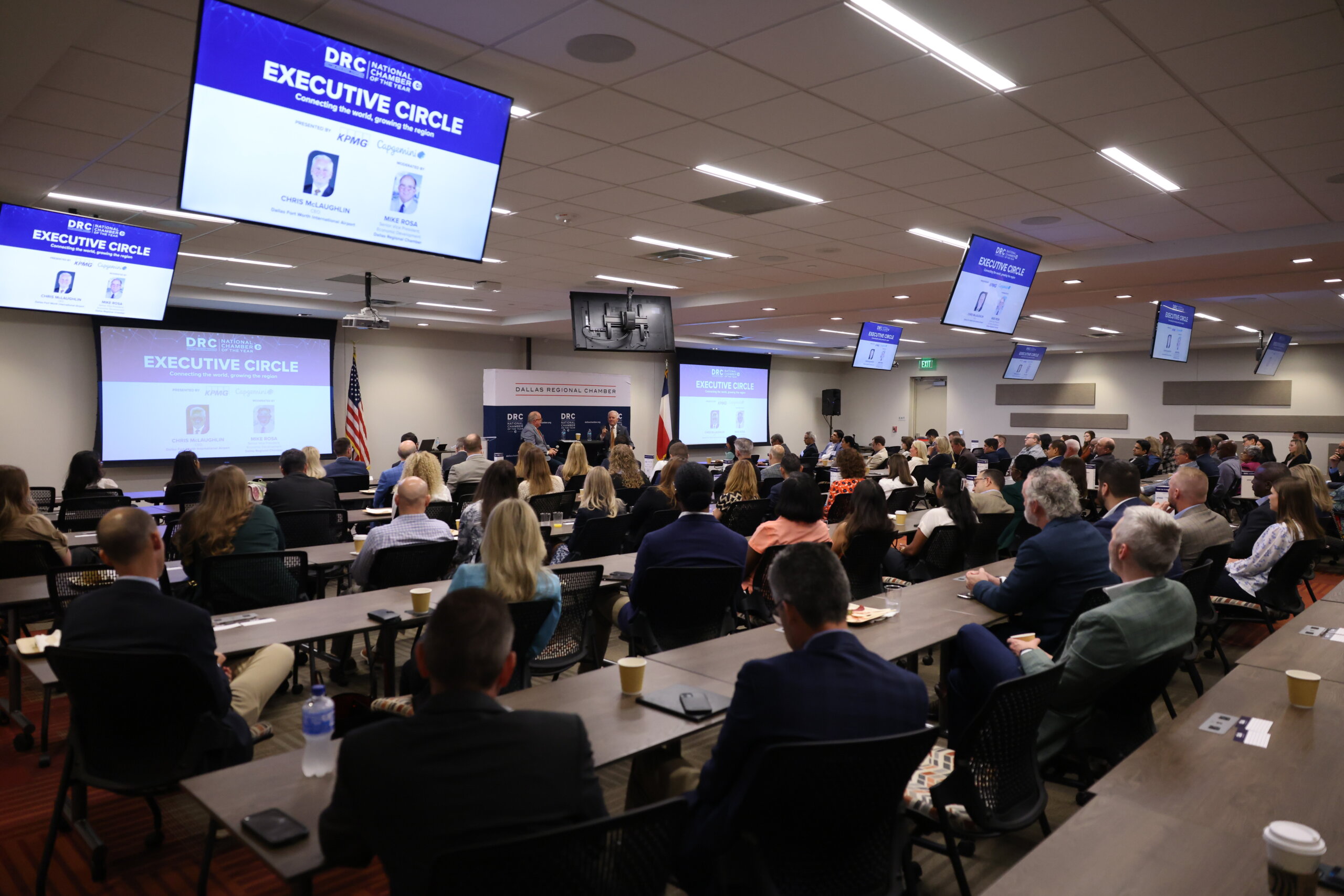
That was the central message as Dallas Fort Worth International Airport’s new CEO, Chris McLaughlin, keynoted the DRC’s Executive Circle, exploring how the world’s third-busiest airport drives unprecedented growth across North Texas.

Hosted at DFW Airport’s Public Safety Center Headquarters and presented by Capgemini and KPMG, the event revealed how this critical infrastructure does far more than move people and cargo. It serves as the foundation that enables one of America’s fastest-growing metropolitan areas to compete on the global stage, attracting Fortune 1000 headquarters and major corporate relocations that continue to reshape the regional economy.

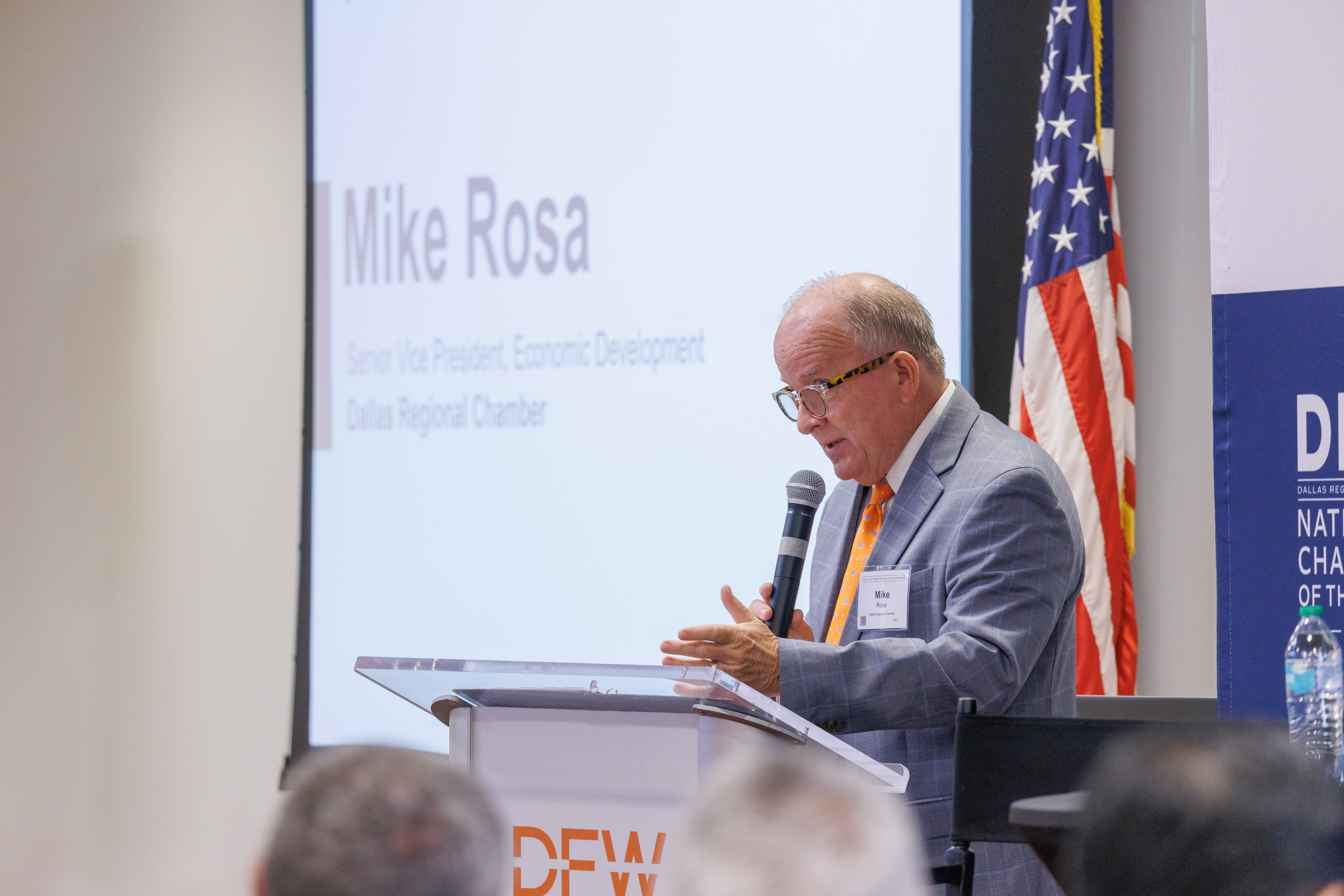
The DRC’s Senior Vice President of Economic Development Mike Rosa shared an economic evaluation of DFW International Airport on the region.

Below are the key insights heard by attendees.

DFW Airport is an economic catalyst

For the DRC’s Mike Rosa, Senior Vice President of Economic Development, DFW Airport’s impact on regional growth is unmatched.

“In my 37 years of working to bring companies and jobs here, no factor has been more important than DFW International Airport, American Airlines, and their partnership with DFW, and our domestic and international air superiority,” said Rosa.

Innovation that creates competitive advantage

McLaughlin outlined how the airport is pioneering technologies that give North Texas businesses distinct advantages.

The airport is developing predictive analytics that identify bottlenecks before they occur across the facility’s multi-level roadway system. McLaughlin likened it to Waze for airports.

Unlike most airports that rely on outside contractors, DFW operates its own police and fire departments, ensuring complete operational control, said McLaughlin. The facility is also the first airport to use modular construction for terminals, with most building happening off-site before installation—a methodology other airports are now studying.

For business travelers, these innovations mean smoother connections and enhanced customer experiences that support international deal-making.

The Executive Circle event was hosted at DFW Airport’s Public Safety Center Headquarters.

Global gateway advantages for business

As the third-busiest international gateway into the U.S., DFW Airport provides North Texas businesses with unparalleled global connectivity.

“More customers connect through DFW internationally than all but two other airports,” said McLaughlin, “and we expect about 7 million international customers coming up [in 2026].”

The airport is launching a game-changing program that will streamline international travel—while addressing a major pain point for business travelers.

“In the coming months, we will be launching a pilot with CBP and the TSA and American Airlines called One Stop Security,” McLaughlin announced. “Passengers traveling east can now process through Heathrow without having to go through customs and without having to reclaim their bags.”

World Cup readiness and global showcase opportunity

As North Texas prepares to host nine FIFA World Cup matches in 2026—more than any other region—DFW Airport represents a critical opportunity to showcase the region’s capabilities to global business leaders and investors.

“Very few people that are coming to North Texas next year are coming because they want to spend time at DFW Airport,” McLaughlin said. “They want a seamless experience, a friendly, welcoming, seamless experience through our airport.”

The preparation extends beyond infrastructure to service excellence: “We’ll have greeters, we’ll have a ton of folks out, language assistance, people in the building, making sure that guests can get where they need to go.”

One airport team—65,000 strong

While DFW directly employs about 2,000 people, McLaughlin emphasized the collaborative culture across the airport’s 27-square-mile campus. McLaughlin says the leadership team considers all 65,000 workers—from airline staff to concessionaires—as “one DFW, one team. “This approach extends to inclusive business practices.

“DFW Airport is fundamentally committed to providing opportunities for our community, and we believe there’s enough opportunity for everyone to be successful,” McLaughlin said. “We’re doing things through contractual mechanisms; through the way we can split work up to ensure that we do provide opportunities for everyone.”

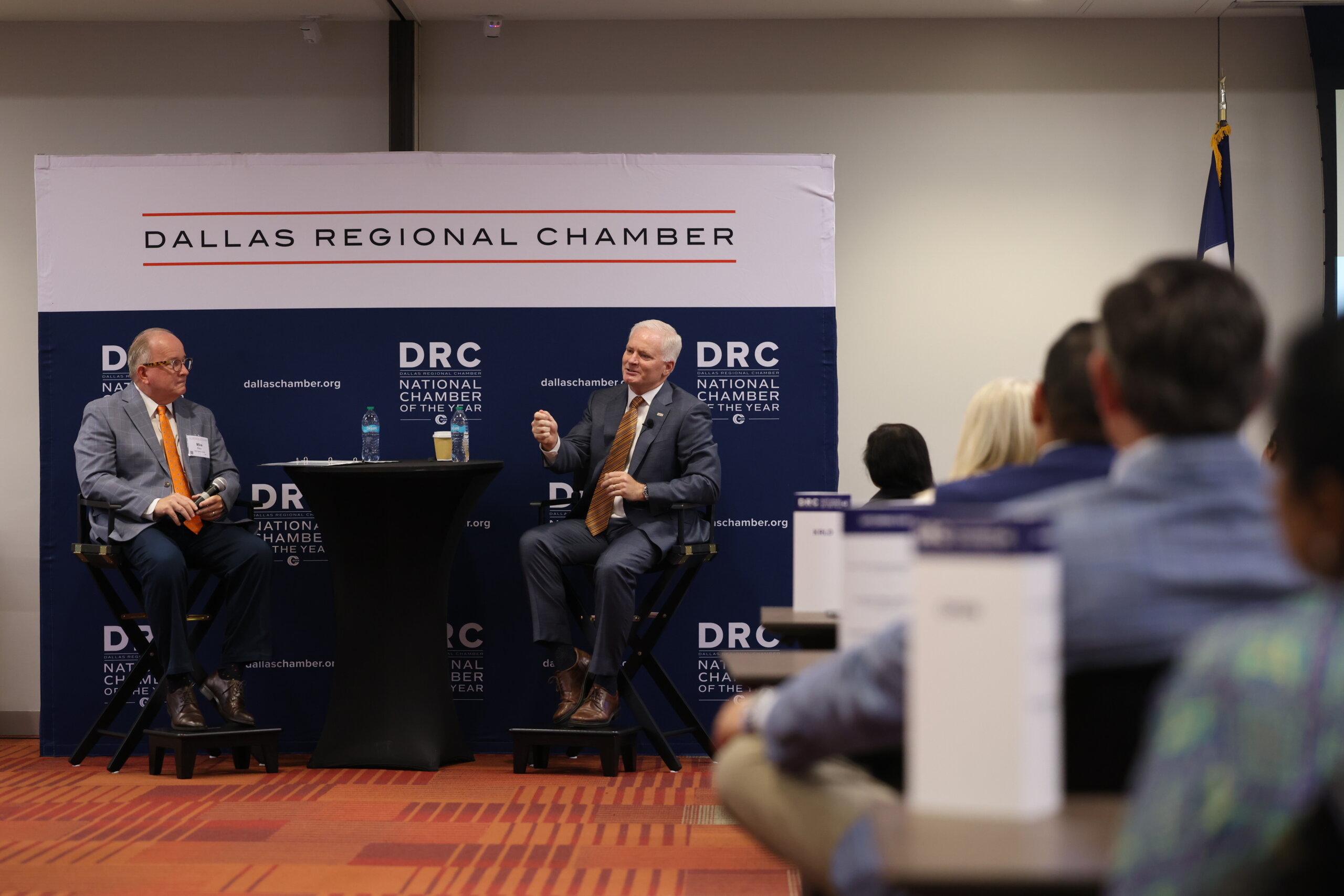
Rosa and DFW International Airport’s new CEO Chris McLaughlin in conversation.

Strategic vision for sustainable growth

Currently, 65% of DFW Airport passengers are connecting travelers. However, the airport is preparing infrastructure for the region’s growing local market.

“It’ll always be a connecting model, but we’ll have more and more folks from here getting to the airport and leaving. And we need to make sure that infrastructure is in place,” McLaughlin noted.

“We’re all for development. We want to do it responsibly… in a way that 50 years from now, my grandkids are enjoying a facility that we purposefully left behind.” McLaughlin said, emphasizing he wants future generations to find the airport efficient, amenity-rich, and reflective of Texas’ conservation values.

This strategic approach ensures DFW remains the cornerstone of regional economic success and a critical asset for companies choosing North Texas. The airport remains the cornerstone of the region’s economic success and a critical asset for companies choosing to locate, expand, or relocate to North Texas.

The Executive Circle is presented by Capgemini and KPMG, with corporate sponsorship from Axxess and Whitley Penn, and media partnership from NewsRadio 1080 KRLD. The DRC’s Executive Circle series connects key decision-makers with subject-matter experts quarterly. To attend a future Executive Circle event, connect with our membership team.

By Makayla Rosales, Coordinator, Opportunity & Impact

Average reading time: 2.5 minutes

This October marks the 80th anniversary of National Disability Employment Awareness Month (NDEAM), a time to honor the vital contributions of people with disabilities in the workforce and to reaffirm the importance of creating inclusive opportunities for all.

First established in 1945 as a weeklong observance recognizing workers with physical disabilities, NDEAM has since grown into a nationwide month of awareness and action. In 1988, Congress formally designated October as NDEAM, expanding its scope to include individuals with mental health conditions and other invisible disabilities. Today, the U.S. Department of Labor’s Office of Disability Employment Policy leads the observance, selecting an annual theme that inspires organizations across the country to advance workplace inclusion.

Engage in the workplace

NDEAM is an excellent time to review your company’s policies and ensure they reflect a genuine commitment to accessibility. Examining areas such as recruitment, accommodation, professional development, and workplace culture can reveal opportunities to better support employees with disabilities.

To support these efforts, the Dallas Regional Chamber’s Disability Inclusion Toolkit, presented by Ernst & Young LLP, demonstrates why disability inclusion is a strategic business imperative that drives innovation, strengthens workplaces, and creates lasting value. It was developed with input from local experts and the experiences of individuals with disabilities, including those with invisible or neurodivergent conditions. It also encourages employers to create a culture where employees feel comfortable discussing accommodations and highlights the business benefits of disability inclusion.

Reinforcing a commitment to a disability-inclusive workplace starts with employee education. NDEAM provides the perfect opportunity to highlight this commitment through engaging activities such as disability awareness training, workshops, or informal sessions like brown-bag lunch discussions. Employers can take advantage of ready-to-use resources, including disability etiquette guides, videos, and discussion materials to spark meaningful conversations. Partnering with local disability organizations is another impactful way to bring expert-led training directly into the workplace, fostering greater understanding across teams.

Attend an event

If you are interested in bringing your team, friends, or family to events acknowledging NDEAM, here are some local events:


Disability Days of Service 2025: Oct. 10-11
Various Locations in North Texas
The inaugural 2025 NTX Disability Days of Service will feature more than eight nonprofits and 80+ volunteer opportunities spanning two days across North Texas.

Job Fair for People with Disabilities: 10 a.m.-2 p.m., Tuesday, Oct. 21
Gilley’s Dallas, 1135 Botham Jean Blvd. Dallas, TX, 75215
Meet inclusive employers and network directly with companies committed to disability inclusion. Learn about open roles, application tips, and explore opportunities in a variety of industries.

Book a Custom Engagement: Oct. 1-31, 10 a.m.-4 p.m.
Virtual
Partner with Disability:IN to find the right course for your organization’s priorities, with more than eight courses to choose from.

Employee Engagement Assessment
Virtual
Gauge how your disability practices impact employees and ensure you are meeting their needs with the National Organization on Disability’s Employee Engagement Assessment. Enrollment is limited.

Other October holidays to celebrate

October is filled with meaningful observances that offer opportunities for reflection, awareness, and celebration. World Mental Health Day on Friday, Oct. 10, reminds us of the importance of prioritizing mental well-being and fostering supportive environments.

Indigenous Peoples’ Day on Monday, Oct. 13, honors the history, culture, and contributions of Native communities, encouraging us to learn and engage with their enduring legacies.

Diwali, the Festival of Lights, on Monday, Oct. 20, is a time to celebrate new beginnings, hope, and the triumph of light over darkness.

Throughout October, Breast Cancer Awareness Month underscores the critical need for early detection, research, and support for those affected.

By Amber Dyer, Coordinator, Communications & Marketing

Average reading time: 2 minutes

On Thursday, Aug. 21, at the DRC’s Alliance for Opportunity and Impact event hosted by Improving, a panel of AI experts examined how organizations can leverage AI to drive responsible, impactful action while exploring whether these technologies can help mitigate inherent biases.

The DRC’s Alliance for Opportunity and Impact event featured a panel of experts.

The future of AI must be human-centered.

“The future of work lies in the collaboration between humans and AI,” said Latosha Herron-Bruff, DRC Senior Vice President of Opportunity and Impact. “Technology enhances our natural abilities, allowing us to think more strategically and creatively.”

Companies looking to integrate AI into their practices must strike a balance between fostering human-AI partnerships and dissuading over-reliance on automated systems to make decisions.

“[Employees shouldn’t] just rely on algorithms to give them the answer,” said Shuchi Agarwal, Technical Director at SMBC Group. “They are enhancers to help [employees] do the work faster and more efficiently.”

Because of this, organizations should offer comprehensive training when employees express interest in using AI tools, as human oversight can lead to the perpetuation of algorithmic biases.

“Even in traditional machine learning systems, AI is all about historical data,” said Michael Slater, Technical Director at Improving. “If you have inherent biases or direct biases in that historical data, it does show up in AI, depending on how you use it.”

This reality underscores the need for companies to establish ethical AI frameworks.

AI frameworks can help mitigate inherent biases.

“Building ethical practices all comes down to training and understanding the pros and cons [of AI] and having appropriate governance,” said Agarwal. “So even before implementing any kind of technology, any kind of AI inside your workforce, have governance, have a set of principles about dos and don’ts.”

Effective governance involves establishing safeguards to ensure employees understand the implications of AI in their work.

Michael Slater, Suchi Agarwal, and moderator Maiya Winston discussed the future of AI.

“So, if people are trying to abuse it, misuse it, you should know about that in your organization,” said Slater. “Reporting, auditing usage, automated testing of AI systems, all of that goes into good governance.”

Cross-functional teams are essential for comprehensive AI governance.

In addition, companies can form AI governance councils made up of individuals from various departments to identify and lessen potential biases in the prompt creation process.

“So, even if you think: ‘this is the best algorithm that can solve all our problems’, send it for review to different kinds of people,” said Agarwal. “As many perspectives as we can add. The richer we can make our data, the better the output.”

Successful implementation depends not only on the technology itself, but on prioritizing a human-centered approach that places employees’ needs first.

“[When used responsibly,] AI can make everyone better,” said Slater. “Some people say that it lowers the barrier to entry, and I think it’s really brilliant to think about it that way.”

By Catie George, Director, Communications & Storytelling

Average reading time: 4 minutes

The Dallas Regional Chamber’s Talent Talk, presented by BGSF and Holmes Murphy, brought together workforce experts and business leaders on Wednesday, Aug. 6, at the DRC for an insightful discussion on the evolving talent landscape and strategies for building resilient, family-friendly workplaces. Below are the key insights shared by the day’s speakers.

The modern workforce demands flexibility

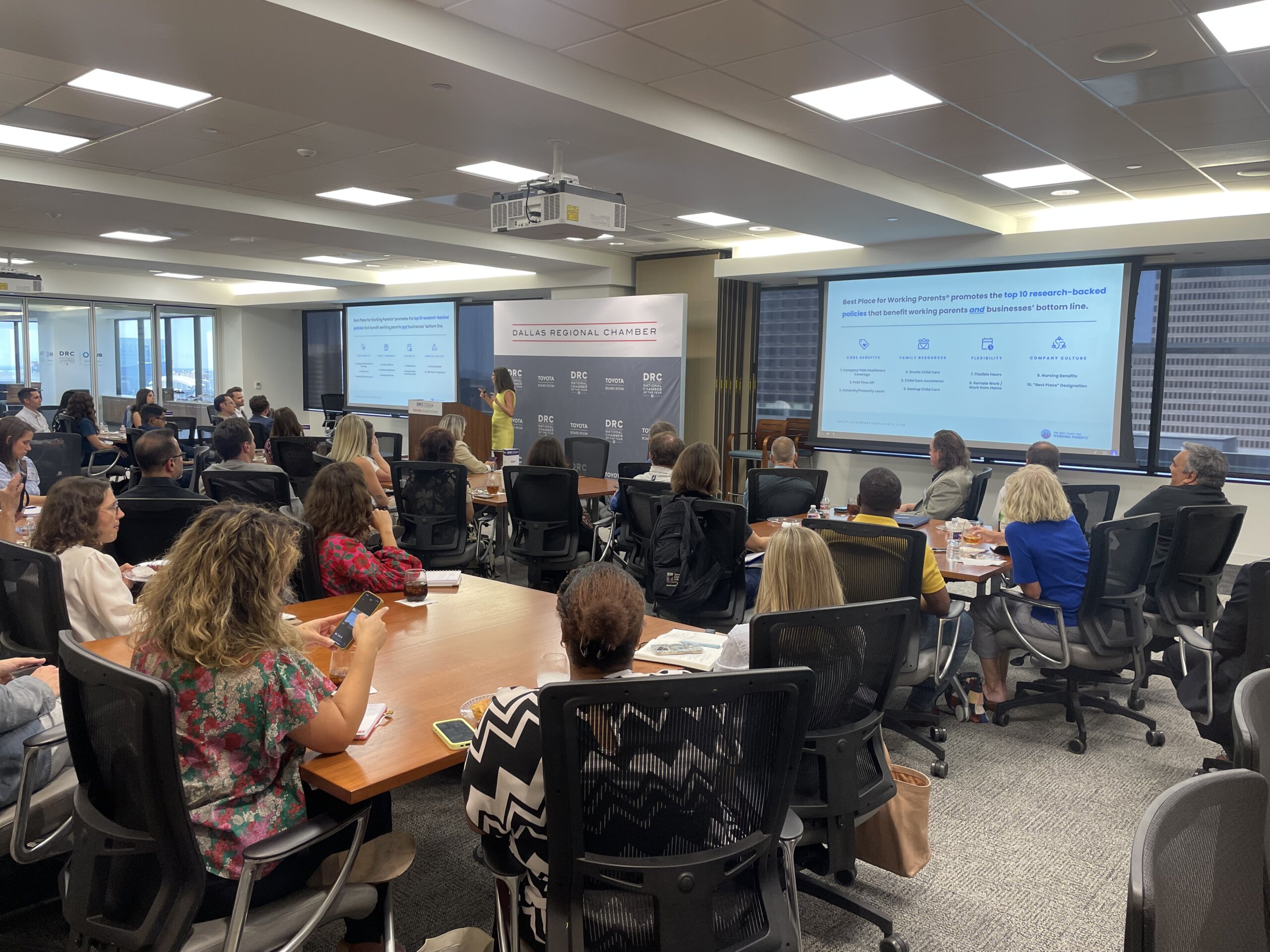
The workforce landscape has fundamentally shifted, requiring employers to adapt their approaches to talent management and retention. Sadie Funk, Co-Founder and National Director of Best Place for Working Parents®, highlighted the dramatic transformation of today’s workforce composition.

“The reality is that today, two-thirds of children under the age of six have all parents in the workforce. 75% of the workforce in general are caregivers,” Funk explained.

This shift extends beyond child care responsibilities. Workers may be caring for elderly loved ones or adult dependents, meaning “the workforce today looks drastically different than it did 30, 20, even 10 years ago, so employers are charged to respond differently.”

The data reveals compelling statistics about flexibility’s impact on retention and engagement.

According to Funk, “66% of women who have access to flexibility say they’ll stay for three years or more, compared to 19% of women who say they won’t,” and “employees with remote benefits are 75% more likely to be often or always engaged.”

Building family-friendly workplaces drives results

Co-Founder and National Director of Best Place for Working Parents® Sadie Funk shares workforce tips for parents and caretakers.

The business case for family-friendly policies extends far beyond retention, delivering measurable improvements in performance.

Funk’s research demonstrates that “those who have access to flexibility rate their workplace as 123 times more supportive” and shows factors such as being “more likely to be a high performer, higher retention rates, more loyalty, and a more motivated workforce.”

The shift is particularly pronounced among millennials and fathers.

“Eighty-three percent of millennials say they leave one job for another with more family-friendly benefits,” while “80% of dads say they’d leave one workplace for another if it allowed them to be more present in their children’s lives.”

For employers looking to implement change, Funk recommended starting small: “Survey your employees, hear what some of their challenges are, both at work and at home, and then find strategies to be able to address even just one of those. There’s this sentiment that you have to go big, but I think what’s more meaningful is just to start small.”

Understanding Generation Z in the workplace

As the newest generation enters the workforce, employers must understand unique characteristics and career expectations of Generation Z, people born between 1997 and 2012.

Amit Banerjee, CEO of Philanthropy Kids, cautioned against oversimplification.

“Like any generation, no generation is a monolith,” he said, but technology proficiency sets this generation apart.

“Technology is evolving faster than it ever has been before, and Gen Z is able to adapt to those new tools, new resources, and overall new technology environment,” Banerjee noted. However, this comes with unique challenges: “They’re skeptical of institutions and they’re obsessed with identity management.”

The career landscape presents both opportunities and obstacles for Gen Z. While “Gen Z sees everything as an option because of the Internet,” they also “feel unqualified for everything because when they click on that job posting, they see that it’s requiring so much more work experience than they have.”

Banerjee emphasized the importance of early investment in this generation: “Invest in soft skills development early on.”

Maximizing veteran talent potential

A panel of experts evaluate current trends in the workforce.

Another underutilized talent pool is military veterans, but current hiring practices often fail to capture their full potential. Charles Bischoff, North Texas Program Manager at NextOP, shared concerning statistics about veteran employment outcomes.

“60% of veterans make less at their first job than they did while they were serving, 33% are underemployed, and only one in four have a job lined up prior to leaving the service.”

Despite these challenges, veterans bring exceptional qualifications to the workforce. They are “160% more likely than non-veterans to have a graduate degree or higher” and have “2.9 times more work experience with a bachelor’s degree than [their] counterparts.” Veterans also demonstrate superior retention rates, being “8.3 times more likely to stay with [their] first position than college graduates” and “39% more likely to be promoted earlier than non-veterans.”

The key to successful veteran hiring lies in proper support systems.

“Veterans using a coach are two times more likely to get a job and three times more likely when getting help with an interview,” Bischoff explained.

However, many military veteran hiring programs lack proper measurement and accountability.

“One of the biggest things that I see consistently is with the military veteran hiring programs, no one tracks data,” Bischoff noted, emphasizing the need for employers to measure return on investment for these programs.

As the workforce continues to evolve, companies that proactively adapt their approaches to talent management will be best positioned to attract, retain, and develop the skilled professionals needed to fuel Dallas’s continued economic growth.

Thinking about new ways to strengthen your talent pipeline? The DRC’s Talent Labs program is a six-month, hands-on program where senior talent and HR pros workshop strategies and solutions for their company’s needs. To inquire about joining the program, email talent@dallaschamber.org.

By Nicole Ward, Data Journalist, Research & Innovation

Average reading time: 3 minutes

Whether someone is starting out in their career or at the highest level, work-related stress is a problem for everyone, and it can affect mental health. Recently, the U.S. Chamber of Commerce has emphasized the importance of mental and physical health for entrepreneurs. However, everyone balancing responsibilities can benefit from prioritizing all aspects of their health to combat mental fatigue.

Mental health is everyone’s concern

You don’t have to be starting a company to experience stress, uncertainty, or regret; these are all part of the human experience. The key is to diffuse negative feelings before they overwhelm you—something easier said than done.

Data released in April by the Centers for Disease Control (CDC) indicated that the prevalence of depression in U.S. adolescents and adults increased by 60% in the past decade.

This adds to CDC findings that said more than 49,000 adults died by suicide in 2023, or one death every 11 minutes. That data set showed that another 1.5 million adults attempted suicide.

Crystal Lockett-Thomas, licensed professional counselor supervisor and Clinical Director at Bright Futures, who also teaches at the University of North Texas, held a session at the Dallas Regional Chamber during Mental Health Awareness Month for employees. She pointed out that whether it’s a mood disorder or psychotic illness, mental health is something that impacts everyone. She says it’s critical to check in with each other, not just during advocacy months like September’s National Suicide Prevention Month but year-round. That can be as simple as saying to a friend or colleague, “Hey, it seems like something’s got you down lately, is everything okay?”

She also explained that the chances of being diagnosed with a mental health challenge rise in people who have a disability or chronic illness. In medical terms, this is referred to as comorbidity—having more than one diagnosis at the same time. Another way to think of it is in terms of intersectionality.

Balancing all the parts of yourself

Lockett-Thomas says the term mental health is not widely embraced. While some people feel gratified by talking about how they feel or getting a specific diagnosis, many feel labeled and somehow damaged. There are an infinite number of ways people can be part of more than one community, and some of the cultural norms attached to these affiliations are in conflict.

For example, men are typically characterized as being providers who are strong and independent. Talking to a therapist about something they’re struggling with that makes them feel vulnerable may not only be intimidating but may also be embarrassing. Sometimes these negative connotations compound and leave the person emotionally stuck.

Additionally, it sounds counterintuitive, but some people might not realize they have a mental health challenge. People can be very good at masking—covering up their true feelings with smiles and fake enthusiasm—even to themselves. That’s why, Lockett-Thomas says, it’s key to tune into your body.

“The body cannot be tricked, and if you pay attention, you may recognize signs,” she says. “You may realize that you used to be able to take on 15 projects at a time, but now you can only handle half that.”

She says there’s no amount of ‘healthy burnout.’ If you’re feeling detached and unmotivated, seek help before it gets worse. Just like travelers are instructed to put on their oxygen mask before helping others, the same goes for mental health. You need to get yourself in a good place before you can be an effective leader, friend, or parent.

Employers’ role in changing perception

“Why struggle in life if you don’t have to?” asks Lockett-Thomas.

Emotional regulation is crucial to our happiness, and while many things are beyond our control, taking charge of our own mental health isn’t something we need permission for.

Additionally, given that we spend a significant portion of our lives at work, companies have an opportunity to shift the perception of mental health and the discussion surrounding it.

“People at the top—CEOs or other senior leaders—can help destigmatize and demystify mental health by being open.”

She suggests that this could involve sharing a personal story or setting up small but consistent opportunities to learn and discuss mental health.

“Lunch and learns are a great way to get people comfortable with the topic in a non-confrontational way.”

She also says organizations need to show their care by being intentional in everything from broad policies to the words leaders use. With one-in-five U.S. adults experiencing mental illness each year, there’s no better time to start than now.

By Catie George, Director, Communications & Storytelling

Average reading time: 3 minutes

The Dallas Regional Chamber’s Higher Education Forum, presented by the Communities Foundation of Texas, in June brought together key leaders to examine how post-secondary education drives economic growth and workforce development across North Texas. The event highlighted the region’s educational strengths and the critical role higher education plays in maintaining Dallas-Fort Worth’s (DFW) competitive edge.

“The DRC’s North Star is to help make the Dallas Region the best place in America for all people to live, work, and do business,” said DRC President & CEO Dale Petroskey. “The bedrock of that principle is higher education.”

Higher education’s massive economic impact

DRC President & CEO Dale Petroskey shares the importance of higher education in the region.

The Dallas Region’s educational infrastructure represents a powerful economic force that often goes unrecognized.

“Here in the Dallas Region, we have more college students and more college graduates than any other place in Texas… 72% of them stay here and work after they graduate,” said Petroskey. “College graduates in DFW contribute $120 billion a year to our economy.”

This is true when thinking of the future workforce as well.

“Texas can’t achieve its education and workforce goals without the Dallas-Fort Worth Region,” said Commissioner of the Texas Higher Education Coordinating Board Dr. Wynn Rosser. “1.5 million K-12 students just in these two regions… If you were to compare that to the U.S. population of states, that 1.5 million students would be the 40th largest state in the country.”

With the combination of educational excellence, federal investment, and industry partnerships, the DRC’s Higher Education Review, an online publication highlighting the impact of the region’s foremost colleges and universities, showcases how the Dallas Region stands poised to meet the evolving demands of a rapidly changing economy.

Addressing critical workforce gaps

Despite the region’s educational strengths, speakers identified significant challenges in meeting industry demands, particularly in technical fields.

Koushik Venkataraman, Director of Workforce Development at Texas Instruments, highlighted a stark reality: “Out of close to 150,000 students enrolled in the five community college ecosystems in the region, less than 1% were enrolled in courses related to mechanical, electrical, and automation.”

This skills gap extends across critical industries.

“We need more electricians and plumbers and HVAC technicians and commercial truck drivers and welders,” Dr. Rosser acknowledged.

The challenge isn’t just about numbers—it’s about awareness, particularly in industrial and systems engineering spaces.

“I think the biggest issue I see is that there’s a lack of understanding on what supply chain means for anyone,” said Tim Feemster, CEO & Managing Director of Foremost Quality Logistics. “Most of the time, they don’t understand what a supply chain is. All they see is trucks. And it’s a lot more than that.”

Commissioner of the Texas Higher Education Coordinating Board Dr. Wynn Rosser’s keynote on the higher education and talent.

Federal investments drive innovation

The region is leveraging federal initiatives to strengthen its position as a national innovation hub.

Dr. Sukumaran Nair, Chief Innovation Officer & Vice Provost for Research at SMU, discussed the impact of the CHIPS and Science Act: “Within that 53 billion [dollars], they set aside 10 billion for tech hubs, and SMU’s is one of the ones that were selected, and the only one selected for Texas.”

Similarly, Dr. Terry Pohlen, Senior Associate Dean of UNT’s G. Brint Ryan College of Business, outlined the university’s role in the Texoma Innovation Engine: “We’re the fourth-largest freight market in the country. From an industrial real estate perspective, we’re the second largest only to Southern California.”

Building pathways to opportunity

Education leaders emphasized the importance of creating clear pathways from education to employment.

“Every Texan deserves an education that empowers them to earn a good living, find a purposeful career, and the chance to achieve their dreams,” said Kerri Briggs, Executive Director of Educate Texas at the Communities Foundation of Texas.

Dr. Rosser highlighted recent legislative victories that support this goal: “Students in the sixth grade have an opportunity to set up that My Texas Future profile. It also requires that direct admissions be a graduation requirement for students before they finish high school.”

The state has also made significant investments in making higher education more accessible. “We received an additional $328 million for state need-based financial aid. That’s a 22% increase,” Dr. Rosser reported.

By Kevin Shatley, Vice President, Economic Development

Average reading time: 2 minutes

In May, I attended the SelectUSA Investment Summit, a four-day event put on by the U.S. Department of Commerce to connect foreign companies with the federal government and state and local organizations, like the Dallas Regional Chamber and the State of Texas, to talk about locating and expanding into wherever they want to go.

With more than 5,000 attendees and representation from over 100 countries and 54 states and territories, Texas and the Dallas Region interacted with companies from across the globe.

Here are my biggest takeaways from the summit.

Texas’ business-friendly attitude continues to shine.

At the Texas booth, there were more than 80 economic developers from Texas touting the attributes of the state. Led by the Office of the Governor, the Texas Economic Development Corporation, and Team Texas, the Lone Star State was well-represented.

In fact, Texas had the most communities represented of any state there. Many of our allies and partners were there, representing the cities of DeSoto, Plano, Houston, Austin, El Paso, San Antonio, Lubbock, Amarillo, and more. With upwards of 1,100 economic development organizations represented from around the U.S., it was an impressive feat.

Our region attracts attention from all types of industries.

We received interest from companies representing many industries, from software and AI development, manufacturing, medical, and life science—everything.

A lot of companies are interested in doing operations in the U.S. because they want to have a “Made in America” label on their business and product. However, even though companies want to come to the U.S., Texas stands out because of our business-friendly environment, and the Dallas Region is unique because of our growth within the state.

The DRC made promising global connections.

Over the course of the summit, the DRC connected with companies from more than eight countries representing varied industries, including technology companies from South Korea, manufacturing companies from Peru and Pakistan, and more.

We also interfaced with over 30 countries from around the world, including Switzerland, India, Finland, Australia, and the U.K. Follow-up conversations are already underway with several of the companies we met at the summit, and many are now earnestly evaluating Dallas-Fort Worth for their businesses.

Events like these allow us to share the impressive DFW economic landscape with prospective companies from around the world. Our region is set apart on the world’s stage, and we will only continue to grow.

To learn more about the DRC’s Economic Development work, visit our website and sign up for our newsletter to stay up to date.

By Makayla Rosales, Coordinator, Opportunity & Impact

Average reading time: 3.5 minutes

National Hispanic Heritage Month, observed annually from Monday, Sept. 15, to Wednesday, Oct. 15, is a time to recognize and celebrate the rich histories, cultures, and contributions of Americans whose ancestry traces back to Spain, Mexico, the Caribbean, and Central and South America.

Established as Hispanic Heritage Week in 1968 under President Lyndon B. Johnson, the celebration was expanded to a full month by President Ronald Reagan in 1988 and officially enacted into law. The month begins on Monday, Sept. 15, a date that coincides with the independence anniversaries of Costa Rica, El Salvador, Guatemala, Honduras, and Nicaragua. Mexico and Chile celebrate their independence on Tuesday, Sept. 16, and Thursday, Sept. 18, respectively. The period also includes Día de la Raza (Sunday, Oct. 12), a day that recognizes the diverse heritage of Latin America.

In the workplace and beyond, Hispanic Heritage Month is an opportunity to deepen our understanding of Hispanic and Latino cultures, reflect on the community’s wide-ranging impact across industries, and reaffirm our commitment to building inclusive environments where all voices are valued.

Engage in the workplace

Celebrating Hispanic Heritage Month in the workplace requires intentionality and depth. One powerful approach is to center storytelling as a way to build authentic connections. Inviting employees to share their personal narratives, family traditions, or cultural heritage through internal blogs, videos, or newsletters can foster a sense of belonging and increase understanding across teams.

Education should be at the heart of any heritage month initiative. Providing curated learning resources such as documentaries, podcasts, and articles encourages ongoing reflection and dialogue among employees. Facilitating discussions around these materials adds structure to self-directed learning and invites deeper exploration of Hispanic history, contributions, and contemporary issues. It is also critical to recognize the intersectionality within Hispanic and Latino communities, including Afro-Latino, Indigenous, LGBTQ+, and immigrant experiences.

Finally, consider organizing a group outing to a local Hispanic art gallery or museum exhibit, where employees can engage with powerful visual narratives and learn about the diverse histories and identities within Hispanic communities. Pair the visit with a guided tour or post-event discussion to deepen the impact. Alternatively, host a cooking class led by a Hispanic chef, allowing employees to connect through food while exploring the cultural stories behind each dish. These shared experiences foster team connection, cultural appreciation, and a more inclusive workplace environment.

Attend an event

If you are interested in bringing your team, friends, or family to Hispanic Heritage Month festivities, here are some local events:

Hispanic Heritage Month: Dance Across Latin America– 6-7:30 p.m., Monday, Sept. 15

Mesquite Main Library, 300 West Grubb Dr., Mesquite, TX 75149

Celebrate with the Mesquite Main Library as they welcome the talented dancers of the Indigenous Cultures Institute. These talented dancers will bring the vibrant traditions and colorful costumes of Hispanic historical dance to life, offering an amazing experience for all ages.

Vida Sana– 2-4 p.m., Saturday, Sept. 20

Mesquite Art Center, 1527 N Galloway Ave., Mesquite, TX 75149

In celebration of Hispanic Heritage Month, enjoy this free event offering a variety of fitness classes, mental health resources, clean eating tips, health-related vendors, and more.

Hispanic Heritage Celebration– 10-4 p.m., Saturday and Sunday, Sept. 13 & 14

The Dallas Arboretum, 8525 Garland Rd, Dallas, TX 75218

Join for the 8th annual Dallas Arboretum Hispanic Heritage Celebration. This two-day celebration will feature food, vendors, live music, children’s activities, and the Quinceañera Fashion Show.

In-Person Culinary Tuesdays– 12-1 p.m., Tuesdays in September

Anita N. Martinez Recreation Center, 3212 N Winnetka Ave., Dallas, TX 75212

Taste the incredible flavors of Latin America! Their Hispanic Heritage Month Programming features five countries: Mexico, Guatemala, Peru, Venezuela, and Ecuador, through fun, easy-to-make recipes using budget-friendly ingredients.

Other September holidays to celebrate

Labor Day, observed on Monday, Sept. 1, honors the contributions and achievements of American workers. Rooted in the labor movement, it’s a time to recognize the hard work, dedication, and resilience of those who power our communities, industries, and economy. Use the day to reflect on the value of fair work, dignity, and the people behind progress.

Wednesday, Sept. 10, marks World Suicide Prevention Day, during Suicide Prevention Awareness Month, a time to break the silence, promote hope, and prioritize mental well-being. Suicide impacts millions each year, yet stigma and isolation often prevent people from seeking the help they need. Whether you are navigating your own challenges, supporting a colleague, or simply seeking to understand more, you have the power to make a difference. Together, we can learn to recognize the warning signs, encourage open conversations around mental health, and connect ourselves and others to effective resources and support.

By Nicole Ward, Data Journalist, Research & Innovation

Average reading time: 3 minutes

Companies that tap into the disability community create a competitive advantage and report seeing a benefit to the bottom line. Bank of America (BOA) is one organization that knows this well.

“Everyone has strengths—corporations just need to learn how to harness them,” says Marc Woods, who leads the financial services company’s Support Services team in Dallas.

In addition to Dallas, Support Services has operations in Wilmington, Delaware; Belfast, Maine; and Boston. It’s made up of approximately 300 employees who have Intellectual and Developmental Disabilities (IDD).

From account management, which includes flagging and resolving potential fraud, to packaging documents for use by the business, Support Services fills a critical role in BOA—acting as an in-house consulting firm for every line of business.

Woods adds that people with IDD are uniquely suited to this kind of work.

“Doing a repetitive task, matching account details on multiple documents, over and over again, might be boring to you or me, but for someone who is neurodiverse, it could be the thing they do exceptionally well.”

In fact, he says in the 13 years of dedication, the team reduced the number of errors to zero—mistakes that would have cost the bank money.

Growing into opportunity

Alana celebrating her birthday with her BOA coworkers.

Alana Drablos, who has Down Syndrome, is one of 85 members of BOA’s Dallas team; Woods says she’s one of the reasons for the team’s success.

“She’s great to work with—everyone loves her—she’s good at what she does, and she’s a great advocate for the disability community,” Woods said.

Alana has been with BOA for more than 13 years, but she’s been part of the workforce for longer. Her first job was with Kroger as a courtesy clerk.

Alana’s mother, Kelly, says her daughter has worked hard to get where she is. She and Alana’s father, Scott, were relentless about keeping her as integrated as possible throughout her education, in addition to getting her the extra attention she needed, such as speech and occupational therapy.

Kelly also gives a lot of credit to companies like Kroger and BOA for creating opportunities that are both good for the company and the person.

“There’s still a lot of resistance to employing people with disabilities,” says Kelly. “BOA’s Support Services unit is big enough to create synergy, and the managers are also very creative in designing tasks that make the most of the unique skills people have.”

Examples to follow

Kelly points to other companies that have figured out how to harness the talent of people with disabilities—historically overlooked and undervalued in the workforce.

“In the warehouse industry, there’s a real push to hire from this group of people,” she said. “There’s an organization called Ken’s Krew, started by Ken Langone of Home Depot, whose purpose is to get companies to hire people with disabilities.”

Like My Possibilities, the local 501(c)(3) that serves adults with IDD, which began as the vision of three mothers, Ken’s Krew was started in 1998 by a group of parents and children with neurodevelopmental disabilities.

Alana and her niece, Sadie.

“Every organization’s path to workplace disability inclusion is going to be different,” says Woods. “But it starts with a conversation at the top. Do we want to put an emphasis on hiring from the disability community, and if so, what makes sense as a first step for us?”

He says in addition to clear benefits for the organization, people like Alana, who are dedicated, responsible employees, and grateful for the opportunity.

Outside of work, Alana also contributes her time to the Down Syndrome Guild of Dallas. She did a rotation on their board of directors and helps with fundraising activities.

“Each year I help with the Buddy Walk,” says Alana. “I like to be involved and help people out.” She raises money each year and has led a team during several walks.

“She is so dedicated to her job,” says Woods. “She does not want to get sick—she doesn’t want to miss a day. She never wants to be late. She doesn’t get angry.”

Doesn’t everyone want to work with employees like that?

To help your company embrace disability inclusion, check out the Dallas Regional Chamber’s Disability Inclusion Toolkit.

By Michael Wood, Vice President, Education & Workforce

Average reading time: 4 minutes

The Texas Education Agency (TEA) released A-F accountability ratings for the state’s public school districts and campuses for both the 2023-24 and 2024-25 academic years on Friday, Aug. 15.

Texas’ A-F Accountability System is a statewide rating system for public schools and the primary tool stakeholders can use to evaluate campus and district performance. Additionally, A-F ratings give state policymakers important data to understand the return on Texas’ investment in public education, which totals more than $160,000 per student through the duration of their PK-12 career.

Earlier this year, the TEA released ratings from the 2022-23 academic year following the conclusion of a lawsuit that precluded the agency from publishing grades. A separate lawsuit contesting results from the 2023-24 academic year was settled in July. State education officials elected to align the release of 2023-24 results with the scheduled release of 2024-25 results on Friday, Aug. 15. As a result, the state has released three years’ worth of A-F ratings in just six months.

Despite the delayed release, ratings from the 2022-23 and 2023-24 academic years are still critically important in identifying trends in school performance – and allowing the state to intervene in cases of poor outcomes.

More than half of Texas’ school districts and campuses earned an “A” or “B” rating in 2025

Across the state, 24% of school districts and 31% of campuses increased their ratings from 2024 to 2025.

  • Among Texas school districts, 14% earned an “A” rating in 2025, compared to 11% in 2024, while 41% earned a “B” rating in 2025, up from 37% a year ago.
  • At the campus level, 23% of schools received an “A” and 33% received a “B” in 2025 – up from 18% and 33%, respectively, in 2024.

These gains follow a refresh of the A-F Accountability System, introduced for the 2023 ratings, which enhanced the rigor of the state’s accountability grades. In 2022, prior to the new accountability standards, 74% of campuses earned an “A” or “B” grade.

Frisco, Garland, and Dallas ISDs lead North Texas school district ratings

Most of the Dallas Region’s largest school districts and charters have seen stability or growth in their A-F ratings since 2023, with Frisco, Garland, and Dallas ISDs leading the pack.

Dallas ISD, in particular, has achieved significant growth since 2023. Texas Education Commissioner Mike Morath kicked off a statewide tour touting improved school ratings at Dallas ISD’s Walnut Hill International Leadership Academy, which rose to an “A” rating in 2025 from a “C” in 2024.

See the table below to evaluate how the ten largest public school systems in the region have performed since 2023. You can search for your neighborhood school or school district at www.txschools.gov.


District 2025 2024 2023 Trend since 2023
Arlington ISD C / 76 C / 74 C / 72 +4
Dallas ISD B / 83 C / 79 C / 76 +7
Fort Worth ISD C / 73 C / 70 D / 65 +8
Frisco ISD A / 90 A / 90 A / 90 ~
Garland ISD B / 84 B / 81 B / 81 +3
Irving ISD C / 76 C / 73 C / 72 +4
Mesquite ISD B / 80 C / 79 C / 77 +3
Plano ISD B / 82 B / 83 B / 84 -2
Richardson ISD C / 79 C / 78 C / 75 +4
Uplift Education C / 78 C / 76 C / 75 +3

Texas lawmakers exploring changes to state PK-12 assessment system

Governor Abbott included an overhaul of the state’s PK-12 assessment system on the agenda for the second called special session of the 89th Texas Legislature, which gaveled in on Friday, Aug. 15.

The charge asks legislators to eliminate the STAAR exam, a foundational component of the A-F grading system, and replace it with new tools to evaluate student progress and provide for school district accountability. Proposals under consideration by the legislature would replace the STAAR with three shorter exams administered at the beginning, middle, and end-of-year. The proposed assessment system is intended to provide teachers and parents with more consistent and actionable feedback on student achievement.

If lawmakers approve the proposal – filed as House Bill 8 by Chairman Brad Buckley and Senate Bill 9 by Chairman Paul Bettencourt – the TEA would have until the 2027-28 school year to implement the new test.

Join us at the DRC’s annual State of Public Education on Wednesday, Sept. 24, to hear more about accountability ratings and potential changes to the state assessment system from Commissioner Morath and a panel of local school system leaders.

By Bart Slowik, Managing Director, Research and Innovation

Average reading time: 2.5 minutes

The DRC’s AI Office Hours is a groundbreaking service that connects you with free, personalized one-on-one sessions with AI implementation experts from some of Dallas-Fort Worth’s leading companies. Whether you’re looking to understand the fundamentals, explore practical business applications, or solve a specific challenge, you’ll get tailored guidance at your own pace through a free video call designed around your unique needs.

Building a community where AI expertise flows freely

At the heart of AI Office Hours is the DRC’s strength as an ecosystem-building organization, connecting the dots to help our member companies and broader community thrive. AI Office Hours enables strategic matchmaking between our experienced consultant members and anyone who needs specialized AI guidance.

This service makes AI expertise accessible throughout our entire community, sparking meaningful conversations around AI that often lead to innovative collaborations, partnerships, and breakthrough solutions.

By fostering these connections, we’re building a stronger, more knowledgeable AI ecosystem – and we further cement DFW’s status as a destination for applied AI innovation.

Free and open to all – thanks to the Tomorrow Fund

AI Office Hours is made possible by investments in the DRC’s Tomorrow Fund, allowing us to operate on a truly inclusive model: free, open to all, and with no membership requirements or limits on participation.

Thanks to the Tomorrow Fund, organizations of every type, including corporations, startups, nonprofits, civic institutions, and small businesses, gain access to expert AI guidance they might not otherwise be able to obtain.

Whether you are a corporate leader seeking outside support, a founder unsure how to begin your AI journey, a nonprofit exploring mission-driven applications, or a small business with specific technical questions, the Tomorrow Fund ensures that practical, high-quality expertise is available to you regardless of size, sector, or budget.

Access world-class AI guidance

Our intelligent matching system assigns consultants based on your specific needs and their expertise, ensuring you receive the most qualified guidance for your particular challenge. When you book a session, our algorithm considers your requirements and consultant availability to create the optimal pairing for maximum value.

We actively welcome partnerships with chambers of commerce, community organizations, and other groups interested in promoting AI literacy within their networks. If you represent a chamber or community organization and want to bring AI education to your members, we invite you to collaborate with us in spreading awareness and accessibility of this valuable resource.

Providing expert answers to your AI questions

AI Office Hours transforms complex AI concepts into actionable insights through personalized, expert guidance. During your free video consultation, you’ll have the opportunity to ask detailed questions, explore specific AI applications relevant to your industry, and develop a clearer understanding of how AI can drive your organization forward.

Our consultants bring real-world experience from DFW’s most innovative companies, offering practical perspectives that go beyond theoretical knowledge. Each session is tailored to your current understanding level, business context, and specific goals, ensuring that you walk away with concrete next steps and a deeper appreciation for AI’s potential in your work.

Ready to unlock AI’s potential for your organization? Book your free consultation today and join the growing community of DFW leaders embracing the future of business innovation.

Connect with an AI expert now

Leverage AI Office Hours to get tailored guidance, ask questions, and explore AI topics at your own pace.

By Amber Dyer, Coordinator, Communications & Marketing

Average reading time: 2 minutes

Urban agriculture has the potential to drive real community impact—but only if existing challenges can be overcome. That was the focus Wednesday, May 21, when community leaders gathered at East Texas A&M University for the Dallas Regional Chamber’s Community Connections event to showcase promising initiatives and develop collaborative strategies.

The panel of experts discussed urban agriculture as a solution to food insecurity.

Closing the hunger gap takes more than food—it takes education

Food insecurity demands urgent attention because of its cascading effect, including poor health outcomes, reduced educational performance, and increased health care costs. Addressing food insecurity is both a moral imperative and an economic necessity, as food-secure communities are healthier, more stable, and better positioned to contribute to the region’s growth and prosperity.

However, solving food insecurity extends beyond increasing availability, shared Dr. Brooke Clemmons, Assistant Professor of Animal Science at East Texas A&M University. Solving persistent food insecurity requires matching the affected community’s needs with sustainable, healthy lifestyle choices.

To meet those needs, Clemmons is developing a new Urban Food Systems Graduate Certificate program at East Texas A&M University here in the Dallas Region to equip students with the skills and knowledge to support food-focused initiatives in underserved communities.

“In developing this [program],” said Clemmons, “one thing that we saw was that there were people who were filling a niche of providing foods and trying to find fresh produce and other sources to our communities like Bonton Farms and trying to understand how we can train some students to be involved in or start those organizations.”

The four-course program collaborates with local stakeholders and organizations to provide students with hands-on learning in food security policy, small-scale farming techniques, and urban agricultural design.

When transitioning into roles focused on urban food systems, students can drive community transformation by addressing food insecurity while enhancing their individual purpose.

“There is something amazing that happens when you are putting your hands in the dirt,” said Gabe Madison, then-President & CEO of Bonton Farms. “[Many] community members that we work with have been told, ‘you’re never going to be anything.’ [But] when you take a small seed and see it grow in three to four months into this amazing plant that people want to eat from, that does something mentally to you that says, ‘I did that. I created [something valuable that people want].’”

The prosperity and food insecurity paradox

“We probably have the best economy in the nation right now, and it continues to grow,” said DRC Senior Vice President of Opportunity and Impact Latosha Herron Bruff. “But food access remains a challenge in many of our communities.”

The Dallas Region’s booming economy adds approximately 320 new residents daily. Food access, however, remains a significant challenge, revealing a paradox between prosperity and food insecurity. Addressing food insecurity requires both targeted community efforts and effective urban leadership to ensure residents have access to essential resources for prosperity.

“We’ve got to have food security, we’ve got to have nutrition so that if nothing else, our kids can think,” said Dr. Bryan Rank, Dean of the College of Agriculture at East Texas A&M University. “If we can have [food security and education] work together, we can overcome everything that’s coming at us.”

By Michael Wood, Vice President, Education & Workforce

Average reading time: 2.5 minutes

In July, Congress passed a budget reconciliation bill that codified many significant changes to federal spending. Among the hundreds of provisions was a longstanding priority for postsecondary education access championed by the DRC: Workforce Pell.

Under new guidelines, students will now be able to draw down federal Pell Grants for short-term workforce training programs aligned with in-demand, high-wage occupations. Here’s what you need to know about the new program.

Pell Grants are the most common form of federal financial aid for higher education

Established by Congress in 1972, Pell Grants have helped millions of students access higher education throughout the country. Students may receive a Pell Grant if they meet the income eligibility requirements and are an undergraduate pursuing their first postsecondary degree. Award amounts vary per student based on individual need and their postsecondary enrollment status, up to a maximum of $7,395 for the 2025-26 school year.

Annually, roughly a third of the country’s nearly 25 million undergraduate students receive a Pell Grant based on their financial need. In Texas, 34.4% of the state’s undergraduate students receive a Pell Grant, with an average award amount of nearly $5,000.

These grants are vital in helping students attain a postsecondary education. In fact, the average Pell Grant award in Texas is often more than enough to cover the entire cost of attendance at an in-state community college.

However, students enrolled in short-term workforce training programs have historically not been eligible for Pell Grants. While these programs are often cheaper than a traditional two- or four-year degree, the cost can still be prohibitive for students.

Creation of Workforce Pell is a hard-fought win for postsecondary access

Workforce Pell has long been a priority for higher education access advocates, including the DRC.

Across the state, 54% of jobs require training beyond a high school equivalency but less than a four-year degree, yet just 45% of Texans meet this threshold. This mismatch leaves many good-paying jobs unfilled, suppressing economic growth broadly and for individual families. Workforce training programs are well positioned to fill the gap.

Under the new guidelines, students enrolled in workforce training programs between 8 and 15 weeks, with at least 150 clock hours, will now be able to draw down Pell Grants provided they are enrolled in an eligible program and meet other income-based criteria.

To be Pell Grant eligible, workforce training programs must meet additional approval requirements, including established workforce demand, minimum completion and job placement rates, and earnings thresholds for graduates.

Workforce Pell is slated to take effect by July 1, 2026, in time for students to receive Pell Grants for the 2026-27 academic year. To keep up with increased demand and a pending budget shortfall, Congress appropriated an additional $10.5 billion for Pell Grants for fiscal year 2026 as part of the reconciliation package. Once live, Workforce Pell will help students access a range of high-demand, high-wage training pathways in industries like healthcare, information technology, logistics and manufacturing, and construction.

What this means for business

Many Texas community colleges were already doubling down on skills-training, thanks in large part to House Bill 8 from the 88th Regular Texas Legislative Session that overhauled the state funding formula for two-year colleges to focus on student outcomes.

Now, with federal aid on the table, employers can expect to see community colleges and other institutions of higher education investing even more in short-term workforce training programs aligned with critical occupations, from cybersecurity and nursing to HVAC and plumbing.

Does your company have any open roles that Workforce Pell may help fill? Send me a note at mwood@dallaschamber.org.

By Catie George, Director, Communications & Storytelling

Average reading time: 4 minutes

To celebrate five decades of transforming communities, developing visionary leaders, and shaping the future of Dallas, the DRC brought together alumni, community partners, and civic leaders for the 50th anniversary of Leadership Dallas (LD) celebration, presented by PNC Bank. The event honored the program, sponsored by Grant Thornton, and the graduates who have gone on to serve the Dallas Region.

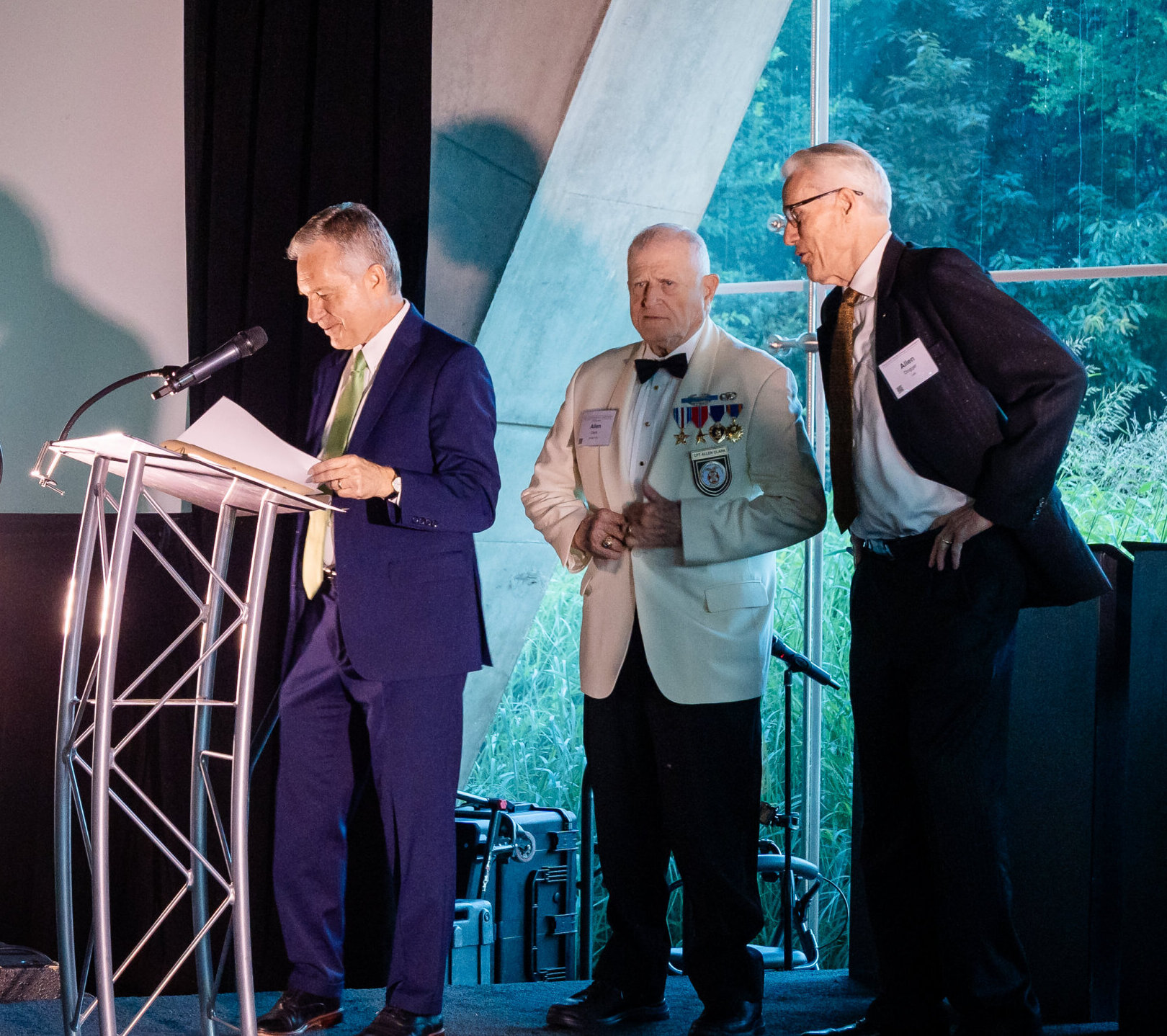
Dale Petroskey with Allen Dogger and the Honorable Allen Clark.

Honoring distinguished alumni and their legacy

“2,300 people, including many of you tonight, have made themselves better leaders, helped make our community better, helped make their companies better, and just set the bar in our community,” said DRC President & CEO Dale Petroskey at the celebration, which took place at the Perot Museum. “I hope [future generations] will remember that this was the moment where the DRC was a catalyst for helping lift up under-championed populations by narrowing the opportunity gaps in our communities.”

To honor meaningful contributions to the community, the Leadership Dallas Alumni (LDA) Distinguished Alumni Award was presented to Peter Brodsky, CEO of The Shops at RedBird and member of LD ‘10.

“Leadership Dallas really did change the course of my life,” said Brodsky. “I had never been to Southern Dallas, I didn’t know much about the community, I wasn’t civically plugged in, and through this incredible program and most importantly through my incredible classmates, I was able to get exposed to the fullness of this city, the richness of this city. I love this city, and my love is really rooted in the things that I learned about in Leadership Dallas.”

Also honored were two alumni of the first class of LD ‘75, Allen Dogger and the Honorable Allen Clark.

“Mr. Dogger and Mr. Clark, you represent the kind of people and leaders Leadership Dallas is meant to serve and cultivate,” shared Petroskey. “People who use their skills and experiences to help the people around them lead good lives and make the world a better place in the process.”

Alumni reflections on connection and community impact

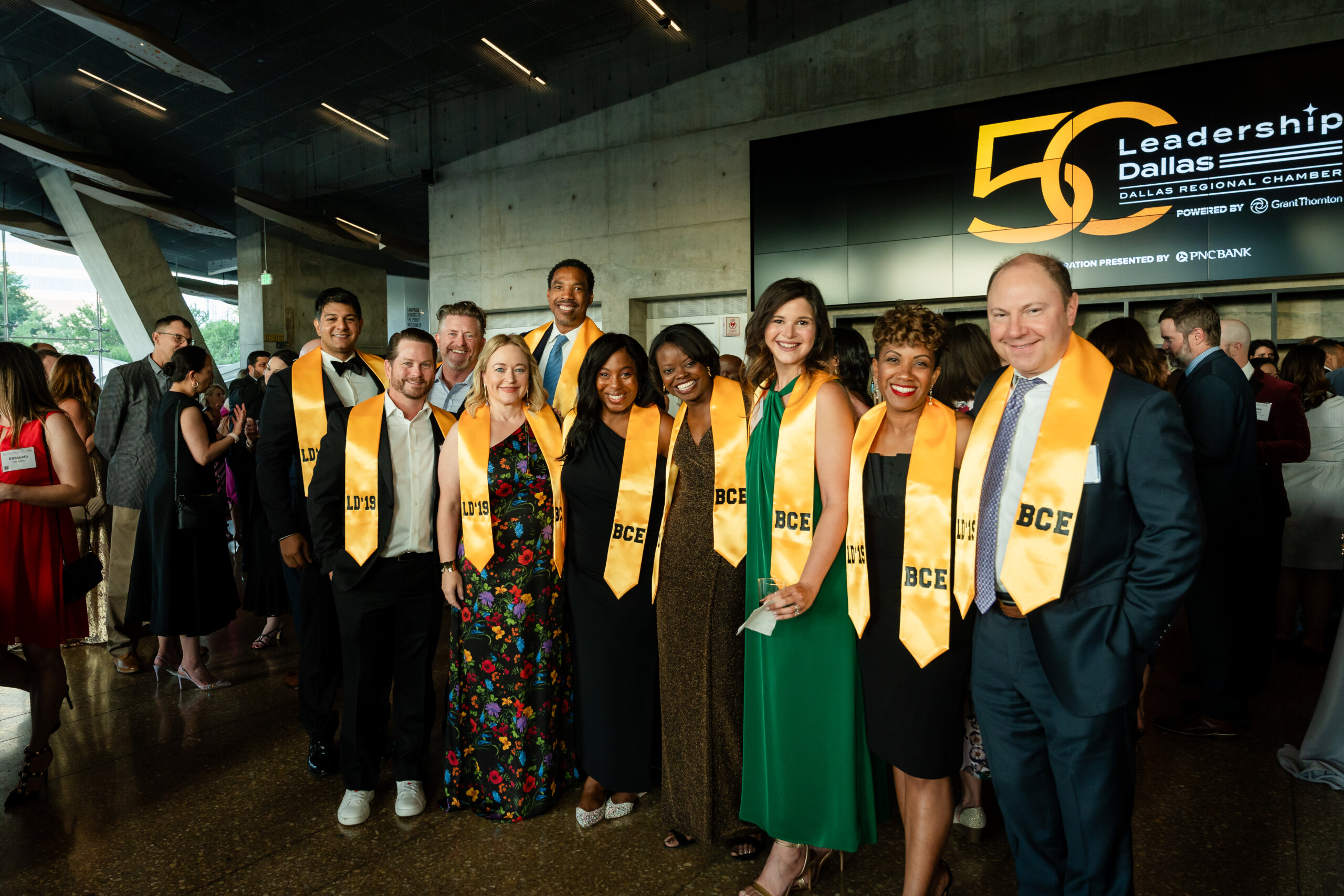
The Class of LD ’19 pose with stoles that say “BCE,” or “Best Class Ever.”

Brodsky’s transformation from someone unfamiliar with parts of Dallas to a passionate advocate illustrates the program’s deeper purpose.

“Leadership Dallas made Dallas home for me,” said Senior Vice President and Director of Client & Community Relations at PNC Bank Amber Scanlan, LD ‘19. “Part of the vision of LD is creating inroads, creating networking, and creating opportunity not only for all of us but for the City of Dallas, and there’s no organization who does it better than the DRC.”

This sense of home and connection that Scanlan describes reflects the program’s reach beyond professional development. LD received official recognition from the Texas Legislature, highlighting the program’s statewide significance.

“Since 1975, Leadership Dallas has helped shape the future of North Texas by investing in people. It is a program built on a simple but powerful idea: that informed, connected and compassionate leaders can change the trajectory of a city,” shared Rep. Linda Garcia, who presented House Resolution 1126. The resolution honored the members of the Leadership Dallas class of 2025 and commemorated the 50th anniversary of the program. The resolution was originally filed and presented in the Texas Capitol by Rep. Rafael Anchia, LD ‘99.

“Leadership Dallas alumni are everywhere, serving on boards, launching initiatives, running businesses, holding office, and of course mentoring the next generation. They are firmly integrated into every part of our community. It is the ripple effect of leadership that reaches every corner of our region,” continued Rep. Garcia. “As a member of the Texas House, I can tell you firsthand what a difference you all are making not just here at home but across the state.”

Current leaders of LDA emphasized their commitment to continuing the program’s mission of community engagement, underscoring how individual leadership development creates community-wide change.

Celebrations took place throughout the Perot Museum.

“We are all like-minded in that we care deeply about the community in which we live, work, and play, and it is people like us that this city and this chamber can rely on to continue to push the boundaries of what is possible,” said Jennifer Bartkowski, CEO of Girl Scouts of Northeast Texas, class of LD ‘16, and LDA Chair for 2024-2025. “Without Leadership Dallas, I don’t know that I would’ve valued the city for what it is and found myself wanting to fight for it like I do.”

The evening concluded with recognition of the corporate partners who have supported LD throughout its history, ensuring the program’s continued success.

“For 15 years, Grant Thornton has been a participant in the Leadership Dallas program, and I have seen firsthand the Leadership Dallas graduates and the development of their leadership,” said Nichole Jordan, Grant Thornton’s Dallas and Texoma Regional Managing Principal and Honorary LDA Member. “We’re grateful to be a part of this Leadership Dallas ecosystem, [and] we want to extend our heartfelt congratulations to all of our Leadership Dallas alum.”

Thank you to presenting sponsor, PNC Bank, and silver sponsor, Blue Cross and Blue Shield of Texas. Thank you to Grant Thornton, the LD class sponsor.

By Catie George, Director, Communications & Storytelling

Average reading time: 4 minutes

During the Dallas Regional Chamber’s State of Talent and Workforce event, presented by BGSF and Texas Mutual Insurance Company, industry leaders shared insights on building stronger connections between talent and business while addressing the evolving needs of today’s workforce. Below are the key takeaways that emerged from discussions with regional business leaders and workforce development experts.

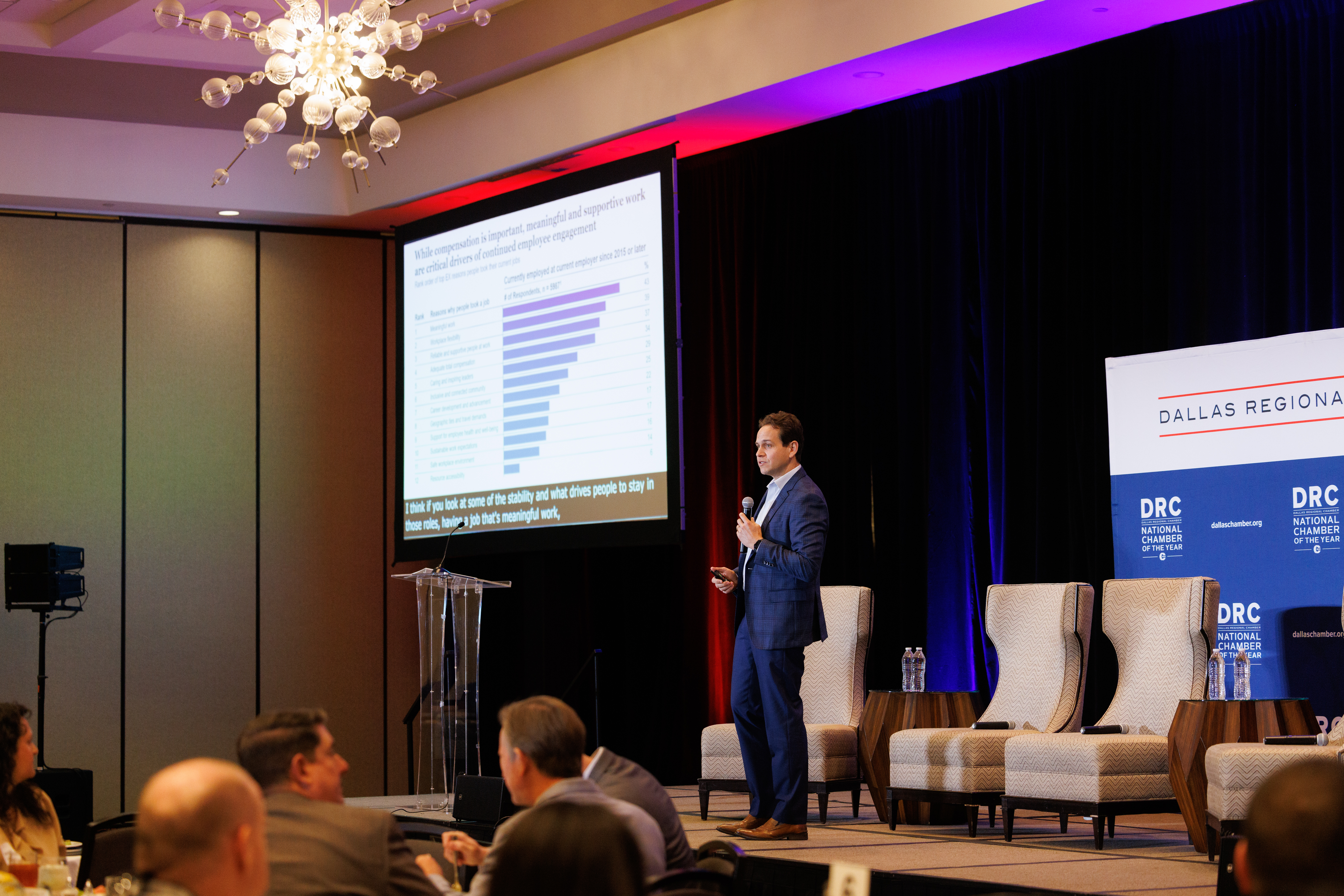
Taylor Cornwall discusses workforce satisfaction beyond compensation.

The Dallas Region has a competitive advantage.

The Dallas Region continues to lead the nation in job growth and economic opportunity, and DFW has established itself as the premier example for workforce development and job creation. According to DRC Senior Vice President of Talent Strategies Elizabeth Caudill McClain, the region’s success during the pandemic recovery was remarkable.

“The Dallas Region is a leader among metro areas across the country in job growth and continues to be the premier example for others to follow,” she said, citing a study by economist Wei Pyramid that shows one in five U.S. jobs post-pandemic were created in Texas, with 40% of them in Dallas-Fort Worth.

The continued expansion of the workforce in Dallas-Fort Worth is crucial for supporting local businesses because a growing labor pool creates a self-reinforcing cycle of economic vitality that benefits employers, workers, and the broader community. As more skilled professionals, service workers, and specialists move to the region, local businesses gain access to the talent they need to grow, innovate, and remain competitive in an increasingly dynamic marketplace.

Modern work goes beyond compensation.

While compensation remains important, it is not the primary driver of workforce satisfaction.

“Purpose and meaning are incredibly important, not just productivity. We all know that people who are more engaged tend to be more productive, not just for innovation,” said Taylor Cornwall, Partner at McKinsey & Co. “For a long time it was, ‘do I want stability, or do I want productivity?’ And I think one of the things that we often see is that the two actually work very closely together.”

In a survey of 6,000 people, McKinsey found that meaningful work, or work that a person perceives as personally significant and valuable, significantly contributes to employee retention and satisfaction, often outweighing financial incentives, workplace flexibility is a critical factor for employees, enhancing their work-life balance and overall job satisfaction, and organizations that prioritize purpose and flexibility are more likely to foster a committed and engaged workforce.

McKesson’s Nimesh Jhaveri sharing insights into the workforce.

Employee-focused initiatives help define organizational identity.

Creating authentic employee experiences requires alignment between promises and reality.

“When we were talking to prospective employees, when they walked in the door, the experience that they had matched what we told them that they would get,” said Smith.

Having employees find value in their work is a process that begins with leadership. Ensuring that employees have support through Employee Resource Groups (ERGs), for example, is a demonstrated way to increase employee satisfaction.

“ERG members that are part of ERGs versus not being part of ERGs is their engagement is higher, between 3 to 4%, and their turnover is better,” said Nimesh Jhaveri, Executive Vice President and Chief Impact Officer at McKesson.

Additionally, the focus on storytelling helps employees understand their impact.

“We like to tell the stories that show our employees the impact that they are having on customers and patients,” shared McKesson’s Executive Vice President and Chief Human Resources Officer LeAnn Smith, and shared the story of Noah, a 9-year-old who received McKesson employees’ help to get from Spokane, Washington, to Boston.

This and other stories help McKesson demonstrate how their company’s purpose translates to real-world impact.

“It’s not about companies or products,” said Jhaveri. “It’s about changing people’s lives.”

BGSF’s Emily Burroughs welcomes LeAnn Smith to the stage.

Purpose-driven employment increases more than just performance.

The connection between employee engagement and health outcomes has become increasingly clear. Organizations that measure engagement alongside health metrics find they develop “not only a better workforce on the job, but a better workforce outside of the job,” said Cornwall.

Organizations should examine their own workforce development strategies, implement measurement systems that track both engagement and outcomes, and actively participate in regional partnerships that amplify collective impact.

Smith shared that when positive sentiment exists in the key drivers of meaning—direction, impact, goodness, and value—their employees are 50% more engaged. Businesses that invest in purpose-driven workforce development create positive change not only within their organizations but throughout the communities they serve.

To transform your company’s talent strategies to increase worker satisfaction, inquire about the DRC’s Talent Labs, a six-month, accredited program designed for talent professionals to elevate their workforce strategies.

To learn more about the DRC’s work in talent and workforce, visit our website.

By Cary Bailey, Managing Director, Member Engagement

Average reading time: 3 minutes

DRC membership is more than just a listing in a directory. At its best, it’s an opportunity to help shape the future of the Dallas Region, advance your own professional and business objectives, and grow your company’s connections and influence.

Here are five ways your DRC membership can help you and your company.

Events like the DRC’s Opportunity Summit are great ways to get connected.
    1. Attend events and programming to stay up to date on our region.

Membership gives every employee in your company access to DRC events and programming. The DRC calendar is packed with a variety of community-driven gatherings designed to connect, educate, and inspire our dynamic business community. From signature events with movers and shakers to focused workshops and happy hours where genuine connections are forged and valuable insights are gained, there’s always an event on the horizon.

2. The DRC’s Councils & Task Forces are your opportunity to help shape our future.

No matter the priority, your voice and expertise can influence the DRC’s advocacy efforts and regional strategies. These meetings are where brilliant minds collide, ideas spark, and leaders connect and collaborate with others who are just as passionate about the Dallas Region’s success. We have Councils & Task Forces within each of our four strategic focus areas and spanning a wide array of topics. You and your team can choose a council or task force that aligns with your professional role or fits a topic that matters to you and your company. We encourage your entire team to jump in and contribute to our initiatives and build relationships.

Pro tip: Get several members of your team involved across our suite of councils and task forces to increase your company’s share of voice in DRC initiatives and impact.

3. Don’t overlook the many valuable member resources available to you.

Need the inside scoop on Dallas’s thriving economy? We’ve got the data at your fingertips with full access to our research team. Our expert team can offer customized insights to inform business decisions.

As part of our ongoing effort to support AI adoption across the region, the DRC has also launched AI Office Hours, a chance to connect with local AI experts for a free one-on-one virtual session. While not every company has in-house AI expertise, especially small and medium-sized businesses, many are trying to understand how tools like ChatGPT can fit into their operations. Through this initiative, anyone can easily schedule a free, hour-long session with an expert to ask questions, discuss strategy, or talk through technical challenges.

Looking for top-tier talent for your team? Tap into our Say Yes to Dallas campaign and talent attraction resources to help strengthen your workforce. The DRC also offers free publications of the Newcomer & Relocation Guide to share with talent prospects considering or joining the Dallas Region.

Send us an email at memberinfo@dallaschamber.org to schedule a personalized meeting about which member resources will be most useful to you.

The DRC’s newest leadership program, Talent Labs, is for HR and talent professionals.

4. Participate in a DRC Leadership Program to develop your potential.

Transformative programs like Young Professionals or Leadership Dallas will help sharpen your leadership skills, expand your network, and foster connections with a diverse group of emerging and established leaders. If you are ready to be inspired and ignite your leadership spark, invest in your personal and professional growth by getting involved. The DRC has programs in place to cultivate leaders at every phase of their career.

5. Elevate your brand in front of our high-impact audiences.

To elevate your brand within the Dallas business community, check out our marketing opportunities for increased visibility through the DRC’s blogs, website, social media outlets, and event sponsorships. All members can participate in a Member Spotlight once a year, as well as submit corporate events, offers, and news to be featured in our Member Announcements. Our audience consists of corporate leaders, community partners, and government officials you’ll want to know.

Unlock your membership’s full potential and thrive within the Dallas business community.

If you’re interested in strengthening your membership with the DRC and diving further into your membership, please reach out to cbailey@dallaschamber.org.

The Dallas Regional Chamber has announced the 51st class of Leadership Dallas (LD), presented by Grant Thornton, the Dallas Region’s premier leadership program. The 55 members of the LD Class of 2026 represent a wide range of industries and organizations.

Established in 1975 by the DRC, the Leadership Dallas program unlocks leadership potential and inspires class members to elevate engagement within their organizations and communities. The nine-month curriculum positions class members to address the challenges and opportunities facing the Dallas Region.

“For more than 50 years, Leadership Dallas has given emerging leaders the tools to help shape the future of our region,” said DRC President & CEO Dale Petroskey. “The Class of 2026 continues that great legacy—bringing a fresh perspective, passion, expertise, and a deep commitment to making the Dallas Region an even better place tomorrow than it is today.”

Through expert-led sessions, collaborative dialogue, and a community-focused project, class members dive into key regional issues ranging from education and workforce to innovation, public policy, health care, and more.

“Leadership Dallas continues to be a transformative experience for leaders committed to making meaningful change,” said Elizabeth Caudill McClain, Senior Vice President of Talent Strategies at the DRC. “This year’s class is eager, engaged, and ready to take on the challenges—and opportunities—that lie ahead for the Dallas Region.”

The members of the Leadership Dallas Class of 2026 are:

First Name  Last Name  Company
Aaron  Sarfati  Jacobs 
Ahava  Silkey-Jones  Dallas College 
Andrew  Reese  Moss & Associates 
Andrew  Schendle  AECOM 
Austin  Whisenhunt  Comerica Bank 
Bethany  Hilton  Improving 
Bibi Yasmin  Katsev  Teach for America – Dallas-Fort Worth 
Brad  Jones  Arcosa 
Brandon  Jumonville  KPMG 
Brenna  Wriston  JBJ Management 
Brennan H.  Meier  Akin Gump Strauss Hauer & Feld LLP 
Cathy  Susie  Schneider Electric 
Charles  Stewart  Turner Construction Company 
Clayton  Smith  Children’s Health 
Cory   Hoffman  Toyota Motor North America 
Daniel   Walsh  Huntington Bank 
David  Dominguez  Grant Thornton 
Demetria  Robinson  Workforce Solutions Greater Dallas 
Derrik  Gay  USAA 
Dimitri  Hughes  BCG 
Elaina  Mulé  Charles Schwab & Co 
Ethel  Mangum  7-Eleven, Inc. 
Gene  Davis  The Commit Partnership 
Gracie   Andraos  HKS, Inc. 
Jennifer  Chapman  Regions 
Joe  Edwards  Tonic3 
Joel   Doolen  Frost 
John   Mitchener  Methodist Health System 
Johnathan  Eaves  Axxess 
Juanita  DeLoach, PhD  Barnes & Thornburg LLP 
Katie  Sauce  Southwest Transplant Alliance 
Kelly  Dowd  AT&T Inc. 
Keshia  Robinson  Dallas Mavericks 
Kimberly  Smith  Atmos Energy Corporation 
Lauren  Combest  Goodway Group 
Leah   Guinyard   Wells Fargo Bank 
Lincoln  Cohoon  Ernst & Young LLP 
Marcus   Ranallo  JPMorganChase 
Mark  Yelich  BAL Immigration Law 
Matt  Shuba  PNC Bank 
Michael   Grabowski  McCarthy Building Companies 
Mike  Pierce  Lockton Dunning Benefits 
Morgan   Cox III  Marquis Group 
Nathan   Jacks  UMB Bank 
Nick  Monier  Haynes and Boone, LLP 
Nicole  Mountjoy  Caterpillar Inc. 
Sam   Douglas  Vistra Corp 
Saranya  Kumar  PwC 
Scott  Trapp  Oncor 
Seth  Toomay  UT Southwestern Medical Center 
Sohail  Khan  American Airlines 
Terrance  Williams  Bank of America 
Theda  Khrestin  Dallas Citizens Council 
Tosan  Ojeahere  Thomson Reuters 
Will  Short  Accenture 

For more information on Leadership Dallas, visit our website. Thank you to our presenting sponsor, Grant Thornton LLP.