By Catie George, Director, Communications & Storytelling

Average reading time: 4.5 minutes

On Wednesday, Oct. 29, 189 business and community leaders traded their usual routines for an eye-opening day inside Dallas ISD classrooms as part of the annual Principal for a Day (PFAD), presented by Capital One. The initiative, which concluded with an “After School” reception, presented by Amazon, at the Frontiers of Flight Museum, brought together members of the Dallas Regional Chamber, elected officials, and corporate partners to witness firsthand the remarkable transformation happening in Dallas’ schools.

Among the participants were 21 members of the DRC Board and Executive Committee and three elected officials (Texas State Representatives Linda Garcia and Rafael Anchia and Texas State Senator Royce West) all eager to connect with the educators and students shaping the region’s future workforce. The day offered a distinct look at the daily dedication, strategic planning, and community-building that drives student success across the district.

Dale Petroskey admiring South Oak Cliff High School’s achievements.

Witnessing educational excellence in action

DRC President & CEO Dale Petroskey started his day at South Oak Cliff High School by sitting in on a weekly leadership meeting led by Principal Dr. Willie F. Johnson.

This approach to continuous measurement and goal setting within these leadership meetings have transformed South Oak Cliff from an underperforming school when Dr. Johnson arrived in 2017 to one of the best-performing high schools in Dallas ISD today.

A district transformed

The timing of this year’s PFAD coincided with unprecedented achievement across Dallas ISD. Superintendent Dr. Stephanie Elizalde shared remarkable data at the reception that illustrates the district’s upward trajectory. During the 2025 school year, Dallas ISD doubled the number of A-rated campuses from 30 to 60 and increased B schools from 71 to 103. Perhaps most notably, the district cut its failing schools from 24 to just two.

“Dallas ISD is changing what people think of when they think about public schools,” said Dr. Elizalde.

The district’s focus on college and career readiness has also yielded impressive results. About one out of every ten members of the Dallas ISD class of 2025 earned at least 60 college credit hours or career certifications, while 32% of the entire class graduated with at least some college credit. Over the past five years, Dallas ISD students have earned more than 47,000 industry certifications and approximately 4,700 college associate degrees. For the most recent graduating class, 91% were college, career, or military ready by graduation.

The district’s innovations extend beyond academics. Dr. Elizalde highlighted the school counselor excellence initiative that links counselor pay to student outcomes, expanded mental health services added since the pandemic, and groundbreaking work with AI. Infrastructure investments include a new career institute in West Dallas and two state-of-the-art schools: John Lewis Social Justice Academy and Longfellow Career Exploration Academy. The district has earned the highest bond rating possible—a triple-A rating—and its graduates generate $26.8 billion in annual gross product and nearly 213,000 jobs for the Dallas economy.
Amazon’s Vickie Yakunin talks to students at Career Institute North.

The business case for engagement

For corporate participants, the event reinforced the direct connection between educational excellence and regional competitiveness. Vickie Yakunin, Head of Community Affairs at Amazon, stressed the ongoing partnership required to sustain this momentum.

“I encourage you to think about how your organizations can continue to show up for students, whether that’s through mentorship, resources, or simply staying engaged,” Yakunin said at the reception. “Together, we can help Dallas ISD become the best urban district in the nation and its students the future workforce our region needs.”

Capital One’s Andrella Thomas, Senior Manager of Social Innovation, found inspiration in the student interactions.

“I love to be able to sit there and hear the inspirational stories of how our journeys help other students determine the next pathway for themselves,” Thomas shared during the reception.

A personal perspective

In a separate interview, Marshalling Resources President & CEO Cynt Marshall reflected on her PFAD experience and the morning huddle with teachers that left a lasting impression on her.

“I actually enjoyed the huddle with the teachers and watching the teachers literally have this community to start the day,” Marshall said. “You could tell they are bonded and that there’s a spirit of teamwork… It was a great way just to see their bonding, which then I saw bleed into the spirit of the school.”

Marshall didn’t mince words about the importance of participation.

“Don’t think twice about joining PFAD. This needs to be the number one priority on your to-do list for your year, to get outside of your business, outside of your organization, and go and see what true impact looks like. These educators give us a lesson every day about impact.”

She also emphasized the interconnected nature of educational and business success.

“These wonderful students that teachers are pouring into every day, these are our future neighbors, our future doctors, our future teachers. But they’re impacting our future employees, so they’re impacting our pipeline.”

Marshall’s message was clear: educators are on the front lines every day, and the business community has a responsibility to support them.

“This is a day to get out and say, ‘I’m here for you. I see you. Yes, I’m going to learn something. I’m going to have fun. I’ll be able to share some of your knowledge and experience with some of these people. But more importantly, I’m here to help you. And I see you, and I want to be a part of your success, because your success as an educator is my success.'”

Looking forward
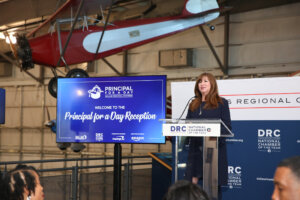
DISD’s Superintendent Dr. Stephanie Elizalde thanks PFAD participants at the Frontiers of Flight Museum.

As Petroskey noted at the reception which took place at the Frontiers of Flight Museum, participants “spent the day in schools with kids who are preparing to take off, and they’re preparing to take off with the help of all the principals and all the teachers and all the other school personnel who spend pretty much every waking hour helping these kids launch into the world.”

The PFAD experience demonstrated that the future of the Dallas Region economy is being shaped right now in classrooms across the district—and that the business community has both an opportunity and a responsibility to support that work.

Thank you to the presenting sponsor, Capital One, the reception sponsor, Amazon, and our corporate sponsor, Dallas College. And thank you to our reception exhibitors, All Stars Project, Beacon Hill, Catch Up & Read, Dallas Education Foundation, and United to Learn. Thank you to Dallas ISD for their continued partnership in hosting 25 years of PFAD.

Hilti North America provides leading-edge hardware, software, and services for the commercial construction industry. With a passionate and inclusive team made up of more than 4,500 employees and a customer-centric approach, we help construction professionals build safer, more productive and sustainable job sites. Hilti North America is headquartered in Plano, Texas and is part of the larger Hilti Group which operates in more than 120 countries with more than 34,000 team members.

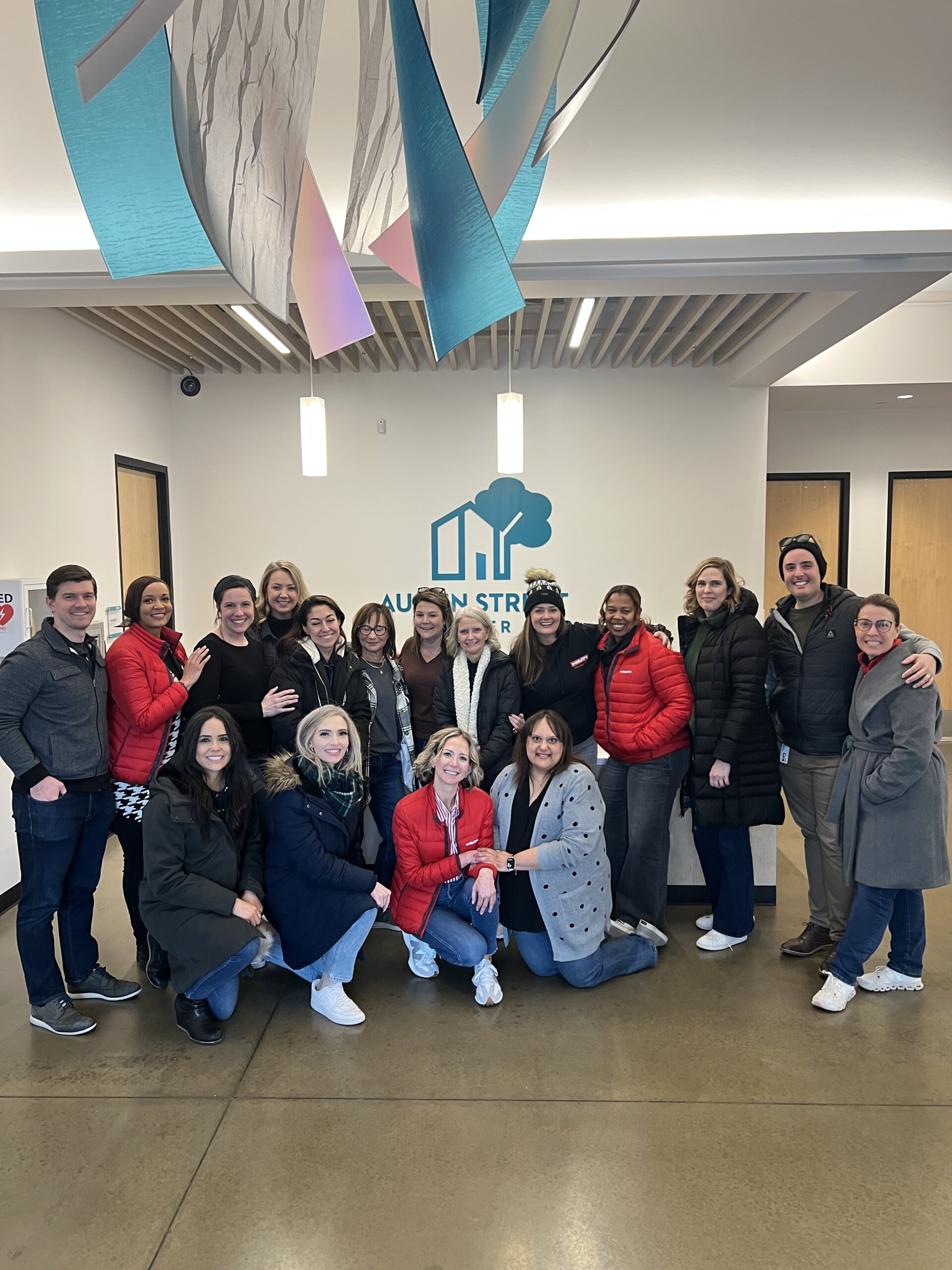
Members of the Hilti staff serving at Austin Street Center.

1. How does Hilti North America help its clients build value?

At Hilti, we offer innovative solutions that address the full lifecycle of a construction project—from design to build to maintenance. Our engineering support, wide range of services, advanced product portfolio, and software platforms are designed to improve efficiency and support jobsite health and safety and sustainability. We have close and trusting relationships with our customers and partner with them to deliver tailored solutions based on their needs. We work with a shared purpose to make construction better by delivering better applications, better projects, better processes and better experiences.

2. What differentiates Hilti within your industry?

Hilti’s biggest differentiators are our people and our product offering. Our direct-to-customer model means our team members work alongside customers on the job everyday while partnering with them to solve complex construction challenges. Around the world, Hilti has hundreds of thousands of customer touchpoints a day. This informs the solutions we bring to our customers and as a result, invest heavily in innovation to bring solutions that help solve their most pressing issues.

We develop and produce our own products and have an uncompromising approach all the way from research to delivery. We run our own research and development labs with specialist scientists and engineers. We also collaborate with leading technical universities worldwide to share research and push our boundaries even further. We manufacture our products in our own factories across the globe and also work with external specialist suppliers with exacting standards. This ensures that everything that bears the Hilti name meets the same high-quality standards.

3. What benefits does Hilti enjoy by doing business in the Dallas Region?

The Dallas Region is a hub for innovation, construction growth, and diverse talent – making it an ideal home for Hilti North America. With access to a skilled workforce, major infrastructure developments, and a thriving business ecosystem, the region fuels our growth and ability to serve customers. The central location also supports our logistics and supply chain operations across North America.

4. Why did Hilti become a DRC member?

We joined the DRC to be part of a forward-thinking community that shares our commitment to progress and partnership. The Chamber’s focus on economic development, talent attraction, and regional collaboration aligns with Hilti’s values. Being a DRC member allows us to engage with other leaders, contribute to regional success, and stay connected to what matters most in the business community.

5. How has Hilti changed in the past five years?

Over the past five years, Hilti North America has transformed to meet the future of construction and to be an even better partner for our customers. We’ve expanded our digital and software offerings and continued to launch industry-first innovations like Nuron, a digitally connected, single 22 volt battery platform, that enables heavy-duty applications that were once restricted to corded, gas-powered or higher voltage battery systems. We believe working in construction is both purposeful and rewarding. Through it all, our people, our customers and our communities remain the driving force behind everything we do.

OUTFRONT Media is one of the most innovative media companies in the country. With operations in more than 50 major markets, including Dallas-Fort Worth, we help advertisers connect with audiences in the real world through powerful creative, premium locations, and smart audience data. Our goal is to make brands unforgettable by creating meaningful moments of impact, whether on the streets, in transit, or on mobile devices. We extend our reach beyond our physical inventory with our in-app mobile ad platform, allowing brands to engage audiences digitally and amplify the impact of Out of Home.

1. How does OUTFRONT Media help its clients build value?

We help brands grow by delivering high-impact, engaging experiences that reach people as they move through their daily lives. Our approach blends technology, location, and creativity to drive awareness, trust, and engagement across every touchpoint, from billboards and transit to digital out-of-home and mobile platforms. By offering real-time analytics and audience intelligence, we ensure campaigns are both measurable and meaningful.

2. What differentiates OUTFRONT Media within your industry?

What makes OUTFRONT unique in the Out of Home industry is our focus on the power of presence. We believe great creativity has the ability to spark emotion, shift perception, and build lasting connections. By combining data-driven insights with bold storytelling, we help brands stand out in the physical world where attention is earned.

3. What benefits does OUTFRONT Media enjoy by doing business in the Dallas Region?

Dallas-Fort Worth is a thriving, diverse market with a strong business community and a fast-growing population. The region’s energy and connectivity make it an ideal place for brands to engage with consumers. Our strategic media placements across the metroplex allow us to deliver campaigns that are both visible and impactful, on the streets and on screens.

4. Why did OUTFRONT Media become a DRC member?

We joined the Dallas Regional Chamber to build stronger relationships within the local business community and to collaborate with other organizations that are driving innovation and growth. The DRC provides valuable resources, advocacy, and networking opportunities that support our continued success in the region.

5. How has OUTFRONT Media changed in the past five years?

Over the last five years, OUTFRONT has evolved into a digitally enabled media company. We’ve invested in audience intelligence, real-time analytics, and dynamic creative capabilities to make our media more measurable and responsive. This transformation reflects our commitment to innovation and our belief in the power of Out of Home – amplified by mobile, to deliver results in a digital-first world.

By Morgan Scruggs, Coordinator, Leadership Programs

Average reading time: 2.5 minutes

To celebrate 25 years of Young Professionals (YP), presented by Fidelity Investments, the DRC is highlighting a series of alumni to learn more about their experiences in YP.

Erika Leigh Nobles, Lease Administration Manager with Colliers.

Erika Leigh Nobles, Lease Administration Manager with Colliers and current Chair of the Young Professionals Advisory Council, found a home with YP after her first introduction to the program.

“In the midst of the COVID pandemic, I was struggling with the challenges of working from home full-time, the worry of potentially bringing more than just groceries home to my family, and, above all, coping with loss,” Nobles explained. “I had lost over 80 family members and loved ones and was in need of comfort. Will Haynes told me about YP and mentioned there was a call happening in a few hours. The sense of connection I experienced on that virtual call felt like more than just a hug; it was the supportive community I needed during a difficult time.”

After Nobles joined YP, she began reflecting on her existing leadership skills.

“Participating in the Young Professionals program has been a transformative experience in helping me understand and refine my leadership skills. Through this journey, I’ve gained deeper self-awareness, recognizing that effective leadership is not just about guiding others, but also about listening, adapting, and leading with empathy.”

In addition to attending events, Nobles gained valuable mentorship from her colleagues in YP.

“The mentorship and feedback I received throughout the program were instrumental in shaping my leadership style. I now see leadership as a continuous journey – one that requires reflection, humility, and a commitment to learning.”

The community service Nobles did with YP significantly shaped her leadership trajectory.

“The moment that changed everything for me professionally wasn’t in a boardroom; it was making sandwiches with Tango Charities. It didn’t matter if you were the VP or the person grabbing coffee for the team. In that moment, we were one,” Nobles added. “I’ve always been the kind of leader who gets in the weeds and gets the work done. But that day, I realized I wasn’t just doing the work, I was part of a company and a community that leads the same way. That experience elevated my professional development in ways I never expected. It reminded me that real impact starts with connection.”

Nobles also reflects on the impact YP has made on her professional development.

“Through YP’s network and development opportunities, I’ve gained valuable leadership experience, which directly contributed to my two promotions. Being active in YP also helped me build confidence and visibility, leading to elevated roles within my company’s employee resource groups.”

For those ready to grow, connect, and lead within a new community, Nobles highly recommends joining YP.

“YP has been more than just a network; it’s been a launchpad. It’s where I found mentorship, leadership opportunities, and a space to grow beyond my day-to-day role. Whether you’re looking to expand your network, sharpen your leadership skills, or simply find your voice, YP is where it can start. If you’re on the fence, take the leap. Your future self will thank you.”

ENGAGE WITH YOUNG PROFESSIONALS

YP YEAR-END CELEBRATION

Join us Thursday, Dec. 4, for a special evening celebrating another year of YP!

By Nicole Ward, Data Journalist, Research & Innovation

Average reading time: 5 minutes

This story was originally published on Dallas Innovates. Read it here.

There are estimated to be more than 70 million individuals with disabilities in the United States, according to the CDC. For this population, they struggle to function in a world that was not built to accommodate people’s differences, which costs them extra time and effort to complete every task, every day.

Time isn’t the only “disability tax” — social and financial costs also rack up for people who have disabilities and their caregivers. According to the American Academy of Pediatrics, nearly 15% of families with children who have chronic health conditions, including autism, epilepsy, and cerebral palsy, have scaled back their participation in the workforce.

That figure jumps to more than 40% in families of children with an intellectual disability. And that means less money to run the household; reducing work hours or leaving the workforce altogether costs families in the disability community an average of $18,000 per year in lost earnings.

Meanwhile, purchasing adaptive or accessible products can be more expensive than families have budgeted for. For example, according to the National Highway Safety Transportation Board, a new car with adaptive equipment could cost up to $80,000.

Navigating sources of support

Paul Voelker is intimately familiar with balancing costs and enabling loved ones to live their best lives.

Voelker and his wife, Kris, first noticed their son had sensory challenges when he was a toddler. Sensory Processing Disorder (SPD) was followed up by an Autism Spectrum Disorder (ASD) diagnosis a couple of years later. Voelker’s son is smart and relatively social, but they decided to homeschool him because of the ongoing SPD, ASD, as well as anxiety and OCD, for which he takes medication.

“My wife was a teacher at Fairhill, which is a school in North Dallas for kids with learning differences,” Voelker said. So, she was keenly aware of learning differences and learning styles.”

She was the perfect person to teach their son, but that also meant they became a single-income household.

Today, Voelker’s son has a part-time job at McDonald’s and keeps busy at UT Dallas, participating in classes and programs through the Callier Center, as well as taking tennis lessons there through Acing Autism.

Voelker’s understanding of ASD has grown through personal experience, which he applied as the Mayor of Richardson. He made a concerted effort to learn about others in the disability community, forming a blue-ribbon committee to determine how the city could better serve all people.

“I reached out to some early-stage companies that were doing some really cool things in transportation and figuring out, for example, how you can more safely cross the street as a blind person. We had programs with organizations that would convert Braille to spoken word, to provide additional options for people.”

Voelker also greenlit the construction of a sensory-sensitive playground at Cottonwood Park. Playgrounds first emerged in the United States in the early twentieth century, but there’s been little innovation or effort to make them accessible to all.
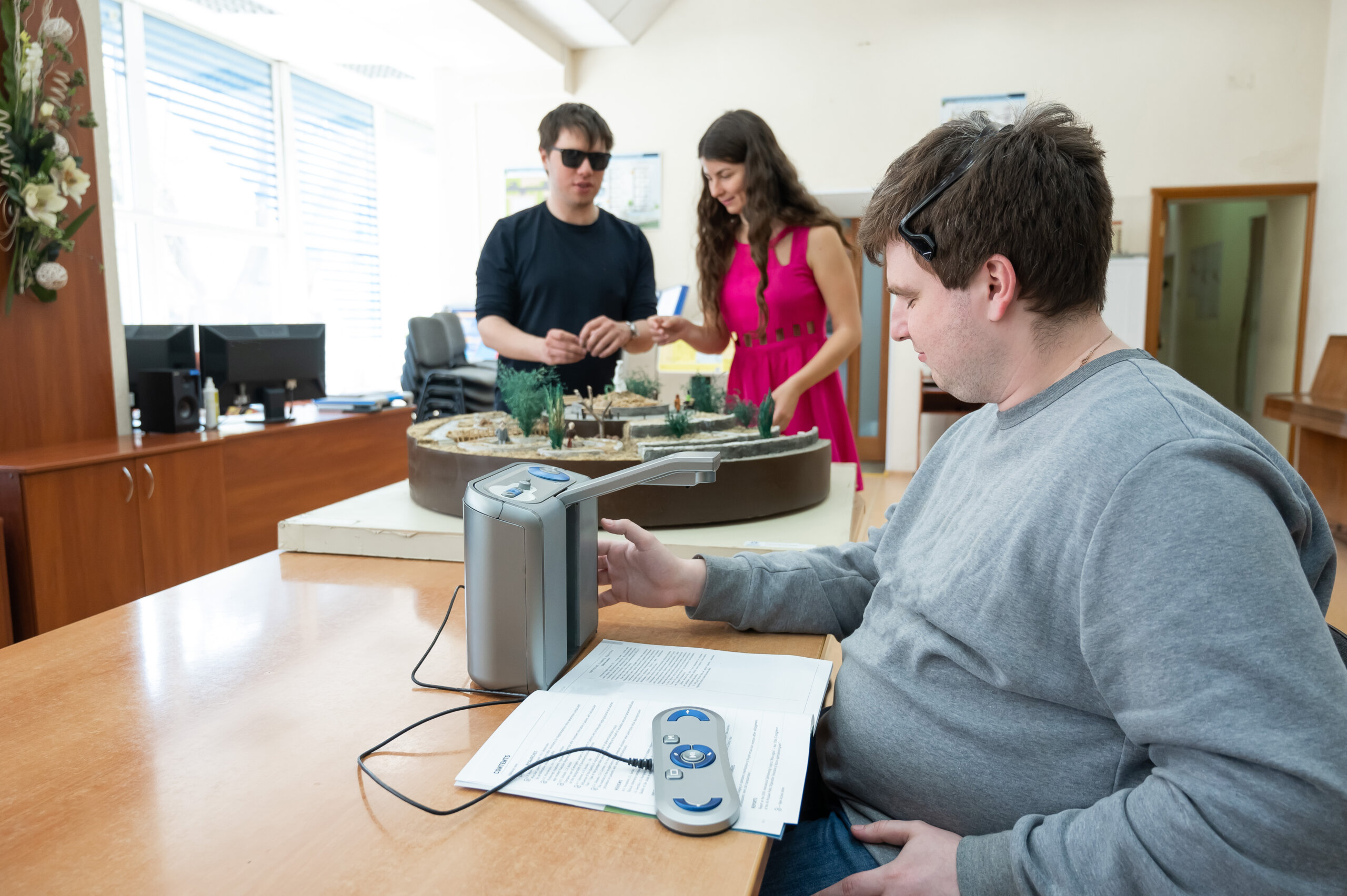
“It’s a fairly recent phenomenon — creating playgrounds that can be used by children with varying abilities,” said Voelker. “And I’m really proud of the one we were able to build.”

He and his wife helped establish Access+Inclusion at The Eisemann Center and put together the first program in the series with Kevin Spencer, creator of The Magic Therapy Program, and Phil McKinney, CEO of CableLabs, who started the nonprofit Hacking Autism, which evolved from a bunch of people in tech sitting around a table trying to improve interfaces to a mission-driven organization trying to improve the employment situation for people who have disabilities.

But despite all he learned being the father of an Autistic child and being in local government, Voelker still finds it challenging to navigate certain financial costs and insurance. He says it’s not something where you can just hope for the best.

“I was just on a phone call with Social Security, yet again, for long-term disability for him, and this has been over a year—every time I have an appointment, they cancel. Well, this time I got through, and now they’re saying it’ll be almost 300 days upon the final interview before the claim will be made.”

Working within the system

For Meghan Kelley Wehner, being a caregiver is second nature. She and her husband, Tyler, have three children. But even before they married and started a family, she remembers having a serious conversation about what the future would look like.

“We were dating, and I told him that I was a package deal—that one day we would assume guardianship of my younger brother, Jordan,” says Kelley Wehner.

Born with Apert Syndrome, the plan has always been for Jordan to live full-time with their parents until he moves in with Kelley Wehner’s family. She’s been working with their mom and dad for years to understand the nuances of the trust that has been set up in his name, the legal ramifications of inheriting property or other assets, and navigating the state and federal regulations as they pertain to his eligibility for benefits. It’s that piece, she says, that is unnecessarily punitive.

“The goal is for individuals to become contributing members of society, right? Earning their own income, receiving corporate benefits. And let’s say Jordan does get that at some point but then loses that job. He would have to start over—reapplying for government benefits, but the waiting list is 15 to 18 years. That is a risk we are not willing to take.”

What’s more, those who rely on social security to make ends meet cannot earn more than $1,620 to $2,700 per month, depending on their disability, or they will have to forfeit it.

“There’s legislation proposed to raise that limit, but even then, it’s not enough to pay rent, groceries, utilities, and have some left over for an emergency. And that’s not even getting into medical care or special services and transportation,” said Kelley Wehner.
Asset limits were created in 1974, when the program launched, and have been frozen since 1989.

“At some point, we’ll probably move to a place where he can have his own room, instead of retrofitting my office. But he’s ‘Uncle J’ to my kids, and we’re lucky to be able to fill this forgotten space for people who need some help sometimes, rather than the full gamut of services.”

Kelley Wehner, like Voelker and thousands of other families impacted by disability, relies on strategic planning and constant vigilance to navigate their unique paths through terrain that is remarkably common.

For more information on the disability community, check out the Dallas Regional Chamber’s Disability Inclusion Toolkit.

Read the full story on Dallas Innovates.

By Amber Dyer, Coordinator, Communications & Marketing

Average reading time: 1.5 minutes

To celebrate 25 years of Young Professionals (YP), presented by Fidelity Investments, the DRC is highlighting a series of alumni to explore their experiences in YP and the program’s impact on the Dallas Region.

Trenton Newell, Director of Reconciliation at Fidelity Investments.

When Trenton Newell, Director of Reconciliation at Fidelity Investments, relocated to Dallas, he saw YP as a way make a meaningful difference in his new community.

“YP was a clear opportunity to meet other leaders who were engaged in the region and similarly wanted to make a difference,” said Newell.

Through YP, he connected with leaders from both the corporate and nonprofit sectors, gaining exposure to a range of leadership styles.

“This exposure to such a broad set of diverse thinkers [not only showed] me how transferable many leadership skills are,” said Newell, “but also how critical it is to be able to [adapt your management approach to fit] your organization’s circumstances.”

Those connections led to Newell developing lasting relationships with his cohort.

“I have kept up with numerous friends made in YP,” he said. “We occasionally meet socially and discuss our journeys. Hearing the paths they have traveled has elevated my thinking on my own journey and prompted me to explore roles and other forms of opportunity I previously hadn’t considered.”

YP’s impact extended beyond professional development through immersive community experiences. A tour of Southern Dallas became particularly meaningful for Newell, offering insights that reshaped his leadership philosophy.

“The experience opened my eyes to the potential of an entire area,” said Newell. “Which is an interesting analogue to the potential that we so often overlook in each other as well. As leaders, we need to recognize that, bring it out, and develop it in others.”

For those considering YP, Newell emphasizes the program’s unique culture of mutual support and shared commitment.

“YP is a supportive, close-knit community of leaders who care—about each other, about their coworkers, and about the Dallas Region. That’s how we thrive together as a region. YP is a conduit to making impact through and with each other—and that’s when we’re at our strongest.”

ENGAGE WITH YOUNG PROFESSIONALS

YP YEAR-END CELEBRATION

Join us Thursday, Dec. 4, for a special evening celebrating another year of YP!

By Ashlynn Bouldin, Intern, Communications & Web Content

Average reading time: 3 minutes

As artificial intelligence transforms industries at record speed, one question defines the future of work: how do we keep people at the center of progress?

Dr. DeLancey Johnson shared information from Parkland Hospital on AI and talent.

The DRC’s Talent Talk, presented by BGSF Professional Services and Holmes Murphy, convened business and workforce experts to examine AI’s role in shaping adaptable, resilient teams.

Below are the key insights shared by experts at the September 25 event.

The key to stability is adaptability

With the integration of AI in the workplace, the workforce has been propelled into a new age of professional and business evolution. To sustain and excel in this ever-changing environment, both employers and employees must be well-equipped to embrace change and adopt new skills and methodologies.

Mark Benton, Vice President of HR Corporate Functions at McKesson, emphasized that “history shows us that while some jobs may disappear with new technology, new ones are created.” Just as the horse and buggy gave way to the car, and the switchboard operator gave way to the smartphone, “AI will force mankind to evolve once again, [but] it’s our ability as humans to adapt to change … The key is to be resilient, not resistant.”

Dr. DeLancey Johnson, Senior Vice President and Associate Chief Talent Officer at Parkland Hospital, encouraged employers and employees to embrace “curiosity [as] the catalyst to innovation.” Change is often followed by concern and questions, but “the only way that you can truly get ahead of the curve of AI is to know where you stand, know how to get feedback and how to receive feedback, be agile, and stay curious.”

Companies looking for success and sustainability in history’s fastest era of innovation must open themselves to change, learning, and adapting.

Skills-based hiring can be crucial for retaining talent with potential for growth

If adaptability is required for a company’s sustainable success, then employers must approach talent acquisition, retention, and management with adaptability in mind. Bank of America’s Market Executive Brian Angle stressed the importance of acquiring and retaining talent with potential for growth and change in achieving company-wide success, especially in the age of AI.

“Looking at experience and looking for potential for growth is what matters,” said Angle, because “having a college degree is one thing, but having the potential for that growth is another.”

Skills-based hiring continues to be an effective method of talent acquisition and retention as AI is incorporated into the workplace. As Benton emphasized, when working and improving efficiency with AI, “you don’t have to be an expert; you don’t have to be a data scientist. You just have to know how to ask good questions, get good prompts, and determine what you say next.”

Human traits are essential for an efficient workplace

“There are human-centered skills that we all uniquely have that AI can’t replicate. It’s about leadership. It’s about empathy and creativity,” Benton said. Human traits will be essential to companies’ success as technology progresses, just as they always have.

As Angle described, “AI will do what it’s great at, which is taking a large bunch of data and giving you recommendations. And then we will be able to do what we’re great at, taking that recommendation and saying, ‘does this feel right?’” For AI-generated data to be useful, humans must be the conduit through which it is filtered and shared; we must be the final decision-makers.

Companies that approach change with enthusiasm, adapt their approaches to talent acquisition, management, and retention, and affix human traits to the core of their practices will be well-equipped with the talent necessary for success and growth in this era of innovation.

Thinking about new ways to strengthen your talent pipeline? Email talent@dallaschamber.org to connect on your company’s needs.

By Makayla Rosales, Coordinator, Opportunity & Impact

Average reading time: 3 minutes

Native American Heritage Month is an annual celebration in November to come together and honor the traditions, cultures, and histories of Native American, Alaska Natives, and Native Hawaiian communities.

This observance began with a powerful goal to recognize the first Americans whose contributions helped shape and build the nation. In May of 1916, “American Indian Day” was first declared, laying the foundation for broader recognition. It wasn’t until 1990 that the George H.W. Bush administration officially designated November as Native American Heritage Month, giving this important celebration a permanent place on the national calendar.

Texas itself is home to three federally recognized tribes living on reservations: the Alabama-Coushatta, Tigua, and Kickapoo. The state’s history also traces back to many other tribes, including the Caddo, Comanche, Kiowa, Tawakoni, and Wichita, who originally called North Texas home. By recognizing and learning from these communities, we honor not only their enduring legacy but also the foundations they laid for the society we share today.

Engage in the workplace

A meaningful way to engage in Native American Heritage Month in the workplace is by creating opportunities for learning and connection. Consider inviting Native American speakers, artists, or scholars to share their experiences and cultural traditions through panel discussions or fireside chats. These conversations can explore themes such as tribal history, cultural preservation, and the lasting contributions of Native communities to society. To extend this learning beyond a single event, organizations can also build a shared resource hub featuring books, films, podcasts, and articles by Native authors and creators, encouraging employees to continue deepening their understanding throughout the year.

Attending local events is a meaningful way to engage with and learn from the Native communities around you. Participating as a team, whether by inviting colleagues to join you or organizing a department-wide outing, can strengthen connections while deepening appreciation for the rich cultures and histories that have shaped our nation. And while Native American Heritage Month offers a special opportunity to celebrate and reflect, it’s important to remember that appreciation shouldn’t end in November. Continue building long-term relationships with Native communities and finding ways to include Indigenous perspectives in your workplace year-round.

Attend an event

If you are interested in bringing your team, friends, or family to local festivities celebrating Native American Heritage Month, here are some local events:

Art in the Style of… RC Gorman-6-7:45 p.m. Wednesday, Nov. 19, at Oak Lawn Auditorium at the Oak Lawn Branch Library, 4100 Cedar Springs Rd. Dallas, TX, 75219

See the special edition of Art in the Style of…, by exploring the vibrant, expressive world of R.C. Gorman, often called the “Picasso of American Indian artists.” Known for his bold use of color and graceful depictions of Indigenous women, Gorman’s work radiates strength, beauty, and cultural pride. In this hands-on session, participants will create their own artwork inspired by his iconic style, using pastels and vivid hues to capture movement and spirit.

Worldwide Passport: Indigenous People-Ella Mae Shamblee– Friday, Nov. 21, at Fort Worth Public Library, 1062 Evans Ave. Fort Worth 76104

Travel the world without leaving Fort Worth. Learn customs and traditions, play cultural games, and try crafts inspired by the different indigenous groups within the continent.

Crafternoon: Beaded Corn Cobs– 2-3 p.m. Saturday, Nov. 22, at Forest Green Branch Library, 9619 Greenville Ave. Dallas, TX 75243

Honor Native American Heritage Month by learning about the significance of corn to Indigenous American culture and history. Make your own colorful corn cob to represent this important crop.

Indigenous Storytelling– 11 a.m.-12 p.m. Nov. 29, at Forest Green Branch Library, 9619 Greenville Ave. Dallas, TX 75243.

Experience a performance blending movement, literary elements, and videography as you learn about Indigenous culture, history, and experiences.

Other November holidays to celebrate

November is a month that is dedicated to remembrance, gratitude, and community. Veterans Day, observed on Tuesday, Nov. 11, is a time for us to pause to honor the men and women who have served our nation with courage and dedication. Their sacrifices safeguard the freedoms we enjoy every day, reminding us of that service to others is one of the highest forms of gratitude. Later in the month, Thanksgiving is on Thursday, Nov. 27, offering an opportunity to count our blessings, express appreciation, and extend kindness to those around us. Together, these November observances remind us of the enduring values of service, gratitude, and connection that unite us as a community.

Dexian is a global talent and technology solutions leader with more than 10,000 employees and 70+ locations worldwide. As one of the largest minority-owned staffing and solutions firms in the U.S., we combine over 30 years of industry expertise with innovation to deliver comprehensive support to clients and consultants around the world. We’ve fused talent, technology, and workforce solutions into a single global platform that connects the right people and capabilities with the organizations that need them to produce trajectory-changing results and help everyone achieve their ambitions and goals.

How does Dexian help its clients build value?

Dexian helps clients build value by closing workforce gaps, strengthening teams, and modernizing how work gets done. We hire skilled professionals, manage large workforce programs, and deliver cloud, data, automation, and AI services. Guided by Black Sky Thinking, we look beyond the immediate need and design solutions that work today and create room for future growth and innovation.

What differentiates Dexian within your industry?

We connect people, technology, and workforce strategy in one seamless experience. While most firms focus on either staffing or technology services, we bring both together – and even at a global scale, we deliver it with a personal, flexible touch. Our model blends modern technology with access to talent across the globe, allowing us to adapt to how each client works, rather than asking them to fit into a single way of doing things. Our approach is built to scale while still feeling relationship-driven and focuses on building solutions that last — ones that support growth, evolve with our clients’ needs, and strengthen partnerships long after the launch.

How has Dexian changed in the past five years?

In the last five years, DISYS and Signature Consultants came together to form Dexian. Building on 30 years of expertise and a single global platform, we developed a model that blends operational efficiency with white-glove service: global in scale, boutique in experience. Since then, we’ve expanded across the U.S. and internationally, strengthened delivery capabilities, and unified our staffing, consulting, workforce, and digital solutions under one client-focused platform. We continue to grow quickly, but our mission remains the same: to enhance the lives of those we serve, identifying and delivering trajectory-changing opportunities that enable better outcomes which yield new levels of mutual success.

What benefits does Dexian enjoy by doing business in the Dallas Region?

Dallas is one of the best places in the country to build a business around people, technology, and growth. The region offers a deep and diverse talent pool, a thriving tech and financial services ecosystem, and a central location that makes it easy to support clients across the U.S. and around the world. Dallas represents innovation, community, accessibility, and a business-friendly environment without the high costs of coastal markets. It’s a place where big ideas and practical solutions can grow side by side, and we’re glad to be part of that story.

Why did Dexian become a DRC member?

We joined the Dallas Regional Chamber because being in the business for good starts with investing in the community you serve. Dallas is home to many of our clients, consultants, and employees, and the DRC brings together leaders shaping the region’s future in workforce, innovation, and economic development. As a global talent and technology firm, we can contribute insight on hiring trends, skills of the future, and workforce resilience — and we look forward to sharing, collaborating, and helping Dallas continue to thrive.

By Amber Dyer, Coordinator, Communications & Marketing

Average reading time: 2 minutes

Dom Haskett, Business Development & Origination at Farol Asset Management, LP.

To celebrate 25 years of Young Professionals (YP), presented by Fidelity Investments, the Dallas Regional Chamber (DRC) is highlighting a series of alumni to explore their experiences in YP and the program’s impact on the Dallas Region.

Dom Haskett of Farol Asset Management, LP, found the DRC’s LEAD YP program while pursuing his MBA at the SMU Cox School of Business.

“I sought a program or experience focused on leadership teachings and principles, as the MBA coursework and clubs were more technically oriented,” said Dom. “I had leadership roles in the military, so this was also valuable from a transition perspective as well as growing further into the corporate world.”

One of the principles he learned through LEAD YP was the value of introspection.

“YP helped me gain a deeper understanding of my strengths and leadership style,” said Dom. “This self-awareness is crucial for recognizing what I do best, knowing when to leverage my strengths in leadership situations, and identifying when to rely on colleagues for support. Not knowing what you do best and where the gaps are in your playbook can be detrimental.”

Developing a deeper understanding of his own strengths allowed Dom to appreciate and identify the strengths of his fellow teammates.

“Collaborating on our group project was valuable because I worked with individuals who each had distinct styles different from my own,” he said. “It was fascinating to observe how we determined who would lead specific tasks and identified each person’s strengths.”

Through observing these leadership styles, he discovered that true success comes from authenticity.

“Authenticity means being true to yourself and showcasing the unique traits that define you,” said Dom. “These diverse environments, where varied experiences and perspectives converge, foster innovation and breakthrough discoveries. Much of what you learn in your career comes from the colleagues you encounter along the way.”

For Dom, many of those connections were members of his LEAD YP cohort.

“Connecting with other rising leaders had the greatest impact because it provided a community to grow alongside,” he said. “It’s invaluable to have peers to exchange ideas with and use as sounding boards when making decisions about future endeavors.”

In addition to cultivating a community of emerging leaders, Dom recommends the program to those seeking to equip themselves for long-term success.

“If [someone] is serious about their own professional development and wants to be intentional about growth, this is a great place to start,” he said. “The trajectory is limitless when you begin your journey being intentional about growth.”

ENGAGE WITH YOUNG PROFESSIONALS

YP YEAR-END CELEBRATION

Join us Thursday, Dec. 4, for a special evening celebrating another year of YP!

By Catie George, Director, Communications & Storytelling

Average reading time: 4.5 minutes

Against the backdrop of the Dallas Arboretum’s fall blooms, over 300 business and education leaders gathered to explore a critical question: How do we build an education system that powers regional competitiveness and creates pathways to prosperity for all students?

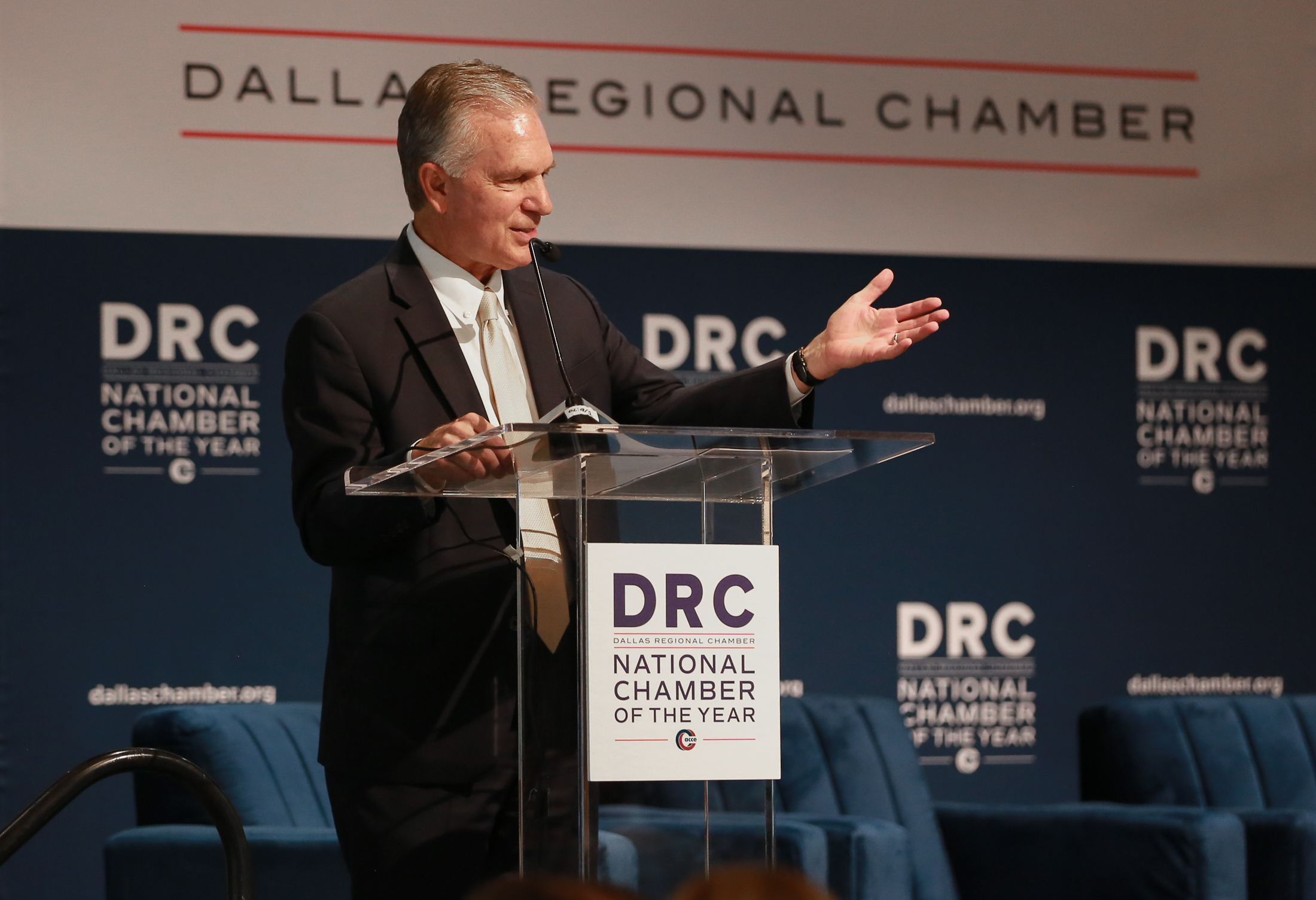
DRC President & CEO Dale Petroskey shared the importance of the event.

The Dallas Regional Chamber’s State of Public Education on Wednesday, Sept. 24, presented by Toyota Motor North America and The Commit Partnership, brought together a powerful coalition of voices united by a common mission: ensuring schools in the Dallas Region can supply the talent our region’s economy demands.

Education as economic strategy

Dale Petroskey, President and CEO of the DRC, set the stage by framing education not just as a social good, but as the cornerstone of regional competitiveness.

“When we talk to companies about coming here, one of the first things they ask is, what about your talent? Can the region supply the workers we need?” Petroskey explained. “And that answer mostly depends on the strength of our schools. And it’s not just about jobs. Families make decisions about where to live based on the school district. So, education drives both opportunities and quality of life.”

Petroskey praised the North Texas business community’s commitment to standing “shoulder to shoulder” with educators through mentoring, internships, and job opportunities. “Our region will only succeed if our schools succeed,” he emphasized.

Ana Meade, Vice President of Sustainable Development at Toyota Motor North America, reinforced this urgency from an industry perspective.

“With a rapid pace of change in every industry, preparing students for the future is not just a priority; it’s our responsibility,” she said. “We cannot afford to miss out on the creativity, ideas, and skills of the next generation.”

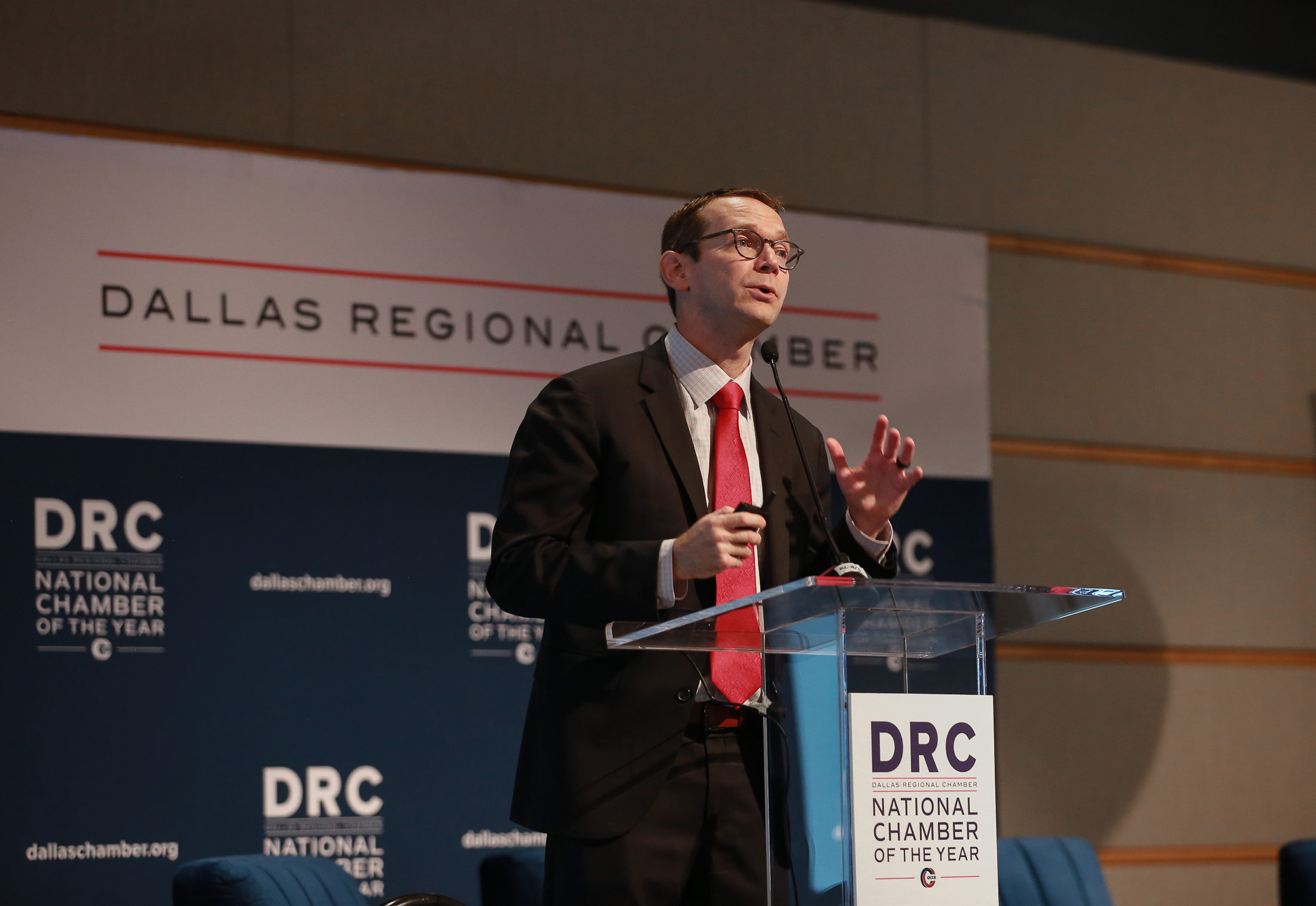
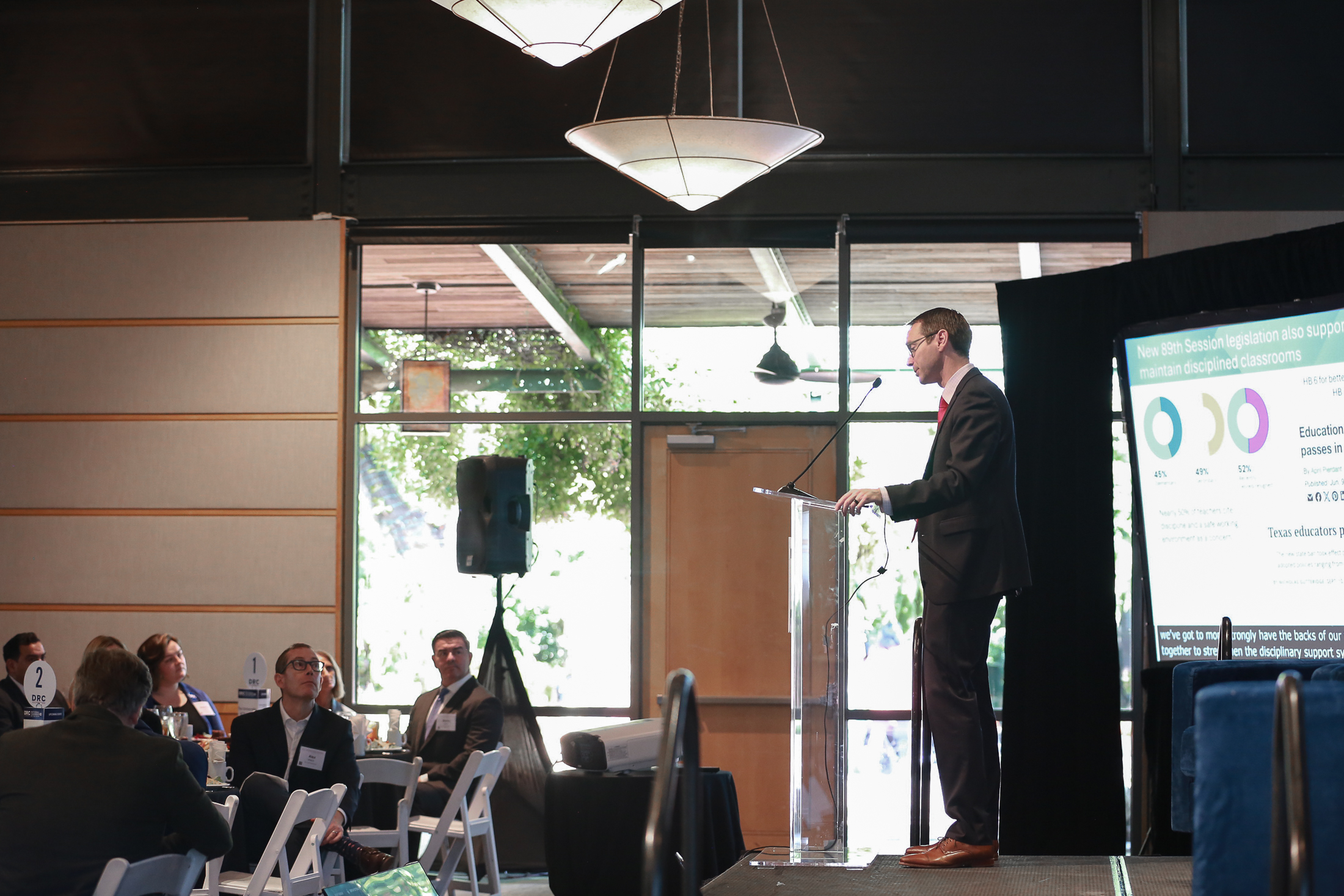
Texas Commissioner of Education Mike Morath shared the progress made in public schools over the past year.

A bold vision for Texas

Texas Commissioner of Education Mike Morath delivered a keynote address that captured both the scale of the challenge and the momentum of recent reforms. Overseeing 5.5 million students across 9,000 campuses and 1,200 school systems, Morath articulated a unifying vision.

“We want every child, whether they live in this zip code right around White Rock, whether they live in a zip code around Fair Park, whether they live in a zip code that has almost as many cows as it does people… we want our schools to equip them for success.”

While Texas boasts a 90% on-time high school graduation rate, placing the state in the top five nationally, Morath highlighted a critical gap: only 36% of students earn a bachelor’s degree, associate’s degree, or trade credential within six years of graduation.

“We have to be very intentional in how we recruit, support, and retain teachers in the classroom,” he stressed, noting that the most important in-school factor for student outcomes is what happens “bell to bell, by that teacher in the classroom.”

Revolutionary compensation reforms

The centerpiece of Morath’s address was Texas’s transformative approach to teacher compensation. Inspired by Dallas ISD’s pioneering Teacher Excellence Initiative, the state has invested over $2 billion annually to reward effective teaching rather than simply tenure.

“We have been so wedded to seniority-based compensation in our industry for 100 years, we’ve almost forgotten what merit is,” Morath observed, describing traditional systems where starting teachers earn $61,000 and reach only $71,000 after decades in the profession. The new system provides performance-based raises of $3,000 to $5,000 at key career milestones, with districts like Dallas putting teachers on pathways to six-figure salaries.

The results speak for themselves: 809 school systems have adopted merit-based compensation, teacher retention has increased 8-9 percentage points, and students below grade level are 20% more likely to catch up when taught by teachers in these systems. Dallas ISD alone will receive $49 million this year through the incentive program.

Morath also detailed investments in teacher training, including $25,000-$40,000 for teaching residencies, $3,000 annually for paid mentorship programs, and $10,000 per paraprofessional to complete bachelor’s degrees and enter teaching.

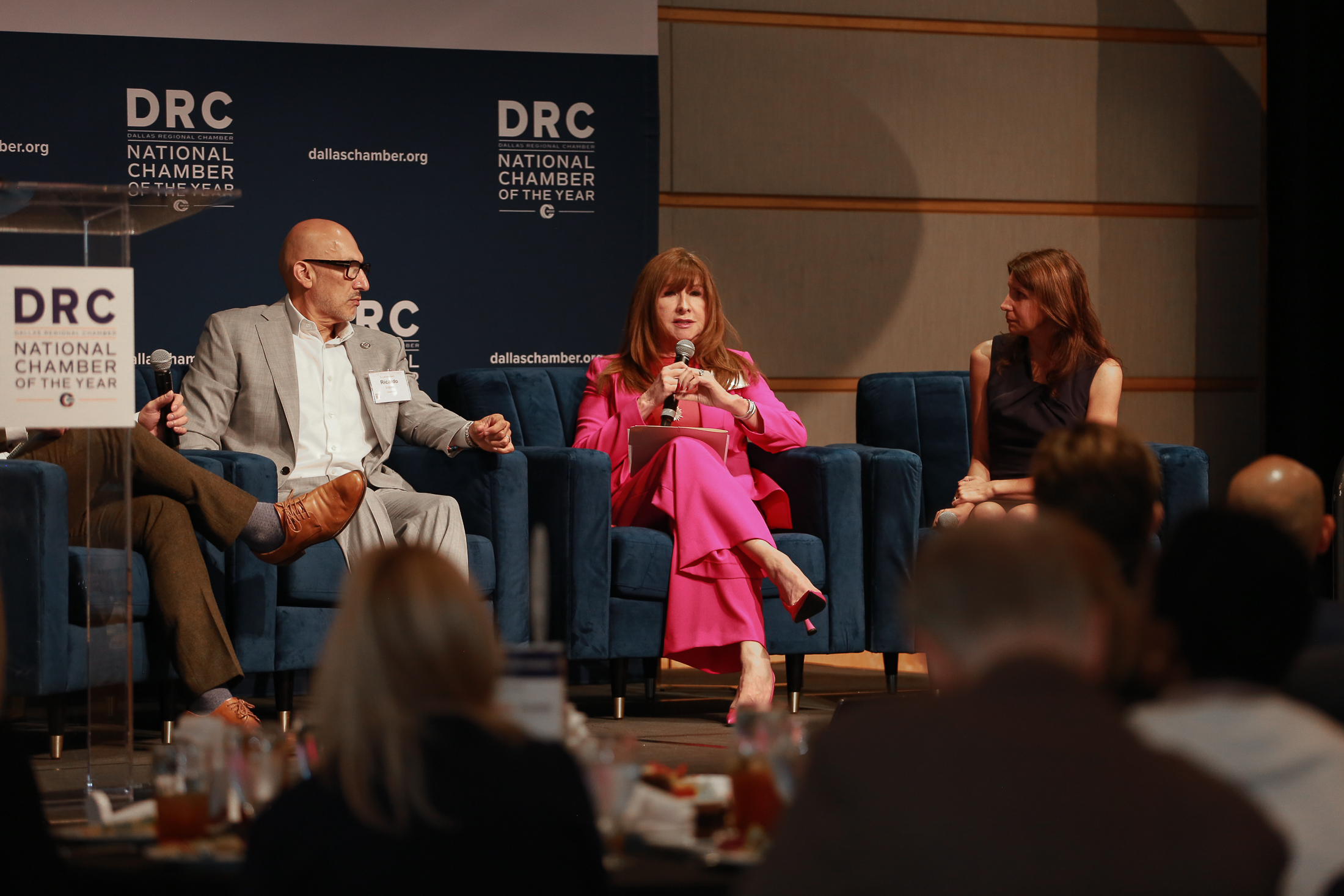
Garland ISD Superintendent Dr. Ricardo López, Dallas ISD Superintendent Dr. Stephanie Elizalde, and Uplift Education CEO Yasmin Bhatia in conversation.

Excellence in action: A superintendent panel

The afternoon panel, moderated by Matt Goodman of The Lab Report, showcased how three school systems are translating policy into practice.

Dr. Stephanie Elizalde, Superintendent of Dallas ISD, described how her district’s approach began with principals before extending to teachers and now high school counselors.

“The idea is to recruit, retain, and reward the best and brightest because our kids deserve the best and brightest,” Elizalde said. The district’s strategic staffing ensures students who need the most effective teachers receive them intentionally.

The impact is dramatic: Dallas ISD’s annual new teacher hires have dropped from 2,000-2,500 to just 800 out of 10,000 teachers, a testament to improved retention.

This improved teacher retention has far reaching effects in the classroom. “Every kid isn’t getting a first-year teacher, especially in the areas where they need teachers who have more experience,” Elizalde noted.

Yasmin Bhatia, CEO of Uplift Education, emphasized the importance of pairing accountability with support. Her charter network partners with families from graduation through college enrollment and beyond, with an alumni support team ensuring students reach living-wage attainment.

“We need to put our dollars in making sure that we can walk side by side with families as partners,” Bhatia said.

Dr. Ricardo López, Superintendent of Garland ISD, highlighted how data-driven collaboration transforms teaching precision.

Morath covered both challenges and opportunities facing public schools.

“These three school systems operate on data. They look at children’s progress constantly. They rank teachers against each other because you may be good in one area, and another one may not be so good,” López explained, describing how teachers now collaborate and tutor students across classrooms based on specific strengths.

Building North Texas’s future

The event also included a recommitment to The Commit Partnership’s ambitious goals: by 2030, at least 60% of Texans will have a postsecondary degree or credential of value, and by 2040, at least half of young adults will earn a living wage.

As Petroskey emphasized in his opening remarks, this isn’t just about education policy. It’s about ensuring North Texas remains competitive in attracting businesses and talent. With business leaders, educators, and policymakers aligned on this mission, the region is positioned to turn that vision into reality.

The Dallas Regional Chamber’s Education, Talent & Workforce initiatives drive regional competitiveness by ensuring businesses have access to the skilled workforce they need to thrive. Learn more about our Education, Talent & Workforce efforts or contact education@dallaschamber.org to share your thoughts on the region’s educational progress.

In this exclusive interview, Improving CEO Curtis Hite shares how his background, entrepreneurial mindset, and commitment to team engagement have shaped the company’s strategy and culture.

Curtis Hite’s leadership is defined by a commitment to excellence, team engagement, and innovation. His vision for Improving is bold: shared ownership, challenger brand status, and lasting impact. As the company moves forward, these values will continue to shape its journey.

Read on for candid answers to six key questions about leadership, innovation, and the future of Improving.

Improving’s CEO Curtis Hite

How has your unique background and experience shaped Improving’s strategic direction?

My background, especially my experience in the Texas A&M Corps during college, taught me more than the classroom ever could. It instilled discipline, teamwork, and the importance of excellence in both big and small things. Our company values, dedication and excellence, are rooted in those early lessons. Later, my first business experience showed me the importance of collective engagement. Seeing a few partners take disproportionate equity made me realize that success is a team effort. That’s why Improving shares ownership widely, allowing many to be equity holders. This philosophy is unique and has contributed to our long-term success.

What does the Entrepreneur of the Year recognition mean to you personally and for Improving?

For Improving, it’s the culmination of nearly 20 years of teamwork. The recognition validates the efforts of everyone who has been a part of the journey. Personally, it means a lot because it feels like a true entrepreneur is being recognized. Not just a “hired gun” but someone who helped build the company from scratch.

What entrepreneurial qualities or decisions do you believe led to your recognition?

Sharing equity was a pivotal decision that rallied our team for years. Drive and risk-taking are essential entrepreneurial traits. Ric DeAnda, one of Improving’s co-founders, and I went without salaries for over a year. Few leaders are willing to do that. People often question why entrepreneurs are rewarded, but it’s about the risks and drive they bring. Our team has an abundance of both.

How has your entrepreneurial mindset influenced Improving’s culture and approach to innovation?

We strive to be a challenger brand, which means doing things differently. That mindset drives not just technology, but innovation in our processes and how we share knowledge. Initiatives like encouraging public presentations, producing our innovative event, CodeLaunch, and our Engage system, which is our internal platform that logs employee development and engagement, are examples of our innovative approach. We are always seeking new ways to add value.

What advantages do you see in leading Improving’s operations from the Dallas Region, and how have you maximized those benefits?

Dallas is a thriving community with a healthy economic environment. It’s easier to lead an organization here because of the balance between worker-friendly and business-friendly laws. During downturns, Dallas recovers faster, giving us a competitive advantage over companies in weaker markets.

As you look toward the future, what goals are you most excited to accomplish with Improving?

I want every person at Improving to become a shareholder, fully living in our vision of shared success. The second goal is to become a true challenger brand in the digital services industry. Most companies grow and sell, but we aim to create a lasting entity that challenges the biggest brands. Reaching a billion dollars in revenue and making a lasting impact in our industry is incredibly exciting.

By Catie George, Director, Communications & Storytelling

Average reading time: 4.5 minutes

The Dallas Regional Chamber brought together business leaders, economic development experts, and capital markets executives for the Tomorrow Summit, presented by Hillwood, a Perot Company, and PNC Bank, at HALL Park Hotel on Tuesday, Sept. 9, diving deep into the forces shaping the future of work, talent, and economic growth in Dallas-Fort Worth (DFW).

From population gains and corporate relocations to AI’s influence on the workforce and the rise of new capital markets, the discussions underscored one message: DFW’s growth story is only getting started.

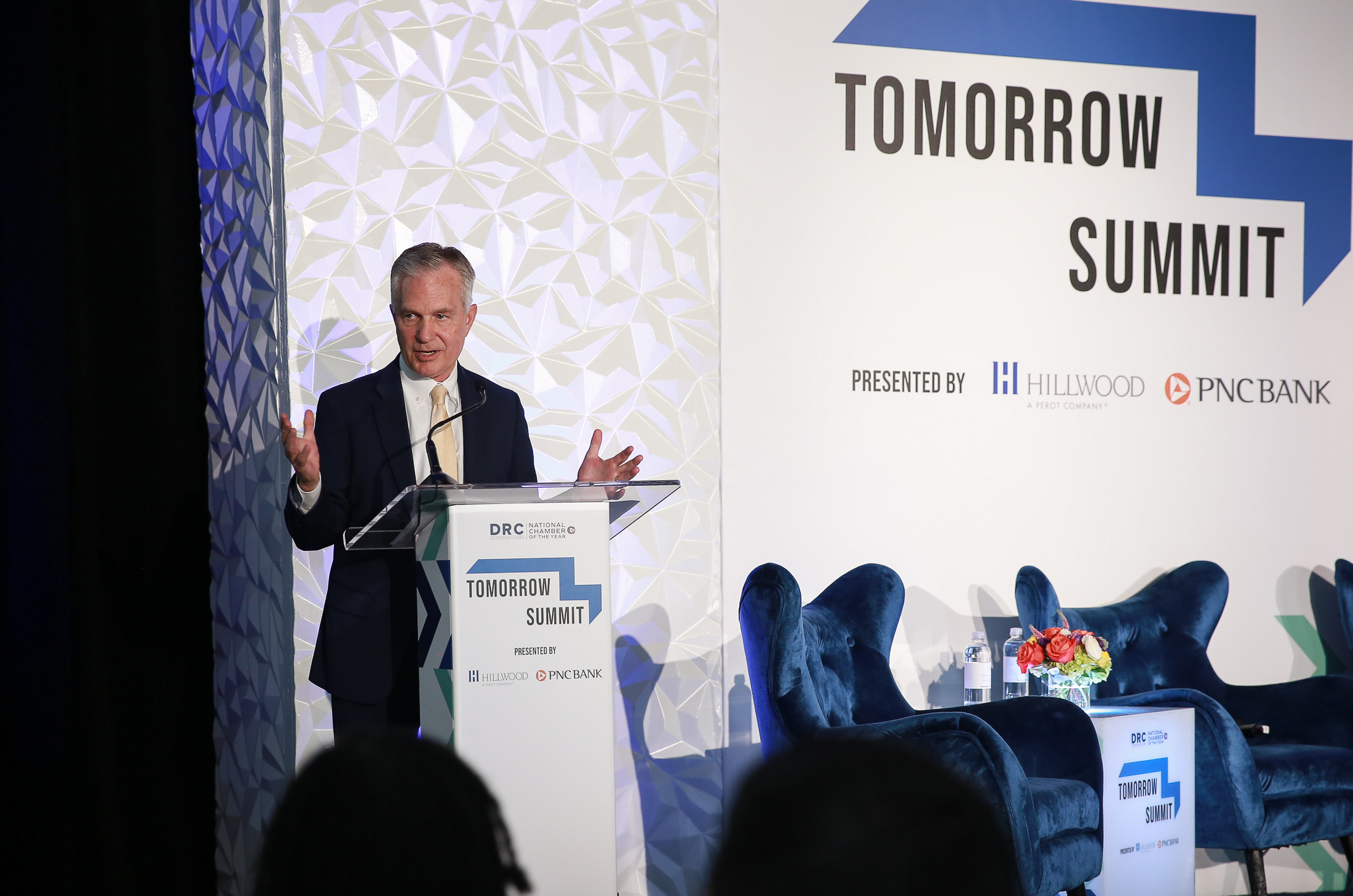
DRC President & CEO Dale Petroskey on the importance of the first-annual Tomorrow Summit.

A global powerhouse still on the rise

“The Dallas Region has become a global powerhouse with seemingly endless possibilities,” said DRC President & CEO Dale Petroskey to open the event.

The region’s remarkable growth story is supported by compelling data.

“We count 460 notable corporate announcements in DFW since 2020,” said DRC Senior Vice President of Economic Development Mike Rosa. “In just five years, the region has welcomed 160 headquarters relocations—59 from California, 69 from 24 other states, and 32 international companies from 19 countries.

DFW has added 700,000 people since 2020, more than any other metro area, and now stands as the fourth-largest metro in the United States with 8.3 million residents.

A labor market redefining opportunity

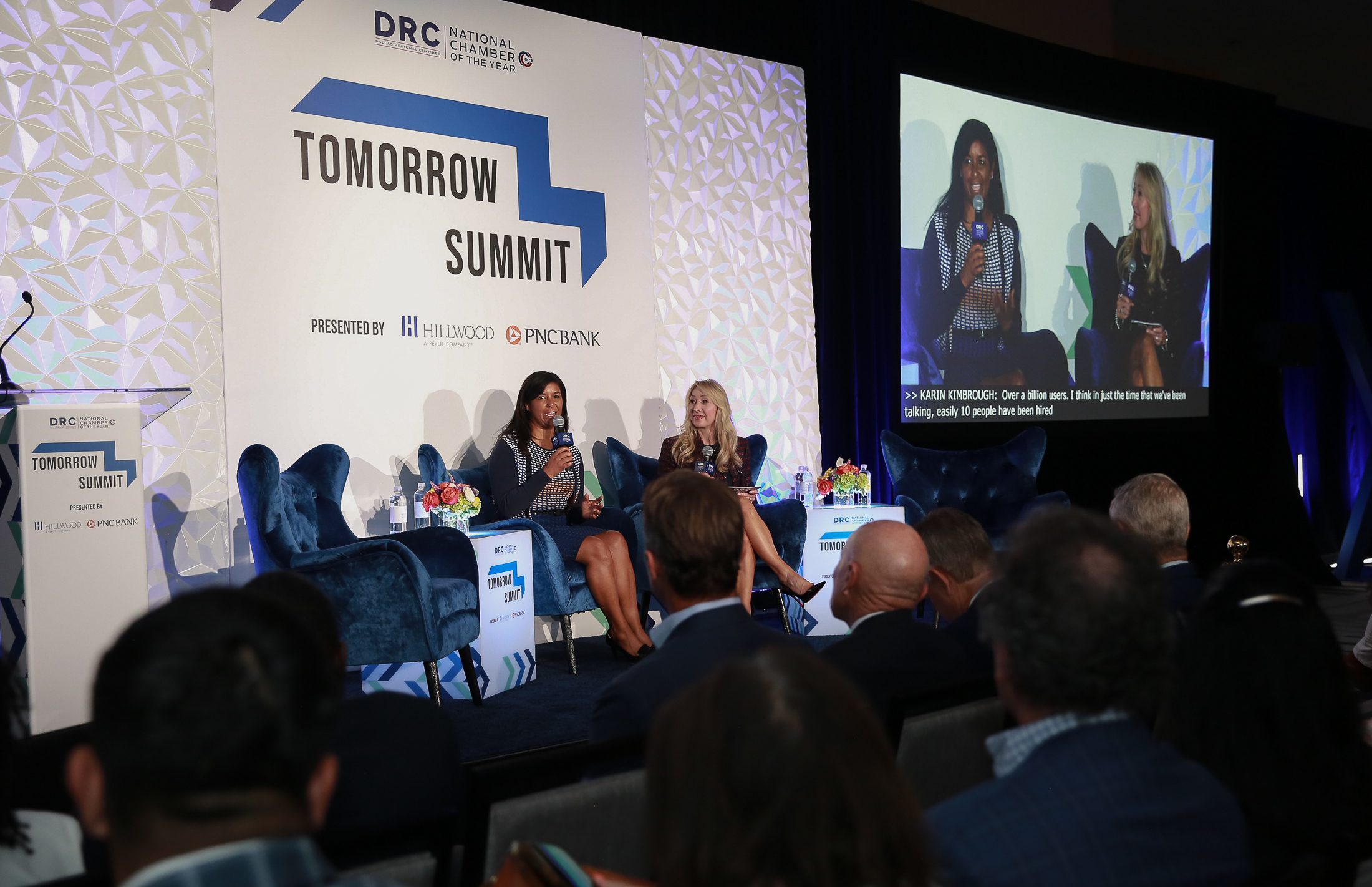
“There’s been a 20% increase in the number of applicants for every open job, which means that people are job seeking with more intensity than ever before,” Dr. Karin Kimbrough, Chief Economist at LinkedIn, explained. “It’s a complete 180 from what we saw in 2021 or 2022.”

While national hiring has slowed approximately 5% compared to last year, DFW continues to buck the trend.

“If I look at Dallas, hiring is still growing, it’s still expanding,” Kimbrough said. “This is one of the most dynamic labor markets that we see with companies relocating here, people moving here, getting jobs.”

However, young workers face heightened challenges.

Karen Kimbrough in conversation with Nichole Jordan.

“Confidence is down for the worker in terms of their confidence about getting a job and keeping a job,” she said. “We also see that it’s particularly down for younger Gen Z applicants.”

The takeaway: DFW’s momentum is strong, but the evolving labor market demands continued investment in workforce confidence, skills, and career pathways.

AI is transforming work – but human skills still win

LinkedIn data shows a sixfold increase in job postings seeking AI literacy across roles from marketing specialists to product managers to strategy heads. Kimbrough emphasized that AI will eventually affect 80-90% of all jobs, but human skills remain paramount.

“What’s going to set you apart is going to be your ability to bring your human skills,” Kimbrough stressed. “You need a little bit of abstract problem-solving and critical thinking. It’s not going to be enough to rely on AI. So, I’m a big believer in the human future of work.”

Kimbrough also highlighted how career trajectories are fundamentally changing.

“People are holding twice as many jobs now,” she noted. “It’s not that linear [career] path [anymore], it’s much more like a net.”

The takeaway: The future of work will depend on the intersection of technology and human capability, requiring lifelong learning and adaptability.

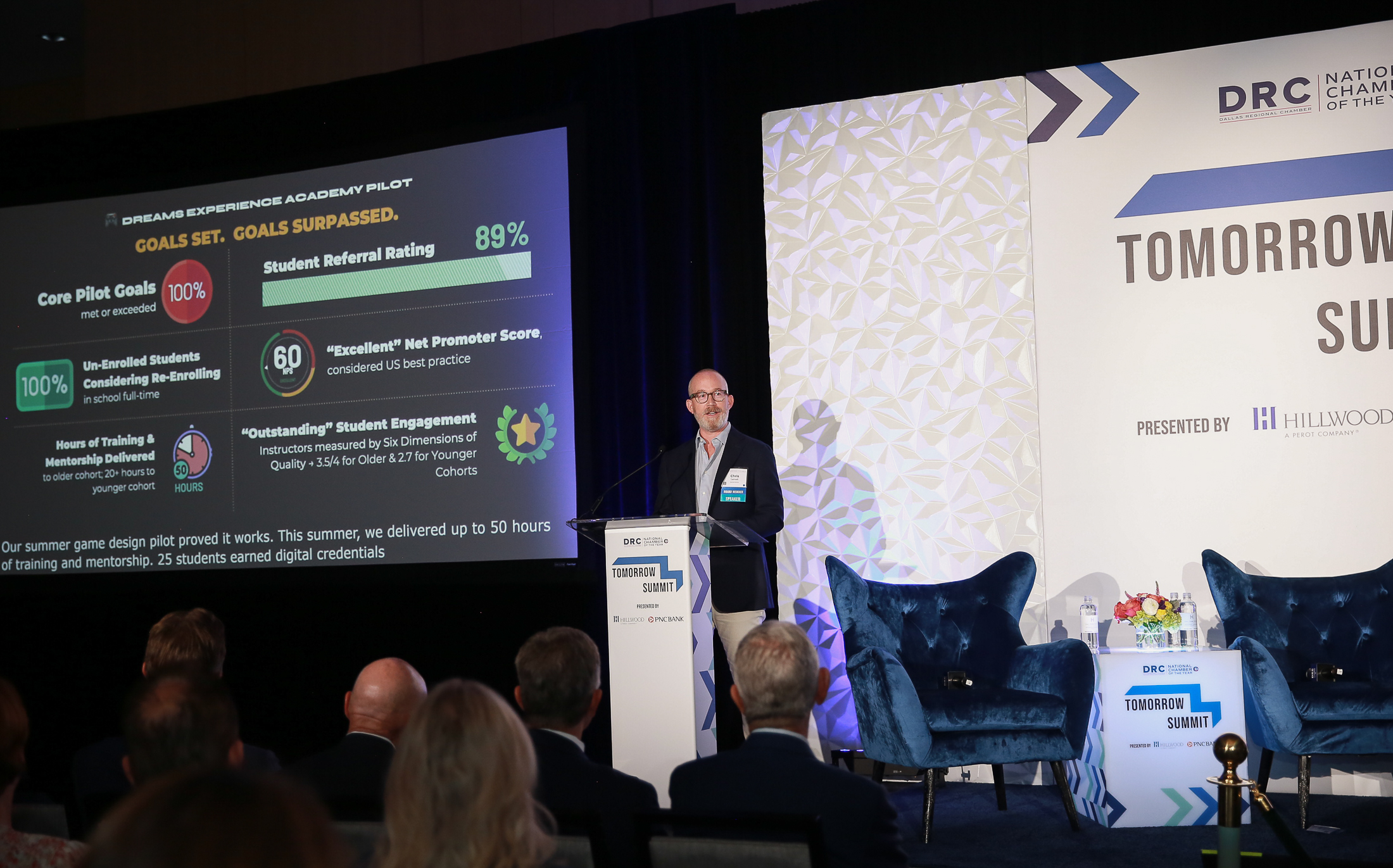
Chris Gannett on the Dreams Experience Academy.

Education and industry: the engine of prosperity

Chris Gannett, CEO of Gannett.Partners and President & Board Member of DOC Cares, reinforced the critical link between education and economic vitality.

“Today, our city thrives when education and industry come together to transform potential and opportunity,” he said. Gannett’s latest project, the Dreams Experience Academy, is a nonprofit connecting Dallas youth to the $3 trillion media, entertainment, and tech industries.

He went on to highlight DFW’s economic diversity and cultural impact. The region is home to more than 20 Fortune 500 headquarters, with expansions from companies like Goldman Sachs and Scotiabank adding thousands of new jobs. At the same time, DFW’s arts, sports, and creative industries generate $34 billion annually and support more than 200,000 jobs.

Rosa underscored the importance of educational infrastructure.

“Having nimble K-12 education, colleges, and universities to grow the talent for our companies and prepare our people for jobs of the future is imperative.”

Texas: The new capital markets frontier

For the first time ever, leaders from all three major U.S. stock exchanges shared a stage in Dallas, exploring how Texas is redefining access to capital and cementing its role in the global financial landscape.

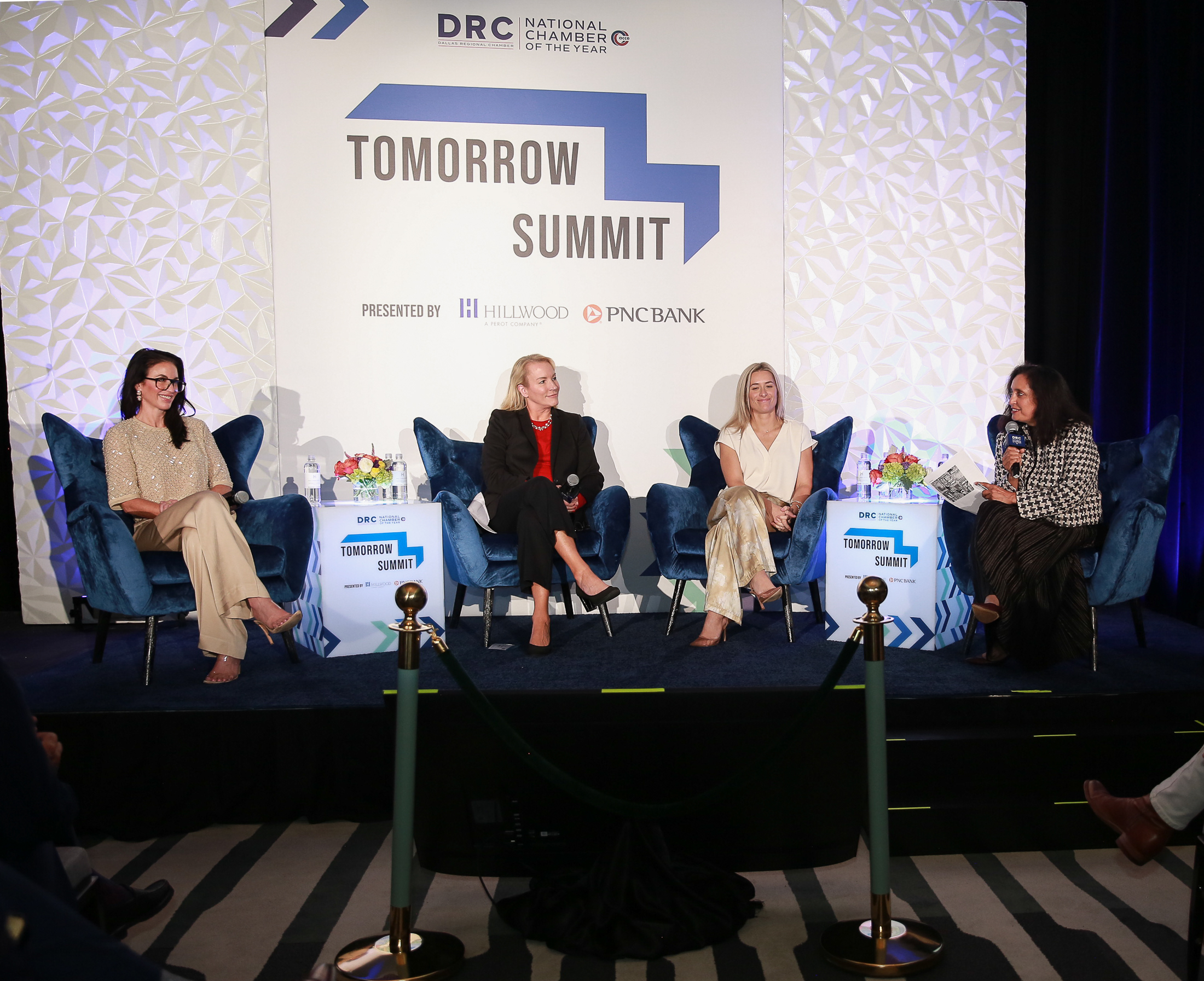
Nicole Chambers, Liz Hocker, Kate Speight, and moderator Sonal Shaw discuss the importance of capital markets for business.

Nicole Chambers, Global Managing Director of Listings at Texas Stock Exchange Group, outlined the vision for rebalancing public and private capital access.

“Going public is the cheapest way [for companies] to access capital,” Chambers explained. “We want to give companies that are in that mid-cap range, small to mid-cap, that opportunity to go public at an earlier stage.”

Kate Speight, Senior Managing Director of Listings & Capital Markets at Nasdaq, highlighted why Texas is attracting capital markets attention.

“Texas has done a great job being able to create that business-friendly opportunity and being able to maintain that business-friendly climate,” Speight said.

Liz Hocker, Regional Head of Capital Markets at the New York Stock Exchange, was direct about Dallas’s trajectory.

“[Dallas] is going to be an epicenter for the global financial markets.”

Chambers concluded by pointing to continued investment in infrastructure, housing, and emerging industries, such as life sciences and biotech, as essential to sustaining growth.

The takeaway: As Texas strengthens its position in national and global capital markets, Dallas is emerging as a hub for innovation, access, and long-term investment.

Looking ahead

The Tomorrow Summit painted a clear picture of a region at an inflection point—maintaining extraordinary momentum while adapting to technological disruption, workforce transformation, and new opportunities in global finance.

The DRC’s economic development priorities align directly with these opportunities, positioning the Dallas Region to turn today’s progress into tomorrow’s legacy.

By Morgan Scruggs, Coordinator, Leadership Programs

Average reading time: 2 minutes

To celebrate 25 years of Young Professionals (YP), presented by Fidelity Investments, the DRC is highlighting a series of alumni to learn more about their experiences in YP.

Brennan Meier, Partner at Akin Gump Strauss Hauer & Feld LLP, first became involved with Young Professionals through the LEAD YP cohort program.

Brennan Meier, Partner at Akin Gump Strauss Hauer & Feld LLP.

“I was looking for a way to push forward in my own development while also getting to know similarly motivated people in Dallas,” he said. “When I saw the great cross-industry focus for LEAD YP classes in the past, I knew it would be a great opportunity, and I applied.”

LEAD YP deepens young professionals’ understanding of their leadership style and primes them to grow into leaders who champion the Dallas Region.

After being accepted into the program, Meier began to learn about his own leadership style.

“The LEAD YP program is a rigorous process, both in and outside of class, that makes you look at where you are and how you can improve. I embraced the process and was able to see a side to leading and managing that I had not before.”

During Class Days, when the cohort meets monthly to receive leadership training and engage with their peers, Meier participated in group activities that helped him put these lessons into practice.

“[During] one class, the lead team created an obstacle course. Each other team then had to navigate a blindfolded teammate through the course while only listening to the instructions from the team,” Meier recalled. “It revealed communication styles and encouraged teamwork and reliance on others when to complete a nearly impossible task… it was a great distillation of the principles we had learned in the in-class sessions.”

The lessons Meier learned through LEAD YP have influenced his perspective.

“Before LEAD YP, I was much more of an ‘action-now’ kind of person. Now, I recognize that the process of getting to the right answer can be just as important as getting there if you want to have a bought-in team who will be willing to stay the course and achieve at a high level over the long term.”

In addition to learning valuable leadership lessons, Meier also found community within YP.

“From about the halfway point through the program, I could tell that the friendship and network being built was one that would endure for years. YP allows you to consistently see and interact with the same people and build real bonds.”

Meier recommends YP to those who want to make a difference with others.

“YP is for Dallas professionals who wake up and want to get better and make the city better. If that is you, then YP is your people, and you will meet and become friends with a diverse group that cares.”

ENGAGE WITH YOUNG PROFESSIONALS

YP YEAR-END CELEBRATION

Join us Thursday, Dec. 4, for a special evening celebrating another year of YP!

All five statewide constitutional amendments supported by the DRC-backed Good for Texans campaign—Propositions 1, 4, 6, 9, and 14—were approved by voters in the Nov. 4, 2025, election.

Each proposition passed with decisive support, all receiving at least 54% of the vote, with some reaching shares as high as 70%. The Good for Texans campaign targeted voters in Dallas, Collin, Tarrant, and Denton Counties—the four primary counties comprising the Dallas Region. Dallas Region voters represented an average of 23.4% of the statewide votes in favor of each proposition.

Together, these measures represent smart, forward-looking investments that will strengthen our workforce, safeguard resources, and enhance Texas’ long-term competitiveness—without creating or raising any taxes.

Turning policy priorities into progress

The DRC first backed the Good for Texans campaign in 2023 to help pass eight constitutional amendments that strengthened Texas’ economy and quality of life. The 2025 campaign built on that success, continuing the DRC’s strategy to champion key policy priorities through the legislative process and compel voters to bring them to fruition.

“Each proposition represents an investment in the people, places, and industries that power our economy — and all will deliver benefits for families, communities, and employers statewide,” shared DRC President & CEO Dale Petroskey in an op-ed for the Dallas Morning News ahead of the election. “They are visionary and fiscally responsible, practical and forward-looking — and every one of them is good for business, good for families, and good for Texans.”

To appear on the ballot, constitutional amendments must first be approved by a two-thirds vote of both the Texas House and Senate as a joint resolution—meaning each measure already has broad, bipartisan support before reaching voters.

Investing in people and competitiveness

Proposition 1 modernizes the Texas State Technical College System (TSTC), ensuring students train on industry-aligned tools and technology for high-demand fields like advanced manufacturing, aviation, and energy. Nearly 54% of Texas job openings are “middle-skill” positions—requiring more than a high-school diploma but less than a four-year degree—yet fewer than half of Texans currently have the training to fill them. Updating TSTC’s campuses and equipment helps close that gap and strengthens the talent pipeline that fuels business growth.

Proposition 4 creates a long-term, dedicated funding stream for water infrastructure projects, drawn from existing sales-tax revenue. Texas is projected to need $150 billion in water investments over the next 50 years to repair aging systems and meet rising demand. The amendment represents an important step toward safeguarding one of the state’s most critical resources for families, communities, and industry.

Proposition 6 ensures Texas remains a stable, low-tax environment by prohibiting future financial-transaction taxes on securities trades. Millions of Texans rely on 401(k)s, IRAs, and other investments to build financial security. As the Texas Stock Exchange prepares to open in Dallas, the amendment provides certainty for investors while reinforcing the state’s pro-business reputation.

Proposition 9 raises the exemption on business personal property taxes, providing meaningful relief for small and mid-sized employers that make up 99.8% of all Texas businesses. The change reduces administrative burdens and allows entrepreneurs to reinvest in growth, hiring, and local job creation—benefiting Main Street economies across the state.

Proposition 14 establishes the Dementia Prevention and Research Institute of Texas to accelerate innovation, attract top scientists, and advance new treatments for dementia and related brain disorders. More than 400,000 Texans are living with dementia, a number expected to exceed 500,000 by 2030. The measure positions Texas as a national leader in brain health research while strengthening the state’s medical innovation economy.

The DRC’s support of these measures reflects its ongoing commitment to advancing policies that secure Texas’ economic future. With the passage of all five propositions, voters reaffirmed their confidence in a vision of growth rooted in innovation, opportunity, and fiscal responsibility.

Learn more about the Good for Texans campaign at 2025TexasPropositions.com

By Catie George, Director, Communications & Storytelling

Average reading time: 4.5 minutes

On Thursday, Oct. 23, hundreds of women leaders, entrepreneurs, and changemakers gathered at Gilley’s Dallas for the Dallas Regional Chamber’s 27th Women’s Business Conference (WBC), presented by JPMorganChase and Baylor Scott & White Health. Under the rallying theme of “Be Bold,” attendees explored what it truly means to lead with courage and create opportunities for the next generation of women in business.

“When we think about being bold, we have to think about courage,” said DRC Senior Vice President of Opportunity & Impact and WBC’s emcee Latosha Herron Bruff. “Even within that framework, boldness can look different in many things. Today, we want each of you to discover what boldness means to you and spark ideas and inspiration about what your next bold move will be.”

Focus on your audience, not your critics

In the first keynote of the day, New York Times bestselling author Alex Snodgrass captivated the audience with her journey from a one-woman operation to building a thriving business empire, offering practical wisdom for women at every stage of their career.

Alex Snodgrass in conversation with Amber Williams.

The founder of Defined Dish and SideDish emphasized the importance of staying focused on your audience rather than worrying about critics in your inner circle.

“The thing about taking that leap of faith and starting your own business is to not think about your inner circle and what they think, but really think about who I am trying to reach, who I am trying to share this with, and who I am trying to communicate to,” Snodgrass shared.

As Snodgrass’ success grew, so did the challenge of discernment. Snodgrass encouraged women to trust their instincts when evaluating opportunities.

“Does it feel authentic for me to talk about? Is it adding value to my community? Is it keeping their trust in me?” she asked. “I think women have a superpower of having this gut instinct that we can either listen to or ignore.”

Her advice for women pursuing bold careers was clear: be willing to make mistakes, shift gears when needed, and remember to prioritize self-care.

“Remembering to prioritize yourself, take care of yourself, and take mental health breaks amongst all the hustle is, I think, the most important thing for us humans to always remember.”

In addition to Snodgrass’ journey through entrepreneurship, women-owned businesses shined in the Frost Marketplace. The largest-ever WBC marketplace invited attendees to discover and shop with nearly 30 vendors.

Leading with purpose and integrity

Laysha Ward in conversation with Roslyn Dawson.

Keynote speaker Laysha Ward, acclaimed author of “Lead Like You Mean It,” challenged attendees to think deeply about their personal purpose and how it aligns with their professional lives.

“Leading with meaning is about operating with integrity, with intention, and with humanity,” Ward explained. “It’s really being focused on your personal purpose, like your why, your reason for being. What do you feel called to do at work and in the world?”

Ward encouraged women to be declarative about their personal purposes to create purpose congruence with the organizations where they spend their time.

“Your personal purpose really becomes a lantern that guides your way, but it’s also a measuring stick that helps you stay accountable to making progress,” she said.

Importantly, Ward reminded attendees that boldness looks different for everyone.

“You have to define what bold looks like for you. We’re all at different starting points, so don’t let folks judge what they think is bold versus what you think is bold.”

Building confidence through action

In complement to the insights from Snodgrass and Ward, Herron Bruff shared data-driven insights into the experience of women in leadership from CMP’s 2025 Women’s Leadership Pulse Check Report.

CMP’s data shows nearly one in four women still frequently experience imposter syndrome, but fewer women today say they experience it occasionally, and more report they rarely or never feel it.

“Confidence isn’t something you’re just born with. It’s not a personality trait. It’s a practice,” Herron Bruff explained. “It’s the act of showing up, even when you’re unsure. Bold doesn’t mean never feeling doubt…it means moving forward despite it.”

Emcee and DRC Senior Vice President of Opportunity & Impact Latosha Herron Bruff welcomed attendees from the WBC stage.

The data revealed another important truth: 62% of women said their self-perception at work is tied equally to their own performance and how others perceive them. This tension between internal confidence and external validation is something many women recognize, even as they advance. Nearly three in four women identified showing confidence and owning their success as the biggest drivers of career advancement.

“Boldness begins when we stop waiting for validation and start defining success in our own terms,” Herron Bruff said, emphasizing that bold advocacy isn’t arrogance. It’s leadership.

To encourage knowledge sharing, WBC also hosted AI Office Hours, powered by Improving, and Table Talks, powered by CMP. These experiences encouraged attendees to learn about a variety of topics, including AI, self-advocacy, career planning, and more. Nearly 300 attendees attended a total of 12 sessions between AI Office Hours and Table Talks.

The ATHENA® legacy continues

The conference also celebrated the DRC’s longstanding commitment to recognizing women’s leadership. The YPL ATHENA® Award, sponsored by KPMG, and the ATHENA® Award, sponsored by Wells Fargo, recognized women who excel in their careers, contribute to their communities, and develop women leaders.

Erika Leigh Nobles, Lease Administration Manager at Colliers International and YPL ATHENA® Award recipient, shared her framework for purposeful decision-making: gathering information, approaching with humility, seeing things from different perspectives, and then planning.

“It is important to know that nothing happens by chance, but rather there is a purpose for all of us,” she said.

Caren Lock, Managing Director and Government Relations Officer at TIAA and ATHENA® Award recipient, emphasized that boldness extends beyond individual action.

Attendees shopping in the Frost Marketplace.

“Being bold isn’t about just taking risks. It’s about having the courage to challenge convention. To ask ‘why not’ instead of ‘why’,” Lock said. “Boldness is rarely a solo act because it’s built on collaboration, trust, and the willingness to lift others up.”

Looking ahead

As the conference concluded, one message resonated clearly: the work of building bold, confident, and purpose-driven women leaders continues.

“Leadership isn’t just about climbing higher. It’s about strengthening the ladder and holding it steady for others,” said Herron Bruff. “The next generation should not have to rebuild the same rungs we’ve all climbed. We should all be lifting as we climb.”

With women leading with courage and confidence more than ever before, the future of business in the Dallas Region—and beyond—is undeniably bold.

THANK YOU TO OUR SPONSORS

PRESENTING SPONSORS


ATHENA® AWARD SPONSOR

YPL ATHENA® AWARD SPONSOR

MARKETPLACE PRESENTED BY

AI OFFICE HOURS SPONSOR

TABLE TALKS SPONSOR

LOUNGE SPONSOR

BREAKFAST SPONSOR

SPEAKER SPONSOR

Don and Carol Glendenning

GOLD SPONSORS

SILVER SPONSORS

American National Bank of Texas |  Axxess  |  Carrington, Coleman, Sloman & Blumenthal, L.L.P.
DHD Films  |  Hillwood, a Perot Company

FLORAL

As of Oct. 7, 2025

By Catie George, Director, Communications & Storytelling

Average reading time: 4 minutes

This Wednesday, Oct. 29, business and community leaders once again stepped into Dallas ISD classrooms for Principal for a Day (PFAD), presented by Capital One. But this year was especially meaningful as it marked 15 years since Capital One became the presenting sponsor of this transformative program, and their commitment to Dallas students has grown into something far beyond a single day of engagement.

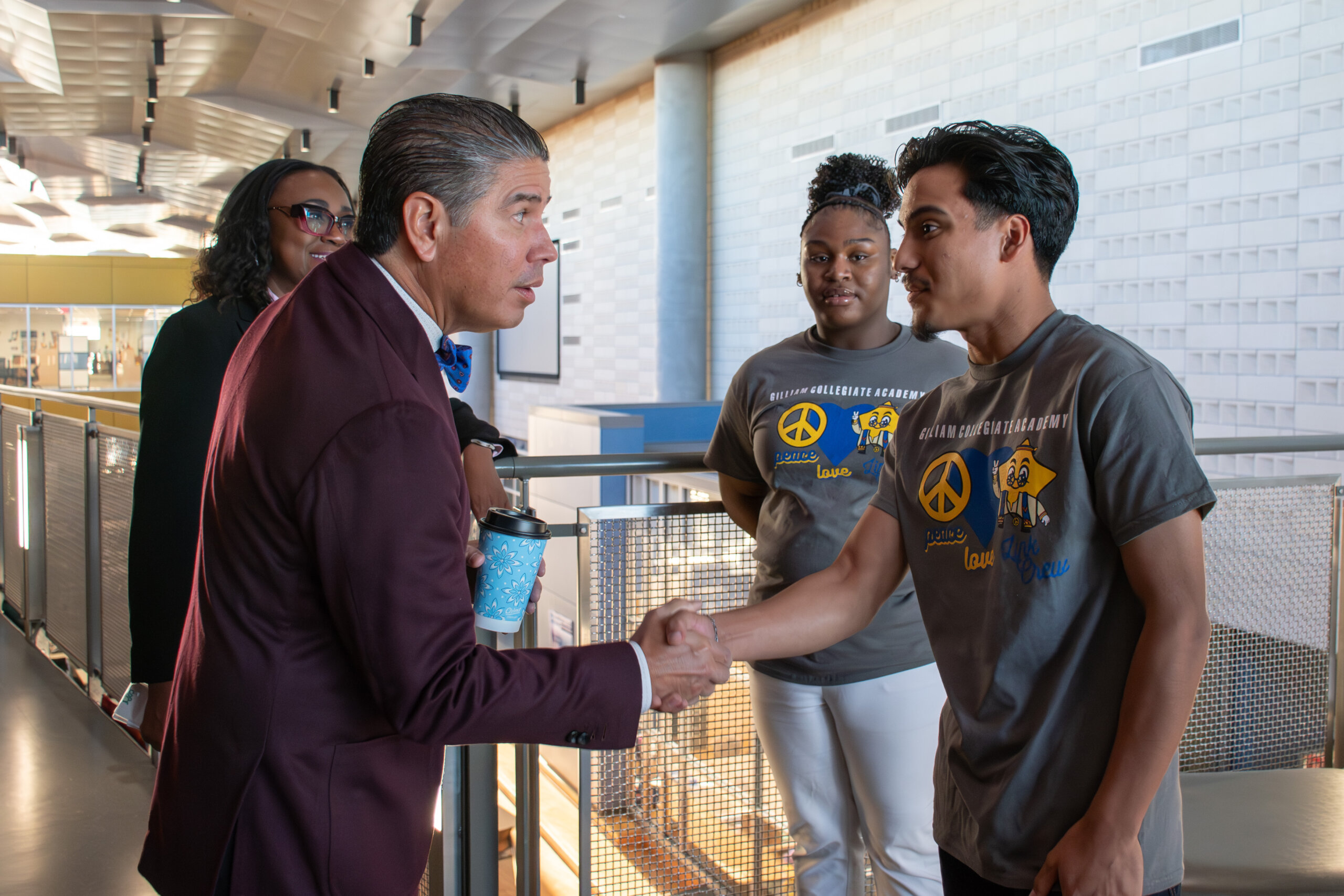
Jorge Calderon meeting students at Kathlyn Joy Gilliam Collegiate Academy during 2023’s PFAD.

From classroom visits to lasting change

When Capital One first became the presenting sponsor of PFAD in 2010, they could have simply participated alongside other corporate partners. Instead, they saw an opportunity to truly understand what Dallas ISD students needed to succeed, and then they acted on it.

“As a partner of 15 years running, we continue to embrace the opportunity to better understand what makes a quality education and do what we can to ensure Dallas students thrive now and into the future,” said Jorge Calderon, Dallas Market President at Capital One.

What began with observing classes and shadowing principals has evolved into a comprehensive partnership that touches nearly every aspect of student success: from financial literacy courses and P-TECH programs to paid internships and workforce development initiatives.

Addressing a critical gap: financial literacy

Through their consistent presence at schools like North Dallas High School, Capital One identified a pressing need that students themselves were reporting: the lack of practical financial knowledge. Many students were completing 13 years of education without understanding how to pay for college, manage employment benefits, or make informed decisions about their financial futures.

That insight led to action. Capital One’s support helped Dallas ISD implement Personal Financial Literacy courses across the district, equipping students with essential skills for life after graduation.

The impact has been profound. LeRoy McNac, a financial literacy teacher at Pinkston High School, shared that his students are now applying what they’ve learned when completing the FAFSA and making more informed decisions about student loans.

One former Dallas ISD student’s story illustrates the lasting power of this education.

“I always wanted to go to TWU to get a degree in dental, but financially, it just wasn’t possible. So, I made the decision to attend community college while working a full-time job… One thing that really helped me navigate all of this was taking a financial class in high school. I didn’t realize it at the time, but it gave me practical knowledge that I’ve actually used in real life… That class didn’t just give me book knowledge; it gave me tools.”

That student went on to join the Army, using military benefits to continue their education, a decision informed by the financial literacy skills gained in high school.

Building tomorrow’s workforce today

Capital One’s partnership with Dallas ISD extends well beyond financial literacy. As a proud P-TECH partner at Moisés E. Molina High School and North Dallas High School, Capital One helps students earn postsecondary credit in business administration and information technology at no cost. They’ve also hosted P-TECH Summits, connecting more than 160 Dallas ISD students with critical job readiness skills and information about careers in technology.

Through the NAF Future Ready Labs program, Capital One has provided hundreds of Dallas ISD students with paid internships since 2017. These aren’t just resume builders but real-world experiences where students tackle meaningful projects for local, small businesses, connect with mentors from Capital One, and develop essential professional skills like design thinking, project management, and personal branding.

“Providing our leaders of tomorrow with the skills, tools, and resources they need for the future has never been more crucial,” said Sanjiv Yajnik, President, Financial Services of Capital One and NAF Board Treasurer. “Through our NAF partnership, we prepare students for college and fulfilling careers. Our associates also give back in a rewarding way, mentoring young minds, telling them no challenge is too big to overcome.”

Students like Sebastian Delgado from Skyline High School and Perla Arredondo from Thomas Jefferson High School have gained invaluable experience through these internships, having developed skills in teamwork, collaboration, time management, and communication that will serve them throughout their careers.

A model for meaningful corporate engagement

Capital One’s approach demonstrates what’s possible when a corporation moves beyond transactional engagement to true partnership. By consistently showing up year-round, they’ve been able to identify genuine student needs and develop innovative solutions that benefit both the students and their own workforce pipeline.

Calderon with Amazon’s Vickie Yakunin at Career Institute North during 2025’s PFAD.

“PFAD is only the beginning for many participants,” Calderon explained. “Capital One has been able to establish a long-term relationship with Dallas ISD through PFAD and ongoing volunteerism. Through this relationship, we’ve discovered innovative strategies to support Dallas ISD while addressing our own priorities, such as strengthening our workforce pipeline through internships and work-based learning initiatives.”

The collaboration has also enriched Dallas ISD’s curriculum more broadly. Through partnerships with organizations like the Dallas Federal Reserve Bank and Next Gen Personal Finance facilitated through these corporate connections, Dallas ISD has been able to host professional development sessions for teachers and integrate high-quality, student-friendly resources into their financial literacy instruction.

This year’s Principal for a Day

This year’s PFAD on Wednesday, Oct. 29, offered participants the same opportunity that sparked Capital One’s transformative partnership 15 years ago: the chance to truly understand Dallas ISD’s strengths and challenges, meet the dedicated educators and inspiring students who make up Dallas’ schools, and discover how an organization can make a lasting impact.

For 25 years, PFAD has connected thousands of business executives, elected officials, and community leaders with Dallas ISD schools, and many, like Capital One, have turned that single day into years of meaningful collaboration.

Fujitsu Intelligence is Fujitsu’s innovation hub for Data and AI in the Americas. They focus on building practical, high-impact AI solutions that help organizations move from experimentation to execution. Their work centers on Agentic AI, systems that can reason, coordinate, and act autonomously across complex workflows, creating faster, smarter, and more human-centered digital experiences. As part of Fujitsu’s global network, they connect world-class R&D with real business outcomes.

1. How does Fujitsu Intelligence help its clients build value?

We help clients turn AI from a buzzword into measurable advantages. Our approach is hands-on: understanding the challenge, identifying where data and AI can make a difference, and deploying solutions that deliver clear impact. Whether it’s through predictive analytics, automation, or Agentic AI orchestration, our team brings deep technical expertise and a practical lens that helps organizations work smarter, serve customers better, and build long-term value.

2. What differentiates Fujitsu Intelligence within your industry?

It’s our combination of scale and agility. We have the reach and trust of Fujitsu, but we operate with the speed and innovation of a start-up. Our people are builders, AI engineers, data scientists, and domain experts who deliver real solutions, not just pilots. We’re leading the way in Agentic AI, designing systems that can manage complex decisions, connect across enterprise data, and amplify human capability. That mix of deep tech, speed, and integrity sets us apart.

3. What benefits does Fujitsu Intelligence enjoy by doing business in the Dallas Region?

Dallas is the perfect home base for what we do. It’s one of North America’s strongest regions for supply chain, manufacturing, and enterprise operations, industries where Agentic AI can have the biggest impact. The city’s innovation ecosystem, talent pool, and collaborative business culture create a strong foundation for partnerships. From our Dallas office, we’re leading Fujitsu’s Data and AI strategy across the Americas, delivering solutions that blend human expertise with intelligent automation.

4. Why did Fujitsu Intelligence become a DRC member?

We joined the DRC to connect, collaborate, and contribute. Dallas has a fast-growing innovation community, and we want to help shape its AI future. We’re offering DRC members exclusive access to our AI expertise, Bootcamps, and Workshops, hands-on sessions where teams can explore how technologies like Agentic AI can solve real business problems. Our next AI Workshop is on Tuesday, Nov. 11, and we’d love DRC members to join us and share ideas on how to move business forward responsibly and at speed.

5. How has Fujitsu Intelligence changed in the past five years?

We’ve evolved from an optimization-focused group into a full Data and AI business, helping customers deploy intelligent systems that act, learn, and adapt. Over the past few years, we’ve leaned heavily into Agentic AI, building orchestrated, goal-driven agents that connect data, people, and processes in new ways. It’s a major step toward our vision of practical AI that doesn’t just analyze but acts with purpose at scale.

By Morgan Scruggs, Coordinator, Leadership Programs

Average reading time: 2 minutes

To celebrate 25 years of Young Professionals (YP), presented by Fidelity Investments, the Dallas Regional Chamber is highlighting a series of alumni to learn more about their experiences in YP.

Casey Sharp, Director of Enterprise National Accounts at Blue Cross and Blue Shield of Texas.

Casey Sharp, Director of Enterprise National Accounts at Blue Cross and Blue Shield of Texas, discovered YP while looking for opportunities to build new connections.

“I first heard about the DRC YP program through my employer, Blue Cross Blue Shield of Texas, when I was looking for a way to get more involved in my community while expanding my professional network. I am extremely lucky to work for an organization that encourages and promotes community involvement.”

Once she joined YP and the LEAD YP cohort program, Sharp realized how to integrate her own leadership talents into her professional roles.

“The YP program and LEAD YP helped me gain confidence and understanding of how to best use my natural strengths,” Sharp said. “This helped me learn how to lean into my unique personal leadership style as a Connector/Promoter, develop those personal strengths, and make them my superpower.”

Later, Sharp joined the YP Advisory Council to help oversee programming for YP and LEAD YP.

“Being involved with the YP Advisory Council allowed me to learn how to quickly identify and collaborate in a group with diverse leadership styles. When I was an emerging leader, this helped me learn the importance of flexibility, and it allowed me to put into practice several of the skills I learned from LEAD YP.”

One of Sharp’s most memorable experiences in YP was when she heard Dale Petroskey, President & CEO of the DRC, talk about lessons in leadership.

“In one of Dale’s speaking engagements with YP, he spoke to the importance of relationships and always taking notes on the details. This advice from Dale allowed me to remember those details and use those details to help me connect with people to build authentic relationships in the future.”

Sharp’s YP experience shaped her professional and leadership trajectories.

“Since joining the YP program in 2019, I have moved from an individual contributor role in my organization to a people leader, and I have continued to develop my skills to be tapped into now leading statewide projects for my organization. This progression with YP built the experience and skills I needed to become part of the Leadership Dallas Class of 2025.”

Sharp recommends YP to anyone looking for networking opportunities and leadership development through the DRC.

“The DRC understands how to use YP to attract top talent from across North Texas. Joining YP will allow you to meet with and learn from the rising young professionals in the region while building a robust and talented professional network. Fun fact, I hired one of my current team members after meeting them at a YP event!”

ENGAGE WITH YOUNG PROFESSIONALS

YP YEAR-END CELEBRATION

Join us Thursday, Dec. 4, for a special evening celebrating another year of YP!

By Amber Dyer, Coordinator, Communications & Marketing

Average reading time: 3.5 minutes

Accenture’s Tracy Ring presenting at Convergence AI earlier this year.

At the Dallas Regional Chamber’s Convergence AI Dallas conference, presented by Accenture and Google, Accenture’s Tracy Ring emphasized that successful generative AI integration depends on more than just technological capability; it requires organizational trust.

“We have research telling us that 77% of executives believe that unlocking the true benefits of AI are only possible when it’s built on a foundation of trust,” said Ring, who serves as Accenture’s Chief Data Officer and Global Generative AI Lead for Life Sciences.

This trust must evolve alongside the technology itself, requiring companies to approach AI integration with strategic transparency.

“Sharing your AI strategy, making it part of the board discussions, making it part of all your people discussions,” said Ring. “Embracing it wholly and truly across [the organization is essential]… Engendering trust is really one of the most critical success factors of driving adoption and change management.”

Ring outlined four key trends organizations should consider when developing their AI strategy:

1. Binary Big Bang: Transformative agentic systems

The Binary Big Bang is a transformative shift in AI where agentic systems redefine software development conventions.

“It’s this idea that the ways that we approach every technological implementation, whether it’s the way we gather requirements [or] the way we implement it, we have to think about what ways that these autonomous agents can help us at each stage,” said Ring. “But as we think about the limits of programming and the way that we implement all of these, we see these multiplying digital outputs vastly accelerating implementation timelines.” Organizations are deploying agentic systems to streamline processes, enhance decision-making, and foster innovation across various departments.

RobotLAB’s robot from Convergence AI.

2. Face of the future: Personalized customer engagement

AI enables personalized customer experiences by analyzing individual preferences and behaviors to tailor interactions and recommendations.

“We think about AI having a personality. So, this personified AI can breathe life into these experiences [and] unlock customer relationships,” said Ring. “And for those of us that have B2C businesses, there’s just an incredible opportunity to engender trust and continue to grow that relationship.”

3. Large Language Models (LLMs) getting ‘bodies’: AI-powered robotics

LLMs are being integrated into robotics to enhance their functionality, enabling them to perform complex tasks with greater autonomy and decision-making capabilities.

“Robotics has always employed AI with this idea that when you move into the physical realm, [it’s] an opportunity for organizations to do something quite dramatic across the board in aspects of digital manufacturing, how we interact with customers, etc.,” said Ring.

These ‘bodies’ can revolutionize industries such as health care, manufacturing, and logistics by automating processes, improving efficiency, and reducing the need for human intervention in repetitive tasks.

4. Learning loop: Continuous AI improvement

This continuous improvement cycle uses AI feedback to drive ongoing development, with regular model updates based on real-time data and user interactions to meet evolving business needs.

“[It’s] similar to how large language models work, where everything we do is fed back in – the ideas that our people can continue to learn, grow, and lead is the most valuable reinvention we have,” said Ring.

Organizations that embrace these trends in their AI strategy can foster employee trust and drive effective AI adoption.

“It’s about creating a cohesive workforce. One that doesn’t feel disenchanted by the technology and that they feel happier by using it,” said Ring.

Ready to unlock AI’s potential for your organization? Book your free DRC AI Office Hours consultation today and join the growing community of Dallas Region leaders embracing the future of business innovation.