
|
Takeaways
|
By Ashlynn Bouldin, Coordinator, Communications & Marketing
Estimated reading time: 2 minutes
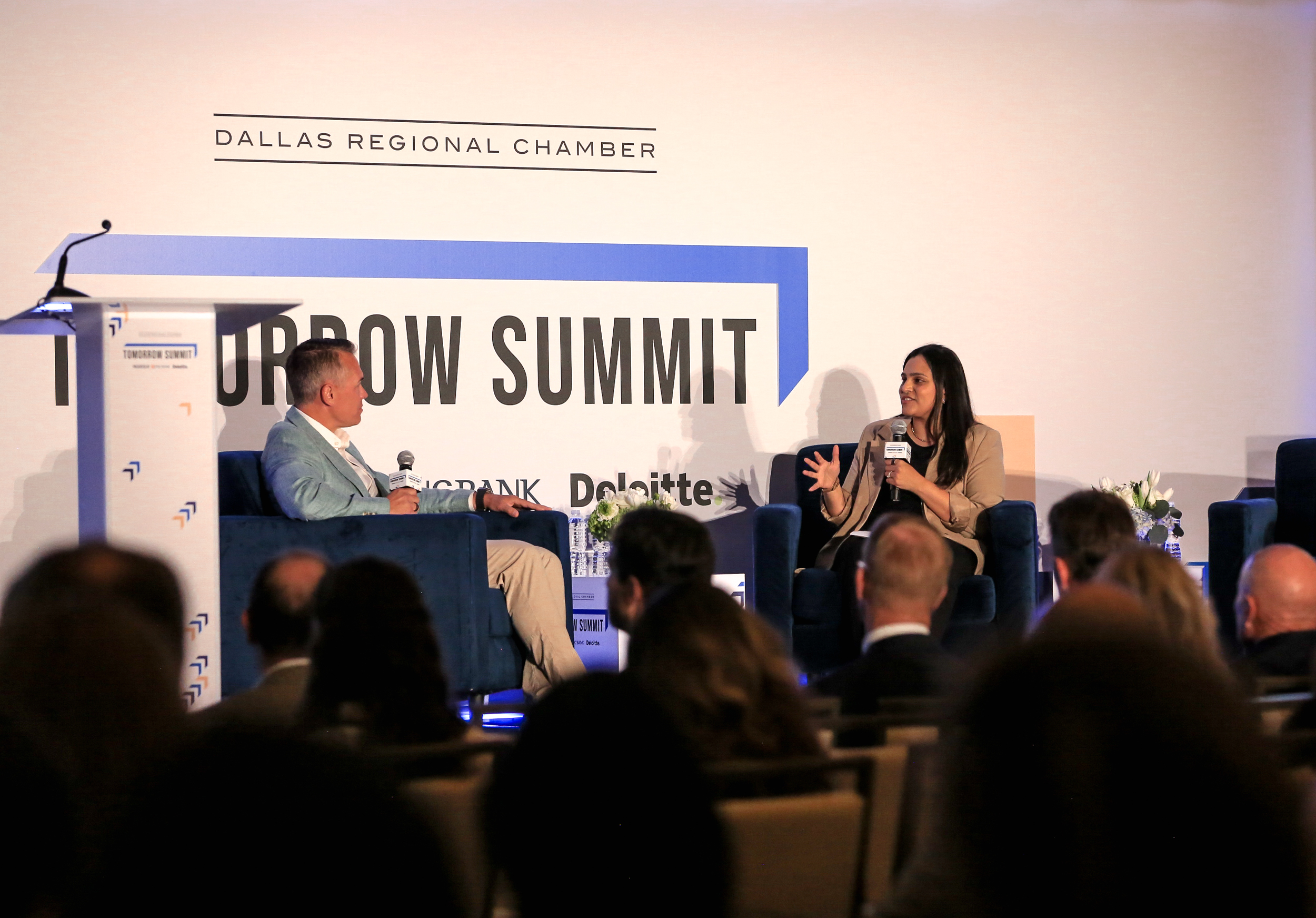
At the DRC’s second-ever Tomorrow Summit, presented by PNC Bank and Deloitte, business and economic development leaders examined the forces shaping the future of Dallas-Fort Worth. At the event, Wes Spurlock, Co-founder & Chief Operating Officer at Principal Mineral, discussed the rising demand for critical materials and the importance of securing domestic supply chains for national security and economic resiliency.
Below are key insights from Spurlock’s conversation, moderated by Naheed Rajwani-Dharsi, Reporter at Axios Dallas.
The supply-chain problem starts further upstream than most businesses realize
Most modern technologies, like the microchips in smart phones and the jet turbines in military aircraft, are manufactured using critical materials. Ensuring these technologies remain abundant and available in the U.S. starts with a fundamental shift in the national business ecosystem, where domestic supply chains are secured at every level of production.

“It’s absolutely catastrophic to not have the supply chains for the things that protect our nation and the things that our world runs on today,” said Spurlock.
While many of these technologies are manufactured domestically, their materials are often sourced internationally, creating supply chain choke points and vulnerabilities. Spurlock referenced copper foil as a leading example of this phenomenon and its wide-ranging impact, as nearly all electronic devices require copper foil for their printed circuit boards (PCBs).
Spurlock noted that while there are roughly 150 PCB manufacturers in the U.S., there is only one copper foil factory in the entire western hemisphere. Reshoring PCBs is part of the solution to unsecure supply chains, but it does not eliminate dependence on foreign suppliers when foundational inputs, like copper foil, are sourced externally. Spurlock emphasized that securing every link in these supply chains is more crucial now than ever.
“The demand for microelectronics is not slowing down. With data centers and increased demand from different technology sectors, it’s just rising. It’s rising so fast that we have to make sure we can get that capacity in place.”
Supply chain security has become a business-continuity issue
Supply chain security is no longer a defense or manufacturing-specific issue; it is a longevity concern expanding beyond any one industry, sector or community. Critical materials affect every facet of the economy at every level of production, and securing their supply chains is essential to sustainable business models.
“If you don’t have secure supply chains, you don’t have a product. And if you don’t have a product, you don’t have a business.”
When critical materials are sourced internationally, geopolitics plays a major role in a business’ ability to function. Spurlock encouraged leaders to prioritize geopolitical awareness and understand where their businesses fit in supply chains to ensure financial and logistical longevity.
 “You have to understand what is going on in geopolitics. You have to have people who understand that because it can really change the dynamics of how the finances work in the business.”
Rebuilding domestic capacity takes more than building factories
Spurlock emphasized that transforming the national business ecosystem into one where domestic production is commercially viable requires a specialized workforce. He encouraged leaders to support workforce development efforts that bolster the nation’s ability to extract and refine critical materials and manufacture their products.
“We’ve lost this skill set, and bringing that back is not just a capacity manufacturing problem—it’s a workforce development problem. Both of these need to come together to be successful.”
Spurlock also noted that domestic capacity is built by collaboration between the public and private sectors. Shared demand for critical materials gives businesses a wider customer base and creates opportunities for partnerships that strengthen manufacturing and advance new technologies through joint research and development.
“There are a lot of applications where you get a more secure business model when you have customers on both the government side and from the private sector. Then, you can advance these technologies so that we’re providing better technology for both of those products.”
As demand for critical materials scales with innovation, the nations and regions that proactively secure their supply chains will strengthen their security and sustain their economies. Spurlock concluded his panel emphasizing that “getting ahead” on supply chains is not about copying or beating a competitor. Rather, it is about leveraging innovation and incentives to advance critical material technologies and proactively anticipate supply chain needs.
To learn more about the DRC’s Tomorrow Summit and find insights shared by speakers from Gallup, Google, Nasdaq Texas and NYSE Texas, explore the full event recap.