
By Ashlynn Bouldin, Coordinator, Marketing & Communications
Estimated reading time: 3 minutes

Dallas-Fort Worth’s economic and business successes have propelled the region into a long-lasting era of growth. But with such exponential growth comes a greater demand for resources.
“Our economy is growing at such a pace that it’s outstripping our infrastructure,” said Claudia Morrow, Senior Vice President, Development, Vistra.
To address this topic, infrastructure leaders converged at the Dallas Regional Chamber’s 2026 State of Infrastructure event, presented by Jacobs, on Thursday, March 12, to examine the evolution of Texas’ energy and technology infrastructure through the lens of the state’s increasing water and power demand.
To expand Texas’ infrastructure in congruence with DFW’s growing economy and to continue supporting the companies and people joining our region, public officials and business leaders must work together to develop our energy infrastructure and ensure its longevity.
“We have to plan ahead—and invest ahead—to ensure the infrastructure supporting our economy keeps pace with the growth that defines it,” said Brad Cheves, President & CEO of the Dallas Regional Chamber.
From power grids to kitchen faucets, all of Texas relies on water
DFW is the fastest-growing metropolitan area in the United States, with over 127,000 people moving to the region in 2025—and a larger population requires more power.
Electric Reliability Council of Texas’ (ERCOT) forecast for Texas’ power demand in 2031 is “145 gigs,” said Chad Seely, Senior Vice President, Regulatory Policy & General Counsel, at ERCOT. “That’s almost twice the [state’s] all-time peak demand.”
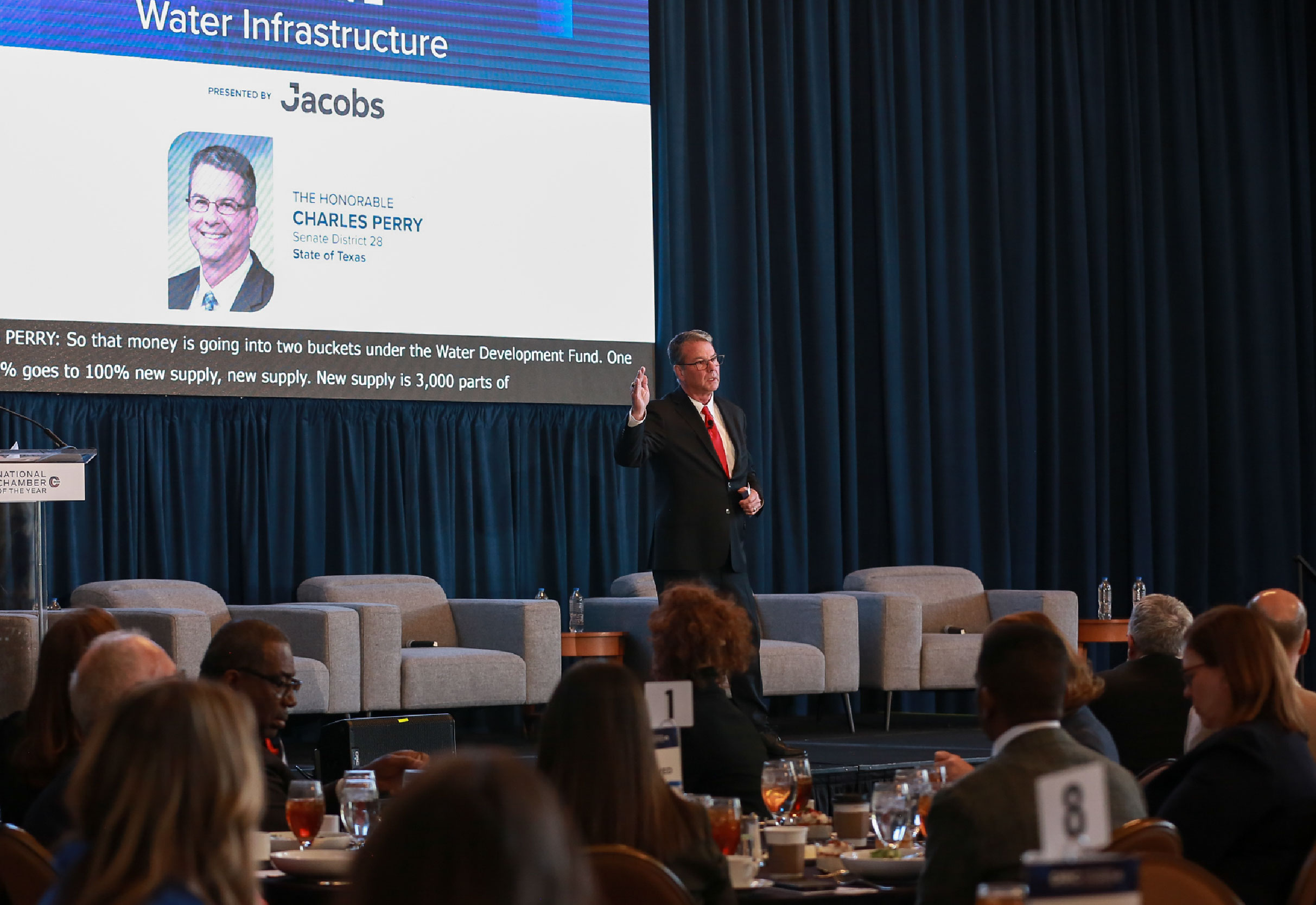
Meeting Texas’ power demand doesn’t require only grid expansions and increased energy generation, however. During his keynote on water infrastructure, Texas State Senator Charles Perry emphasized the importance of water as both an independent resource and a resource for power generation.
“50% of the reliable generation that we’re talking about putting online so that our grid works for us requires water, either to cool it or to generate steam and turn the turbines,” Sen. Perry said.
Preparing Texas’ water and energy infrastructure for increased demand requires policy-focused collaboration across the state and our region.
“We have a lot to do to continue to move forward and make sure that we have a reliable system,” said Seely. “That requires not only ERCOT staff—that requires an entire industry, the legislature and the [Pedernales Electric Cooperative (PEC)] to be heavily involved in these policy decisions to make sure that we have a resilient and reliable group.”
Texas’ latest legislative wins are just a drop in the bucket
The state’s investment in infrastructure is crucial to DFW’s continued growth and longevity. “There’s not a single area of this state that does not have an undeveloped water resource to develop,” said Sen. Perry. With proactive policies, we can tap into these resources and steer Texas toward a more sustainable and reliable future.

In the 89th Texas Legislative Session, House Joint Resolution 7 and Senate Bill 7 passed, paving the path for Proposition 4’s approval the following November. These initiatives, supported by the DRC in Austin and through the Good for Texas campaign, mark the state’s largest water infrastructure investment in history.
Senate Bill 7 and HJR 7 “seek to coordinate [Texas’] water planning like [the state coordinates its] roads so that everybody’s on the same page,” said Sen. Perry.
HJR 7 invests $20 billion into Texas’ water infrastructure by dedicating $1 billion annually to the Texas Water Fund for the next 20 years. But these wins are just “a drop in the bucket,” according to Sen. Perry.
Data centers demonstrate how businesses can invest in infrastructure
DFW is experiencing growth across a wide range of industries, from manufacturing to life sciences, but the AI industry may be the most contentious in terms of sustainability. DFW has become a national leader in data center development, and data centers’ water and power consumption has raised alarms for many. However, during the event’s ‘Powering Texas’ Energy Future’ panel, Dan Diorio, Vice President of State Policy at the Data Center Coalition, pointed out that “data centers are amongst the most efficient water users in the economy,” accounting for “less than 1% of Texas’ overall water use on an annual basis.”
Diorio also noted that when AI and technology companies build data centers, these facilities serve as an investment in the region, “not just in the technology side … [but] in the system side. … Data centers make these investments—these commitments—to invest in the infrastructure, not just for them, but for the surrounding community.”
Infrastructure investments, like those made by data centers, are critical if Texas and DFW are to build a sustainable, robust infrastructure capable of supporting economic and population growth for the long-term. As Dr. Wei-Jen Lee, Professor and Director of the Energy Systems Research Center at the University of Texas at Arlington, noted, infrastructure investments also require sustainable water and energy efforts.

“When I look at [water consumption by data centers and other agencies], it’s about how we recycle the usage and the water that comes from data centers and different processes,” said Lee. “You must also try to reduce the consumption itself.”
Lee notes that businesses that develop technologies that reduce water consumption and employ sustainability efforts are critical to ensuring Texas’ future is powered for the long –term.
Powering Texas’ future
“Recently, with Winter Storm Fern, we saw nuclear, natural gas and coal did a fantastic job. The backbone of [Texas’] grid performed exceptionally well, and we didn’t see any outages,” said Morrow. “And unlike some of the events that we had in the past, like Winter Storm Uri, there weren’t any outages, emergency alerts or requests for conservation. That was the result of winter weatherization, mandatory weatherization and required checks in that regard.”
Texas has proven it can react to the past by improving and preparing its energy infrastructure for growth and potential challenges. But now is the time to look to the future—it is the time for regional collaboration, proactive investments and forward-thinking legislation.
Preparing Texas’ water and energy infrastructure “requires deliberate engagement from the business community, and it requires [legislators] to tell the truth,” said Sen. Perry. “Talk to your representatives and senators. … Texas is big enough to solve this. What you need to remember is Texas is too big to think small.”