
By Ashlynn Bouldin, Coordinator, Communications & Marketing
Estimated reading time: 3 minutes
Child care is “the workforce behind the workforce,” said DRC President and CEO Brad Cheves. “When families have access to affordable, high-quality child care, parents can participate fully in the workforce, grow their careers and contribute to our economy.”
On Wednesday, April 8, the Dallas Regional Chamber hosted its biannual State of Child Care, presented by Texas Mutual Insurance Co., to explore the economic impacts of child care and employer-led solutions for child care access.
Below are key insights from the event’s speakers.
Inadequate child care access negatively impacts parents, children and businesses
Kelsey Clark, Managing Director & Partner at Boston Consulting Group (BCG), shared findings from BCG’s latest child care studies.
Their 2024 study found that “child care benefits improve employee retention and reduce absences, which enables companies to avoid replacement costs and benefit from increased productivity.”
Despite that, according to the same BCG study, “just 12% of workers in the United States are offered child care benefits.”
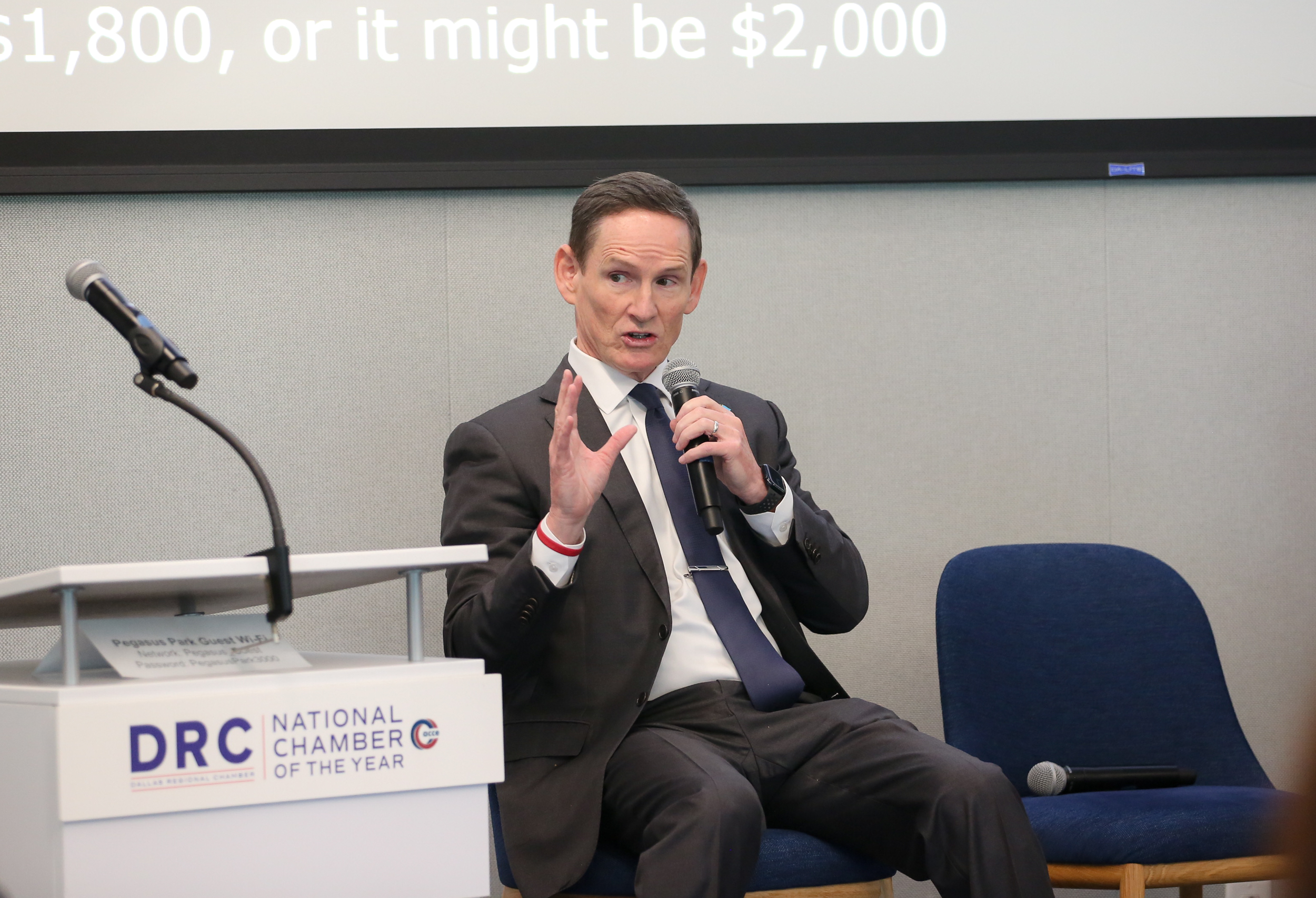
And the long-term impact of inadequate child care access does not stop at parents and employers—it extends to children, as well.
“Kids who aren’t ready for kindergarten are seven times more likely to not be successful in the third grade,” said Dallas County Judge Clay Lewis Jenkins. “We know that, out of the kids that can’t read in third grade, only 5% will ever pull out of it, be successful and get a living wage job.”
Judge Jenkins also noted that, in response to increased demand for child care access, groups are asking the county to explore a Tax Ratification Election (TRE) as a way to draw down additional revenue to support child care initiatives.
Currently, there are 9,500 families on the waiting list for affordable childcare with Workforce Solutions of Greater Dallas (WFS). At Judge Jenkins’ request, WFS is working with Dallas ISD to connect parents on the waitlist with information about signing up children who will be 3 years old by September for pre-k.
Child care benefits improve performance, satisfaction and businesses’ bottom line
If the Dallas Region is to sustain its economic growth, we must bolster the systems supporting our workforce. Child care benefits can involve stipends, on or near-site care, backup care and more.
When sharing BCG’s report, Clark emphasized that “all [surveyed] companies experienced positive financial return, ranging up to 425% ROI,” and that “up to 86% of working parents were more likely to stay with their employer” thanks to child care benefits.
Analisa Eaton, Vice President of Total Rewards at Children’s Health, noted that child care benefits improve customer experiences, as well.
“We look at child care and family support as a workforce strategy—not just a benefit,” said Eaton. “When we can support our team members at home, they’re better able to show up for our patients and patient families.”
Even the smallest investment in child care can produce a major positive impact for a business—and that impact is not short-lived.
Child care “is a legacy-changer for anyone or any company that invests in it,” said Felicia Miller, EVP & Chief Talent Officer at Parkland Health. “They will thereby be able to … improve the lives of the people that they serve.”

Businesses can customize benefits and use untapped resources to start investing in child care
While presenting BCG’s 2023 report, Clark noted that “solutions will need to be customized based on caregiver experiences and industry-specific gaps” because “desired benefits and improvements differ across industries.”
Rob DeHaas, Vice Provost of the School of Education at Dallas College, announced the college’s upcoming solution for child care access: a child care center built in partnership with the Meadows Foundation and Baylor University Medical Center, set to open in 2027.
According to DeHaas, “two of the largest expenditures hindering child care operations are personnel and space.”
To address these expenditures and optimize their individual resources, the Meadows Foundation will donate the center’s space, and Dallas College will leverage their personnel to staff the center.
Jeanette Ward, President and CEO of Texas Mutual Insurance Co., highlighted how her team developed a child care center in their Austin office in partnership with Primrose School of Austin.
To increase their employees’ and community’s access to child care, Ward’s team consolidated over 5,000 square feet of office space for Primrose and helped the center achieve Texas Rising Star certification.
“There are multiple ways to solve the problem,” said Ward. Think about your strength and what you have. … You can find ways that you can contribute, not only for your own employees, but to help strengthen the community, as well.”
Learn more about how the DRC’s education and workforce priorities can support your business—and how you can advance our region’s growth.