
By Pivot One-Eighty
Estimated reading time: 1.5 minutes
Pivot One-Eighty is a change intelligence and organizational strategy company. We help leaders and teams shape how work is experienced, especially during change. Change intelligence means knowing which behaviors make change succeed and when leaders and teams need them. Our behavioral data connects those behaviors to results.
How does Pivot One-Eighty help its clients build value?
We help organizations create transformation that acknowledges the business and its people. That means helping leaders and teams clarify what needs to change, designing the roles and systems to support it, building the capacity to lead it and guiding people through the transition.
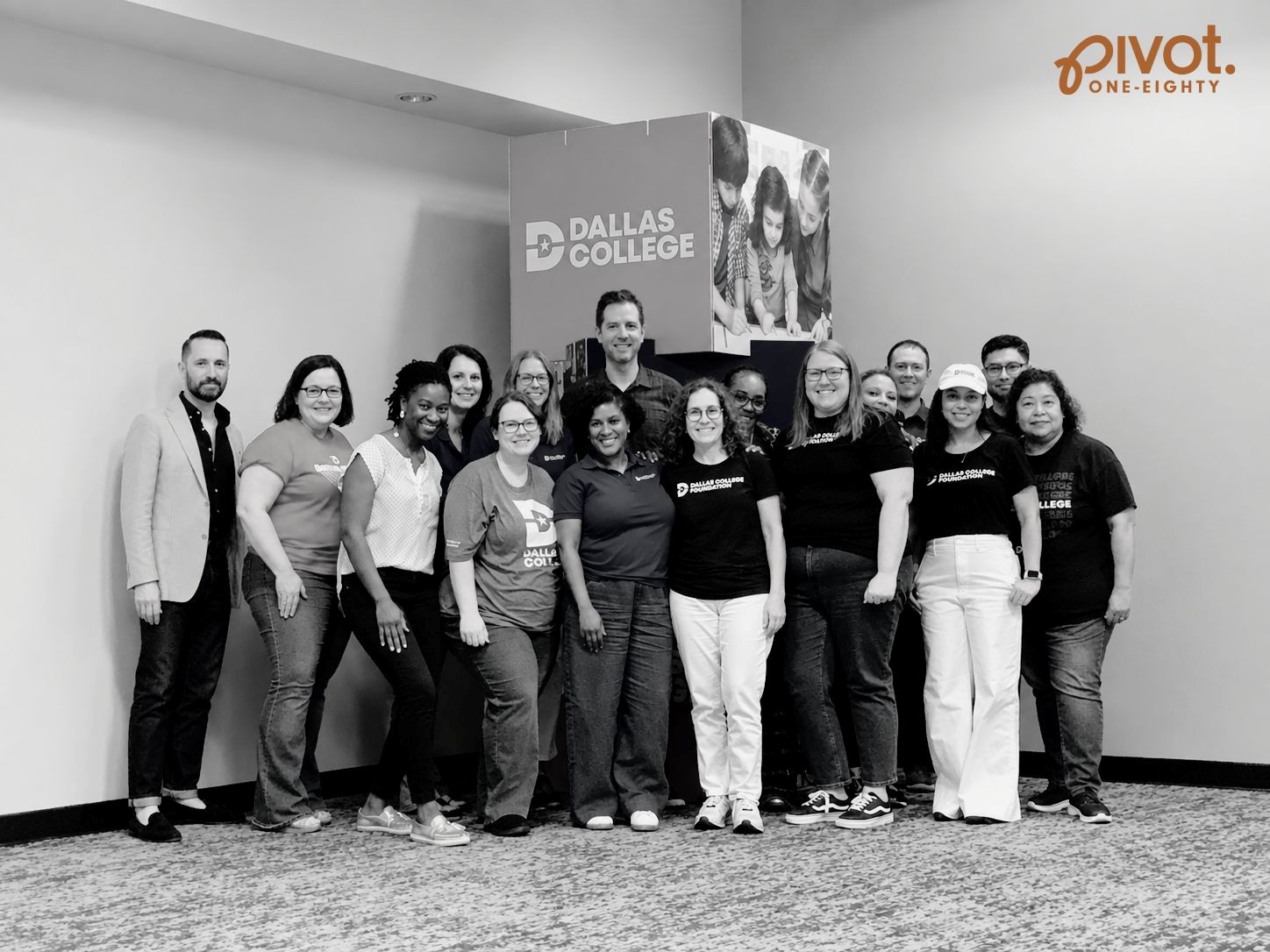 Our methods center the experience of the teams living through the change. When people feel seen and prepared, they commit sooner, and organizations adopt new ways of working faster.
What differentiates Pivot One-Eighty within your industry?
Pivot’s approach starts with the brain science behind change. People respond to uncertainty in predictable ways, and the behavioral data we have gathered over years of client work shows us what leaders and teams need during a transition and when they need it. For example, we’ve learned that when a change is shared across five to seven communication touch points, team members move toward acceptance and become willing to experiment rather than resist. How often and when a message is shared matters as much as the message itself.
Our practitioners have also led change from inside organizations, not only advised from the outside. We know how messy, tedious and challenging transition can be, and we honor that reality in how we advise. That perspective lets us see what traditional approaches miss. Instead of focusing only on strategy, process or employee sentiment, we look at how decisions translate into leadership actions, team behavior and the daily experience of work.
Most importantly, we build capability. We help leaders rethink their role in change, make better decisions and create the conditions for their organizations to move forward long after our engagement ends.
What benefits does Pivot One-Eighty enjoy by doing business in the Dallas Region?
Dallas is growing and changing quickly, which makes it a natural home for our work.
The region puts us close to Fortune 500 companies, fast growing businesses, nonprofits and community organizations, each facing its own kind of organizational complexity. Working across that range keeps us learning what helps organizations change well.
 Dallas also offers a deep leadership and talent pool and a business community actively shaping the region’s future. We get to contribute here at home while bringing what we learn in Dallas to organizations operating nationally and globally.
Why did Pivot One-Eighty become a member of the Dallas Regional Chamber?
We believe better organizations create stronger communities, and we want Pivot to be part of the network shaping how leaders in this region grow and lead.
We also want to add a perspective often missing from business conversations: how to design and lead change in ways that work for the business and for the people responsible for making it happen.
The DRC brings together leaders across industries and organization sizes. That creates room to build relationships, exchange ideas, learn from our peers and share expertise with the broader business community.
How has Pivot One-Eighty changed in the last five years?
Over the last five years, Pivot has grown from a change management consultancy into a change intelligence company.
Our early work focused on guiding specific moments: organizational transitions, culture challenges, leadership needs and strategic initiatives. As that work expanded, we saw a larger opportunity. Organizations don’t only need help managing individual changes. Leaders need the ability to understand change, anticipate its impact, make better decisions and bring people with them.
Along the way, we tracked what we put into each engagement and those outcomes. That behavioral data became insight into how to strategize, plan and lead change well consistently.
Those practices and insight have shaped who we are today. Our design and implementation are guided by strategy and informed by behavioral data.