
By Michael Wood, Vice President, Education & Workforce
Average reading time: 2.5 minutes
Students in the Dallas Region improved both reading and math proficiency during the 2024-25 academic year, according to the latest results of the State of Texas Assessments of Academic Readiness, or STAAR.
STAAR is the annual measure of academic achievement for students in grades 3 through 12. The tool is the primary way parents, employers, and other stakeholders evaluate schools and school districts.
Statewide, student achievement inched forward – with two notable exceptions
Across Texas, students in grades 3-8 saw improvement in both reading and math proficiency. In reading, 53% of students met grade-level standards, an increase of two percentage-points from a year ago. In math, 42% of students met standards, also an increase of two percentage-points.
Reading performance improved the most in grade 5, increasing to 57% from 53%. Grade 8 saw pronounced improvement in math, raising from 40% to 45%.
These results continue the state’s upward trajectory in reading proficiency, which saw a sharp recovery post-pandemic and has continued to improve gradually since. Despite the year-over-year improvement, math proficiency has been slower going. Math proficiency declined significantly after COVID-19 and has yet to get back to pre-pandemic levels.
Across end-of-course exam subjects, just two of the five saw improvements from the previous year: Algebra 1 proficiency was 47%, up two percentage-points, and Biology proficiency was 62%, up five percentage-points. Students lost ground in English 1 (down three percentage-points), English 2 (down four percentage-points), and US History (down one percentage-point).
The Dallas Region continues to run ahead of the state across all subjects
Students from the 108 school districts in the Dallas Region outperformed the state average in all subjects.
In grades 3-8, 56% of Dallas Region students demonstrated proficiency in reading – up two percentage-points from last year, and three percentage-points ahead of the state overall. In math, 44% of Dallas Region students met standards, up one percentage-point and ahead of the state by two.
Consistent with statewide trends, Dallas Region students saw small improvements in Algebra 1 and Biology scores, while English 1, English 2, and US History declined.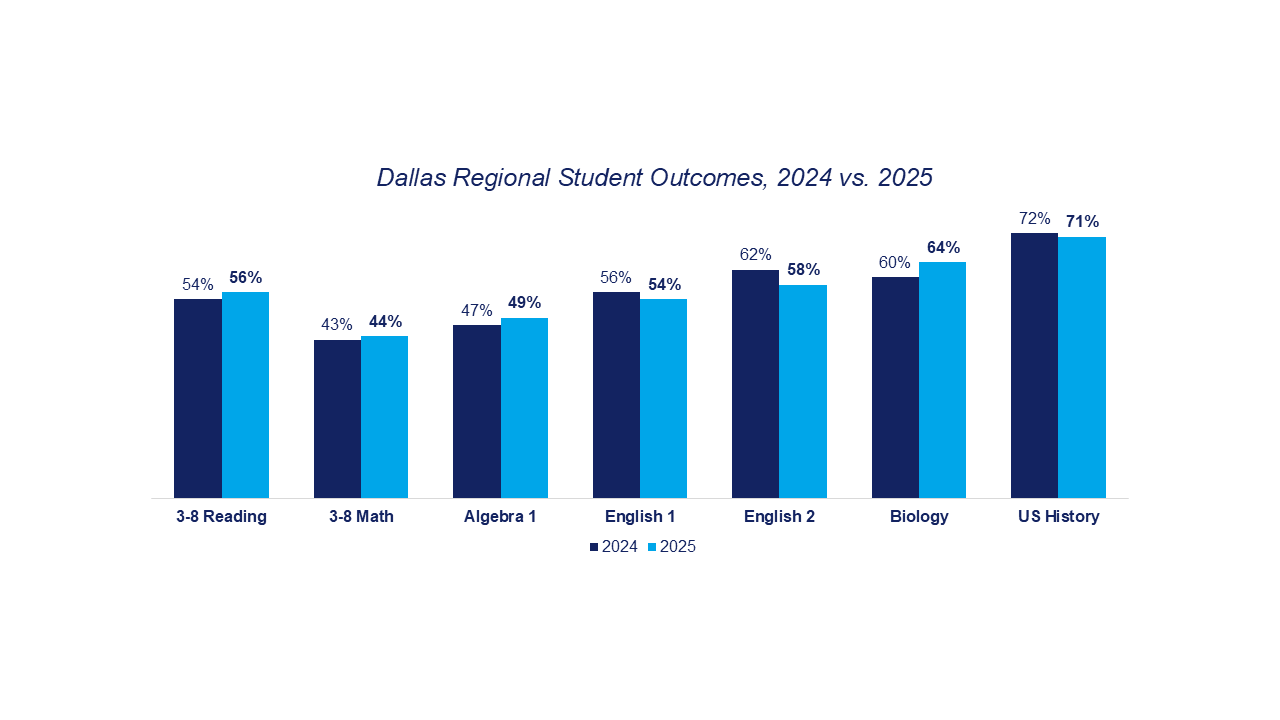
State lawmakers target funding to address gaps
During the 89th Texas Legislative Session, state legislators made historic investments in education and workforce programs, including $8.5 billion for public education.
Within that $8.5 billion is new funding to support pre-service teacher preparation and additional professional development to improve math instruction. In 2019, the state created Reading Academies to help teachers strengthen their literacy instructional strategies. The 2025 Texas Legislature adopted a similar strategy to tackle continued underperformance in math, requiring Math Achievement Academies for all teachers in grades K-8.
These funds build on previous legislative investment in high-quality curriculum. In 2023, the DRC supported House Bill 1605 to create a statewide pool of rigorous instructional materials for Texas classrooms.
Explore how students in your neighborhood school or school district did on the STAAR using the Texas Education Agency’s Texas Assessment Research Portal here.