By Mike Rosa, Senior Vice President, Prosperity & Economic Development 

Last month, Gov. Greg Abbott announced a five-year statewide economic development strategic plan to continue Texas’ economic growth—just days before he announced the state had won its 13th-straight Governor’s Cup for success in economic development.

Prosperity & Economic Development Senior Vice President Mike Rosa

The DRC was asked to contribute to the state’s plan, particularly the DFW regional profile, informing the plan’s economic snapshot of DFW. 

Texas is at a great moment in time, and this strategic plan lays out how the state can continue to win. We are not resting on our laurels or banking on things never changing. This is a great time to think about the future. Texas is constantly growing, and within a great state, our region stands out as a diverse and desirable location.  

The state’s plan amplifies our region 

DFW is responsible for a third of the state’s economy. DFW would be a top 25 global economy all by itself, and Texas is eighth. Within the state’s strategic plan, you can see strong alignment with and consideration of our region throughout as the most impactful regional economy in the state.  

Having a state-wide strategic plan helps communicate to companies and those that advise them the goals and strengths of the state, which align with the work we are doing here in the Dallas Region. We have a passion to be even better than we are, and with this guide, we know how to proceed. 

A diverse economic powerhouse 

Seeing state-wide sectors’ alignment with DFW tells corporations that we know our own strengths, and in DFW, you can find a balance and the best of Texas. We have many sectors represented in the DFW area that were highlighted in the state’s plan. Some focus areas, like finance and bio-life sciences, are in perfect alignment with DFW’s potential and a great match for the region.  

With the construction of Goldman Sachs’ new $500 million campus, the launch of the Texas Stock Exchange from Dallas, and NYSE announcing a move of their regional headquarters to here from Chicago, “Y’all Street” is shaping up to become the new financial capital of the country. 

Dallas’ Pegasus Park was announced as the Customer Experience Hub location for the statewide bid on ARPA-H, a federal agency established to accelerate better health outcomes. The DRC has attended conferences across the country, like the BIO International Convention in San Diego, the International Society of Pharmaceutical Engineering’s Annual Meeting in Orlando, and the iC3 Summit in our own backyard, to share the prestige of our region. With other notable designations, like being named a tech hub by the U.S. Department of Commerce and being chosen as the city for the first U.S. Pharma Aero Logistics Masterclass, it is no wonder the DFW Region is distinguishing itself as a hub for bio and life sciences. Just this month, Colossal Biosciences, based in Dallas, announced the world’s first de-extension by bringing back dire wolves 

We are also a magnet for company headquarters across sectors, with 37 headquarters announcements in 2024 and 223 in the past 10 years. Texas is also home to more Fortune 1000 companies than any other state, with 48 represented in the Dallas Region. DFW also has 22 Fortune 500 companies, showing a clear concentration of excellent corporations.  

Other less obvious sectors, such as rare earths, food, and agriculture are also represented in our region. DFW has the advantaged position of targeting functions in addition to sectors. For example, financial services tend to cluster, and around those clusters come other services and trades. Together, these make a more diverse and economically stronger economic ecosystem.  

No plans to slow down 

Even though Texas is already No. 1, we are always looking to improve and have no plans to stop our progress. It is an impressive thing to live in a state that is at the top of their game, yet with leadership that still invests the time and resources to get better.  

Having a statewide strategic plan for economic development will help get the smaller economies that make up Texas’ economy on the same page. Having aligned messaging will help to inform the legislature on taxes and regulations.  

This focus on economic development across the state also sends a signal to companies and location decision-makers that there is a lot of enthusiasm and positive momentum in Texas to draw from and join.  

By Sara Medina, Director, Education & Workforce 

In today’s competitive labor market, organizations face the challenge of attracting and retaining top talent while addressing evolving workforce demands. The 2024 National Trends Report by Best Place for Working Parents® offers an in-depth look at how companies across the country are adapting to meet the needs of working parents.  

The Dallas Regional Chamber (DRC) is the regional sponsor for the Best Place for Working Parents® Dallas, a local chapter of the national Best Place for Working Parents® initiative. Since 2021, more than 465 Dallas Region companies have been recognized for their family-friendly workplace benefits.  

The new report highlights key trends shaping the relationship between employers and working parents from over 1,500 businesses that have earned the Best Place for Working Parents® designation.  

Nationwide, child care benefits surge

One of the key trends identified in the report is the increasing adoption of back-up child care across businesses of all sizes, indicating its effectiveness at reducing employee absenteeism and turnover. The report shows nearly 60% of small businesses now offer back-up child care, with even higher adoption rates among medium (83%) and large-sized businesses (82%).    

However, while back-up child care is on the rise, more comprehensive child care solutions, such as on-site child care and financial assistance, remain less common.  

As the 89th Texas Legislative Session continues, the DRC is advocating for state lawmakers to consider ways to encourage businesses to offer child care benefits, including financial assistance for working parents.  

Small employers are closing the gap in benefits offerings with big business  

The report reveals that while larger organizations generally have more resources to implement family-friendly policies, micro (1-24 employees) and small (25-200 employees) businesses are making significant strides and, in some areas, leading the way.  

Notably, micro businesses have shown a substantial increase in child care benefits from 2022 to 2024, making advancements in on-site child care and parental leave relative to small and medium businesses. Small businesses also outperform medium-sized businesses (201-999 employees) in providing on-site child care.  

Small businesses are also closing the health care benefits gap with larger organizations. There has been an increased adoption of the “trifecta” of health benefits—medical, dental, and vision—rising from 60% in 2022 to 72% in 2024 among micro businesses and from 69% in 2022 to 75% in 2024 among small businesses. This demonstrates increasing investments in comprehensive health benefits as a strategy to compete with larger companies in attracting and retaining employees.  

North Texas businesses leading on parental leave policies  

Dallas stood out in a regional breakdown of family-friendly policies implementation among Best Place for Working Parents® regions. With high implementation rates for policies like maternity leave (87%), paternity leave (81%), nursing benefits (96%), back up child care (68%), and remote work (96%), North Texas businesses are actively prioritizing family-friendly benefits to attract and retain talent.    

Areas of opportunity for North Texas, when compared to other Best Place regions, include increased on-site child care, flexible work hours, and expanding health care coverage.  

A Best Place for Working Parents® designation can help your company with talent acquisition 

Business leaders can quickly determine whether their company qualifies for the Best Place for Working Parents® Dallas designation by completing a three-minute assessment. The assessment compares an applicant’s family-friendly benefits across 10 research-backed policies with companies of similar size and industry.  

Click here to learn more and earn your Best Place for Working Parents® designation today.  

If your company is interested in learning more about family-friendly policies or the Best Place for Working Parents® program, connect with me and join in on these trends. 

By Michael Wood, Vice President, Education & Workforce 

Texas is losing workers because of a solvable problem: child care challenges. 

A 2021 study by the U.S. Chamber of Commerce Foundation found more than a third of working parents in Texas who quit or planned to quit their jobs cited child care as a primary reason for their decision. As a result, Texas loses over $9 billion annually in economic productivity from employee turnover and reduced workforce participation—all because working parents can’t find or afford quality child care. 

Forward-thinking companies have recognized this challenge as an opportunity. By offering child care benefits—from financial assistance to on-site facilities—employers are helping parents and their bottom line. According to Boston Consulting Group, these investments yield returns of 90% to 425%.  

Policymakers are taking note, presenting an opportunity for the DRC and our member companies in the 89th Texas Legislative Session.  

Taking an informed approach to policy recommendations 

The DRC is championing a three-way partnership between employers, employees, and the government to make child care more affordable for working families.  

In 2024, we formed a Child Care Policy Work Group with more than 15 member companies to explore models of government supports for employer child care benefits and make recommendations for lawmakers in the 89th Texas Legislative Session. 

Programs in Kentucky, Michigan, and North Carolina have implemented plans that effectively split the cost between the government, employer, and employee. Results from an evaluation of Michigan’s “Tri-Share” program found a significant reduction in employee child care costs and improvements in employee satisfaction and retention. 

Texas Legislature takes action 

Two bills have been proposed to establish the Texas Employer Childcare Contribution Partnership Program: 

        • House Bill 3191 by Rep. Angie Chen Button 
        • Senate Bill 2164 by Sen. Tan Parker 

If passed, these bills would support employer child care initiatives through: 

        • Franchise tax credits up to $3,600 annually per child 
        • Matching funds up to $3,600 per child for employers who contribute at least $1,200 annually per child toward care costs 

The matching fund structure incentivizes support for employees at all income levels, with the state matching 100% of employer contributions for workers at or below the state median income. 

Dallas County leads the way 

While state legislation advances, Dallas County has taken first steps to pilot a program similar to what’s been proposed in Austin.  

In March, the Commissioners Court approved the Dallas County Child Care Benefits Program, which offers employers matching funds for investments in child care assistance. The pilot received an initial investment of $1 million for administration and to provide match funds.  

Dallas County is the first local government in Texas to offer employers incentive funding for employee child care benefits, and the program will serve as proof-of-concept for the proposals in front of our state lawmakers while delivering relief to working parents struggling with child care costs. 

What comes next? 

HB 3191 was heard by the Texas House Committee on Trade, Workforce, and Economic Development on Wednesday, April 9. Jarrad Toussant, the DRC’s Senior Vice President of Education & Workforce, provided testimony in support of the bill.

Next, HB 3191 awaits a committee vote before advancing to the full House for consideration. SB 2164 has been assigned to a committee and is awaiting a scheduled hearing. The DRC will continue working with our lawmakers and partners across the state to advocate for these bills.

If your company is located in Dallas County and wants to join the pilot program, please complete the County’s interest form. 

If your company has seen the impacts of child care challenges, I hope you’ll connect with me and join us in advocating for a state-supported solution. Send me a note with your thoughts 

By Nicole Ward, Data Journalist 

This article is part of the Dallas Regional Chamber’s (DRC) award-winning Disability Inclusion Toolkit. The toolkit, presented by Ernst & Young LLP, helps companies assess and maximize their inclusion of people with disabilities, including neurodivergence. The toolkit’s data, resources, and best practices are informed by the perspective of experts and people living and working with disabilities. 

Lola Dada-Olley

An often overlooked part of disability inclusion is the role of caretakers. According to U.S. News & World Report, in the United States, more than one in four people over the age of 50 are caregivers to friends or family members, and 23% of this population is looking after someone with an intellectual or developmental disability. 

Lola Dada-Olley has been in this role since she was a child—first to her younger brother and now her two children, all of whom are on the autism spectrum.  

In addition to this, Dada-Olley is an Assistant General Counsel and Vice President for J.P. Morgan Chase & Co., serving as firmwide counsel for external-facing matters tied to the Americans with Disabilities Act, and before that, she worked in the public sector in both Illinois, at the Attorney General’s office and Workers’ Compensation Commission, as well as in Plano, as an Assistant City Attorney, but you may recognize her name from the “Not Your Mama’s Autism (NYMA) Podcast,” where she talks about the autism journey her family walks. 

“Autism is multi-faceted, so it doesn’t always manifest in one way,” said Dada-Olley. “I wanted to create a space for the conversation and for different perspectives because many times families who are impacted by autism, or another form of neurodivergence, can feel isolated.” 

Her family was first introduced to autism in Chicago in the late 1980s, when her younger brother was given what, at that time, was a little-known diagnosis.  

“There was no awareness, much less acceptance and inclusion campaigns,” she says. 

She recalls he had been communicating verbally until one day, he just stopped. 

“We never heard him speak another word again.” 

He also stopped developing cognitively, staying at the intellectual level of about a three-year-old; he’s now in his thirties. He still lives in their family home with his parents outside of Chicago. 

Little did she know that exposure to neurodiversity while growing up was preparation for her role as a mother to two children also on the spectrum. 

“I couldn’t have possibly known, but growing up with my brother would be part of a blueprint that was essential in raising my children today. I do not believe in coincidences. God was preparing me for a lifetime of caregiving and advocacy through the lens of a sibling, mother, and attorney.” 

Dada-Olley’s role as a caretaker puts her within a much larger nationwide community. However, her role as advocate is motivated by her own experience, which she hoped to share so that other caretakers might feel more supported and learn from her.  

The Dada-Olley family outside their home in Plano.

A different kind of podcast offers a different kind of support

In her podcast, which she spoke about at her 2021 TEDx Talk, Dada-Olley shares her family’s experience with autism through a multigenerational and multicultural lens. It began in the 1980s with her brother’s diagnosis and continues with her two children who are both on the spectrum. NYMA Podcast explores the challenges and triumphs an autism diagnosis can bring. 

She also explores closely-related topics that are important to caretakers such as self-love, treatments, marriage therapy, and redefining success. She speaks as someone who has both had an impressive legal career, as someone whose life has been shaped by multi-generational autism, and with the authenticity of someone who has been through it. 

In Dada-Olley’s podcast, businesses have an opportunity to offer a different kind of support, as it can be a person’s place of employment that they first turn when confronted with a challenge. Creating a culture where employees feel confident finding the resources they need – like help navigating social security or products and services for themselves or a family member – reinforces trust and loyalty. 

Putting pen to paper 

In addition to her podcast, Dada-Olley is also editing her book manuscript, which is scheduled to be published in 2026. Her memoir will highlight the importance of community when navigating unfamiliar terrain.  

“With an autism diagnosis, there are going to be many times when you need to turn to people for support. And, of course, some friends and family will be there, but you need people who have experienced the fear and frustration, but also the joy.” 

Her upcoming book will also have practical information like questions caregivers can ask health care providers and educators when navigating complex medical needs and special education, and it will include a section on questions to ask yourself before taking your own advocacy journey public.  

The Dada-Olley family at the documentary film premiere of Sensory Overload in NYC, Feb. 2025.

Sensory Overload 

Because understanding something can be hard without experiencing it, Dada-Olley and her family were invited to be part of a documentary that highlights what it’s like to be sensory sensitive—common with people who have autism. She would later learn that her family, chosen along with two other families, were considered among nearly two hundred subjects for the film.  

Given the very sensitive nature of having a film crew documenting her family, there was some hesitation at first in providing the filmmakers with such access. However, after speaking with some of the filmmakers in-depth and hearing the level of research and intention that would go into this film, including featuring health care experts in the documentary, Dada-Olley and her husband decided to move forward.  

Once she saw the final cut of the film, she turned to the director and their eyes met. Amid the applause, she simply mouthed the words, “thank you.”   

Called Sensory Overload, the film follows a group of people who both live with sensory sensitivity and those who support them. The documentary was produced as part of the Sensodyne Sensory Inclusion Initiative to promote awareness of the importance of more sensory-inclusive oral care and can be streamed on Hulu.   

Visit Dada-Olley’s website to connect and learn more. 

To access the Dallas Regional Chamber’s Disability Inclusion Toolkit, visit our website. 

By Morgan Scruggs, Coordinator, Leadership Programs 

If you’re a business executive or nonprofit leader in the Dallas Region striving to leverage your skills for meaningful community impact, then Leadership Dallas (LD) is the ideal opportunity for you. 

Founded 50 years ago by the Dallas Regional Chamber (DRC), LD has supported many of the region’s prominent leaders who share a common passion: creating lasting change and improving the quality of life in the Dallas Region. Now, we’re seeking the next group of senior leaders to join the Class of 2026 and elevate their leadership. 

Here are three reasons to apply today:

1. Make a profound impact on the Dallas community 

Since the program’s establishment in 1975, LD has maintained its focus on engaging with the Dallas community through a broad range of service projects and initiatives. Through their class days, participants learn about the region and how they can support the people within it. The cohort also works closely with a local organization to address key community needs through their year-long class project. 

2. Enhance your leadership skills 

Class members receive access to executive coaching to strengthen self-awareness, sharpen decision-making, and lead with confidence. In addition, they collaborate with diverse leaders, learning to tackle complex challenges with empathy, influence, and purpose. 

3. Build lasting connections with other Dallas Region leaders 

Each cohort consists of 55 leaders from a wide variety of industries, backgrounds and experiences, all committed to driving change in their organizations and the community. The relationships formed during class days and service opportunities transcend beyond time spent in the program, both professionally and personally. Read more about how LD has impacted Dallas leaders and expanded their network in our Leadership Dallas 50th Anniversary Series featured on our news page. 

Applications for the LD ’26 class are open through Monday, May 5, 2025. Apply today to unlock your potential and discover why LD is the region’s premier leadership program. For any questions regarding the program or application process, please reach out to Olympia Newman at onewman@dallaschamber.org.

The 56 members of the LEAD YP Class of 2025 represent a diverse group of companies and industries. They were selected through a competitive application process based on their commitment to enhancing their leadership skills, professional background, community involvement, and educational background. 

Through a hands-on curriculum, LEAD YP, powered by Arcosa, deepens young professionals’ understanding of their leadership style and primes them to grow into leaders who champion the Dallas Region. 

“Investing in developing leaders is a direct investment in the future success of our region,” said Dale Petroskey, DRC President and CEO. “The LEAD YP Class of 2025 is made up of professionals who are driven and committed to growing their leadership skills, learning more about what is happening in our community, and preparing to make a lasting impact. We are excited to welcome them and help them grow into leaders who will strengthen our member companies and the Dallas Region.”  

Through the LEAD YP program, participants receive monthly training on personal leadership, navigating change, building a personal brand, and utilizing the Predictive Index Behavior Assessment. The program begins in April with a retreat, followed by monthly class days through October. Each class day focuses on different aspects of the DRC’s work and highlights opportunities for participants to engage in these initiatives. 

Upon graduation, participants will have the opportunity to join the Young Professionals Advisory Council at the DRC, where they can continue to grow their leadership skills and make a meaningful impact on the young professional community in the Dallas Region. 

“LEAD YP provides the tools and opportunities that help promising leaders grow into impactful change-makers,” said Mallory Mullis, Manager of Leadership Programs at the DRC. “We are excited to welcome this new class and help them advance their personal and professional leadership goals.” 

The members of the LEAD YP Class of 2025 are: 

First Name  Last Name  Company/Organization 
Adam  Hunter  Broadway Dallas 
Alexis   Burwinkel  Hillwood 
Amanda  Humrichouse  Pinnacle Group 
Ann  Nordine  Comerica 
Austin  Martin  Forvis Mazars 
Beatrice  Howard  Globe Life 
Blake  Conway  Frost Bank 
Brett  Martin  Whitley Penn 
Camaya  Matthews  Law Offices of Erika N Salter, P.C. 
Christian  England  Wells Fargo 
Christie   Foster  Texas Mutual Insurance Company 
Claire  Riggan  Crow Holdings 
Cooper  Dirck   Boston Consulting Group 
Cristy  Reyna  Career Management Partners (CMP) 
Danielle  Sims  Verizon 
Deji  Adefuye  Per Scholas 
Denis   Hunter  Vistra Corp 
Elijah  Butler  Turner Construction Company 
Ethan  Waldroup  McCarthy Building Companies, Inc. 
Faina  Lacroix Rucker  Blue Cross and Blue Shield of Texas 
Hannah  Smart  RSM USA LLP 
Jack   Niland  Dallas Regional Chamber 
Jeremy   Graham  Year Up United 
Jessica  Muniz  Southern Gateway Park 
Jessica  Sullivan  Ruiz Foods 
Jessica  Thomas  Jacobs 
John   Abe  Arcosa 
Joshua   Fuller  Bell Nunnally & Martin LLP 
JW  Amos  Thomson Reuters 
Kate  Neely  Lockton 
Kean   Villarta  Children’s Health 
Kellie  Jasso  Balfour Beatty US 
Komal  Aslam  Hilti 
Madison  Weber  American Airlines Center 
Margaret  Fete  PwC 
Megan  Ames  Slalom 
Memusi  Ntore  The Commit Partnership 
Michelle  Mai  Communities Foundation of Texas 
Nicholas  Edwards  Bank of Texas 
Nilesh  Munjani  7-Eleven 
Rivir  Berry  The University of Texas at Arlington 
Robin  Ladd  Haynes and Boone LLP 
Samuel  Snyder  KFM Engineering 
Scooter  Mebarek  Improving 
Tayler  Gray  Carrington Coleman 
Taylor  Arnold  JPMorgan Chase & Co. 
Taylor  Watkins  HKS Inc. 
Thomas  Lenskold  Moss & Associates 
Tiffanie   Tovar  MassChallenge 
Todd   Bynum  Dallas Mavericks 
Tucker  Davison  Troutman Pepper Locke LLP 
V  Shiau  Capital One 
Valarie   Williams  Crowe LLP 
Vania  Ochoa  Sixth Street Partners 
Will  Carlson  Gresham Smith 
Zachary  Leard  UMB Bank 

By Makayla Rosales, Coordinator, Opportunity & Impact  

April provides an ideal backdrop for holidays celebrating renewal. The spring season can be a powerful time to focus on rejuvenation and growth. Just as nature sheds the old and brings forth the new, this is a time to pause and reflect on past accomplishments, acknowledge areas for improvement, and set the stage for a more productive and energized remainder of the year.  

Engage in the workplace

Engaging an attitude of renewal in the workplace can be done in a variety of ways:  

    • Reassess goals – Take dedicated time to review team and individual progress and adjust priorities when needed. 
    • Track accomplishments – Connect daily efforts to broader objectives by monitoring what’s been achieved. 
    • Host brainstorming sessions – Set aside time specifically for creative thinking and innovative discussion. 
    • Invite cross-department feedback – Bring in colleagues from other teams to provide fresh perspectives on current projects. 
    • Spark collaboration – Create opportunities for employees from different areas to work together on shared challenges. 
    • Invest in professional development – Support growth through relevant workshops, courses, and learning opportunities. 
    • Establish mentorship programs – Facilitate connections that foster long-term career development and satisfaction. 
    • Create feedback channels – Develop systems for open, constructive communication between team members. 
    • Recognize achievements – Acknowledge progress and successes to maintain momentum and motivation. 
    • Balance innovation with well-being – Show commitment to both business success and employee satisfaction. 

Attend an event

If you are interested in bringing your team, friends, or family to festivities celebrating the Season of Renewal, here are some local events: 

Dallas Blooms– 9 a.m.-5 p.m., until Sunday, April 13, 2025 

8525 Garland Rd, Dallas, TX 75218 

Dallas Blooms is the largest floral festival in the Southwest and is a must-see springtime affair. Each year, the Dallas Arboretum & Botanical Garden transforms with a breathtaking display featuring 500,000 blooms from tulips to pansies, live entertainment, Easter events and more. 

South Street Art Festival 4-8 p.m. Friday, 11 a.m.-8 p.m. Saturday, 11 a.m.-5 p.m. Sunday, April 4-6, 2025 

300-500 blocks of East South St., Arlington. 

This is the longest-running and only fine art festival located in the Downtown Cultural Arts District in Arlington. Art lovers can stroll down South Street as they admire a variety of original local works. 

Festival of Joy 11 a.m.-7 p.m., Saturday, April 26, 2025 

Klyde Warren Park, 2012 Woodall Rodgers Freeway, Dallas, TX 75201 

The sixth annual celebration of Indian culture will take place in Dallas’ Klyde Warren Park. It features a parade, dancing, live performances, yoga, a free vegetarian feast, crafts, face painting, and a chance to ask a monk questions. 

Dallas’ Biggest Easter Egg Hunt– 10 a.m.-12 p.m., Saturday, April 19, 2025 

Hilton Anatole, 2201 N. Stemmons Freeway, Dallas, TX 75207 

Dallas’ BIGGEST Easter Egg Hunt is happening on Saturday, April 19th at the Hilton Anatole. Kids Admission is $13, and children will be separated into egg hunts by age group. 

April holidays to celebrate 

The holidays in April–Passover, Vaisakhi, Good Friday, Easter and Earth Day–reflect themes of liberation, reflection, and new beginnings. Passover, April 13-20, commemorates the liberation of the Israelites from slavery in Egypt, symbolizing freedom and renewal. Vaisakhi on Sunday, April 13, marks the harvest festival and the founding of the Khalsa, celebrating spiritual growth and community unity. Good Friday on Friday, April 18, observes the suffering and sacrifice of Jesus, signifying new life, hope, and rebirth. Easter, celebrated Sunday, April 20, is a Christian holiday celebrating the resurrection of Jesus. Earth Day on Tuesday, April 22, focuses on environmental consciousness, urging individuals to reflect on their role in preserving and renewing the planet for future generations. 

By Travis Reynolds, Vice President, Public Policy 

The Texas Senate has passed its version of the state budget, Senate Bill 1, launching the most critical negotiation of this legislative session and a step forward for the only bill the Legislature must pass before adjournment.  

Budget process snapshot

The Texas State Capitol Building

Texas operates on a two-year budget cycle. Each legislative session: 

      1. State agencies submit funding requests 
      2. The House and Senate each develop and pass budget revisions 
      3. A Conference Committee reconciles differences 
      4. Both chambers approve the final budget 
      5. The Governor signs it into law 

What’s happening now 

For the 2026-2027 biennium, Texas Comptroller Glenn Hegar projects $194.6 billion available for general spending, including a $24 billion surplus. While smaller than last session’s historic $32 billion surplus, this represents significant investment potential for the future of our state. 

Key DRC priorities in Senate Bill 1 

The Legislature has an opportunity to invest in areas and opportunities important to the future of our state and the Dallas Region. Here are a few of the items related to our legislative agenda the DRC is watching as SB 1 moves through the budget process. 

    • Infrastructure: The Senate has allocated substantial funding to invest in Texas’ infrastructure needs, including: 
      • $36+ billion for transportation planning, design, construction, and maintenance  
    • Education and Workforce: Funding for PK-12 and higher education makes up the single largest segment of funding in the budget, with more than $73 billion of general revenue allocated to education spending, comprised of: 
      • $4.3 billion for teacher pay raises 
      • $500 million for school safety 
      • $850 million endowment for Texas State Technical College System capital needs 
      • $410 million for the Texas Research Incentive Program, including $150 million for Dallas Region universities 
    • Property tax relief: Gov. Greg Abbott tagged property tax relief as a top priority for this legislative session, and the Senate provided $51 billion for new and continuing tax relief in its version of the budget. Gov. Abbott and our lawmakers have deliberated and addressed this topic in recent legislative sessions, but here’s what’s new for this session: 
      • $3.5 billion to increase homestead exemption from $100,000 to $140,000 
      • $3 billion for school district compression to lower property tax burden for homeowners and businesses 

What comes next 

The House Appropriations Committee will continue meeting, with a House version of SB1 expected by late April. This leaves the remainder of the session for House-Senate negotiations. The current Senate budget stands at approximately $163 billion, under the state’s constitutional spending limit. 

As business leaders, staying informed throughout this process is crucial. The Dallas Regional Chamber’s Public Policy team will continue to provide timely updates. 

Are there items in the state budget important to your company? Let us know. 

By Catie George, Director, Communications and Storytelling 

In the past 20 years, women in senior management roles have increased 14.1%, from 19.4% to 33.5% in 2024. For Grant Thornton’s Nichole Jordan, Dallas and Texoma Regional Managing Principal, Women’s History Month is the time to celebrate this progress and continue pushing forward. 

“Women’s History Month is a time for gratitude and reflection. We stand on the shoulders of those who paved the way before us, and this month serves as a reminder to pause, appreciate their sacrifices, and acknowledge the progress we’ve made,” said Jordan. “It’s also an opportunity to look forward with optimism—thinking about the ways we can create opportunities for the next generation.”   

Jordan specifically shouted out her mother as an inspiration. 

My mother was a hardworking businesswoman who raised our family with strength and an innate belief that we could achieve anything we set our minds to. She taught me the importance of hard work, integrity, and building deep, authentic relationships. Even when there weren’t many women in leadership roles, her influence gave me the confidence to walk into rooms knowing that my hard work, contributions, and ability to add value would speak for themselves.” 

As a mother herself, Jordan also shared how her own daughter’s attitude is a sign of the progress that’s been made and emphasizes hope for the future. 

What excites me most is the limitless potential women bring to the table. My 17-year-old daughter is a great example—she’s ready to take on the world, with no sense of barriers or limitations. As a competitive athlete, she demonstrates the power of performance and leadership, giving me hope for the future,” she said. “I’m proud of her mindset and the potential she sees in the world – a perspective that wasn’t always common for women in past generations.” 

Jordan shared that Texas is home to 52 Fortune 500 companies, the second largest concentration among states. The Dallas Region is home to 22 of Texas’ Fortune 500 companies. This professional presence, with women at the helm in many cases, is inspiring to young women like Jordan’s daughter growing up with this representation around them.  

 “Women in business are thriving. Texas’ growing economic environment is on its way to becoming a capital markets epicenter, and we’re seeing more women playing key roles in this growth.”  

Jordan advises women who aspire to leadership positions to look to current leaders for guidance.  

Be proactive in reaching out to leaders, scheduling time and showing genuine interest in learning from them. Build strong relationships by offering to contribute and staying engaged,” she suggested. “Collaborate and engage with them outside of traditional meetings, whether it’s working alongside them in community service activities or the organizations they are involved in. This builds deeper connections and demonstrates your work ethic and dedication.” 

On the other side of developing women leaders, companies have opportunities to build conducive environments for connection, collaboration, and networking. 

Grant Thornton’s Women and Allies Business Resource Group is a great example, offering a space for women to discuss unique challenges and support each other,” said Jordan. “Additionally, organizations should encourage women to engage with their communities and universities, so that young women can see the possibilities available to them. Candid conversations about real-world challenges and successes can empower women, particularly in underrepresented fields, and provide them with valuable, actionable advice.” 

By Rebekah Chenelle, Vice President of Public Policy 

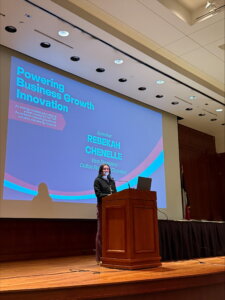
On Friday, March 21, I had the opportunity to represent the Dallas Regional Chamber at the Texas Association of Business Foundation’s lunch-and-learn session for legislative staffers at the Texas Capitol. The event focused on powering business growth through innovation, specifically in energy infrastructure.  

Speaking at the Texas Capitol about powering business growth through innovation.

Here are the key points I shared with our lawmakers’ teams. 

DFW leads the way in Texas’ growth story

Our state’s economic success isn’t happening by accident. The Dallas-Fort Worth region continues to punch above its weight in contributions to the Texas economy. We have a 26.6% share of the state population, but we boast 28.7% of the state’s economy.  

Our region is projected to become the nation’s third-largest metro area by 2028. Our economic prowess and explosive growth create opportunities and challenges that require thoughtful policy solutions. 

Infrastructure is the foundation for continued success 

With this unprecedented growth comes increased pressure on our infrastructure systems. I emphasized three areas top of mind for the business community: 

      1. Water infrastructure 

We can’t discuss energy or infrastructure without also discussing Texas’s water needs. Without dependable water infrastructure, Texas risks up to $100 billion in economic losses and hundreds of thousands of jobs. 

At the DRC, we’re glad to see the Legislature has taken action on this critical priority, working to secure a dedicated funding source for our state’s water infrastructure. Both the House and the Senate have taken action, with joint resolutions and complementary bills moving through the legislative process, which are to be reconciled to send one joint resolution to voters this November and one bill to Gov. Greg Abbott’s desk for signature.  

2. Energy reliability 

As Texas continues to lead the nation in energy production, we must ensure our grid can meet growing demands while supporting our competitive business environment. The DRC supports an “all of the above and below” approach to energy needs and encourages innovative solutions to efficient energy uses.  

We want crucial industries like tech and manufacturing to continue to move to Texas, but to sustain our growth, we need to utilize all the tools in our toolbox. Many of our member companies are leveraging technologies to make the grid more efficient and we encourage the legislature to spur these innovations—and not stifle them.  

3. Building an ecosystem that supports innovation 

Texas’ ability to innovate to solve our challenges and capitalize on opportunities depends on our workforce. Our workforce now spans four generations, with diverse education levels and skill sets. Upskilling and reskilling to help build experts in ever-growing technologies and to fill in-demand roles in innovative spaces is essential to keeping Texas on the leading edge—and it helps our people earn good wages that, in turn, fuel our economy. 

Additionally, we need to make sure our companies have the ability to foster innovation and grow new ideas and solutions to maintain our competitive advantage. To secure this, our lawmakers can extend Texas’ R&D tax credit—a vital tool set to expire in 2026 that could generate more than 113,000 jobs and $13.8 billion in additional Gross State Product over the next decade. 

Call to action for lawmakers 

I ended my time at the lectern with a direct message to our legislators: When companies decide to come to Texas, they’re betting on their future. Meaning they’re watching Texas to see how we are securing our future. The DRC hopes to see lawmakers work with our members and in-house experts to pass pro-growth, pro-business policies that contribute to growth and innovation.  

Thank you to our friends at the Texas Association of Business Foundation for giving us this audience with our partners in the Capitol. This is one of the many ways the DRC gets to represent our members’ interests in Austin, ensuring our region’s voice is heard as critical policy decisions are made. 

Is the ability to grow and innovate top of your mind for your company? Send us a note to join our advocacy efforts. 

By Jack Niland, Manager, Public Policy 

Public Policy Manager Jack Niland

At the Dallas Regional Chamber (DRC), promoting a high quality of life is central to our mission of making the Dallas Region the best place in America for all people to live, work, and do business. As we engage in the 89th Texas Legislative Session, we are focused on strategic initiatives that strengthen our communities, support our businesses, and enhance opportunities for everyone.

Our quality of life priorities in Austin center on four key areas: homelessness, housing, organized retail theft deterrence, and workforce reentry. Each of these issues directly impacts our region and companies, and we are committed to working alongside lawmakers to drive meaningful progress. 

Here’s a deep dive into each of these areas and how we’re measuring progress. 

Reducing homelessness through employment and data-driven solutions 

At the heart of reducing homelessness is ensuring access to stable, well-paying jobs. The DRC is working closely with business and community partners to connect individuals experiencing homelessness with employment opportunities that can set them on a path to success by securing funding to improve data sharing across in-state networks, which would enable more effective coordination of services and resources for individuals in need. By removing barriers and expanding opportunities, we can help rebuild lives and grow our region’s economy. 

Strengthening housing resilience against extreme weather 

The Dallas Region has experienced extreme heat, freezing temperatures, windstorms, tornadoes, and hail—all of which pose risks to homeowners and increase insurance costs. Investing in resilience initiatives is crucial to ensuring our communities remain protected. This session, we are advocating for critical funding to support windstorm-resistant housing and infrastructure improvements, which will help homeowners safeguard their properties and make our region more resilient in the face of natural disasters. 

Mitigating organized retail theft to protect businesses 

Retail theft has evolved into a highly organized enterprise, posing a significant threat to businesses of all sizes and negatively impacting economic growth. In this session, we are advocating for stronger deterrence measures to combat organized retail theft, including enhanced penalties for offenders and improved coordination between law enforcement and the private sector. Ensuring businesses can operate without the threat of large-scale theft is essential to maintaining a thriving commercial environment. 

Supporting workforce reentry to strengthen our economy 

Successfully reintegrating formerly incarcerated individuals into society begins with stable housing and employment. The DRC is championing policies that remove unnecessary barriers to reentry, allowing individuals who have served their time to secure jobs and contribute to our workforce while building a good life and career. This includes advocating for automatic orders of nondisclosure for certain non-violent misdemeanor offenses, which will help eligible individuals reenter the workforce without the long-term stigma of a criminal record. By easing this transition, we can create pathways to stability and reduce recidivism while addressing critical workforce shortages in key industries. 

Ensuring long-term prosperity for the Dallas Region 

The Dallas Region is already one of the nation’s best places to live, work, and do business. The DRC’s advocacy efforts at the Texas Capitol are crucial to preserving and strengthening that success. By reducing homelessness through employment, building more resilient communities, protecting businesses from organized crime, and supporting workforce reentry, we are ensuring that our region remains a place of opportunity and prosperity for all. As the 89th Texas Legislature progresses, the DRC is steadfast in our commitment to advancing policies that promote a high quality of life for all people. 

To learn more about the Public Policy team’s work, visit our website 

By Catie George, Director, Communications & Storytelling

Dallas Independent School District (DISD) is responsible for about 140,000 children, 49% of whom are young girls. To honor Women’s History Month, DISD Deputy Superintendent of Staff and Accountability Pamela Lear, Ed.D., shared her experiences, inspirations, and encouragement with the Dallas Regional Chamber (DRC).

“Women’s History Month is both a celebration and a call to action. It honors trailblazers who overcame immense challenges and paved the way for future generations,” said Lear. “Professionally, it reaffirms my commitment to creating equitable spaces where women’s voices are heard, valued, and empowered. This month amplifies the importance of mentoring, supporting, and fostering women’s leadership to ensure their potential is recognized and celebrated.”

DISD Deputy Superintendent of Staff and Accountability Pamela Lear, Ed.D.

Lear shared that though women have always been present in education, their leadership has expanded beyond the classroom.

“Our executive team includes six women leaders—a historic achievement for one of the largest school districts in the nation. As more women lead districts and state education departments, the momentum continues to grow, ensuring women will drive meaningful change across education.”

Influential women, such as Dr. Maya Angelou, who wrote, “When you learn, teach. When you get, give,” have shaped Lear’s view on education.

“Her message reminds me that education is about empowering others to find their voice and purpose. I’ve also been fortunate to have women mentors who believed in me before I believed in myself, challenging me to step into leadership roles,” she said. “Their guidance, combined with Angelou’s wisdom, has fueled my commitment to empower, mentor, and uplift the next generation of women leaders in education.”

Mentorship has shaped Lear’s career path, and she credits mentors for seeing her potential early as the reason she is where she is today.

“Mentorship programs pairing emerging leaders with experienced educators are crucial, offering guidance and encouragement,” she said. “It’s also key to identify high-potential women early and provide leadership opportunities. By investing in others, we create a culture where women are empowered to thrive.”

She hopes more women aspire to leadership in education and tells them to trust themselves and their ability to lead, even before they feel ready.

“Leadership isn’t about having everything figured out; it’s about showing up with courage and authenticity,” Lear said. “One of the most valuable lessons I learned early on is that leadership begins exactly where you are. Whether you’re a teacher, a coach, or an aspiring administrator, you have daily opportunities to inspire and make an impact. Never underestimate the difference you can make from the seat you’re in right now.”

In a high-visibility role to many young women, she hopes to serve as an example to them.

“I hope to inspire the next generation of women leaders in education by leading with authenticity and empowering them to believe in their potential. By fostering a supportive environment and leading by example, I aim to encourage confidence, resilience, and a passion for making a positive impact.”

To learn more about the work the DRC’s Quality of Life team is doing, visit our website.

Founded in 2007, Arbisoft is a software services company based in McKinney that creates value through innovative and reliable tech solutions. They design, build, and power websites, applications, and software systems with long-term value addition in mind. Their expertise in traditional machine learning spans over 18 years and generative artificial intelligence for over six years. With a keen focus on innovation and sustainability, Arbisoft has established itself as a trusted partner for businesses worldwide.

How does Arbisoft help its clients create value?

At Arbisoft, value creation is at the heart of everything we do. Our approach emphasizes establishing long-term partnerships with clients. These partnerships thrive on trust, collaboration, and results. By bringing extensive expertise and innovative solutions to the table, we empower businesses to remain competitive in the constantly adapting business environment.

Whether it’s education technology or travel solutions, Arbisoft focuses on providing services that stand the test of time.

What differentiates Arbisoft within your industry?

There are two main principles that we believe differentiate Arbisoft.

      1. Value Over Profits

We believe that success isn’t measured only by revenue. Instead, we focus on getting meaningful results in line with our clients’ goals. This principle isn’t just a corporate philosophy—it’s a value deeply ingrained in every member at Arbisoft. This shapes the way we work and build relationships.

      1. Longevity in Relationships

Our commitment to creating lasting partnerships has been the driving force behind our growth. Many of our clients stay with us for years, valuing the reliability and consistency we bring to every project.

Being at the forefront of a constantly changing business is something we at Arbisoft take great pleasure in. Our teams use advanced technology and agile techniques to ensure that we provide solutions that are targeted at our client’s unique challenges.

What benefits does Arbisoft enjoy by doing business in the Dallas Region?

The Dallas Region offers Arbisoft a strategic advantage with its central location. Its central time zone further facilitates seamless collaboration across North America, making Dallas an ideal hub for Arbisoft’s continued growth. Its status as a major transportation hub makes easy connectivity for both national and international business. Another reason is the city’s thriving tech ecosystem. The region has access to top talent and possibilities because of its rapid expansion, specifically in tech. This makes Dallas the perfect place for technological expansion.

Why did Arbisoft become a Dallas Regional Chamber member?

Since software services is a remote-friendly business, most of our current clients seem to be from outside the Dallas-Fort Worth region. We wanted to deepen our local presence and leverage it to grow in the region. We see immense potential in strengthening our position in this dynamic region. By joining the Dallas Regional Chamber (DRC), we can build a bigger footprint in the area.

As a member, we want to meet with other businesses that share our values and work on projects together. We want to help the area maintain its technological and innovation leadership. We are excited about the opportunities DRC offers for networking and knowledge sharing. It also allows us to participate in initiatives that support economic growth and community development in the Dallas Region.

How has Arbisoft changed in the last five years?

In the past five years, Arbisoft has more than doubled in size. We have experienced remarkable growth and sharpened our focus on specialized solutions. We’ve shifted from providing general technology services to specializing in solution-oriented verticals, such as education technology and travel solutions. This strategic pivot has enabled us to deliver tailored, impactful services that cater to the specific needs of these industries.

To connect with Arbisoft, send them an email at contact@arbisoft.com.

By Catie George, Director, Communications & Storytelling

The Dallas Regional Chamber (DRC) hosted its annual State of Talent and Workforce, presented by BGSF and Texas Mutual Insurance, on Thursday, Nov. 7, 2024, at the Fairmont Dallas. Business and thought leaders convened to hear from experts on workforce development, access, and expansion in the Dallas Region.

“The Dallas Region leads the nation in job growth almost every year, but we still see gaps in the skills that job seekers have versus those that are required for high-paying jobs and careers. The result is that employers have open positions they can’t fill,” said DRC President and CEO Dale Petroskey. “Those workers, especially young adults, often can’t earn a living wage, and that’s just wrong. That’s why these conversations are so important.”

The construction industry is suffering from workforce shortages

Ray Waddell of CEC Facilities answering audience questions.

There are career paths, such as construction, that need support and investment to address shortages outside of the traditional K-12 to higher education pipeline.

“I think there’s a problem in our country right now with the scope shortage that we have,” said Ray Waddell, Founder and Chairman of CEC Electric. “[Skilled work is] a secondary opportunity for a lot of these folks. And if we don’t change that, there are serious impacts in this country that we’re going to see… We need to understand that our industry pays top-notch wages and there’s a bigger need for these people today than there’s ever been.”

CEC Electric established a university for employees and high school students to be trained in the construction industry and increase learning outcomes.

“The trade and the construction industry aren’t what they used to be,” said Fred McHugh, Dean of CEC University. “It is a safe place, it is a professional environment, [and] it has a lot of career opportunities to grow.”

The panel made up of workforce experts discussed shortages and developing talent.

Companies should partner with workforce solutions firms to help fill their needs

“Our job at the DRC is to connect companies, educational institutions, and job seekers to find innovative solutions to fill these gaps so that our region remains the best place in America to live, work, and do business for all people,” said Petroskey.

In a panel moderated by Will Anderson, Editor-in-Chief of the Dallas Business Journal, panelists discussed what makes a partnership work for everyone involved.

“What makes a great partner is someone who really makes sure that their environment is conducive for that talent that’s coming in,” said Dr. Jasmine Collier, a DFW Market Executive with Year Up United. “You can have a mentor, but you also need someone who’s going to be a sponsor for you when you don’t have a seat at the table.”

Year Up United is a 25-year-old workforce development organization that offers a comprehensive suite of programs for employers and young adults, age 18 to 29, to “close the opportunity divide.”

“We run a number of programs and initiatives to get [young adults] connected to the other side of the divide, which is employers. We know in this region alone there are millions of opportunities for talent that need to be connected to employers like those of you who are in this room.”

Health care also suffers major workforce shortages

Also represented was Uplift Heights Healthcare Institute, a college and career-prep high school in West Dallas focused on in-demand health care jobs, established via a partnership between Baylor Scott & White Health and Bloomberg Philanthropies.

“[This community doesn’t] necessarily have access to or knowledge around health care,” said Phil Kendzior, VP of Workforce Development Programs with Baylor Scott & White. “Every single class has a health care element. As an example, when they go into their social studies class, they are learning about globalization and the impact of globalization on things like pandemics.”

Workforce solutions organizations need funding

Senior Vice President of Talent Strategies at the DRC Elizabeth Caudill McClain.

Phedra Redifer, Executive Director of Workforce Solutions for North Central Texas, shared that funding is the difference between her organization being able to function and having to choose between which services they can provide.

“We are very dependent on federal estate funds and depending on what’s happening in the political environment, those funds can be significantly decreased,” said Redifer. “Unfortunately, that then forces us to change the service delivery to our customers, which means that we will have to serve fewer people.”

There are gaps on both sides of the workforce divide that need to be addressed

In Texas, about 4 million people are looking for jobs. Regardless, it can be hard for employers to fill job openings.

“I’ve got 2,000 openings that I can’t fill,” said Phil Kendzior, VP of Workforce Development Programs with Baylor Scott & White. “It’s because the interests, awareness, or competencies aren’t aligned between those 4 million people and the 2,000 openings that I have. So, I think as employers, that’s our challenge and it’s a calling for us to go out there and build bridges.”

Thank you to our co-presenting sponsors, BGSF and Texas Mutual Insurance. And thank you to our silver sponsors, Bank of America, Dallas College, Forvis Mazars, and Oncor.

To join the next State of Talent & Workforce event, visit our events page.

To learn more about the work the DRC is doing in Talent and Workforce, visit our website.

By Rebekah Chenelle, Vice President of Public Policy 

As we approach the halfway point of the 89th Texas Legislative Session, we’re seeing meaningful progress on one of the Dallas Regional Chamber’s (DRC) top legislative priorities: securing a dedicated funding source for our state’s water infrastructure.  

Rebekah Chenelle, Vice President of Public Policy at the DRC.

Here’s a look at where we stand—and what happens next.

Governor makes water an emergency item 

In his State of the State address on Sunday, Feb. 2, Gov. Greg Abbott declared water infrastructure an emergency item, charging the legislature with making a historic investment to secure Texas’ water future for the next 50 years. This designation fast-tracks legislation addressing our water needs – a critical step as North Texas continues its rapid growth.  

We at the DRC are grateful Gov. Abbott elevated this issue. A long-term funding plan for water is critical to preparing us for decades of expansion, so we made water a top item on our legislative agenda and joined a statewide push for a dedicated funding source for water infrastructure. 

House, Senate take action 

On Thursday, March 6, two joint resolutions were filed to establish $1 billion in dedicated funding allocated annually to the Texas Water Fund, which was established in November 2023 following DRC advocacy efforts. 

      • Senate Joint Resolution 66, filed by Chairman Charles Perry, proposes funding through a combination of $500 million from sales and use taxes and $500 million from insurance premium taxes. This resolution ensures at least 80% of funds would be directed toward new infrastructure projects. 
      • House Joint Resolution 7, filed by Chairman Cody Harris, establishes the fund solely from sales and use tax revenue without specifying allocations. 

The joint resolutions establish where the funds come from and how much is dedicated, while complementary bills establish the administration of the Texas Water Fund for water projects in Texas. Chairman Harris filed House Bill 16 on Friday, March 7, and Chairman Perry filed Senate Bill 7 on Thursday, March 13, each proposing their own administration framework. 

When a bill or joint resolution is given a low number as these have been, it is deemed a priority in its respective chamber. The DRC thanks Lieutenant Governor Dan Patrick and House Speaker Dustin Burrows for prioritizing investments in our state’s water infrastructure. 

Why this matters for North Texas 

With our region adding approximately 400 new residents daily and Dallas-Fort Worth set to become the nation’s third-largest metro by 2028, our aging water infrastructure faces unprecedented demands. 

As Rebecca Trevino, Chief Financial Officer of the Texas Water Development Board, noted at a DRC event, a lack of dependable water could result in statewide economic losses of up to $100 billion and hundreds of thousands of job losses. 

What comes next? 

Sharing the DRC’s Legislative Agenda during our Austin Fly-In. Photo by Matthew Lemke.

As the 89th Legislative Session continues, these bills and joint resolutions have a way to go until the finish line. We expect changes as the House and Senate reconcile their plans to send one joint resolution to voters this November and one bill to Gov. Abbott’s desk for signature. Joint resolutions must pass with a two-thirds majority vote before the constitutional amendment is placed on our ballots as a proposition.  

As a first step forward, HJR 7 is scheduled for a committee hearing on Wednesday, March 19.  

As always, the DRC will continue to work with our member companies, the legislature, and our statewide partners to ensure the voice of the business community is represented in the conversations ahead and that adequate investments are made to secure prosperity for current and future Texans. 

Are our state’s water needs impacting your business? We want to know about it. Send me a note, and let’s work together. 

By Mike Rosa, Senior Vice President of Economic Development 

Texas and Dallas-Fort Worth have enjoyed a record run of economic prosperity and corporate announcements. However, our winning economy isn’t automatic. We have to work strategically to keep our momentum.

Mike Rosa meeting with legislators during Austin Fly-In. Photo by Matthew Lemke.

A research and development tax credit is a key to unlocking our economic future. Our ability to foster innovation and grow new ideas, solutions, and companies from our own dirt is a critical part of our competitive advantage—and the Texas Legislature has an opportunity to secure that advantage by extending our state’s R&D tax credit. 

On Tuesday, March 11, bills were filed in both the House and Senate to offer a franchise tax credit for qualified research expenses that will encourage R&D investment across the state. Texas’ current R&D tax credit is due to expire in 2026. Passing Senate Bill 2206 by Sen. Paul Bettencourt and coauthored by Sen. Joan Huffman and House Bill 4393 by Rep. Charlie Geren is essential. 

Understanding Texas’ innovation gap 

Texas is the nation’s second-largest economy, but we rank No. 33 in R&D investment. We contribute just 4.3% of U.S. business-funded R&D, while California leads with a commanding 36.2%.  These figures represent missed opportunities for groundbreaking advancements, especially in high-growth sectors like life sciences, advanced manufacturing, and technology. 

The economic benefits at stake 

A new economic impact study by Dr. John Diamond of Rice University’s Baker Institute, commissioned by Texans for Innovation (of which the Dallas Regional Chamber (DRC) is a member), delivers compelling evidence: extending the R&D tax credit would create more than 113,000 jobs and generate $13.8 billion in additional Gross State Product in just the first ten years. 

For many industries, the R&D process represents the critical “first phase” where ideas and problems are developed into the products and solutions that power our economy. For our region—which has become increasingly attractive to life sciences companies like Verily, Koya Medical, and Psychemedics relocating from coastal hubs—R&D investment is the foundation of continued growth. 

Mike Rosa on an international trip with Texas Gov. Greg Abbott.

This tax credit helps us seed the future, loosening the soil for companies and their innovations to take root and contribute to our economy. 

The path forward 

As Dr. Diamond notes, “The question is not whether Texas can afford to extend the R&D tax credit, but instead whether Texas can afford not to.” 

Supporting SB 2206 and HB 4393 means strengthening Texas’ hand in the global competition for innovation leadership, ensuring DFW companies can keep building their new ideas right here in our backyard and that other companies choose our state for their most cutting-edge work.  

Is the R&D tax credit plan an opportunity for your business? We want to know about it as the DRC’s Public Policy team is down in Austin representing our region’s interests. Send the team a note to join our advocacy efforts. 

Texas is the undisputed champion of economic development in America, claiming Site Selection Magazine’s prestigious Governor’s Cup for an extraordinary 13th consecutive year, recognizing Texas as the nation’s epicenter for private-sector investment in 2024.

In Austin, Gov. Abbott and statewide partners celebrated the 13th Governor’s Cup.

With an impressive 1,368 corporate investment projects—more than doubling second-place Illinois and surpassing last year’s total by 114—Texas continues its commanding economic leadership. At the heart of this success: Dallas-Fort Worth-Arlington metro, which generated 489 of these projects.

“Texas continues to lead the nation in economic development, and the Dallas-Fort Worth region remains at the forefront of our state’s remarkable achievement,” said Dallas Regional Chamber President and CEO Dale Petroskey. “As the top-performing metro in Texas, the DFW region’s contribution to the state’s success reflects the strength and vitality of our business ecosystem.”

DFW added 37 projects over its 2023 count, contributing to Texas’ 9% year-over-year rise in corporate investment projects. The region’s claim to 36% of Texas’ total projects—the lion’s share—underscores DFW’s pivotal leadership role in driving the state’s economic engine.

“This recognition is a testament to our community of economic development professionals who work collaboratively across city and county lines for the good of our region,” Petroskey added. “Their dedication to attracting and retaining corporate investment not only creates jobs and opportunities for Texans and their families but also reinforces Dallas-Fort Worth’s position as the top economic engine for continued prosperity in our great state.”

This objective, data-based ranking comes on the heels of site selection consultants naming Dallas the top city for headquarters in a Site Selection Magazine survey.

To qualify for the count of projects for the Governor’s Cup, a corporate project must do at least one of three things: invest at least $1 million, create a minimum of 20 jobs, or add 20,000 new square feet of space.

Each year, the DRC tracks newsworthy corporate location announcements, which yields a smaller but still high-impact number. In 2024, DFW recorded 97 corporate announcements in the region, up from 67 in 2023 and passing the previous one-year high of 94 in 2021. Fifteen regional cities had multiple announcements, and 31 cities had at least one. The announcements spanned 32 different industries.

Kevin Shatley with Gov. Abbott at the Governor’s Mansion in Austin.

“Achieving this robust, region-wide prosperity and industry diversity is invaluable to our present and future economic prosperity,” said DRC Senior Vice President of Economic Development Mike Rosa. “We are in a great position with many opportunities for 2025. The relationships and work we enjoyed with our community economic development allies and state partners in 2024 positioned DFW—and Texas—at the top.”

Of the announcements tracked by the DRC in 2024, 24 were made by international companies, representing 12 countries. Canada, Mexico, and Germany were leading source countries. Last year, the DRC joined Gov. Greg Abbott on two international missions covering India, Taiwan, South Korea, and Japan.

The DRC was invited to the Governor’s Mansion in Austin on Thursday, March 6, to join Gov. Abbott’s celebration of the Governor’s Cup victory. Vice President of Economic Development Kevin Shatley represented the DRC.

At the event, Gov. Abbott shared that Texas’ attitude toward corporate growth is the key to our success.

“We genuinely partner with the businesses that come here and grow here because of a simple mathematical formula and that is when those businesses succeed, Texas succeeds,” said Gov. Abbott. “We added more new jobs last year than any other state, and we have exceeded that for three years in a row. Texas also added more than 314 corporate headquarters since 2015, making our state the headquarters of headquarters. Texas truly is the land of economic freedom.”

To learn about the DRC’s economic development work, visit our website. To learn more about DFW’s economic status, explore our Economy in Brief and DFW Region Facts.