
|
Takeaways
|
Estimated reading time: 2 minutes
By Michael Wood, Vice President, Education & Workforce
In August, the Texas Education Agency (TEA) released A-F accountability ratings for the state’s public school system for the 2025-26 academic year.
Statewide, school districts demonstrated modest improvements to their accountability rating. Across Texas, the share of school districts earning an “A” or “B” increased 9 percentage points, up to 64%. In North Texas, all ten of the region’s largest school districts and charters either maintained or improved their letter-grade compared to the 2025 release.
Campus-level data provides further insight into student performance throughout the state and in the Dallas Region.
Statewide, overall campus grades are largely unchanged
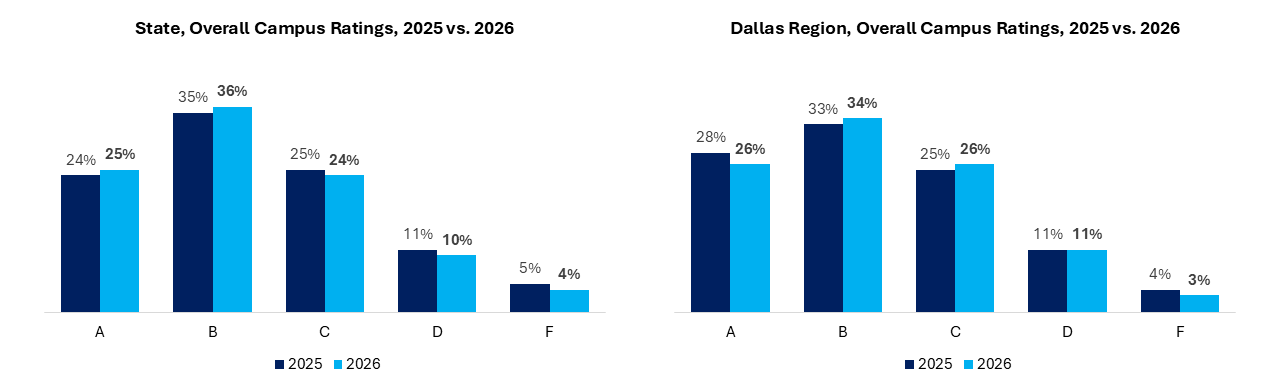
Across all Texas campuses, letter grades inched forward: the proportion of “A” and “B” campuses each ticked up 1 percentage point, while the share of “C,” “D” and “F” campuses declined by 1 percentage point.
While the Dallas Region maintained more “A” campuses relative to the state, year-over-year changes were slightly worse: “A” campuses declined by 2 percentage points, while “B” and “C” campuses each increased by 1 percentage point.
High school ratings jump, thanks to big gains in Algebra 1 and Biology proficiency
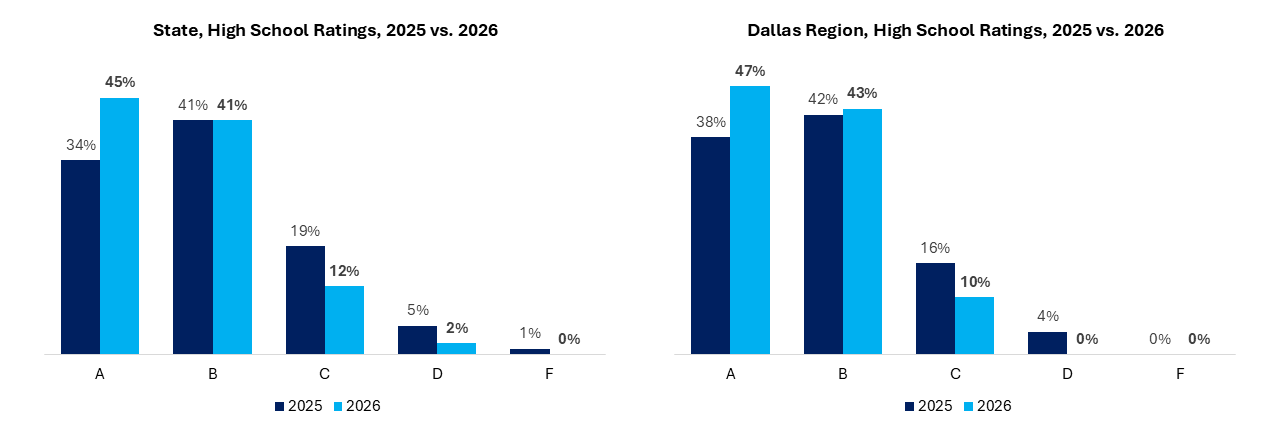
Throughout Texas, high schools posted significant improvements, thanks in part to sizable gains on math and science end-of-course exams.
Improvements in college, career and military readiness (CCMR) also explain the jump in high school ratings. Statewide, a record 87% of graduating seniors met at least one CCMR indicator. CCMR rates comprise a considerable portion of high school grades.
Nearly half of all high schools in the state earned an “A” in 2026. In the Dallas Region, just one high school earned a “D,” and none were rated as an “F” for the second consecutive year.
Middle schools in Texas and the Dallas Region shed unacceptable ratings
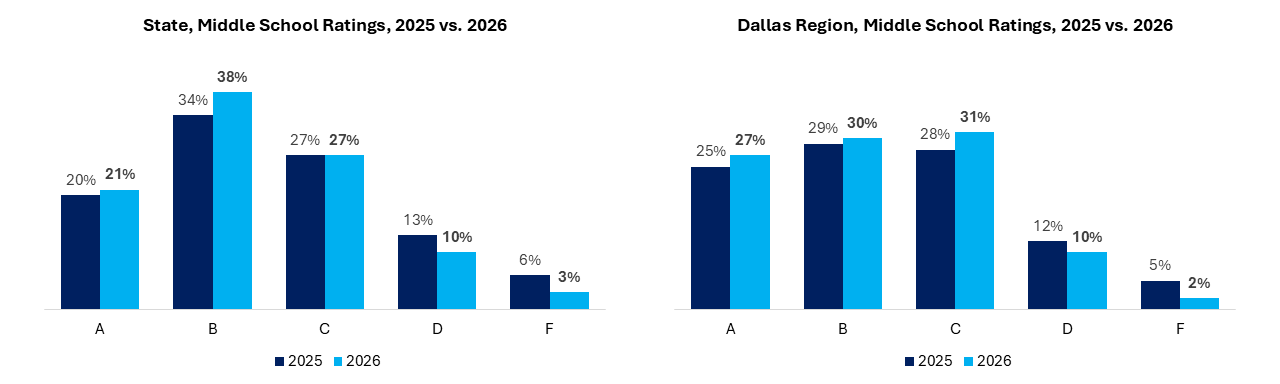
Middle schools, meanwhile, made steady progress. The share of campuses rated “A” or “B” increased both statewide and in the Dallas Region, while fewer campuses earned unacceptable ratings.
State leaders attribute improvements in middle school ratings, in part, to a recently enacted statewide ban on the use of cell phones in the classroom.
Elementary ratings slide, but share of unacceptable campuses remains low
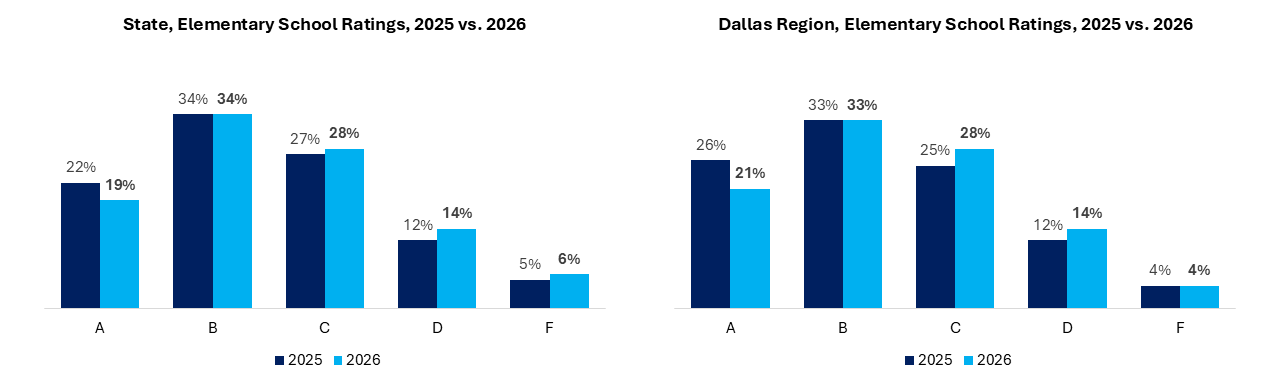
Conversely, accountability ratings for elementary schools declined in 2026, a result of largely stagnant STAAR outcomes in the early grades.
Statewide, grade 3 reading was one of just two tested subjects to decline year-over-year in 2026. Grades 4, 5 and 6 reading remained flat, while grades 3 through 6 mathematics saw minimal growth.
While proficiency generally remains steady, the A-F Accountability System gives districts and campuses credit for overall achievement or year-over-year growth, whichever is better. As a result, flat performance is likely to worsen district and campus grades.
Still, more than half of elementary campuses statewide and in the Dallas Region earned an “A” or “B,” and the number of unacceptable campuses—or those rated “D” and “F”—remains low.
On the whole, campus grades tell a similar story to district ratings: schools across Texas are making steady progress, albeit with some variance. High school ratings are a bright spot, but elementary outcomes require additional attention.
To see your neighborhood school’s 2026 rating, visit www.txschools.gov.
Join us at the DRC’s annual State of Public Education, presented by Toyota Motor North America and The Commit Partnership, on Wednesday, Dec. 9, to hear more about trends in student achievement and public school accountability across the state from Texas Education Commissioner Mike Morath.