
|
Takeaways
|
By Ashlynn Bouldin, Coordinator, Communications & Marketing
Estimated reading time: 2 minutes
At the DRC’s second-ever Tomorrow Summit, presented by PNC Bank and Deloitte, business and economic development leaders examined the forces shaping the future of Dallas-Fort Worth. At the event, Cris Turner, Vice President of Government Affairs, Knowledge & Information Products at Google, shared ways businesses and institutions are currently applying AI to solve challenges.
Below are key insights from Turner’s presentation.
Effective AI applications start with a challenge
Turner encouraged leaders to apply AI with intention by first identifying a challenge it can solve rather than searching for ways to incorporate it into workflows without a clear use case.
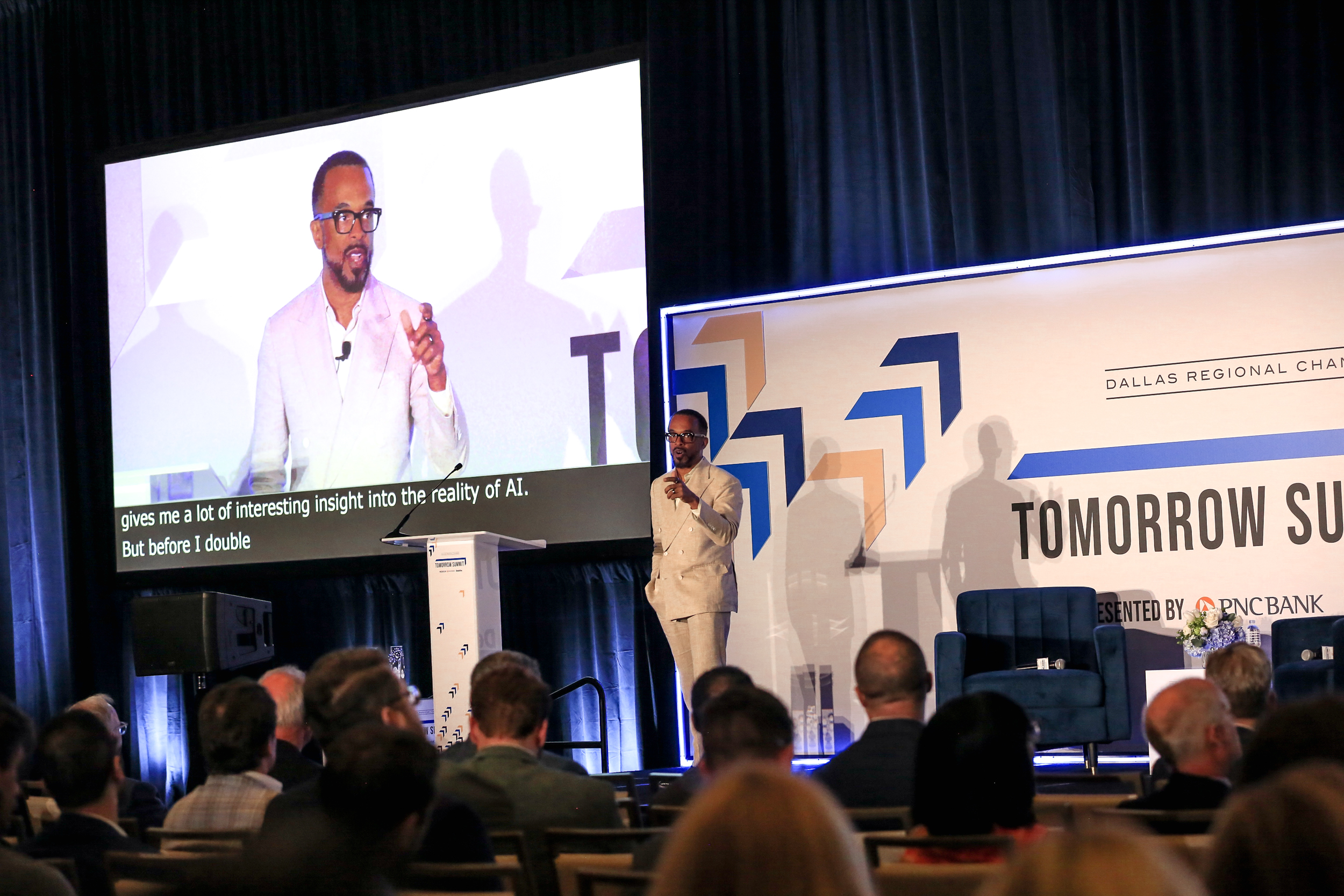
“Please don’t waste your money on AI if you don’t know how you’re going to implement it into your workflow. The magic of AI isn’t AI unto itself; it’s the ability of AI to solve the challenge you’re working with. So, start with the challenge, work backwards and see where artificial intelligence can enter your world.”
Turner gave various examples of how businesses and institutions are effectively applying AI to solve challenges, with different use cases across every industry and sector:
- Nonprofits and businesses in Berlin, Miami and Buenos Aires, among others, noticed that many individuals were denied government benefits because they did not know how to fill out the applications properly, not because of ineligibility. Now, these organizations use AI to help those individuals complete government service applications, which vastly increased benefit approval rates.
- The cities of Memphis and Dallas use AI to review camera footage from trash trucks to identify potholes and illegal dumping.
- Google released the AlphaGenome Atlas, which mapped 9 billion different possible DNA letter changes in the human genome and categorized them for researchers, helping accelerate rare disease research and treatment development.
- Scientific researchers have saved an average of seven hours a week using AI for pattern recognition and data collection, allowing them to do more complex decision making and analytics with their saved time.
Each of these examples started with a challenge, whether it was high rates of illegal dumping or substantial time consumed by data analysis. For leaders looking to improve their organization with AI, Turner cautioned against forcing it into problems that do not warrant AI application, as it will only worsen them. Instead, leaders should examine the challenges within their organization and identify where AI can contribute to a solution.
Successful AI applications require intentional workforce development and training
Turner emphasized that leaders should be intentional not only about where and how they apply AI, but also about training their workforce for AI fluency. He pointed toward university partnerships as an excellent way to build the talent pipeline needed for future AI applications, citing Google’s partnerships with Dallas College, the University of Texas System and Texas A&M as examples.
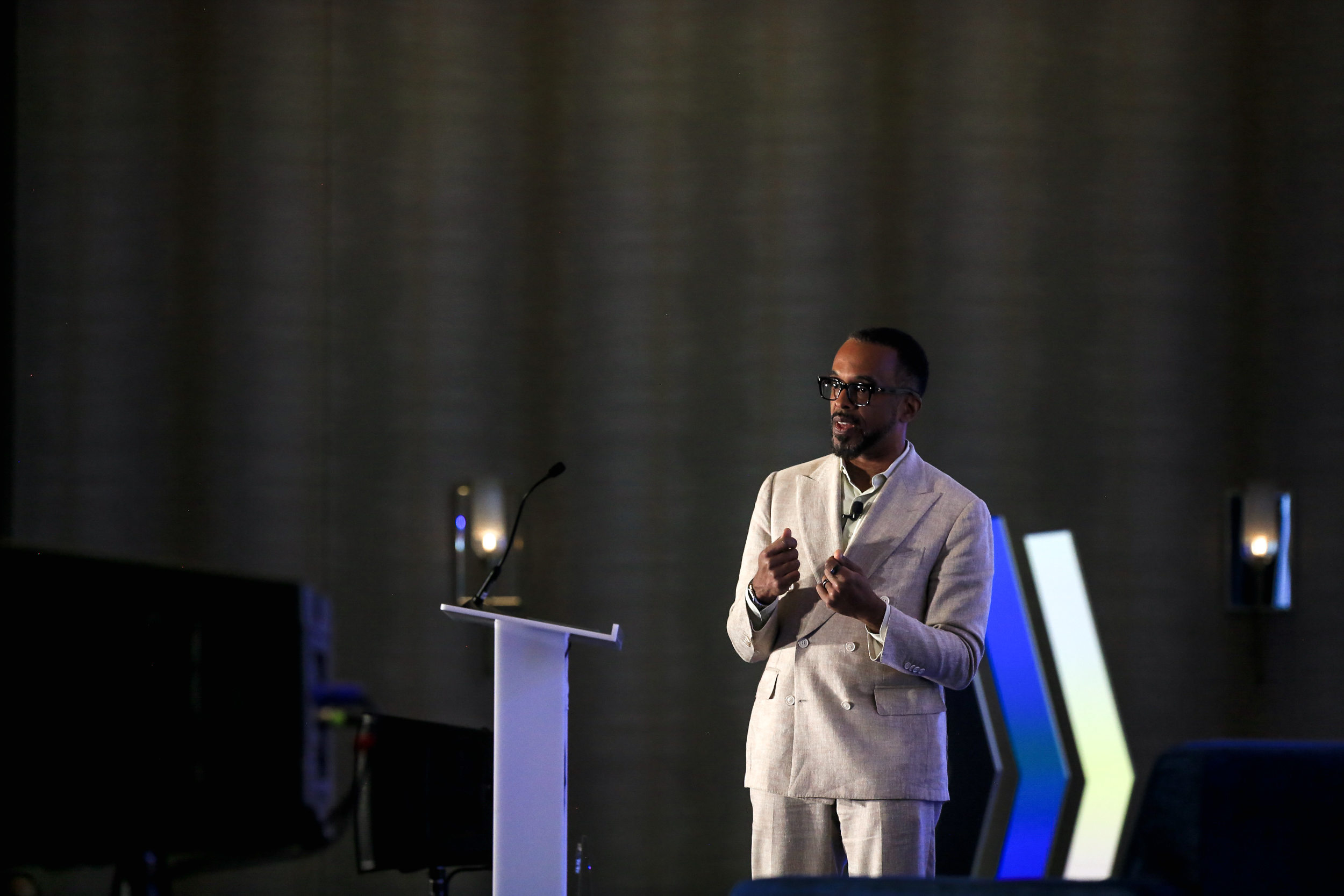 He also stressed that employers have a responsibility to provide their employees with opportunities to use AI in everyday workflows and explore ways it can solve challenges—not mandate that they use it.
“You have to give [this workforce] the time and space to actually figure out how to use [AI] as part of their detail.”
Texas is at the forefront of AI innovation
Turner praised Texas—and Dallas specifically—for its ability to be at the “front of the line” of AI applications, largely due to its capable workforce and innovation-friendly policies that enable infrastructure development.
“To make all of this work, to take advantage of [my previous] examples, you’ve got to have two things. You’ve got to have the infrastructure to pull it off, and you’ve got to have the talent to know how to use it. And on both of these, Texas—and Dallas, in particular—are big front runners.”
Turner also cited Google’s $40 billion investment in Texas, which will help build new cloud and AI infrastructure across the state through 2027, as a testament to Google’s commitment to the state and belief in its ability to lead in applied AI.
“Everything is bigger here, including the ambitions and the capacity of the workforce. You all have the ability to get past the rosy utopian and horrible dystopian narratives on AI and actually use it to move the needle for your citizens, employees, students and economy.”
Dallas-Fort Worth is positioned to lead in applied AI, but to truly scale the region’s innovation-friendly environment, its leaders must keep problem-solving at the core of their AI applications and nurture AI fluency in both the current and future workforce.
To learn more about the DRC’s Tomorrow Summit and find insights shared by speakers from Gallup, Principal Mineral, Nasdaq Texas and NYSE Texas, explore the full event recap.