
By Rebekah Chenelle, Senior Vice President, Public Policy
Average reading time: 5 minutes
2025 was one of the most productive years on record in the Dallas Regional Chamber’s public policy work. From developing our Legislative Agenda with more than 75 member companies to the final days of the 89th Texas Legislative Session, our team remained laser-focused on ensuring the Dallas Region business community had a powerful, unified voice in Austin.
The results speak for themselves.
Building our foundation: The DRC Legislative Agenda
Long before the gavel dropped on the first day of session, the DRC was already hard at work. We spent months meeting with member companies across every sector to understand their priorities and vision for Texas’ future.
The DRC also hosted the first-ever Dallas Regional Days at the top of the Texas Triangle in late November 2024 to show off the Dallas-Fort Worth region to state legislators ahead of the 89th Texas Legislative Session.
This collaborative process resulted in our 2025 Legislative Agenda, a strategic blueprint that guided every meeting, testimony and conversation at the Capitol.
This wasn’t just a wish list. It was a roadmap built on the real-world needs of the companies driving our region’s economy.
140 days of relentless advocacy
Once session began, the Public Policy team hit the ground running. Over 140 days, we tracked more than 550 bills, held over 150 meetings with state lawmakers, submitted 34 written testimonies and kept members informed through 17 weekly briefing calls.
The DRC was an active and engaged voice in Austin throughout the year. Whether testifying before committees, meeting with legislative staff or hosting our Austin Fly-In that brought more than 40 member companies to the Capitol, we made sure the business community’s priorities were heard.
Delivering results: More than $62 billion in strategic investments 
Our advocacy delivered tangible results. We helped secure more than $62.8 billion in state investments aligned with DRC priorities — funding that will transform our region’s infrastructure, workforce and competitiveness.
Key wins include $2.5 billion for the Texas Water Fund as a next step in securing long-term water supply and infrastructure, $5 billion for the Texas Energy Fund to modernize the grid, $4.1 billion in new property tax relief, $466 million for statewide broadband expansion and $60 million for the Texas Moving Image Fund.
Moving critical legislation across the finish line
We didn’t just advocate for funding — we moved policy. Twenty-eight bills that aligned with DRC priorities made it to the Governor’s desk and became law.
House Bill (BH) 2 stood out as cornerstone legislation, addressing Governor Abbott’s emergency designation for teacher pay raises. In addition to across-the-board compensation increases, the bill also incentivizes districts to adopt performance pay measures, which began at Dallas ISD and has been shown to improve both teacher retention and student outcomes in reading and math.
Also passed was Senate Joint Resolution 59, which provided for a constitutional amendment to create an endowment for the Texas State Technical College system. This new endowment will be an asset in continuing to advance career and technical education while demonstrating to prospective employers that we’re developing the skilled workforce they need.
Senate Bill (SB) 7 established a balanced framework directing billions toward water infrastructure, with 50% dedicated to new water projects like desalination and 50% to infrastructure repair, conservation and flood mitigation. This legislation is a great step toward long-term water reliability for Texas communities and removes a major barrier to business growth in our region and across the state.
SB 2206 extended and strengthened the R&D tax credit, keeping Texas competitive in the global innovation economy. By increasing the franchise tax credit and creating enhanced rates for research conducted through higher education institutions, this legislation fuels investment in the next generation of industries and positions Texas to capture a larger share of high-value innovation jobs.
On cybersecurity and technology, we helped pass HB 150 and HB 4751, which established the Texas Cyber Command and other innovative programs, positioning our state as a leader in digital security and emerging technologies — critical capabilities as we continue to attract data centers and tech companies to the region.
HB 149 establishes Texas’s first AI regulatory framework, and the DRC worked with Texas Representative Giovanni Capriglione and our partners to prevent this bill from being detrimental to businesses across the state. This is important because while AI and its regulation are still in early stages, Texas, and specifically the Dallas Region, are leading the progress.
This session, we saw the legislature allocate over $100 million in new funding for rural hospitals across the state, ensuring that communities throughout Texas have access to quality care. Additionally, the Dementia Prevention Research Institute of Texas secured $3 billion over a decade, which was approved by voters in November. This is a significant investment in addressing one of our aging population’s most pressing health challenges.
HB 3348 represents a particularly important victory for North Texas hospitals. This legislation advances funding for uncompensated care through the Local Provider Participation Fund mechanism, allowing health systems to continue to leverage federal matching dollars and ensure that everyone who needs care can receive it, regardless of their ability to pay.
We also secured important business protections. SB 1300 and SB 1646 tackle copper theft and organized retail theft, safeguarding companies’ assets and improving quality of life in communities across Texas.
Playing defense against bad policy 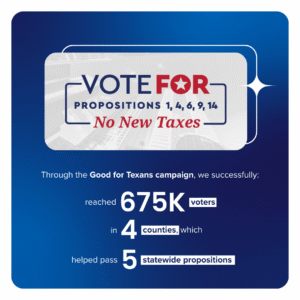
Just as important as the bills we passed were the bills we stopped. Throughout session, we worked to defeat harmful legislation that would have undermined Texas’ competitiveness. We stopped bills that would have raised costs and compliance burdens on employers, risked weakening the state’s favorable business tax environment and introduced restrictive regulations that threatened innovation and growth.
Our ability to play defense is just as critical as our ability to advance proactive policy, and this session demonstrated our team’s effectiveness on both fronts.
Taking our message to voters
Our work didn’t end when the Legislature adjourned. In November, Texas voters faced 17 constitutional amendments on the ballot, and we knew five of them — Propositions 1, 4, 6, 9 and 14 — were critical investments in our state’s future. Through the DRC-backed Good for Texans campaign, we helped educate voters on these smart investments, and all five passed with strong support.
These propositions fund everything from water infrastructure and brain research to education facilities — investments that will pay dividends for decades to come. We also helped cut business personal property taxes and prohibit future taxes, which will help small business owners continue to flourish in our region.
Looking ahead
Looking back on 2025, I’m incredibly proud of what we accomplished together. But I’m also energized by what lies ahead. The work of implementing these historic investments is just beginning, and we’ll continue to work closely with state leaders and local stakeholders to ensure every dollar is deployed effectively and that the Dallas Region remains a driver of Texas’ continued economic success.
To our member companies: thank you for your partnership, your input and your trust. Your engagement made all of this possible. To the state lawmakers who listened, collaborated and fought for policies that strengthen our region and our state: thank you for your leadership.
Here’s to building on this momentum in 2026 and beyond.
Have questions about how these policy wins impact your company? I’d love to hear from you. Send me an email anytime at publicpolicy@dallaschamber.org.