
Average reading time: 4.5 minutes
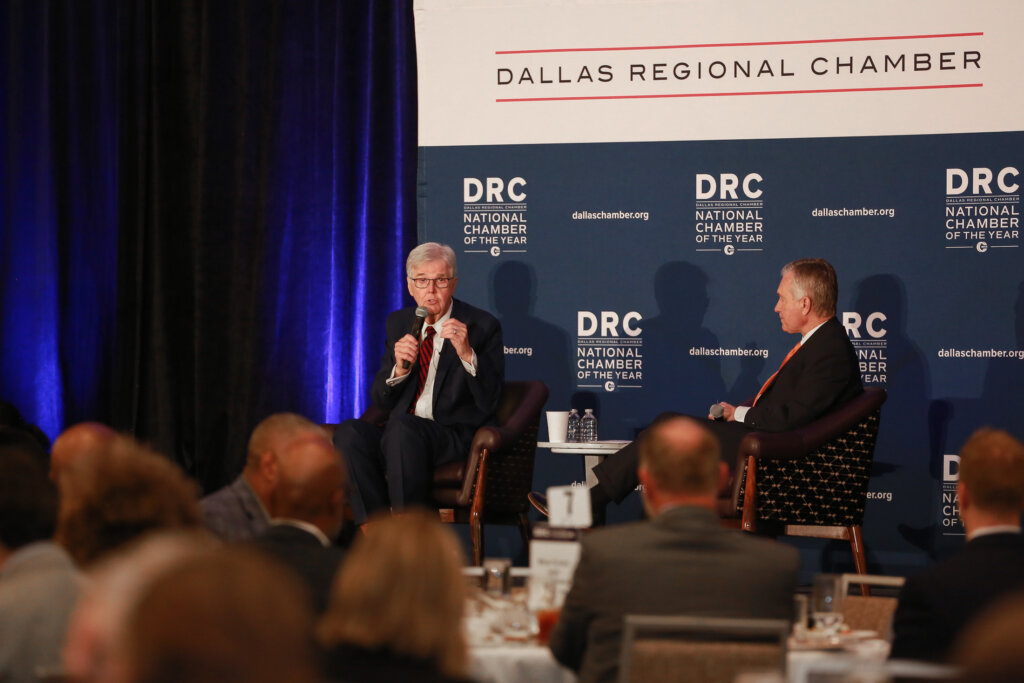
As Texas lawmakers and business leaders begin looking toward the 90th Texas Legislature in 2027, the Dallas Regional Chamber convened one of the state’s most influential officials to reflect on recent policy decisions and the challenges ahead for a rapidly growing state.
On Thursday, Nov. 20, the DRC hosted Texas Lt. Governor Dan Patrick at the Fairmont Dallas for its biannual State of the State event, presented by Toyota Motor North America and Blue Cross Blue Shield of Texas. The conversation drew business and civic leaders together to understand how education, infrastructure, and energy policy will shape Texas’ continued growth following the 89th Legislative Session.
Patrick, who presides over the Texas Senate, framed his remarks around the scale of the state’s expansion, noting that Texas adds roughly 1,600 residents each day.
“Texas is the place that everyone else in the country, in the world wants to be,” Patrick said. “That is why businesses are moving here.”
That growth, Patrick said, brings increasing demands on the systems that support Texas’ economy and quality of life.
“We have to be prepared for the future, for the water needs, the grid needs, and the educational needs,” he said.
Preparing students—and the workforce—for a growing Texas
Education emerged as a central theme of the discussion, reflecting both its size within the state budget and its role in preparing a growing workforce. Patrick pointed to recent legislative action on school choice, resulting in the nation’s largest such program.
“[We’ve] been trying to pass that for a long time, since 2013, and we finally got it over the goal line,” he said, describing the billion-dollar initiative benefiting 100,000 students.
Patrick noted that lawmakers also increased overall public education funding and approved additional teacher pay raises, making this session historic for investments in the education and workforce pipeline.
“The average teacher in 2019 in Texas was making $54,000 a year,” he said. “Today, after the pay raise we gave them again, the average teacher in Texas is now making $69,000.”
Patrick also emphasized education pathways tied directly to workforce needs, particularly in technical and skilled trades, where demand continues to outpace supply. He highlighted models such as Dallas ISD’s P-TECH program, which allows students to earn postsecondary credentials while still in high school.
“Every student has the right to pursue their passion,” Patrick said. “Some for college, some for the military, some for the skilled labor… We have to show the world what’s available to young people.”
Water infrastructure under pressure from rapid growth
Turning to infrastructure, Patrick highlighted water supply and distribution as growing challenges for fast-growing regions across Texas, particularly as aging systems struggle to keep pace with population growth.
“We have plenty of water in Texas, it’s just not where most people are,” Patrick said, adding that an estimated 25% of water is lost through leakage.
Patrick outlined a landmark state investment in water infrastructure, dedicating $1 billion annually for the next 20 years to critical water needs and marking a shift toward treating water systems as critical statewide assets rather than solely local responsibilities.

“This is the first session where the state said we are going to look at water like we look at roads,” Patrick said, noting that cities and counties often lack the resources to address large-scale infrastructure needs on their own, especially amid the state’s booming growth.
“We have to keep up, we have to partner with cities and counties to help them,” Patrick said.
The Texas Legislature’s plan to secure the state’s water future was approved by Texas voters as a constitutional amendment in the November 2025 election, creating a dedicated funding stream for water infrastructure projects drawn from existing sales-tax revenue.
Powering the next wave of economic expansion
Patrick said rising population growth and the expansion of energy-intensive industries—particularly data centers and artificial intelligence—are driving sharp increases in power demand across the state.
“We want to be the AI capital of the world,” Patrick said, noting that ambition brings new demands on the state’s power grid.
He pointed to current capacity of roughly 85,000 megawatts and ERCOT projections showing demand could grow significantly over the next decade, underscoring the need for new generation.
Patrick highlighted legislative action to accelerate the development of reliable, dispatchable power. Lawmakers approved a new financing program designed to incentivize the construction of natural gas plants, offering long-term, low-interest loans to support additional generation and strengthen grid reliability.
“We have to manage this, grow it, and invest in it,” Patrick said. “But we have to be smart about it.”
Finding common ground in a fast-growing state
Reflecting on the 89th Texas Legislative Session, Patrick noted that much of the Legislature’s work advanced through bipartisan cooperation.
“98% of the bills we passed in the Texas Senate and the Texas House are with bipartisan support,” Patrick said, citing shared priorities such as education, health care, and public safety.
Looking ahead, Patrick framed Texas’ growth as both an opportunity and a responsibility for state leadership.
“The real work of an elected official is to make sure that we create jobs, that we attract business, that we educate the public,” Patrick said, “and give every Texan a great opportunity to live the Texas dream and the American dream.”