
By Catie George, Director, Communications & Storytelling
Average reading time: 4.5 minutes
The Dallas Regional Chamber brought together business leaders, economic development experts, and capital markets executives for the Tomorrow Summit, presented by Hillwood, a Perot Company, and PNC Bank, at HALL Park Hotel on Tuesday, Sept. 9, diving deep into the forces shaping the future of work, talent, and economic growth in Dallas-Fort Worth (DFW).
From population gains and corporate relocations to AI’s influence on the workforce and the rise of new capital markets, the discussions underscored one message: DFW’s growth story is only getting started.
A global powerhouse still on the rise
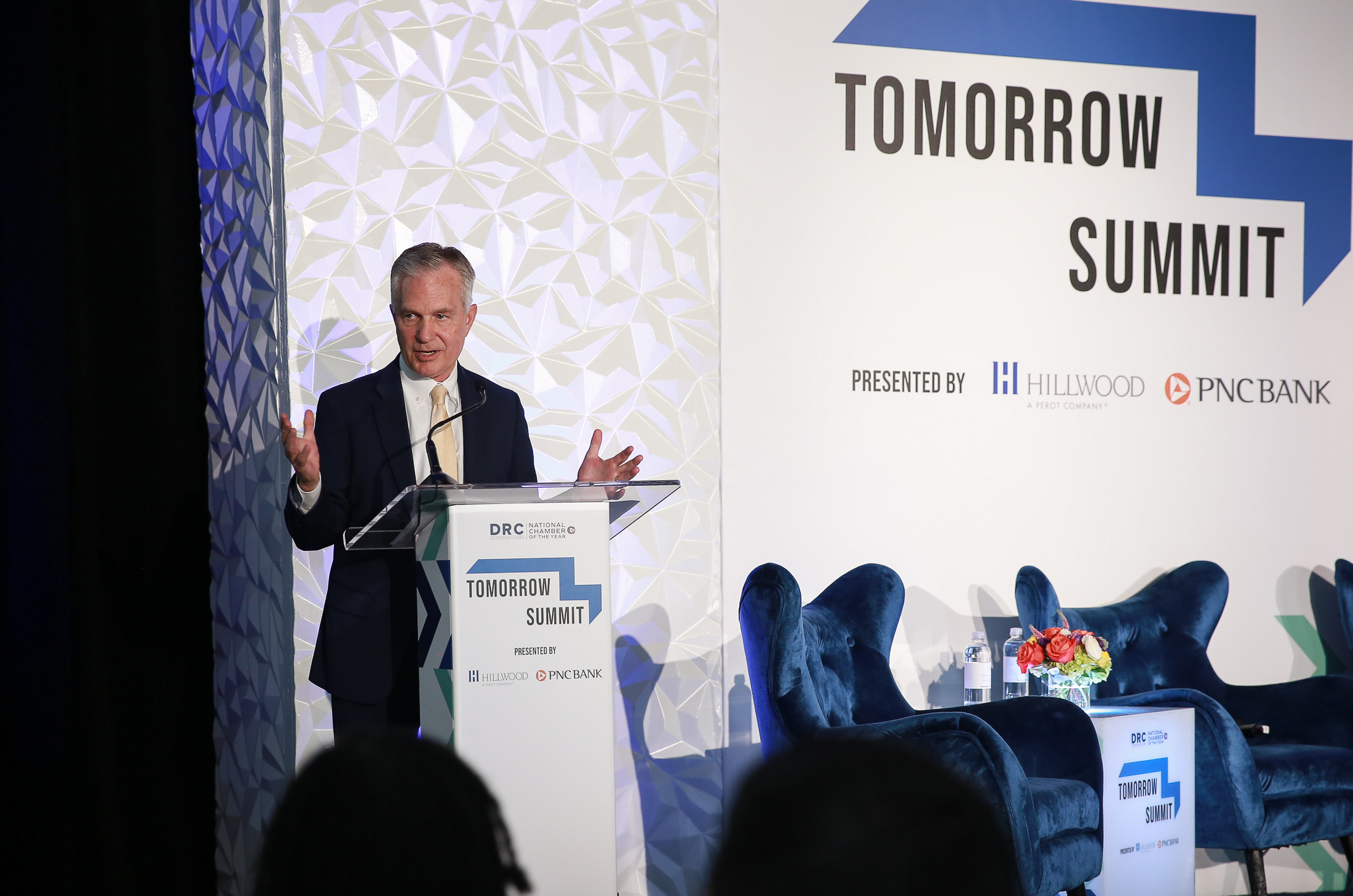
“The Dallas Region has become a global powerhouse with seemingly endless possibilities,” said DRC President & CEO Dale Petroskey to open the event.
The region’s remarkable growth story is supported by compelling data.
“We count 460 notable corporate announcements in DFW since 2020,” said DRC Senior Vice President of Economic Development Mike Rosa. “In just five years, the region has welcomed 160 headquarters relocations—59 from California, 69 from 24 other states, and 32 international companies from 19 countries.
DFW has added 700,000 people since 2020, more than any other metro area, and now stands as the fourth-largest metro in the United States with 8.3 million residents.
A labor market redefining opportunity
“There’s been a 20% increase in the number of applicants for every open job, which means that people are job seeking with more intensity than ever before,” Dr. Karin Kimbrough, Chief Economist at LinkedIn, explained. “It’s a complete 180 from what we saw in 2021 or 2022.”
While national hiring has slowed approximately 5% compared to last year, DFW continues to buck the trend.
“If I look at Dallas, hiring is still growing, it’s still expanding,” Kimbrough said. “This is one of the most dynamic labor markets that we see with companies relocating here, people moving here, getting jobs.”
However, young workers face heightened challenges.
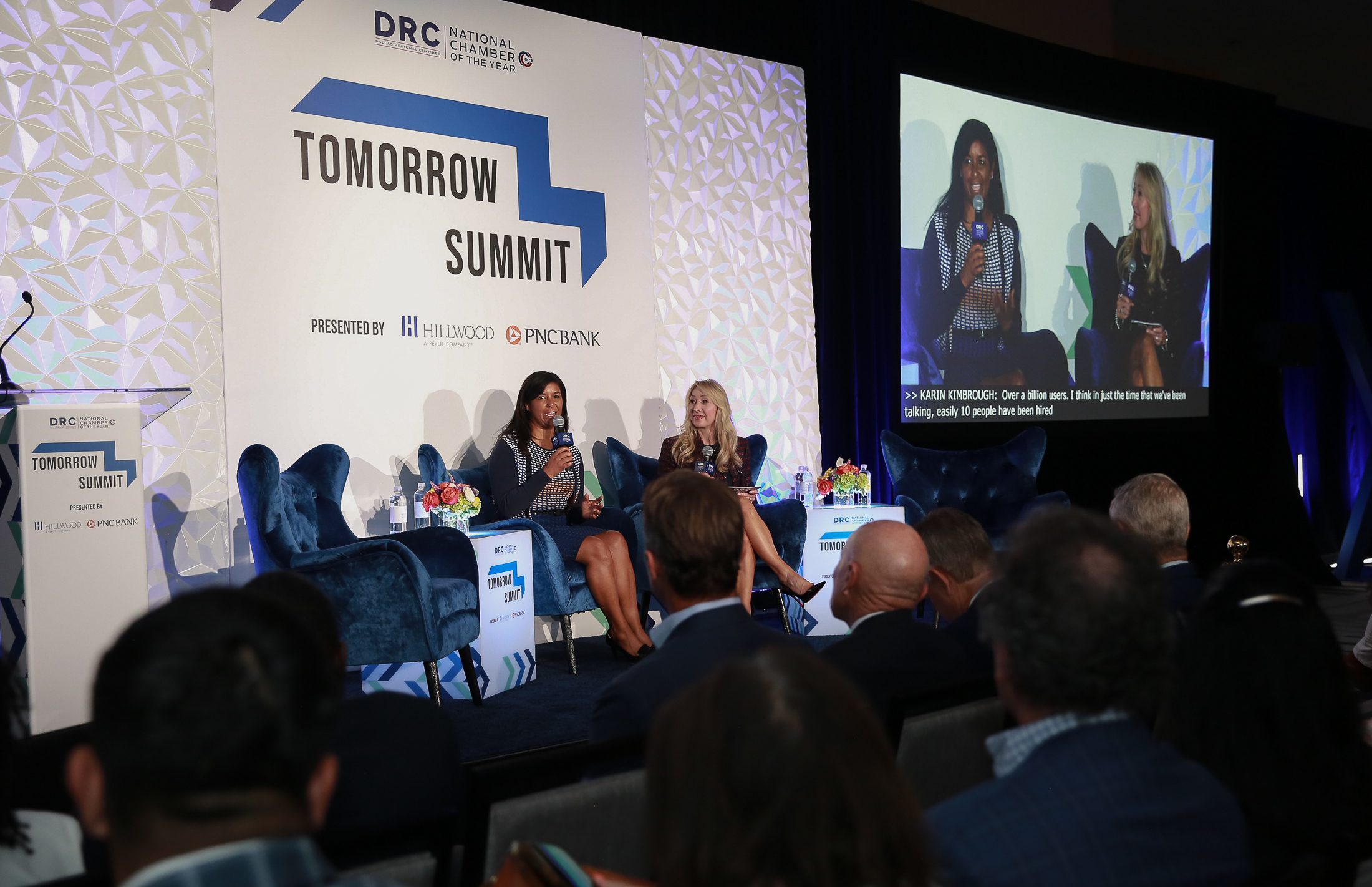
“Confidence is down for the worker in terms of their confidence about getting a job and keeping a job,” she said. “We also see that it’s particularly down for younger Gen Z applicants.”
The takeaway: DFW’s momentum is strong, but the evolving labor market demands continued investment in workforce confidence, skills, and career pathways.
AI is transforming work – but human skills still win
LinkedIn data shows a sixfold increase in job postings seeking AI literacy across roles from marketing specialists to product managers to strategy heads. Kimbrough emphasized that AI will eventually affect 80-90% of all jobs, but human skills remain paramount.
“What’s going to set you apart is going to be your ability to bring your human skills,” Kimbrough stressed. “You need a little bit of abstract problem-solving and critical thinking. It’s not going to be enough to rely on AI. So, I’m a big believer in the human future of work.”
Kimbrough also highlighted how career trajectories are fundamentally changing.
“People are holding twice as many jobs now,” she noted. “It’s not that linear [career] path [anymore], it’s much more like a net.”
The takeaway: The future of work will depend on the intersection of technology and human capability, requiring lifelong learning and adaptability.
Education and industry: the engine of prosperity
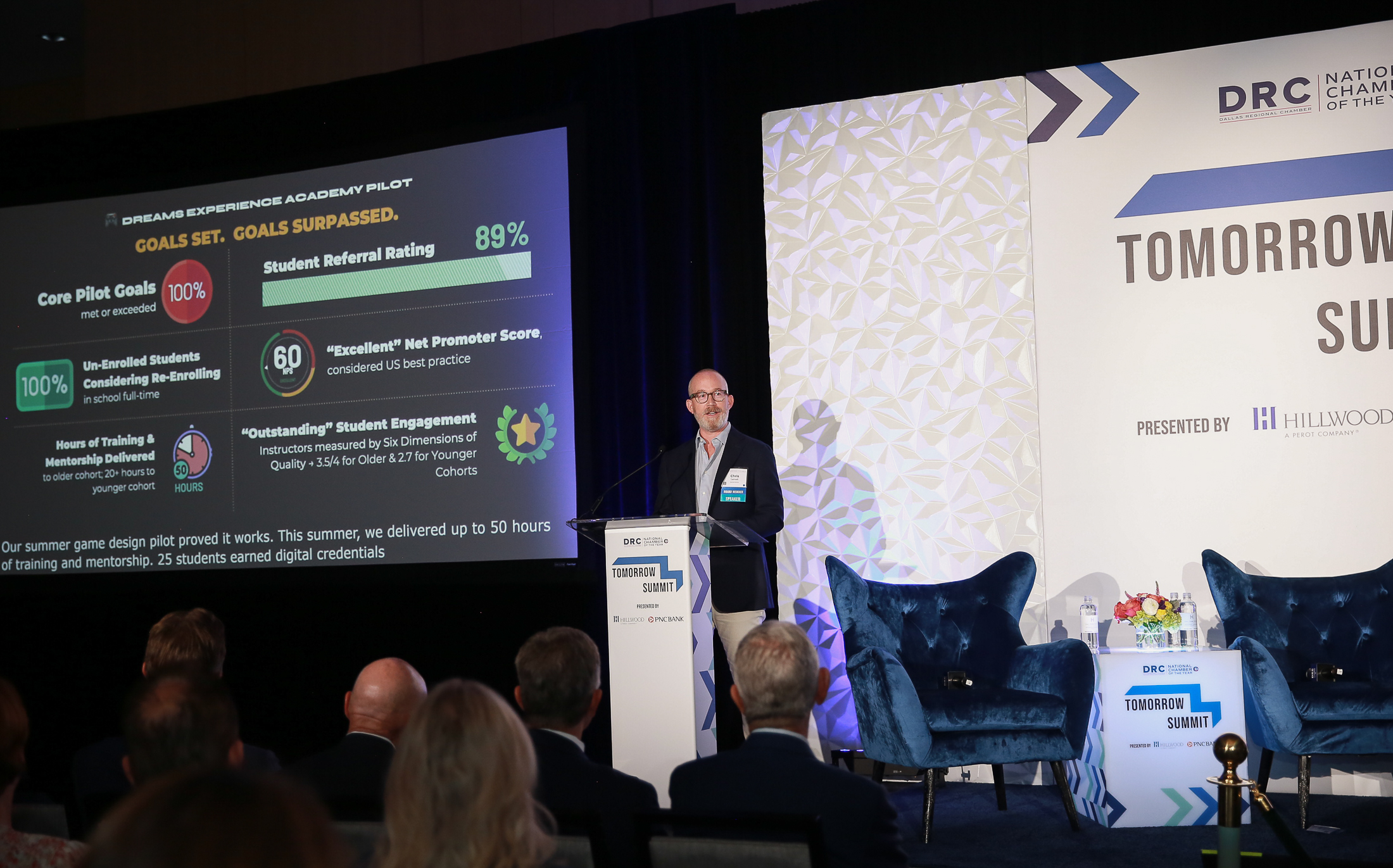
Chris Gannett, CEO of Gannett.Partners and President & Board Member of DOC Cares, reinforced the critical link between education and economic vitality.
“Today, our city thrives when education and industry come together to transform potential and opportunity,” he said. Gannett’s latest project, the Dreams Experience Academy, is a nonprofit connecting Dallas youth to the $3 trillion media, entertainment, and tech industries.
He went on to highlight DFW’s economic diversity and cultural impact. The region is home to more than 20 Fortune 500 headquarters, with expansions from companies like Goldman Sachs and Scotiabank adding thousands of new jobs. At the same time, DFW’s arts, sports, and creative industries generate $34 billion annually and support more than 200,000 jobs.
Rosa underscored the importance of educational infrastructure.
“Having nimble K-12 education, colleges, and universities to grow the talent for our companies and prepare our people for jobs of the future is imperative.”
Texas: The new capital markets frontier
For the first time ever, leaders from all three major U.S. stock exchanges shared a stage in Dallas, exploring how Texas is redefining access to capital and cementing its role in the global financial landscape.
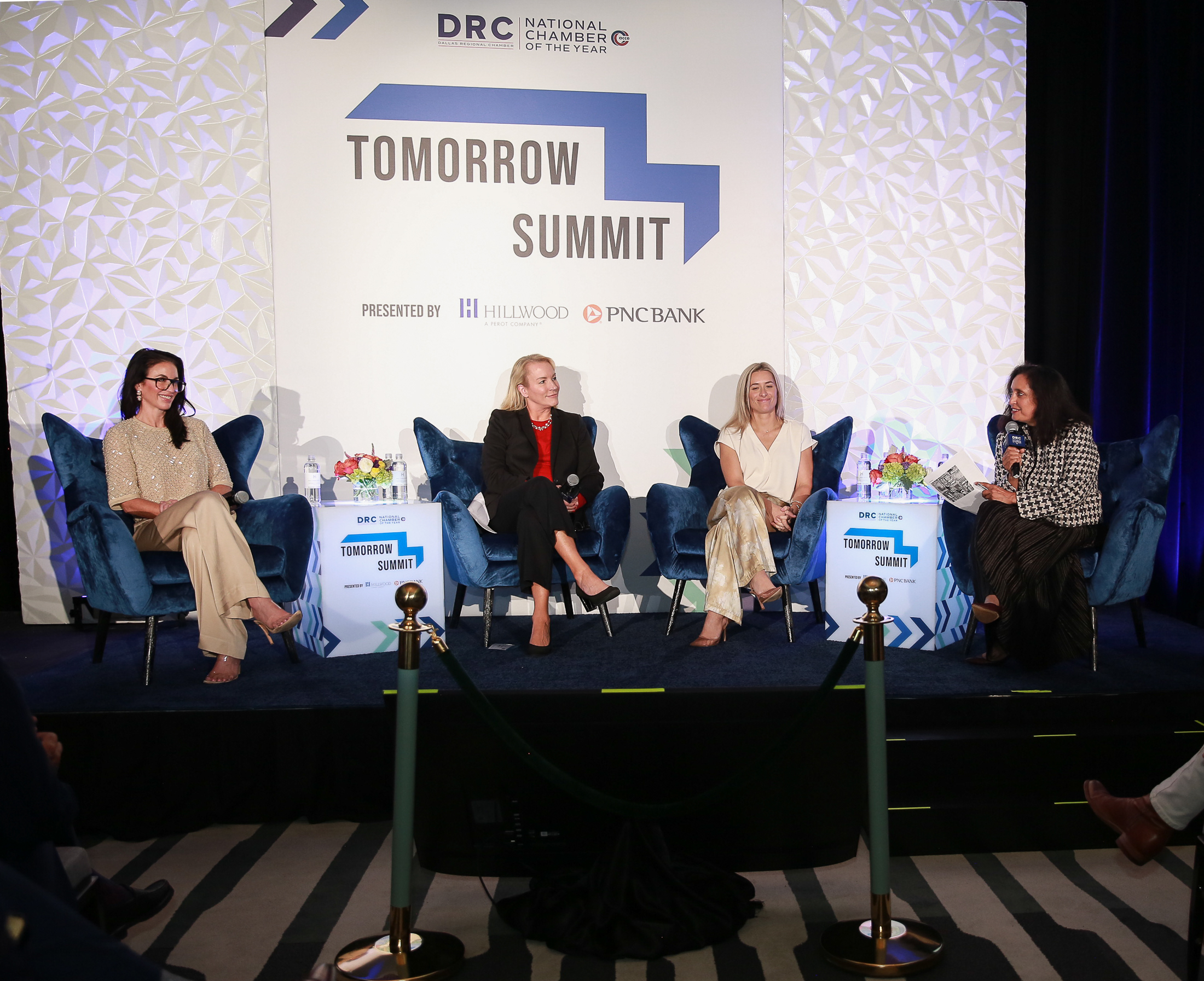
Nicole Chambers, Global Managing Director of Listings at Texas Stock Exchange Group, outlined the vision for rebalancing public and private capital access.
“Going public is the cheapest way [for companies] to access capital,” Chambers explained. “We want to give companies that are in that mid-cap range, small to mid-cap, that opportunity to go public at an earlier stage.”
Kate Speight, Senior Managing Director of Listings & Capital Markets at Nasdaq, highlighted why Texas is attracting capital markets attention.
“Texas has done a great job being able to create that business-friendly opportunity and being able to maintain that business-friendly climate,” Speight said.
Liz Hocker, Regional Head of Capital Markets at the New York Stock Exchange, was direct about Dallas’s trajectory.
“[Dallas] is going to be an epicenter for the global financial markets.”
Chambers concluded by pointing to continued investment in infrastructure, housing, and emerging industries, such as life sciences and biotech, as essential to sustaining growth.
The takeaway: As Texas strengthens its position in national and global capital markets, Dallas is emerging as a hub for innovation, access, and long-term investment.
Looking ahead
The Tomorrow Summit painted a clear picture of a region at an inflection point—maintaining extraordinary momentum while adapting to technological disruption, workforce transformation, and new opportunities in global finance.
The DRC’s economic development priorities align directly with these opportunities, positioning the Dallas Region to turn today’s progress into tomorrow’s legacy.