
By: Michael Wood, Vice President, Education & Workforce
Estimated reading time: 2.5 minutes
Students from the 111 school districts in the Dallas Region progressed in nearly all tested subjects during the 2025-26 school year, according to the latest results of the State of Texas Assessments of Academic Readiness, or STAAR.
STAAR is the annual measure of academic achievement for students in grades 3 through 12. The tool is the primary way parents, employers and other stakeholders evaluate student performance and rate schools.
High school gains lead statewide improvement in student achievement
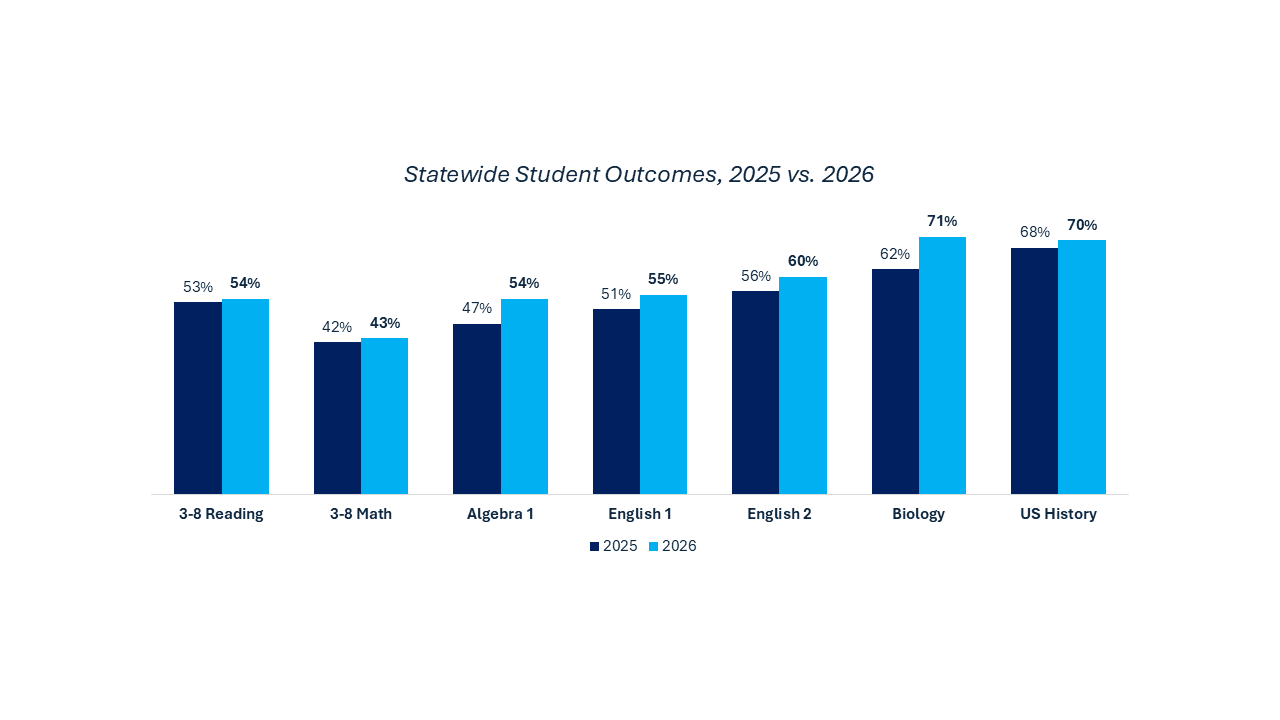
Across Texas, students either held steady or demonstrated improvement in every tested grade and subject except for grade 3 reading and grade 7 math, which declined one and two percentage-points, respectively.
High school students posted the most significant gains. Algebra 1 and Biology saw the greatest improvements: 54% of Texas students met grade level standards in Algebra 1, up from 47% a year ago, and 71% did so in Biology, up from 62% in 2025. Students also made modest progress in English I, English II and US History.
In the earlier grades, progress was less pronounced. Across grades 3-8, aggregate reading and math proficiency each improved by one percentage-point compared to 2025.
Students in the Dallas Region continue to run ahead of state averages
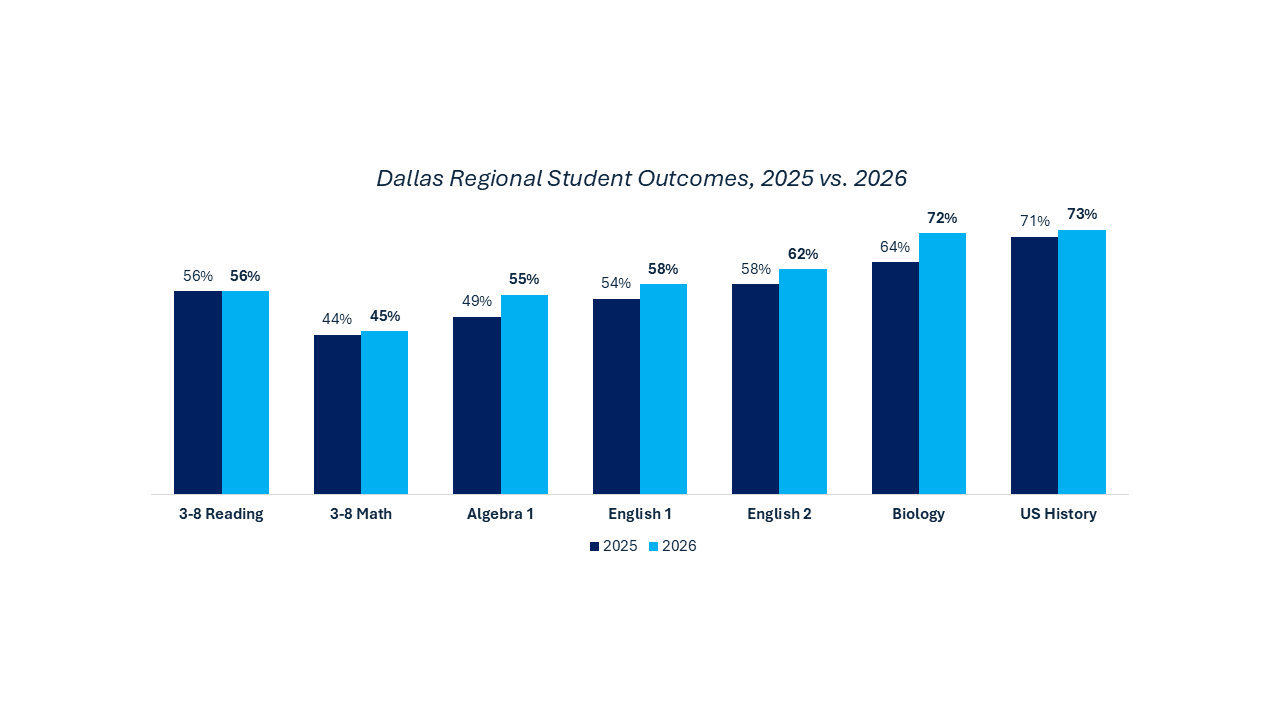
Across all subjects, students from the 111 school districts in the Dallas Region outperformed state averages by between one and three percentage-points.
In grades 3-8, 56% of Dallas Region students demonstrated proficiency in reading—level with 2025 results. In math, 45% of Dallas Region grades 3-8 students met standards, up one percentage-point from last year.
Consistent with the state, Dallas Region high school students made significant strides in Algebra 1 (up six percentage-points) and Biology (up eight percentage-points), plus modest improvements in English I, English II and US History.
Despite progress, math outcomes still lag pre-pandemic levels
Students in every grade level but one—grade 4—still trail pre-pandemic math outcomes, but the gap is closing.
Mathematics achievement declined steeply immediately following COVID-19 school closures. Across the state, Algebra 1 proficiency, for example, dropped 21 percentage-points from 2019 to 2021, from 62% to 41%. Thanks to considerable progress this year, Texas students are now just eight percentage-points shy of pre-pandemic achievement.
Early literacy inches backward, while middle schoolers improve reading proficiency
Grade 3 reading was one of only two tested subjects to decline year-over-year, although by just one percentage-point. This loss, however, is offset by meaningful improvements in grade 7 and 8 reading results, which increased by two and three percentage-points statewide.
“The gains in middle school reading are also notable,” said Texas Education Commissioner Mike Morath in a news release, “as it may be associated with the statewide ban on the use of cell phones in schools.”
Following legislative action, changes forthcoming to Texas’ PK-12 assessments
In 2025, the Texas Legislature approved a bill to overhaul Texas’ public school assessment system. Beginning in the 2027-28 school year, the state will transition to a new test, called the Student Success Tool (SST). STAAR will still be administered in the upcoming 2026-2027 school year.
The SST will make notable changes to how, and when, Texas assesses student competence. Rather than a single, end-of-year exam, students in grades 3-8 will take abbreviated tests at the beginning, middle and end of the school year. This new cadence is designed to give teachers and families more feedback throughout the academic year and inform instruction accordingly.
To explore how students in your neighborhood school or school district did on the 2026 STAAR, visit the Texas Education Agency’s Texas Assessment Research Portal here.