
By Catie George, Director, Communications & Storytelling
Average reading time: 3.5 minutes
Federal policies have a direct impact on every corner of the Dallas Region’s thriving business community, from the smallest startup to the largest corporation. At the DRC’s Congressional Forum, presented by Ryan LLC, on Wednesday, Aug. 20, business leaders and policymakers came together to hear from three members of Congress representing North Texas who shared their perspectives on the federal government’s role in supporting business growth and ensuring American economic competitiveness.
Congresswoman Beth Van Duyne, Congressman Brandon Gill, and Congresswoman Julie Johnson shared the stage to discuss their priorities while representing the Dallas Region in Washington.
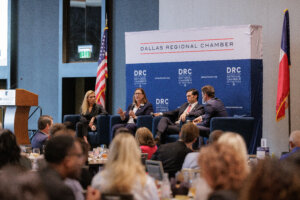
Supporting American business competitiveness
The conversation centered on how federal policy can best position American businesses to succeed in an increasingly competitive global marketplace.
“The role of the government is to allow our U.S. businesses to be able to compete globally and stop benefiting global companies at the expense of our own economy,” said Congresswoman Beth Van Duyne. “Having strong American businesses matters because it’s not just the economy here, but it’s our ability to be able to have influence on other areas of the world.”
Congressman Brandon Gill shared that getting government support in certain sectors, like semiconductors, can help keep companies globally competitive.
“We have to be particularly cautious as we’re getting the federal government involved in any sector, including semiconductors,” said Gill, “But I do think that we have, for the past decade or so, been competing on an unfair playing field. And you see that in the semiconductor space as well, where the United States is lagging in certain areas… And we do have a role for government to help alleviate that challenge.”
July reconciliation tax provisions lend businesses a boost
The July tax and spending bill, also known as “reconciliation,” included multiple business tax provisions that extended or made permanent credits and rates previously passed by Congress. The bill includes an increased advanced manufacturing credit from 25% to 35%, aiming to spur domestic semiconductor manufacturing here in the Dallas Region.
“[In the reconciliation bill], you also have a variety of pro-business tax policies, bonus research and development depreciation that is going to help bring investment back into the United States [and] help stimulate investment here,” said Gill.

Enabling talent to strengthen business
To achieve true economic dominance, it is critical to have a strong workforce.
“The role of government is to foster a strong business culture, to make sure that we have a well-trained workforce that can come through a pipeline so that businesses can grow and expand that is meeting the needs of current technology,” Johnson explained, underscoring how federal policies can support workforce development initiatives that keep Dallas Region businesses competitive globally. “The government should have policies that support business, that take us forward to keep the United States as the leading edge of business development in research and technology.”
The Dallas Region is committed to ensuring that economic opportunity reaches every corner of the community.
“We all know that many areas of the Dallas Region are booming, but some are still under-championed,” said DRC President & CEO Dale Petroskey. “We will not be the kind of region we want to be, we can be, or we should be until everyone, and I mean everyone, has a chance for a good education, a good job, and a good life. And the ability of all of us to achieve these goals is impacted by the laws our elected officials make in Washington, in Austin, and at City Hall.”
The connection between representation and regional opportunity was especially timely as major changes to Texas’ congressional boundaries were proposed and passed by the Texas State House on the day of the forum.
Redistricting
The unconventional step to undergo a congressional redistricting process mid-cycle or not directly following the completion of a U.S. census, is reshaping the state’s political map and could influence how regional priorities are represented in Washington. The topic arose as business and civic leaders alike are committed to ensuring that representation in districts across the region properly reflect shared economic interests.
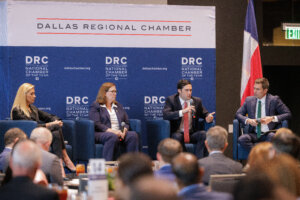
Population growth and demographic shifts across North Texas have made the region a focal point in the redistricting process. For the business community, changes in congressional districts underscore the importance of maintaining strong, consistent dialogue with elected officials, both new and returning, to keep issues like infrastructure investment, workforce development, and support for innovation at the forefront of the federal agenda.
“Businesses need to be planning for 5, 10 years, 15, 20 years in advance, if they’re really being ambitious,” said Gill. “Don’t they need to know at least what district they’re going to live in and work in?”
Through congressional district changes, population growth, and demographic shifts, the DRC remains committed to working across districts and party lines to advocate for policies that will sustain Texas and the Dallas Region’s sustained economic success.
Thank you to our Presenting Sponsor Ryan LLC, Media Sponsor KRLD, Gold Sponsor American Airlines and Fidelity Investments, and Silver Sponsors Amazon, Southwest Airlines, and Cornerstone Government Affairs.
What issues at the federal level are most important to you in growing your business? Reach out with your thoughts and to learn how to engage with elected officials through DRC’s work in Public Policy.