
By Ashlynn Bouldin, Intern, Communications & Web Content
Average reading time: 3 minutes
As artificial intelligence transforms industries at record speed, one question defines the future of work: how do we keep people at the center of progress?
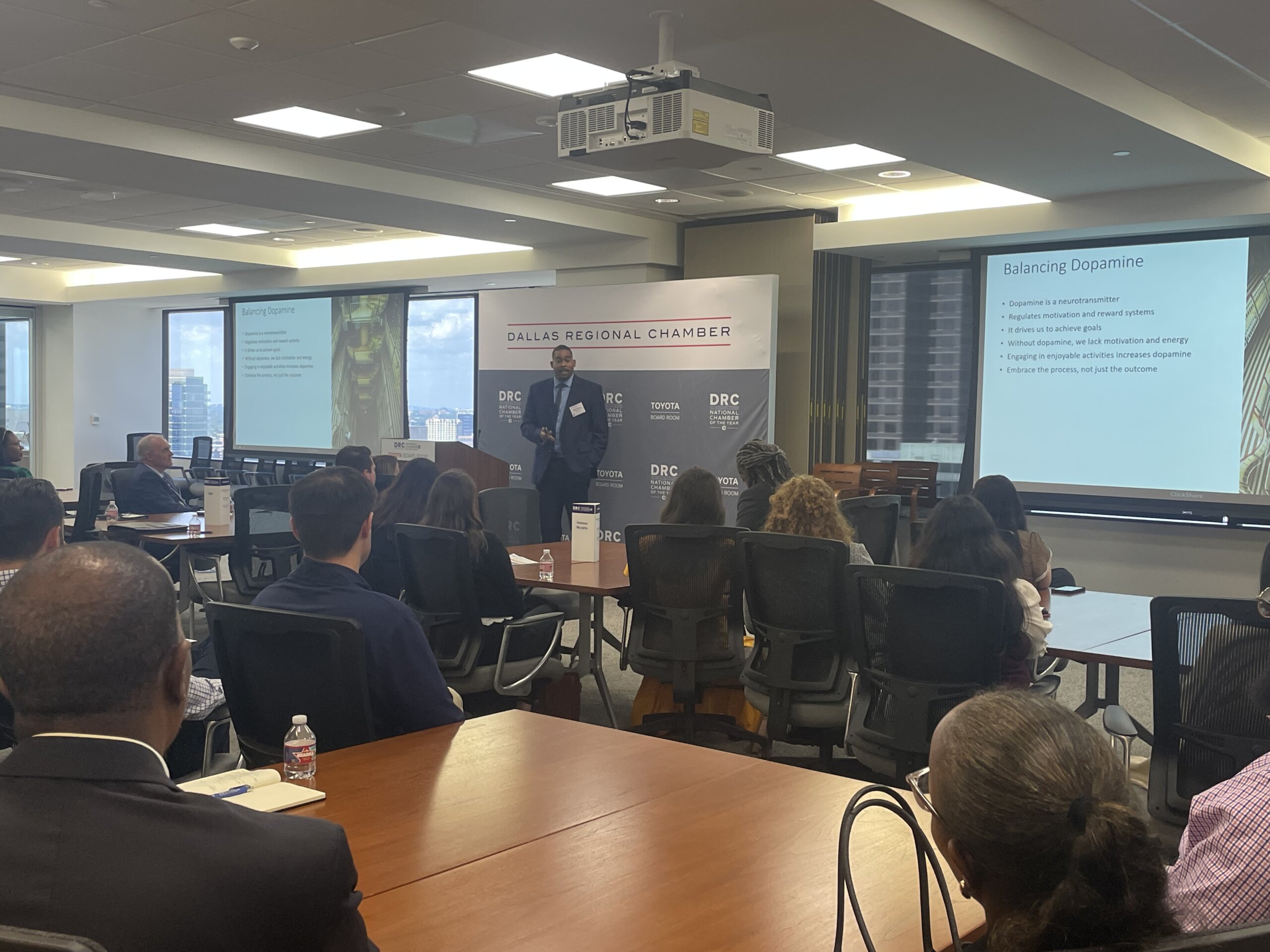
The DRC’s Talent Talk, presented by BGSF Professional Services and Holmes Murphy, convened business and workforce experts to examine AI’s role in shaping adaptable, resilient teams.
Below are the key insights shared by experts at the September 25 event.
The key to stability is adaptability
With the integration of AI in the workplace, the workforce has been propelled into a new age of professional and business evolution. To sustain and excel in this ever-changing environment, both employers and employees must be well-equipped to embrace change and adopt new skills and methodologies.
Mark Benton, Vice President of HR Corporate Functions at McKesson, emphasized that “history shows us that while some jobs may disappear with new technology, new ones are created.” Just as the horse and buggy gave way to the car, and the switchboard operator gave way to the smartphone, “AI will force mankind to evolve once again, [but] it’s our ability as humans to adapt to change … The key is to be resilient, not resistant.”
Dr. DeLancey Johnson, Senior Vice President and Associate Chief Talent Officer at Parkland Hospital, encouraged employers and employees to embrace “curiosity [as] the catalyst to innovation.” Change is often followed by concern and questions, but “the only way that you can truly get ahead of the curve of AI is to know where you stand, know how to get feedback and how to receive feedback, be agile, and stay curious.”
Companies looking for success and sustainability in history’s fastest era of innovation must open themselves to change, learning, and adapting.
Skills-based hiring can be crucial for retaining talent with potential for growth
If adaptability is required for a company’s sustainable success, then employers must approach talent acquisition, retention, and management with adaptability in mind. Bank of America’s Market Executive Brian Angle stressed the importance of acquiring and retaining talent with potential for growth and change in achieving company-wide success, especially in the age of AI.
“Looking at experience and looking for potential for growth is what matters,” said Angle, because “having a college degree is one thing, but having the potential for that growth is another.”
Skills-based hiring continues to be an effective method of talent acquisition and retention as AI is incorporated into the workplace. As Benton emphasized, when working and improving efficiency with AI, “you don’t have to be an expert; you don’t have to be a data scientist. You just have to know how to ask good questions, get good prompts, and determine what you say next.”
Human traits are essential for an efficient workplace
“There are human-centered skills that we all uniquely have that AI can’t replicate. It’s about leadership. It’s about empathy and creativity,” Benton said. Human traits will be essential to companies’ success as technology progresses, just as they always have.
As Angle described, “AI will do what it’s great at, which is taking a large bunch of data and giving you recommendations. And then we will be able to do what we’re great at, taking that recommendation and saying, ‘does this feel right?’” For AI-generated data to be useful, humans must be the conduit through which it is filtered and shared; we must be the final decision-makers.
Companies that approach change with enthusiasm, adapt their approaches to talent acquisition, management, and retention, and affix human traits to the core of their practices will be well-equipped with the talent necessary for success and growth in this era of innovation.
Thinking about new ways to strengthen your talent pipeline? Email talent@dallaschamber.org to connect on your company’s needs.